
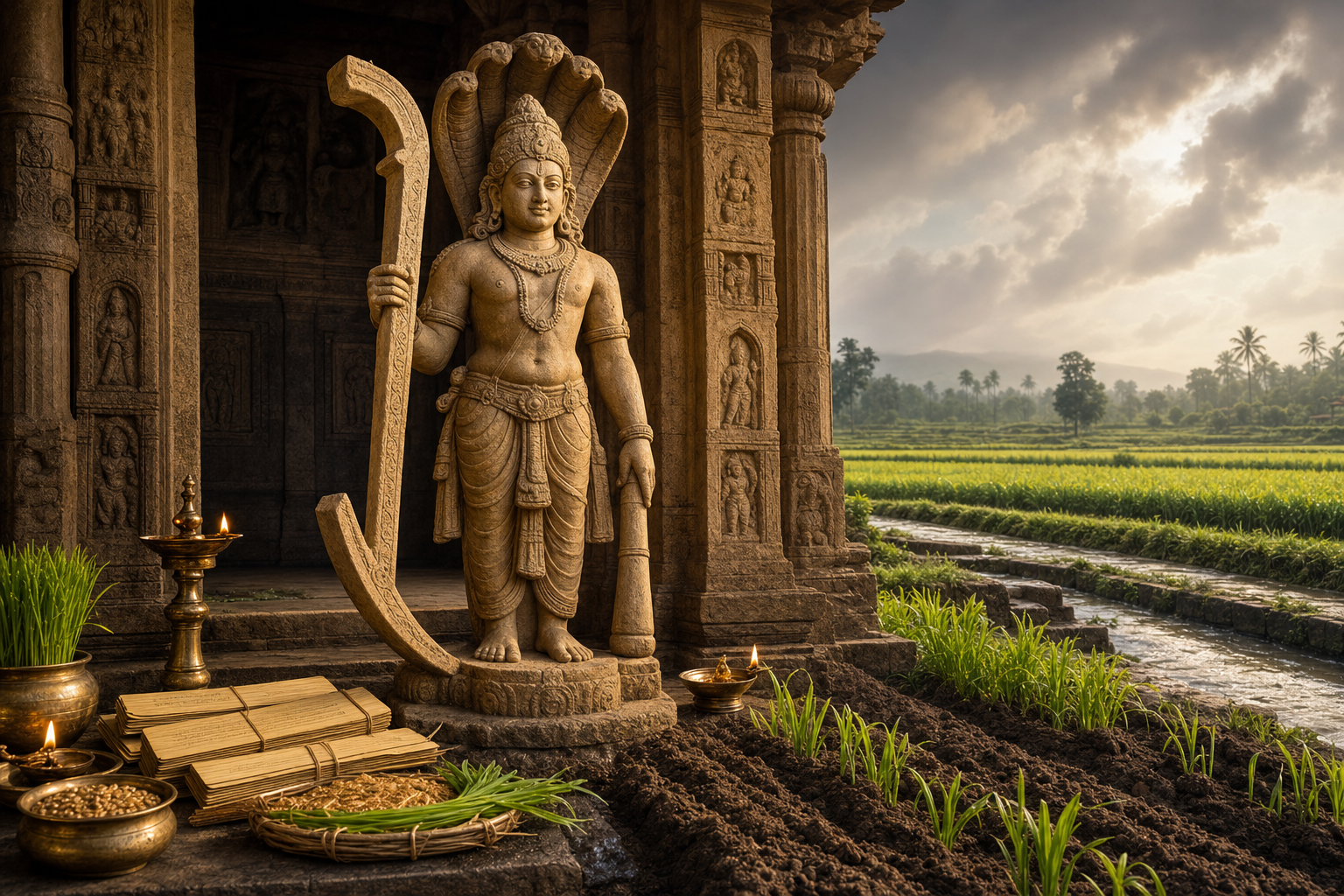
The Langala, also known as Hala, occupies a distinctive place in Hindu iconography because it joins the sacred world of divine power with the everyday world of agriculture, soil, labor, and seasonal renewal. In the hands of Balarama, the elder brother of Krishna and one of the most recognizable figures in Vaishnava tradition, the plough is not merely a rural tool. It becomes a theological emblem: a sign of fertility, discipline, protection, grounded strength, and the sanctity of food-producing land.
Hindu sculpture often communicates through carefully chosen attributes. A chakra, conch, trident, lotus, mace, bow, rosary, book, or water pot can identify a deity, reveal a theological idea, and situate the image within a larger scriptural tradition. The Langala works in the same way, but with a striking difference. It does not first appear as an ornament of royal combat. It arises from the field, from the turning of earth, and from the intimate relationship between human survival and the rhythms of nature.
This is why the Langala is so powerful in the visual language of Hindu art. It reminds the devotee that dharma is not sustained only in courts, forests, temples, and battlefields. It is also sustained in fields where seed meets soil, in cattle paths, in irrigation channels, in monsoon hope, and in the patient discipline of cultivation. The sacred plough dignifies rural labor and places agriculture within the moral imagination of Sanatana Dharma.
In iconographic terms, the Langala is most closely associated with Balarama, who is also called Halayudha, meaning the one whose weapon is the plough. He is also known as Baladeva, Balabhadra, Sankarshana, and Rama in several scriptural and devotional contexts. The name Halayudha is especially important because it shows how an agricultural implement becomes a divine attribute. The plough is a tool, but in Balarama’s hand it is also a weapon, a sign of authority, and a symbol of cosmic order.
Traditional images of Balarama frequently present him with the plough and the musala, or pestle. The pairing is meaningful. The plough opens the earth, prepares the field, and makes growth possible; the pestle suggests strength, processing, and the transformation of harvest into nourishment. Together, these implements link Balarama to the full cycle of agrarian life, from soil preparation to food culture. They also distinguish him from Krishna, whose flute evokes pastoral sweetness, divine play, and devotional attraction.
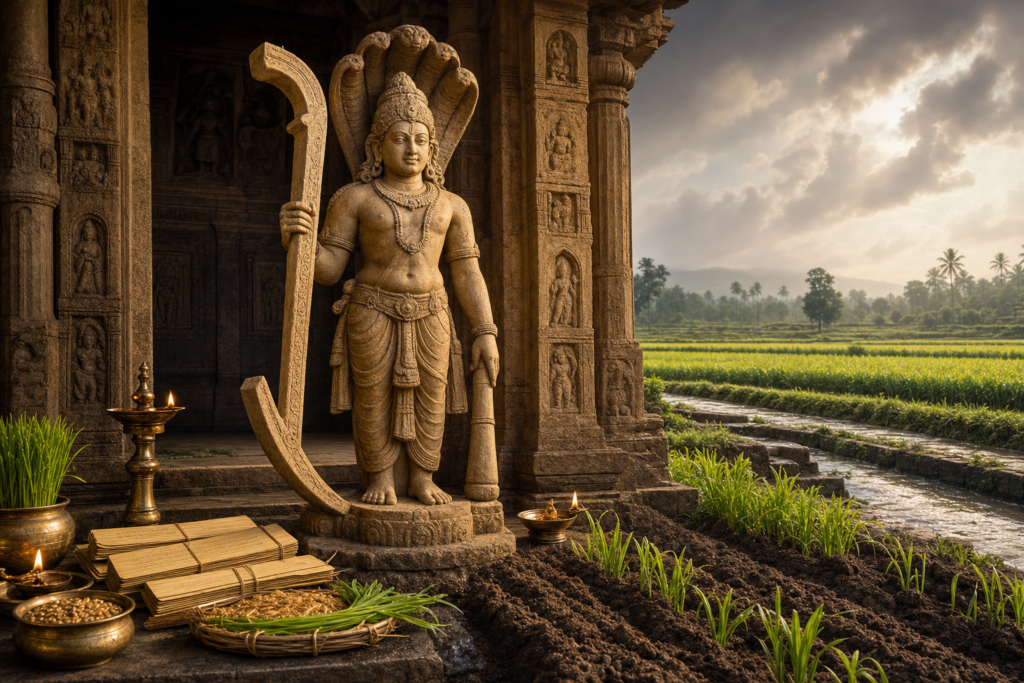
The Langala is usually represented as a curved or hooked ploughshare, sometimes held upright, sometimes resting across the shoulder, and sometimes shown in a compact symbolic form suited to the sculptural scale. In stone and bronze images, the artist often simplifies the agricultural form without losing its recognizability. The curve is crucial, because it evokes the action of drawing, furrowing, pulling, and shaping. A straight staff may suggest authority, but the curved plough suggests engagement with the earth.
Across Hindu sculpture, Balarama’s iconographic identity may include a strong body, a calm or majestic expression, a serpent association through Shesha or Sankarshana theology, and the unmistakable presence of the plough. In some early and medieval images, he appears in a standing posture, holding the Langala in one hand and another attribute in the other. In narrative reliefs, the plough may appear as part of an episode, but in independent cult images it becomes a fixed sign of recognition.
The textual background of the Langala is broad. The Mahabharata, Harivamsa, Vishnu Purana, Bhagavata Purana, and related Vaishnava traditions preserve memories of Balarama as a figure of immense strength, ethical complexity, agrarian rootedness, and sacred kinship with Krishna. These texts do not reduce him to a secondary character. Instead, they preserve a layered personality: teacher of mace warfare, guardian of dharma, elder brother, pilgrimage figure, and divine presence connected to strength that is controlled rather than chaotic.
One of the most memorable scriptural motifs associated with Balarama’s plough is his ability to draw, redirect, or command the landscape. In Puranic and epic imagination, the Langala does not merely cut soil; it can move rivers, discipline pride, and reveal the force of divine will acting through the earth itself. This symbolism is not accidental. Ancient Indian thought often treats rivers, mountains, forests, cattle, crops, and seasons as participants in sacred order rather than as inert matter.
The Langala therefore carries ecological significance. It represents a relationship with the earth that is active but not dismissive. The plough enters the soil, yet its purpose is generative. It breaks the surface in order to allow life to emerge. In this sense, the sacred plough can be read as a symbol of disciplined intervention: human effort aligned with cosmic rhythm, not exploitation detached from responsibility.
In agrarian societies, the plough is one of the most consequential technologies. It changes land, organizes labor, supports settlements, and enables surplus. When such an implement is placed in divine hands, the act of cultivation is elevated beyond economics. It becomes a sacred duty connected with food security, community stability, cattle care, ritual offerings, and the household economy. Hindu art captures this elevation with remarkable visual economy.
Balarama’s Langala also complicates the modern assumption that divine weapons must be instruments of violence. The plough can be a weapon, but its first meaning is nourishment. It protects by making life possible. It defends society by sustaining the conditions under which society can exist. This gives the Langala a moral depth that differs from purely martial iconography. Its strength is not theatrical; it is steady, rural, and deeply practical.
The image becomes especially meaningful when placed beside the broader Hindu understanding of annam, food, as sacred. Vedic and later Hindu traditions repeatedly emphasize food, rain, sacrifice, and life as interconnected. The plough belongs within this chain. It prepares the ground for grain, grain sustains beings, beings perform dharma, and dharma sustains the world. In this way, the Langala becomes a visual bridge between agriculture and metaphysics.
From an art-historical perspective, the Langala helps identify Balarama in sculptural programs where multiple deities and attendants appear together. In temple walls, detached icons, relief panels, and bronze traditions, attributes are essential to recognition. The plough allows viewers to distinguish Balarama from other heroic or divine male figures. Its presence also confirms the sculptor’s awareness of established iconographic grammar, where each implement carries a precise theological memory.
The Langala’s sculptural treatment varies by region, period, and material. In stone, it may appear compact and sturdy, adapted to the limitations of carving and the need for durability. In bronze, it can be more elegant and elongated, sometimes with refined curvature. In relief, the plough may be reduced to its essential outline. These variations show that Hindu sculpture is not rigid repetition; it is a living visual language shaped by local workshops, patronage, ritual use, and regional aesthetics.
The sacred plough also belongs to a larger South Asian reverence for land. Village rituals, seasonal festivals, temple offerings, cattle worship, harvest celebrations, and regional agrarian customs all preserve the intuition that the earth is not merely property. She is mother, field, support, and witness. The Langala participates in this worldview. It is a sign of human dependence on Bhumi, the sustaining earth, and of the responsibility that comes with touching her surface.
In devotional imagination, Balarama’s strength is not detached from tenderness. His association with agriculture gives him a nearness to ordinary life. Devotees can approach him not only as a cosmic being but also as a protector of land, cattle, harvest, family continuity, and bodily strength. This emotional accessibility explains why the Langala remains memorable even when it is visually simple. It speaks to people who know that survival often depends on patient work rather than dramatic victory.
The plough also carries an initiatory symbolism. To cultivate a field, the surface must be opened. To cultivate the mind, habit must be disturbed. In many dharmic traditions, including Hinduism, Buddhism, Jainism, and Sikhism, inner discipline is often described through images of training, purification, restraint, and steady effort. While the Langala is specifically rooted in Hindu iconography, its broader moral resonance can be appreciated across dharmic thought: transformation requires effort, humility, and contact with reality.
This shared ethical resonance is important. The sacred plough does not promote division among dharmic traditions; it offers a language of groundedness. Hindu, Buddhist, Jain, and Sikh communities have all preserved deep respect for disciplined living, ethical restraint, service, and the interdependence of life. The Langala, when understood generously, becomes part of a larger civilizational vocabulary that honors labor, nourishment, self-mastery, and reverence for the natural world.
Within Vaishnava theology, Balarama is also linked to the principle of support. As Sankarshana and through associations with Shesha, he is connected to the sustaining foundation upon which divine order rests. The plough fits this theological identity with unusual precision. Agriculture is foundational; it supports society before society can produce philosophy, art, kingship, poetry, and ritual specialization. Balarama’s attribute therefore mirrors his cosmic role as one who upholds, strengthens, and prepares.
The Langala’s symbolism also helps correct a narrow reading of Hindu sacred art as only mythological decoration. A sculpture of Balarama with the plough is a compressed archive of social history, theology, ecology, and ritual imagination. It preserves the memory of agrarian India, the dignity of work, the sacredness of food, and the transformation of ordinary tools into divine signs. Such an image asks to be read slowly, not merely seen quickly.
There is also a political and social dimension to the plough as an emblem. Agrarian life depends on cooperation: families, cattle, water systems, village institutions, seasonal calendars, seed knowledge, and shared labor. The sacred plough implicitly honors this collective world. It reminds society that civilization is not sustained only by rulers and warriors, but also by cultivators, artisans, ritual specialists, herders, and householders whose work rarely seeks display.
In this respect, the Langala differs from royal weapons that often project conquest. The plough projects continuity. It points toward sowing, waiting, tending, harvesting, and beginning again. It is cyclical rather than merely victorious. Its sacredness lies in its ability to transform time into nourishment. Every agricultural season becomes a lesson in dependence, patience, uncertainty, and gratitude.
The connection between Balarama and the earth also enriches the interpretation of his bodily strength. Bala means strength, but in the sacred context it is not only muscular force. It is the strength to support, endure, protect, restrain, and cultivate. The Langala visualizes that kind of strength. It is power applied to life-giving work. It is force disciplined by purpose.
For students of Hindu sculptures, the Langala is therefore an essential iconographic marker. Its study opens questions about textual transmission, regional art history, temple practice, rural symbolism, and the social memory of agriculture. It also demonstrates how Hindu iconography can transform a familiar object into a profound theological statement. The sacred is not always distant or abstract; sometimes it is held in the shape of a tool known to every farmer.
The Langala’s continued relevance is visible in contemporary conversations about ecological balance, sustainable agriculture, food ethics, and cultural heritage. Modern societies often experience food as a commodity separated from land and labor. Balarama’s plough resists that separation. It invites a more integrated view in which food, soil, water, cattle, community, and worship are understood as parts of one moral ecology.
In temple culture, sacred objects are not passive symbols. They are ritually awakened through worship, memory, storytelling, and community participation. When devotees encounter Balarama with the Langala, they encounter not merely an ancient image but a continuing tradition. The sculpture becomes a point where scripture, art, agriculture, and devotion meet. Its meaning grows through darshan, recitation, festival, and inherited explanation.
The sacred plough ultimately teaches that civilization depends on the humble foundations it often forgets. Before philosophy is debated, grain must grow. Before temples are built, stone must be quarried and food must sustain workers. Before ritual offerings are made, fields must yield. The Langala keeps this truth visible in Hindu art. It gives sacred form to the labor beneath culture.
Thus, Balarama’s Langala is not a minor attribute but a major symbol of dharmic imagination. It unites strength with fertility, divine authority with rural life, and sculpture with scripture. It speaks of the earth as sacred, labor as dignified, and nourishment as a spiritual concern. In stone, bronze, and living tradition, the plough remains one of Hindu iconography’s most grounded and powerful signs.
Inspired by this post on Hindu Blog.





Leave a Reply
You must be logged in to post a comment.