The Srimad-Bhagavatam frequently describes the cosmos as a “cosmic ocean,” with planets appearing as “islands.” Modern astronomy, while built on a very different method of inquiry, echoes this imagery more than one might expect: the observable universe is largely empty space, punctuated by gravitationally bound “islands” of mattergalaxies, clusters, and superclustersthreaded along a vast cosmic web. Far from being a source of conflict, these parallel images invite a disciplined reflection on how scientific cosmology and dharmic thought can speak to one another without overreach, each illuminating different dimensions of realityone empirical and predictive, the other metaphysical, ethical, and contemplative.
Contemporary cosmology’s account of origins is evidence-led. Multiple lines of observationHubble–Lemaître expansion, the cosmic microwave background (CMB), primordial nucleosynthesis, and the large-scale distribution of galaxiesconverge on a hot, dense early state commonly termed the Big Bang. Within the prevailing ΛCDM model (Lambda–Cold Dark Matter), roughly 5% of the cosmic energy budget is baryonic matter, about 25–30% is dark matter, and about 65–70% is dark energy. The precise values are continually refined by missions such as WMAP and Planck, together with baryon acoustic oscillation surveys and Type Ia supernovae catalogs. This empirical architecture yields testable predictions, statistical confidence intervals, and known uncertaintiesan exemplary expression of science and philosophy in practice.
When it comes to cosmic destiny, leading astronomy textbooks remain appropriately cautious. Several futures have been debated: an ever-accelerating expansion toward heat death (the thermodynamic “Big Freeze”); a hypothetical “Big Rip” if dark energy’s equation-of-state were decisively below −1; or a far-future recollapse (the “Big Crunch”) if conditions reversed. Present observations suggest accelerated expansion consistent with w ≈ −1 and favor an expansion that continues indefinitely, but open questions remain about dark energy’s true nature and whether late-time anomalies or new physics could alter the storyline. In short, empirical cosmology responsibly withholds final metaphysical claims about “how it all ends.”
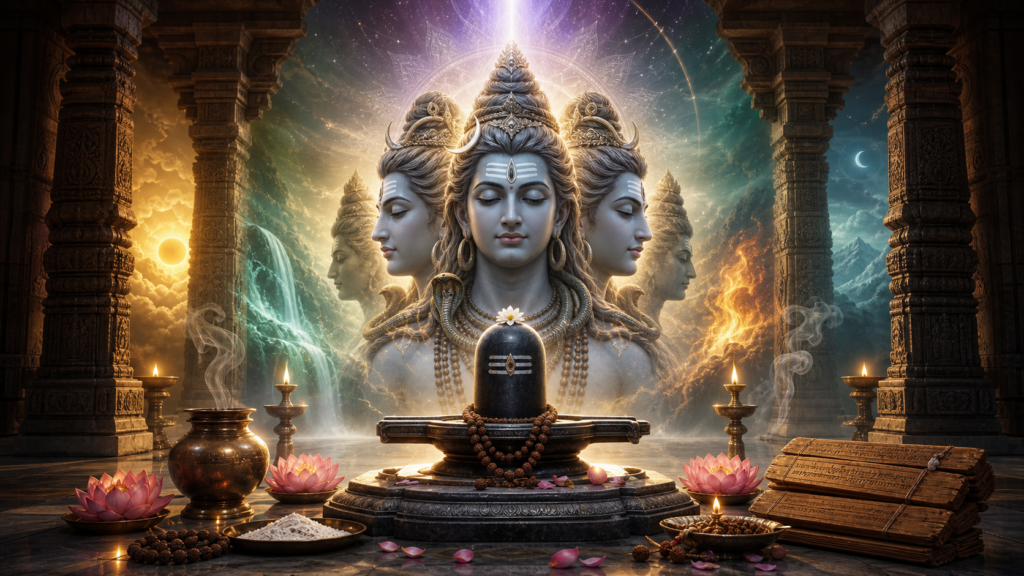
Dharmic scriptures approach the same horizon of meaning differently. The Bhagavata Purana (Srimad-Bhagavatam) frames the cosmos in cycles of manifestation, maintenance, and dissolution (srishti–sthiti–laya), poetically described as the exhalation and inhalation of Mahavishnu. This symbolic language places creation within rhythmic time rather than a single terminal event. Kalpas and yugas articulate “deep time,” cultivating a mental readiness to contemplate scales far beyond ordinary experience. While these scriptural cycles are not scientific models, they provide an intellectual and spiritual grammar for orientation within a vast and dynamic universe.
The metaphor of a “cosmic ocean” and “islands” of worlds resonates uncannily with present-day maps of the cosmic web. Observations reveal that matter organizes along filaments separated by immense voids; galaxies themselves were once called “island universes” long before their extragalactic nature was confirmed. In both vistasscriptural and scientificthe cosmos is expansive, mostly “space,” and textured by discrete domains of order. The similarity does not imply prediction; rather, it highlights how powerful metaphors can travel across cultures and methods, priming the mind to recognize structure at truly cosmic scales.
A broader dharmic perspective reinforces this sense of scale and recurrence. Buddhist texts speak of kalpas that far exceed human timescales, setting contemplative life within a cosmology of vast cycles. Jain cosmology offers a rigorous vision of a beginningless and endless Lokakash, structured with island-continents and cosmic regions. Sikh scripture refers to countless realms and “koti brahmand,” underscoring multiplicity within the divine order. These diverse traditionsHinduism, Buddhism, Jainism, and Sikhismmaintain distinctive doctrines while converging on a shared intuition: time and being unfold in magnitudes that dwarf immediate perception, inviting humility and ethical responsibility. Such religious pluralism strengthens unity in spiritual diversity without collapsing differences or instrumentalizing science to “prove” faith.
Indian philosophical discourse also provides a careful framework for knowledge. Classical pramāṇa theory distinguishes means such as pratyakṣa (perception), anumāna (inference), and śabda (reliable testimony). Scientific cosmology is exemplary in its disciplined use of perception and inference, harnessed by mathematics and instrumentation; scripture belongs to the domain of śabda, addressing meaning, value, and liberation (moksha). Treating the two domains as complementary rather than competitive avoids category errors: cosmology explains how the universe behaves, while dharma addresses how a human being might live meaningfully and ethically within it.
This complementarity is strengthened, not weakened, by scientific humility. Quantum theory’s probabilistic structurecaptured famously by the Heisenberg uncertainty principlereminds inquiry that fundamental limits exist on what can be simultaneously known. In cosmology, too, the earliest Planck-era physics and the ultimate fate of the universe lie beyond easy extrapolation. Dharmic traditions have long emphasized intellectual humility as a prerequisite for wisdom; modern science, in its own way, operationalizes humility through error bars, confidence intervals, and the readiness to revise models when new data arrive.
The contemplation of “deep time” further bridges scientific and dharmic sensibilities. In the Puranic framework, a kalpa is 4.32 billion yearsa figure not offered as a measurement device in modern astronomy, yet one that evokes time depths comparable to geological and planetary scales discovered by science. Scientific chronologies13.8 billion years for cosmic age, 4.54 billion for Earthare established via independent methods (radioisotope dating, stellar evolution models, CMB anisotropies). Scriptural cycles, in contrast, are pedagogical and metaphysical. Seeing them side by side cultivates a mental spaciousness conducive to both rigorous inquiry and contemplative practice.
On the structural side, the “islands” metaphor aligns intuitively with observable hierarchies: stars aggregate into galaxies; galaxies into groups and clusters; clusters into superclusters and filaments. Statistical imprints such as baryon acoustic oscillations help calibrate this scaffolding, while gravitational lensing and redshift surveys chart how matter clumps and stretches across expanding space. The grandeur and austerity of these findings can evoke the very rasa of wonder that scriptural poetry seeks to awakenan affective bridge in which science catalyzes devotion, and devotion sustains patience for science’s slow, careful work.
The question of endings is a natural crucible for meaning. Dharmic cosmologies narrate dissolutionas in the Bhagavata Purana’s vision of reabsorption into Mahavishnu’s inhalationwithout framing it as nihilistic collapse. Rather, dissolution is part of a rhythmic whole through which purpose and ethical action remain paramount. Scientific scenariosheat death, rip, crunch, or bounceare value-neutral but emotionally arresting; they press the existential question of what matters now. Bringing these strands together encourages a synthesis where awe matures into responsibility: stewardship of this rare “island” Earth, compassion across communities, and a commitment to truthful speech and inquiry.
For many students and practitioners who engage both an astronomy textbook and a dharmic scripture, a shared practice emerges. Begin with empirical humility: accept what observation warrants, neither less nor more. Add philosophical clarity: keep methods and aims distinctprediction on one hand, meaning and ethics on the other. Finally, cultivate contemplative steadiness: allow the scale of the cosmos to soften egoic urgency and to deepen kindness. In this way, studying science need not erode faith; it can refine it, aligning inner life with outer knowledge.
In sum, the “cosmic ocean” of the Srimad-Bhagavatam and the cosmic web of ΛCDM are not competing maps but complementary invitations. One invites disciplined observation, statistical inference, and model testing; the other invites metaphysical reflection, ethical resolve, and devotional intimacy. Held together with intellectual integrity, they can nourish unity among Hinduism, Buddhism, Jainism, and Sikhism while honoring the distinctive contributions of each tradition. The result is a spacious, plural visiontrue to science, faithful to scripture, and expansive enough to hold awe, reason, and compassion in a single, steady gaze.
Inspired by this post on Dandavats.