
Ujjaini Mahankali Bonalu Jathara 2026 at Secunderabad is scheduled for Sunday, August 2, 2026, with Rangam observed on Monday, August 3, 2026. The festival is one of Telangana’s most prominent expressions of Shakti worship, community devotion, and regional cultural continuity. At the Sri Ujjaini Mahakali Devasthanam in Secunderabad, Bonalu is not merely an annual temple event; it is a public ritual of gratitude, protection, memory, and social participation.
For devotees who cannot be physically present in Secunderabad, the possibility of watching Bonalu Jathara online through the official temple website has become an important devotional bridge. Online darshan does not replace the embodied experience of standing in the temple streets, hearing the drums, or watching women carry decorated Bonam pots, but it allows families, elders, the diaspora, and distant devotees to remain connected with the sacred rhythm of the festival.
The Ujjaini Mahankali Temple stands in the General Bazaar area of Secunderabad and is dedicated to Goddess Mahakali. Its popular history is linked to the early nineteenth century, when a severe epidemic affected the Hyderabad-Secunderabad region. Tradition holds that devotees associated with the military establishment prayed to Mahakali at Ujjain and later installed the deity in Secunderabad in fulfillment of a vow. This memory of danger, prayer, and communal recovery continues to shape the devotional meaning of Bonalu.
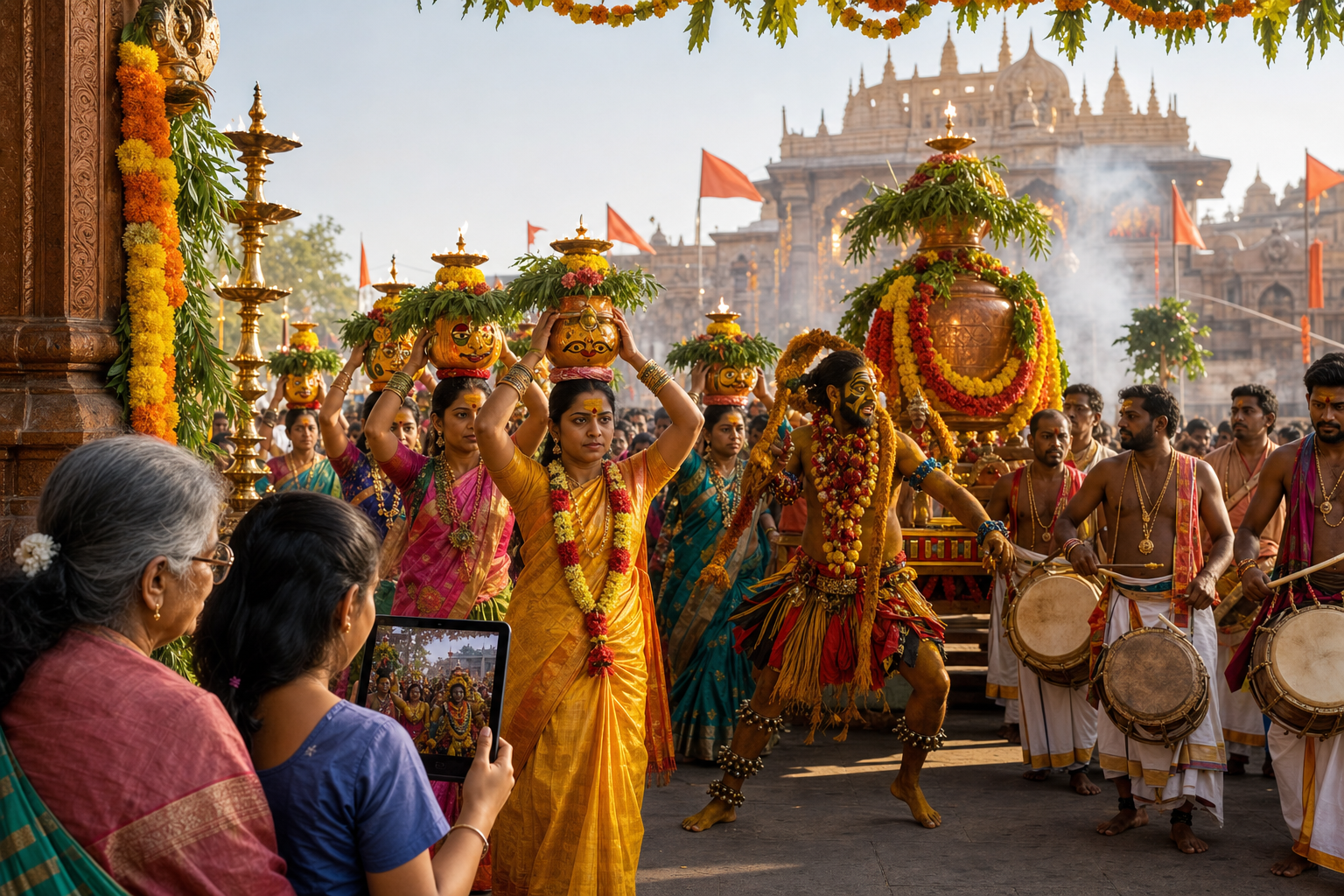
Bonalu itself is rooted in the word Bonam, commonly understood as an offering of food to the Mother Goddess. In ritual practice, devotees prepare rice cooked with milk and jaggery, place it in a decorated brass or earthen pot, adorn the pot with turmeric, vermilion, neem leaves, and a lamp, and carry it to the goddess. The act is simple in form but dense in meaning: food becomes gratitude, household labor becomes worship, and the devotee’s body becomes a moving vessel of faith.
The 2026 date is significant because the main Ujjaini Mahankali Bonalu Jathara falls on a Sunday, the day traditionally associated with major Bonalu observances in Telangana during Ashada masam. Rangam, the oracle ritual, follows on Monday, August 3, 2026. Devotees planning travel, Bonam offerings, or online viewing should confirm final timings and arrangements through the temple committee’s official announcements closer to the festival date.
In Secunderabad, the festival is often identified with Lashkar Bonalu, a name that recalls the area’s historical military and cantonment associations. The term is not merely geographical; it points to the distinctive public character of the celebration. Streets, neighborhoods, temple lanes, markets, police arrangements, volunteer networks, music troupes, and family groups all become part of a large civic-religious organism centered on the goddess.
The main rituals of the Ujjaini Mahankali Bonalu Jathara include Bonam offerings, Ghatam processions, Kolupu, Pothuraju participation, Rangam, and Saganamputa, the ceremonial farewell. Each element represents a particular layer of Telangana’s ritual vocabulary. Together they form a sequence that moves from invitation and offering to public procession, divine consultation, and ritual closure.
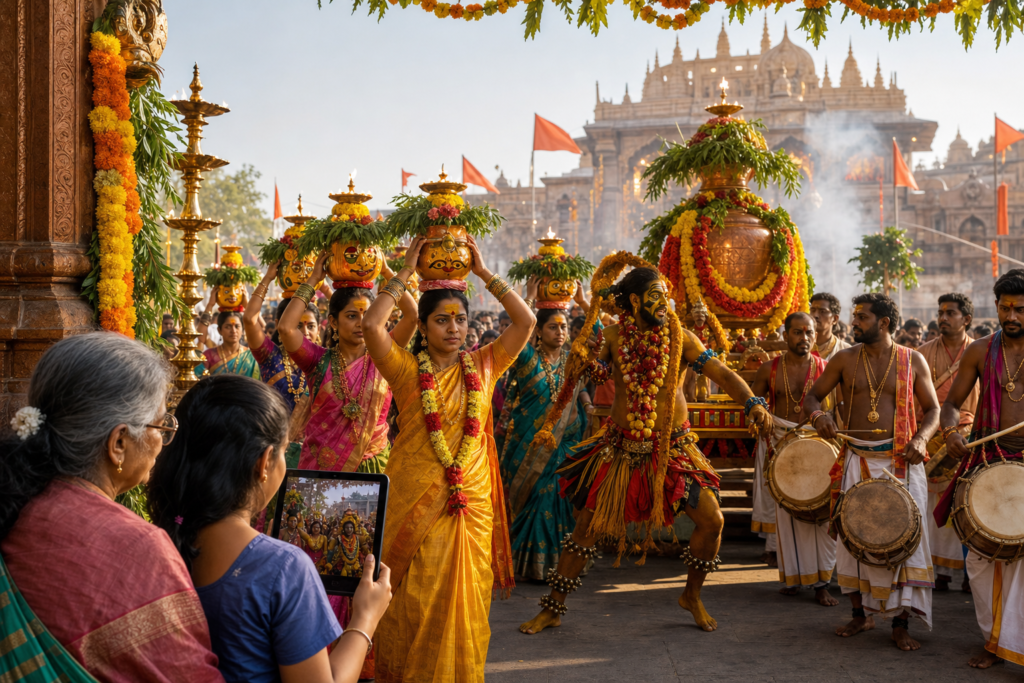
Ghatam is among the most visually and ritually important features of Bonalu. A decorated copper pot represents the presence of the Mother Goddess and is carried in procession by a priest or designated ritual bearer. The Ghatam is not treated as an object of display alone; it is understood as a mobile form of divine presence moving through the community, blessing neighborhoods and drawing public devotion into the temple’s sacred geography.
Pothuraju is another defining presence in Bonalu. Traditionally regarded as the brother or guardian figure associated with Mahakali, Pothuraju appears in the procession with turmeric-smeared body, vermilion marks, bells, and vigorous dance. His movement ahead of the procession symbolizes protection, energy, and the clearing of obstacles. The beat of Teen maar drums and the force of Pothuraju’s dance create one of the most recognizable images of Hyderabad Bonalu and Secunderabad Bonalu.
Rangam, observed on the day after the main Bonalu offering, is an oracle tradition in which the goddess’s message is ritually received and communicated. In public understanding, Rangam is watched with seriousness because it joins devotion, social expectation, and the anxieties of the coming year. The practice reflects the older Indic idea that sacred festivals are not only occasions of worship but also moments when the community seeks moral and practical orientation.
The emotional center of Bonalu often rests with women devotees who carry Bonam pots on their heads. Their participation is not ornamental; it is foundational. The preparation of the offering, the discipline of carrying it, the careful movement through crowds, and the surrender before Mahankali make visible the devotional authority of women within the festival. In this sense, Bonalu is also a public celebration of the Sacred Feminine in Hindu tradition.
The use of turmeric, vermilion, neem leaves, lamps, bangles, and sari offerings reflects a ritual grammar shared across many Shakti traditions in India. Turmeric signifies auspiciousness and protection, vermilion marks sacred power, neem is associated with purification and healing, and the lamp represents awakened presence. These elements make Bonalu both local and pan-Indic: deeply Telangana in expression, yet intelligible within the wider field of Hindu ritual practice.
Historically, Bonalu has often been explained through the memory of epidemics and collective protection. That memory gives the festival special contemporary relevance. Communities facing illness, uncertainty, migration, economic stress, or social fragmentation often return to ritual not only for miracles but for solidarity. The offering to Mahankali becomes a way of saying that survival is not individual alone; it is familial, communal, ecological, and spiritual.
Recent discussions of Bonalu’s history have also pointed to older epigraphic references that may extend the festival’s documented past beyond the nineteenth-century epidemic narrative. Such research strengthens the view that Bonalu belongs to a long continuum of Telangana folk Shakti worship. The nineteenth-century Secunderabad tradition remains important, but the larger cultural pattern may be much older, shaped by regional goddess worship, agrarian cycles, public vows, and community festivals.
Ujjaini Mahankali Bonalu is sometimes described as one of the largest cultural festivals in Telangana. This description is justified not only by the number of devotees but by the density of cultural forms gathered in one event. Folk music, ritual dance, oral memory, local deity traditions, temple administration, public safety planning, food offerings, neighborhood identity, and intergenerational participation all converge during the Jathara.
The festival also demonstrates how Hindu traditions preserve unity through diversity. Mahakali, Yellamma, Pochamma, Maisamma, Muthyalamma, Peddamma, and other local goddess forms are worshipped across Hyderabad, Secunderabad, and Telangana in related but distinct ways. This plurality does not weaken the tradition; it gives it depth. Each locality honors the Mother in its own form while participating in a shared sacred culture.
For dharmic traditions more broadly, Bonalu offers a useful lens into how ritual communities sustain continuity. Hinduism, Buddhism, Jainism, and Sikhism differ in theology, practice, and institutional history, yet all preserve forms of collective memory, disciplined offering, sacred sound, pilgrimage, ethical community, and reverence for lived tradition. Bonalu contributes to this larger dharmic landscape by showing how devotion can be public, embodied, and socially cohesive.
Online viewing of the Ujjaini Mahankali Bonalu Jathara should therefore be understood carefully. It is not entertainment coverage of a colorful festival; it is mediated participation in a sacred event. Devotees watching from home can maintain the dignity of darshan by keeping the space clean, avoiding casual interruption, reciting prayers, lighting a lamp where appropriate, and treating the live stream as a devotional window rather than a spectacle.
The official temple website is the most appropriate place to check for live streaming, darshan updates, queue arrangements, contact details, and festival advisories. In earlier years, online facilities were made available for devotees who wished to watch the Secunderabad Bonalu proceedings remotely. For 2026, devotees should look for specific announcements from Sri Ujjaini Mahakali Devasthanam before relying on any third-party video link.
Those attending in person should prepare for heavy crowds, traffic diversions, security checks, special queue systems, and long waiting periods. Women carrying Bonam offerings may be guided through designated lines depending on temple arrangements. Families with elderly persons, young children, or health concerns should plan conservatively, carry essential water and medicines, and follow police and temple volunteer instructions.
From a cultural studies perspective, the management of Bonalu is as important as the ritual itself. A festival of this scale requires coordination among temple authorities, endowments officials, police, municipal services, sanitation teams, medical support, media units, and volunteers. The sacred and the administrative are not separate in practice; public devotion depends on disciplined civic planning.
The visual power of Bonalu should not obscure its theological seriousness. Mahakali is worshipped as protective mother, fierce energy, and compassionate guardian. The offering of food expresses a reciprocal relationship between devotee and deity: the household feeds the goddess in gratitude, and the goddess is invoked to protect the household, the locality, and the wider community.
The festival’s appeal across Andhra Pradesh, Maharashtra, Karnataka, Odisha, Tamil Nadu, and the wider Indian diaspora shows how local traditions travel through memory and migration. People who once lived in Telangana often carry Bonalu songs, images, and rituals into new cities. Digital darshan extends this movement further, allowing devotion to cross distance without erasing the temple’s local rootedness.
In 2026, the Ujjaini Mahankali Bonalu Jathara is likely to draw attention not only as a temple festival but as a major marker of Telangana cultural identity. The most meaningful way to approach it is with reverence, historical awareness, and respect for the communities that sustain it year after year. Whether seen in Secunderabad’s crowded streets or through an online stream, Bonalu remains a living testimony to faith, feminine divinity, and collective gratitude.
The essential details are clear: Ujjaini Mahankali Bonalu Jathara 2026 is scheduled for Sunday, August 2, 2026; Rangam is scheduled for Monday, August 3, 2026; the principal temple is Sri Ujjaini Mahakali Devasthanam at Secunderabad; and devotees seeking online darshan should follow the official temple website and verified temple communications. These practical details, when placed within the festival’s deeper cultural context, show why Secunderabad Bonalu continues to command such devotion across generations.
Inspired by this post on Hindu Pad.



Leave a Reply
You must be logged in to post a comment.