
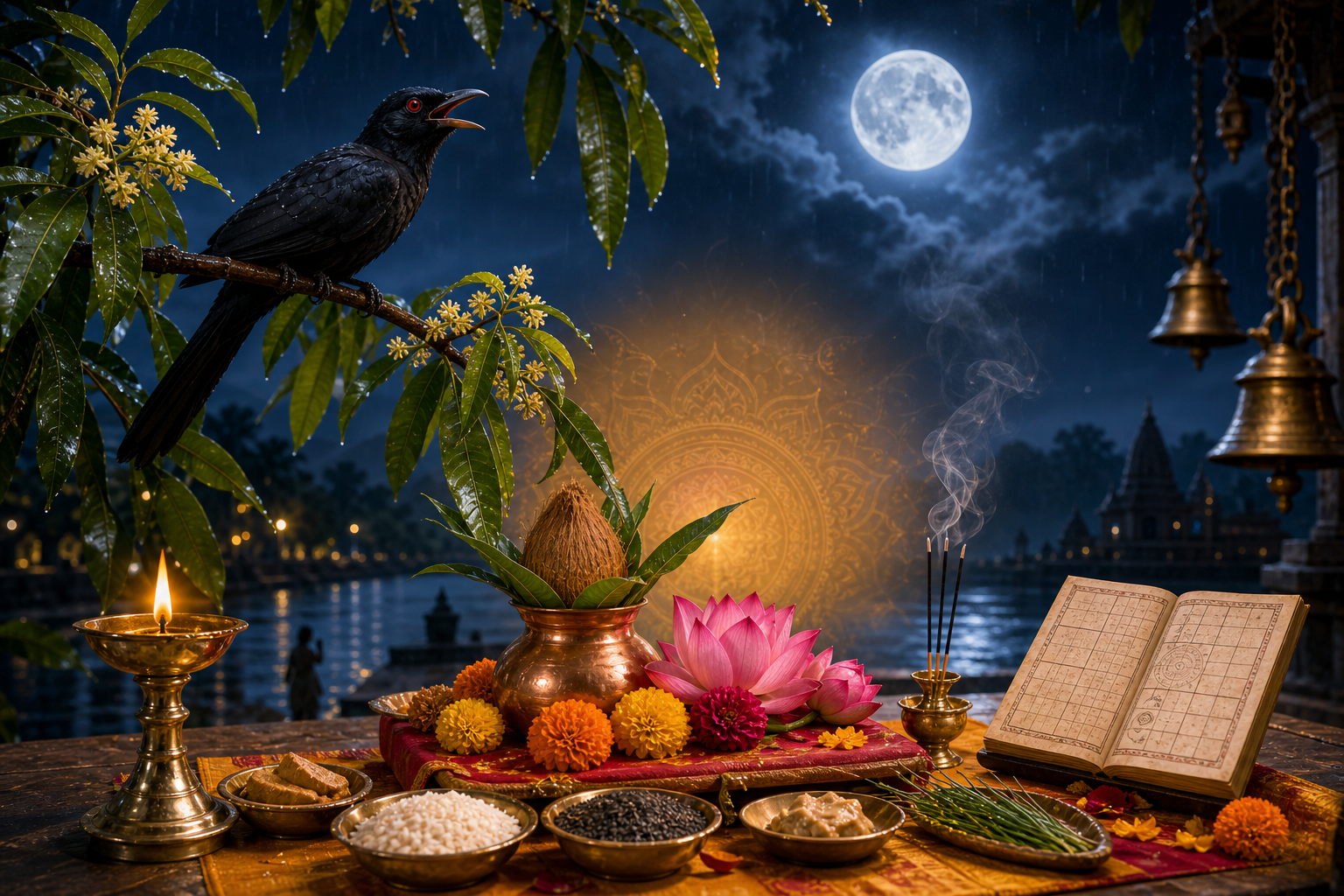
Kokila Vrat, also known as Kokila Devi Vratam, is a devotional observance associated with Ashad Purnima, the full moon of Ashad Maas, and the wider sacred atmosphere of Guru Purnima. In 2026, the observance is traditionally listed for July 29 in the provided Kokila Vrat calendar tradition, though devotees are generally advised to follow the local panchang for the precise tithi, sunrise rule, and regional practice. The vrat is dedicated to Kokila Devi, a form of Adishakti remembered through the image of the kokila, the melodious koel or cuckoo, whose sound becomes a symbol of longing, tapas, and disciplined devotion.
The primary meaning of Kokila Vrat is not merely the desire for marriage, although popular tradition often describes it as a vrata observed by unmarried girls for a worthy husband and by unmarried boys for a suitable wife. At a deeper level, the vrat belongs to a larger Hindu ritual world in which self-restraint, purity of intention, reverence for Shakti, and respect for sacred time are brought together. The observance turns the emotional desire for companionship into a disciplined spiritual practice, making marriage not only a social goal but also a dharmic commitment grounded in steadiness, mutual respect, and inner refinement.
Ashad Purnima gives this vrat its calendrical importance. Purnima, the full moon tithi, is traditionally considered a time of completion, illumination, and heightened devotional focus. Ashad Maas also marks the transition toward the monsoon season in much of India, a period when the rhythm of religious life turns inward through fasting, study, pilgrimage, and vrata observances. The association with Guru Purnima further deepens the context, because the day is widely connected with gratitude toward teachers, spiritual guides, and knowledge traditions. The same reverence for guidance resonates across dharmic traditions, including Hindu, Buddhist, Jain, and Sikh communities, even when the ritual calendars and forms of observance differ.
The name Kokila carries significant symbolic weight. The koel is heard before it is easily seen, and this quality makes it a fitting image for longing that matures through patience. In devotional interpretation, the unseen bird with a distinct voice becomes a metaphor for the soul calling toward the Divine. The vrat therefore expresses an interior discipline: the devotee learns to regulate desire, speech, food, sleep, and conduct while cultivating a clearer aspiration for grace. This is why the ritual remains meaningful even for those who approach it as cultural heritage rather than as a narrowly transactional vow.
The traditional Kokila Vrat katha links the observance with the story of Sati and Shiva. In that narrative, Sati, born as the daughter of Daksha, chooses Shiva as her lord despite Daksha’s hostility toward him. When Daksha performs a great yajna and deliberately excludes Shiva, Sati attends against Shiva’s counsel and is deeply wounded by the insult directed toward her husband. She gives up her body in the sacrificial fire, and Shiva, overcome by grief and anger, destroys Daksha’s pride. Later devotional retellings connect Sati’s tapas in the form of a kokila with her eventual rebirth as Parvati and reunion with Shiva. The story is not simply about sorrow; it is about transformation through tapas, the purification of attachment, and the restoration of divine union.
In some regional accounts, Kokila Vrat is also described through the instruction given by Guru Vashishta to Kirtimala, the wife of Shatrughna. The vrata is explained as a disciplined observance beginning with a sankalpa on Ashad Purnima and continuing through the month of Shravan in certain traditions. The vrata may include bathing, restraint in food, sleeping on the ground, brahmacharya, compassion toward living beings, and the worship of a kokila image made from sesame. These details show that the vrata is not only an isolated act of prayer but a full regimen of bodily, ethical, and devotional discipline.
The ritual form is usually simple but symbolically dense. Devotees may make an idol of Kokila Devi, draw the image of a kokila, or worship a representation of the bird with flowers, sandal paste, incense, rice, sesame, and durva grass. The source tradition also notes that punya snan, a meritorious sacred bath, especially in the Sindhu river, is considered highly auspicious during Kokila Vratam. Where travel to a sacred river is not possible, many households treat an early morning bath, mental purity, and prayerful intention as the practical devotional equivalent. The emphasis remains on sincerity rather than display.
One mantra associated with the ritual tradition is preserved as follows: तिलसहे तिलसौख्ये तिलवर्ण तिलप्रिये, सौभाग्यद्रव्यपुत्रास्रच देहि में कोकिले नम:. The mantra reflects the offering of sesame and the prayer for auspiciousness, prosperity, family continuity, and harmony. In academic terms, such mantras function as condensed ritual language: they name the deity, identify the offering, articulate the seeker’s intention, and place the devotee within a lineage of inherited practice. In lived experience, they also give the mind a stable sound around which faith and discipline can gather.
Fasting in Kokila Vrat should be understood as vrata-discipline rather than mere food avoidance. Hindu fasting traditions often combine ahara-niyama, regulation of food, with vachana-niyama, discipline of speech, and manasa-shuddhi, purification of thought. The devotee may eat simply, avoid harsh speech, reduce distractions, perform japa, listen to or recite the vrat katha, and cultivate compassion. This broader understanding is important because it prevents the observance from becoming mechanical. A vrata is effective in the cultural and spiritual sense when it reshapes conduct, not only when it marks a date on the calendar.
The popular belief that Kokila Vrat helps unmarried devotees receive a suitable spouse should be read with cultural sensitivity. Traditional language often speaks of a handsome husband or beautiful wife, but the more dharmic interpretation is the aspiration for a compatible, virtuous, and stable life partner. Beauty in this context need not be reduced to physical appearance; it can also refer to character, gentleness, responsibility, and shared commitment. This reading is more consistent with the broader objectives of dharmic family life, where marriage is ideally a partnership in duty, affection, spiritual growth, and social responsibility.
For married devotees, the vrat may be approached as a prayer for harmony, mutual care, and emotional steadiness within the household. For unmarried devotees, it may become a disciplined way to prepare inwardly for partnership rather than merely asking destiny for an external result. For families preserving ancestral practices outside India, Kokila Vrat can also become a quiet bridge between generations: elders remember the vrata through stories, younger members encounter the symbolism through explanation, and the household reclaims a form of Hindu culture that is gentle, reflective, and rooted in Shakti worship.
Kokila Vrat also illustrates an important feature of Hindu traditions: ritual diversity. Some devotees observe it specifically on Guru Purnima or Ashad Purnima, while others follow the longer vrata cycle from Ashad Shukla Chaturdashi or Purnima through Shravan Purnima. Some worship an image; others emphasize katha, fasting, snan, and dana. Such variation is not a weakness of the tradition. It reflects the way local calendars, family lineages, regional customs, and temple practices preserve a shared devotional core while allowing practical adaptation.
From a theological perspective, Kokila Devi worship places Shakti at the center of longing and transformation. The devotee does not deny human desire; rather, desire is refined through tapas. The story of Sati and Parvati teaches that love without wisdom can become suffering, while love purified through discipline becomes strength. This gives Kokila Vrat a continuing relevance in modern life, where relationships often suffer from haste, expectation, and emotional restlessness. The vrat invites patience, self-examination, and reverence before asking for companionship.
The connection with Guru Purnima adds another layer of meaning. Guru Purnima is widely known as a day to honor the guru, the remover of ignorance and the guide toward knowledge. When Kokila Vrat is observed in this atmosphere, the prayer for marriage or household welfare is placed under the guidance of wisdom. The result is a more balanced religious psychology: the devotee asks not only for a desired relationship, but also for the maturity to sustain it. This synthesis of devotion, guidance, and discipline is one reason the vrat continues to be remembered in Hindu households.
In practical terms, devotees observing Kokila Vrat 2026 may begin by confirming the date and tithi from a trusted local panchang, especially because lunar observances can vary by region and sunrise convention. The day may be marked with a morning bath, sankalpa, worship of Kokila Devi, recitation of the vrat katha, offering of sesame, flowers, rice, and durva, simple fasting according to health and capacity, and acts of charity. Those with medical needs, pregnancy, advanced age, or demanding work conditions should adapt the fast responsibly. Dharmic practice is not meant to harm the body; it is meant to discipline and elevate it.
Kokila Vrat 2026 is therefore best understood as a compact but profound observance: a Shakti-centered vrata on Ashad Purnima, connected with Guru Purnima, marital aspiration, sacred sound, and disciplined self-cultivation. Its enduring value lies in the way it transforms longing into prayer and prayer into ethical practice. In that sense, Kokila Vratam remains more than a festival date; it is a reminder that auspicious relationships begin with inner clarity, reverence, patience, and the willingness to live according to dharma.
Inspired by this post on Hindu Pad.







Leave a Reply
You must be logged in to post a comment.