Tripura Tandava is celebrated in Śaiva traditions as a fierce and luminous expression of Shiva’s cosmic agency at the threshold of dissolution. Often correlated with the moment of Tripurasamhara—the fall of the “three cities” (Tripura)—this dance dramatizes the collapse of triadic structures in the cosmos and in consciousness. Within the pañcakṛtya framework (creation, maintenance, dissolution, concealment, and grace), Tripura Tandava concentrates the energies of saṁhāra (dissolution) and tirodhāna/tirobhāva (concealment or veiling), culminating in laya (absorption) into pure awareness (cit).
The designation “Tripura” has multiple layers. In Purāṇic narrative, it denotes the three aerial cities of the asuras—of gold, silver, and iron—whose alignment prompts Shiva’s single, decisive act of destruction as Tripurāntaka. In philosophical exegesis, Tripura also symbolizes the pervasive triads structuring phenomenal life: the three guṇas (sattva, rajas, tamas), the three bodies (sthūla, sūkṣma, kāraṇa), the three states of experience (jāgrat, svapna, suṣupti), or the “triple impurities” (mala-traya) of āṇava, māyīya, and kārma in Śaiva Siddhānta. Tripura Tandava is thus both a historical mythic episode and a perennial soteriological diagram.
While Ananda Tandava (Nataraja) is renowned for the ecstatic rhythm of perpetual becoming, Tripura Tandava differentiates itself as the charged instant of resolution, when form and multiplicity are drawn back into their ground. In this reading, tirodhāna is not mere negation; it is the veiling that prepares the field for unmasking, the penultimate contraction without which anugraha (grace) would not be recognized. The dance makes visible this subtle logic of concealment leading to revelation.
Purāṇic sources—especially the Skanda Purana, Shiva Purana, and Linga Purana—narrate Tripurasamhara with striking cosmological imagery. The devas fail against the formidable cities of the asuras (Kamalākṣa, Vidyunmālī, and Tārakākṣa). At the ordained moment when the three cities align, Shiva fashions a cosmic chariot from Prakṛti and the gods: Earth as the chariot, the Sun and Moon as wheels, Meru as the bow, Vāsuki as bowstring, Viṣṇu as arrowhead, Agni as tip-fire, and Vāyu as the guiding wind. One arrow releases; the “three” collapse; the rhythm of dissolution overtakes space and time.
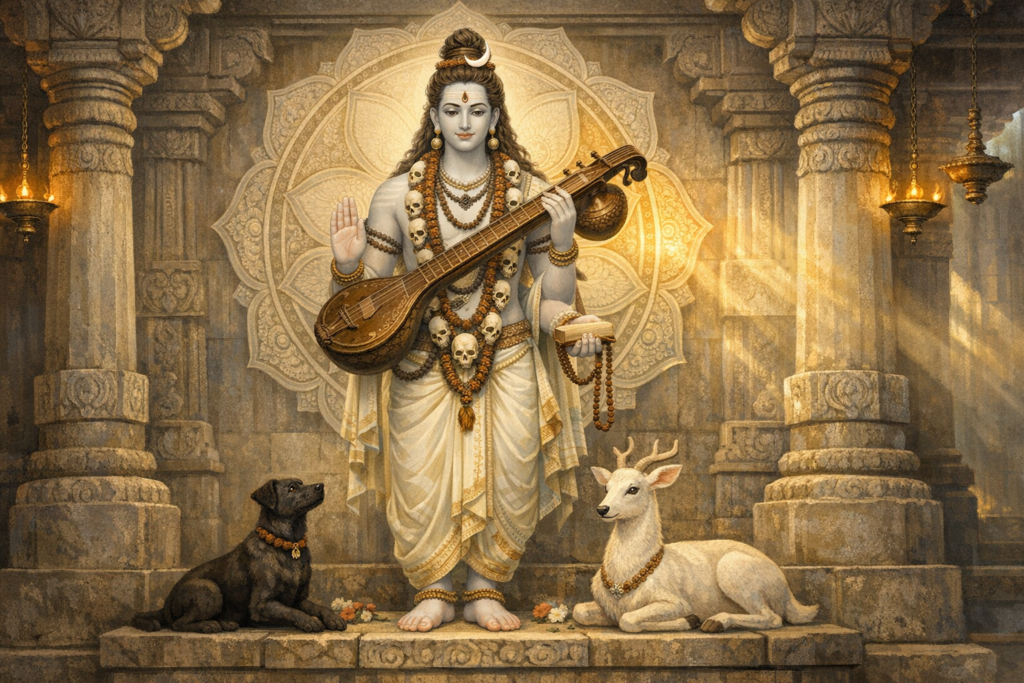
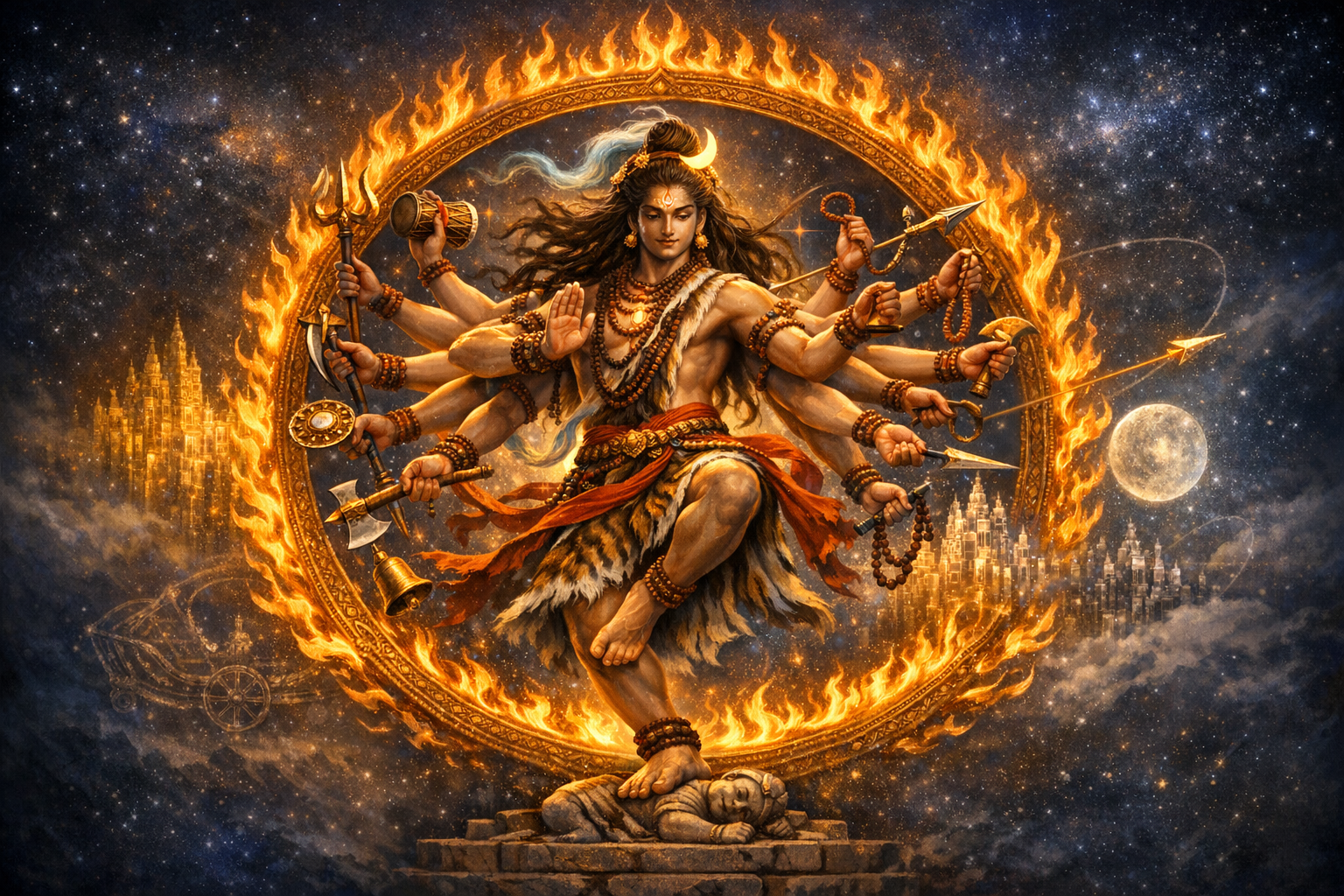
Iconographically, artists encode this concentrated, world-resolving energy as a dynamic, sometimes sixteen-armed (ṣoḍaśa-bhuja) Shiva. Regional āgamic and śilpa traditions vary, yet a consistent grammar emerges: vigorous alīḍha or pratyalīḍha stance; a flowing jaṭā-mukuṭa; the crescent moon and Gaṅgā in the locks; the vyāghra-carma (tiger-skin) across the hips; and a blazing prabhāmaṇḍala that suggests both conflagration and transcendence. The body pivots as if midway between draw and release, motion and stillness—exactly where dissolution becomes a gateway to freedom.
The sixteen-armed convention, attested in South Asian sculptural corpora, distributes Shiva’s śakti across emblematic attributes. Commonly rendered objects include triśūla (trident), ḍamaru (hourglass drum), khaḍga (sword), pāśa (noose), aṅkuśa (goad), paraśu (axe), kapāla (skull cup), akṣamālā (rosary), mṛga (deer), śakti (spear), vajra (thunderbolt), cakra (discus), and the gestures of abhaya (protection) and varada (boon). Not every depiction includes all of these, and local āgamas prescribe differing sets; however, taken together they narrate mastery over time, mind, death, and elemental forces—precisely the domains dissolved in Tripura Tandava.
Some Chola and post-Chola bronzes and stone reliefs, along with panels from temple complexes such as the Kailāsa at Ellora, illustrate Tripurāntaka with compelling movement—Shiva as archer with Parvati near, devas poised in attendance, and the burned cities implied by the encircling flames. Elsewhere, the dance predominates: weapons become rhythmic extensions of limbs; the foot presses the threshold between bondage and release, sometimes evoking Apasmāra’s subjugation as ignorance. Across media—metal, stone, and painted cloth—the visual language converges on one insight: the triad disbands when awareness remembers its own center.
Philosophically, the “three cities” are resolved in three complementary ways. First, as cosmic qualities, the guṇas settle into equilibrium at pralaya. Second, as experiential structures, the waking-dream-deep sleep cycle is transcended in turīya, the non-dual fourth. Third, as impurity-schema (mala-traya), āṇava (the sense of smallness), māyīya (the web of differentiation), and kārma (karmic accretions) are neutralized by insight and grace. Tripura Tandava compresses these domains into a single pedagogical image—dissolution as liberation.
It is sometimes said that Tripura Tandava expresses primarily tirodhāna/tirobhāva. Strictly speaking, Śaiva exegesis separates concealment from dissolution (saṁhāra). Yet in meditative praxis these acts are sequential and interpenetrating: concealment of the Real under māyā is recognized, its power withdrawn, and the now-unveiled field absorbs the differentiated back into source. The dance, performed at the liminal instant, is therefore both the end of bondage and the clearing for anugraha (grace).
Ritually, the narrative is recollected on Kartik Purnima—also called Tripurari Purnima in many regions—where lamps are set afloat and hymns to Tripurāntaka are recited. The memory of a single, unerring arrow becomes an ethical and contemplative cue: alignment matters. When knowledge, action, and devotion converge, what seemed impregnable in inner life yields effortlessly. This thematic link to Deepotsava traditions reinforces Shiva’s role as light within dissolution, not merely its agent.
Natyashastra and āgamic traditions further illuminate the dance grammar: karaṇas, maṇḍalas, and cārīs encode subtle shifts of weight and intent, allowing sculptors to translate kinetic states into stable form. In this sense, Tripura Tandava is not only narrative iconography; it is a visual sutra of yogic states, where prāṇa, manas, and buddhi are coordinated toward laya. The ḍamaru indicates time’s measure dissolving; the triśūla signifies the piercing of triple knots (granthi); the deer (mṛga) marks mastery over the flicker of mind.
Comparative reflections across dharmic traditions strengthen the inclusive horizon of this imagery. Buddhist cosmology speaks of saṃvarta-kalpas, cycles of world-dissolution and re-emanation, with impermanence (anicca) as the governing law. Jain thought articulates avasarpiṇī and utsarpiṇī—descending and ascending time-waves—where cosmic contraction and expansion recur eternally. Sikh wisdom proclaims Ik Onkar, the One from whom countless “khaṇḍ brahmaṇḍ” (realms) arise and into whom they resolve. Tripura Tandava harmonizes with these vistas by portraying dissolution not as nihilism but as return to undivided reality.
In art-historical perspective, Tripurāntaka themes appear in temple programs from the Deccan to Tamil regions—on vimānas, gopurams, and along processional corridors—often dialoguing with Ananda Tandava panels. Aesthetically, the contrast is instructive: Ananda Tandava sustains rhythm; Tripura Tandava concentrates it. Viewers in museums and temples alike frequently report a visceral pause before such images, a felt stillness beneath evident ferocity. That experiential recognition is itself a hermeneutic: the dance transmits doctrine through embodiment.
Contemplative practice can adopt the Tripura schema as an inner map. One approach visualizes the three “cities” as entrenched habits in body (sthūla), breath and emotion (sūkṣma), and deep-seated tendencies (kāraṇa). Coordinating mantra—Om Namah Shivaya—with steady exhalations, practitioners “draw the bow” of attention, release a single-pointed arrow of insight, and rest the mind where distinctions dissolve. While specific methods should follow a qualified lineage, the principle is universal: alignment precedes effortless release.
From a theological standpoint, Tripura Tandava safeguards a crucial balance. It affirms the necessity of dissolution within cyclical time (kāla) yet anchors the process in compassion: the same Lord who veils also unveils. This prevents a descent into mere iconoclasm; instead, dissolution is instructed, timed, and purposeful, clearing space for anugraha. In the lived world of devotees, this translates into ethical clarity—letting go without violence to oneself or others, and recognizing plurality in the many valid paths embraced within Sanātana Dharma.
In sum, the Tripura Tandava of Shiva fuses myth, metaphysics, ritual, and art into a single, potent semiotics of freedom. Whether encountered in Purāṇic recitation, āgamic temple iconography, or meditative visualization, it teaches that triads are pedagogical, not ultimate. When knowledge, action, and devotion align—like the cities themselves—one arrow suffices. The dance ends the many back into the One, honoring the shared insights of Hinduism, Buddhism, Jainism, and Sikhism while preserving the distinct language of each tradition.
Inspired by this post on Hindu Blog.