
Aanivara Asthanam 2026 at the Tirumala Tirupati Venkateswara Swamy Temple is scheduled to be observed at Srivari Temple on July 17, 2026, with Koil Alwar Tirumanjanam, the traditional temple-cleansing rite, scheduled on July 14, 2026. The announcement is significant not only for pilgrims planning darshan but also for anyone interested in how ancient Hindu temple institutions preserve ritual discipline, administrative continuity, and sacred accountability within a living tradition.
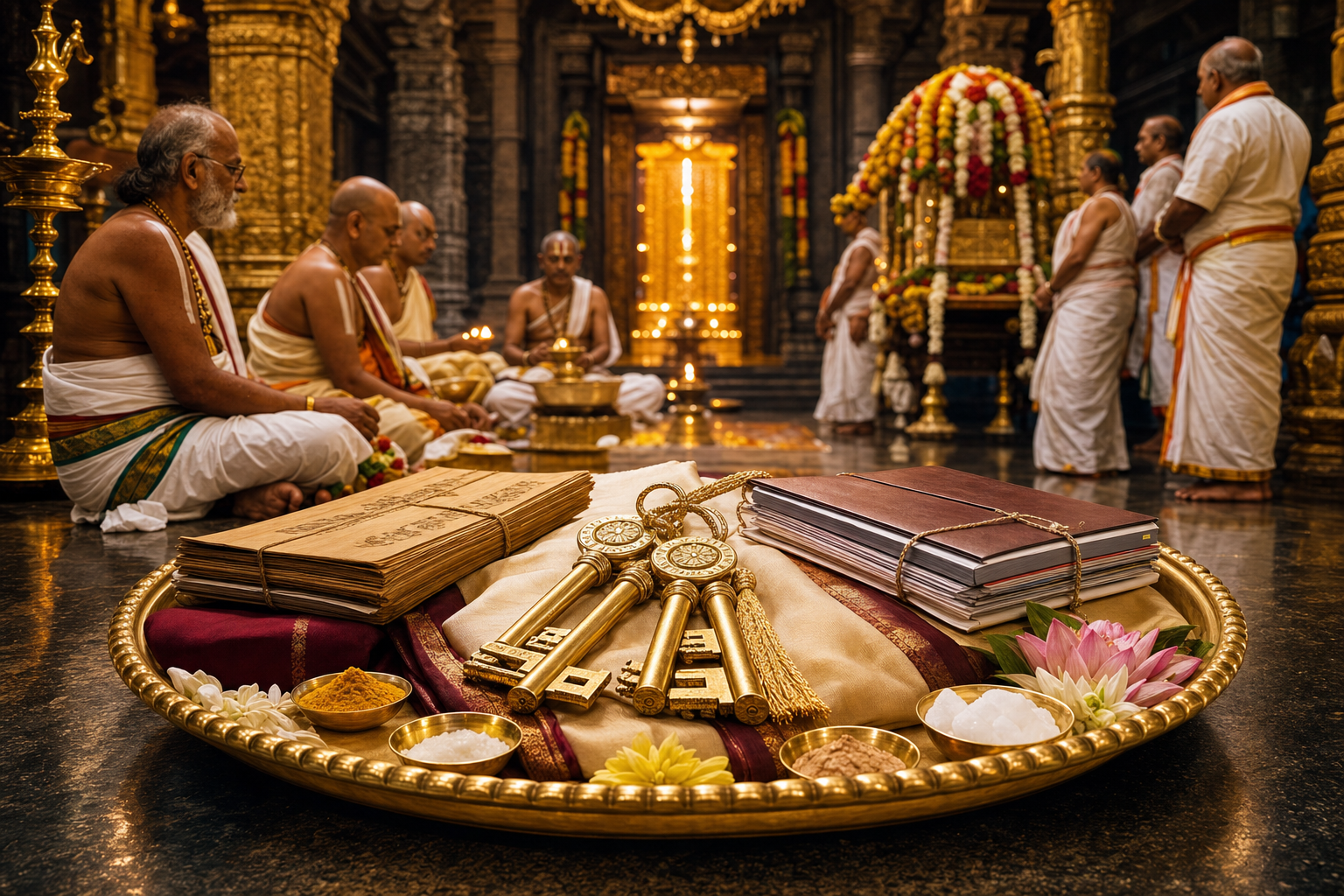
At Tirumala, Aanivara Asthanam is commonly understood as the annual accounting festival of Lord Venkateswara. The word Asthanam refers to a formal court or ceremonial assembly, while Aanivara is connected with the Tamil month of Ani. Historically, this observance came to mark the ceremonial presentation of temple accounts, keys, and administrative responsibility before Sri Venkateswara, affirming a principle that remains deeply meaningful: in a dharmic institution, wealth, authority, and service are not merely managerial matters but sacred trusts.
The 2026 schedule carries practical importance for devotees. Because Koil Alwar Tirumanjanam will be performed on July 14 and Aanivara Asthanam will be held on July 17, Tirumala Tirupati Devasthanam (TTD) has announced the cancellation of VIP Break Darshans on these two dates, except for arrangements that may apply to protocol dignitaries. Pilgrims planning travel to Tirumala during this period should therefore confirm darshan, accommodation, and seva arrangements through official TTD channels before finalizing the journey.
The deeper value of Aanivara Asthanam lies in the way it brings together ritual theology and institutional governance. In many modern settings, annual accounts are viewed as technical documents, but in the Tirumala tradition the act of presenting accounts before the deity expresses the understanding that Lord Venkateswara is the true sovereign of the temple. Human administrators serve as custodians, and the ceremonial submission of accounts becomes a religious reminder that financial stewardship must remain transparent, disciplined, and accountable to dharma.
The historical background of the festival is linked with the period when Mahants administered the affairs of the Tirumala temple. Their annual budgeting cycle is understood to have begun around the closing phase of the Tamil month Ani, which gave the observance its traditional name. After the establishment of the modern TTD framework, the financial year and formal budgeting procedures changed, yet the ritual memory of presenting accounts before Srivaru remained preserved through Aanivara Asthanam.
Such continuity is one of the most striking aspects of Tirumala. The temple does not treat history as a museum artifact; it allows inherited practices to remain active within contemporary administration. The result is a rare institutional culture where modern queues, online booking systems, crowd regulation, security protocols, and audited budgets coexist with Agamic ritual, temple procession, Jeeyar traditions, and the living devotion of millions of pilgrims.
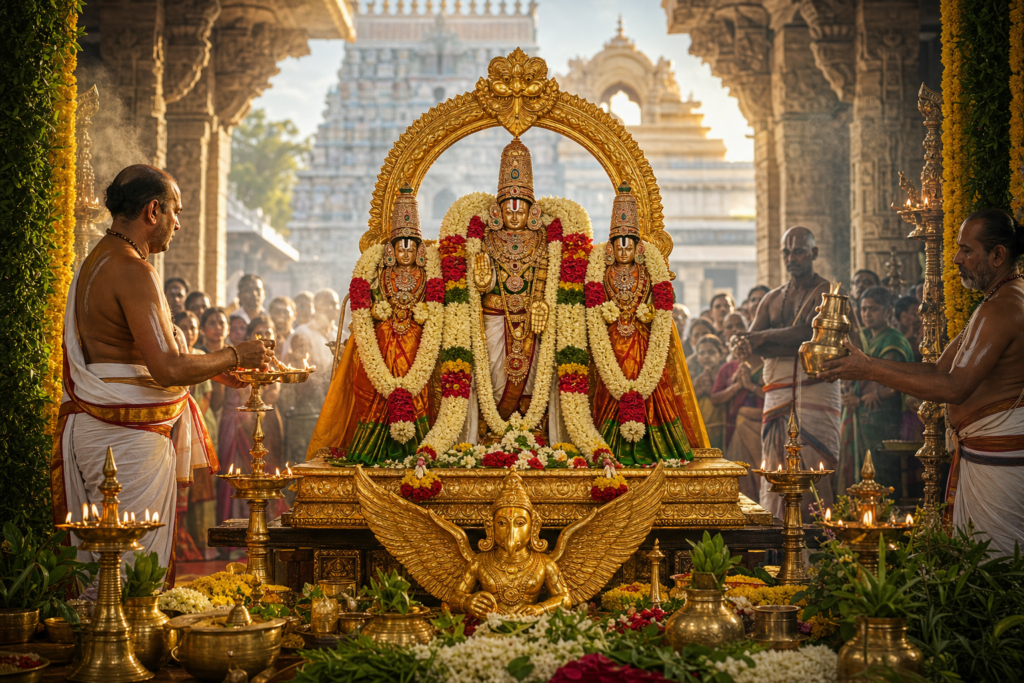
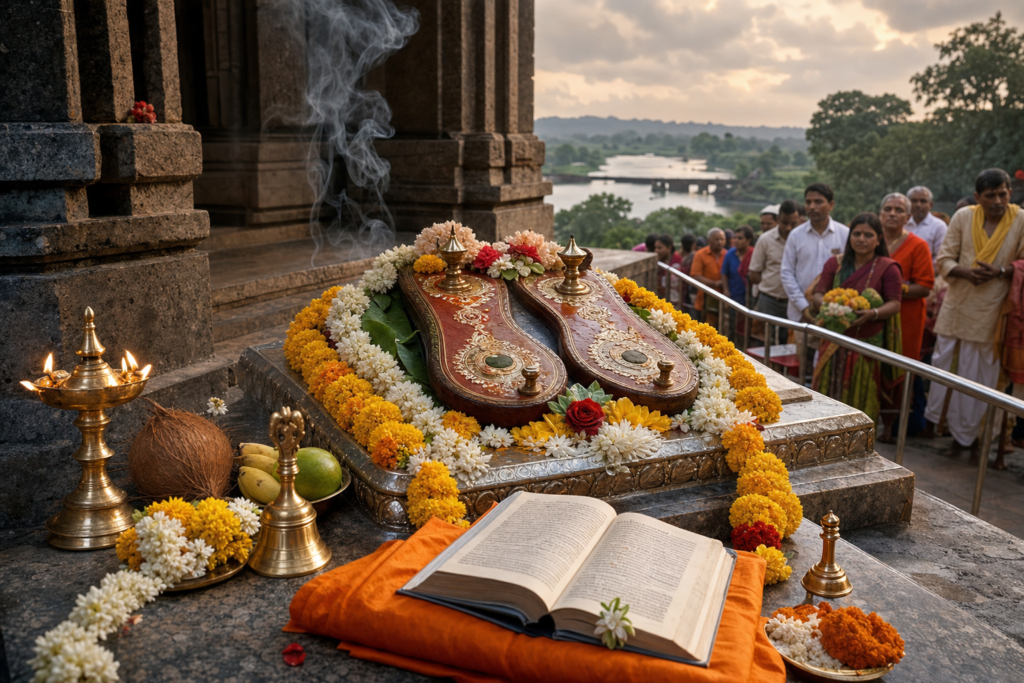
On the day of Aanivara Asthanam, the processional deities occupy a central liturgical role. Sri Malayappa Swamy, accompanied by Sridevi and Bhudevi, is ceremonially seated near the Bangaru Vakili in the Ghanta Mandapam. Sri Vishwaksena, revered in Vaishnava tradition as the commander and organizer of the divine order, is also present in the ritual arrangement. This placement is not accidental. It reflects a temple worldview in which worship, administration, protection, and order are all integrated under the presence of the divine.
The participation of the Tirumala Jeeyar Swamijis gives the observance additional theological depth. Traditionally, Sri Pedda Jeeyar Swamy presents six pattu vastrams, or silk garments. Four are offered for the presiding deity, while the remaining cloths are associated with Sri Malayappa Swamy and Sri Vishwaksena. This offering of garments is not merely decorative; it is a sign of reverence, succession, and service within the Sri Vaishnava sampradaya connected with Tirumala.
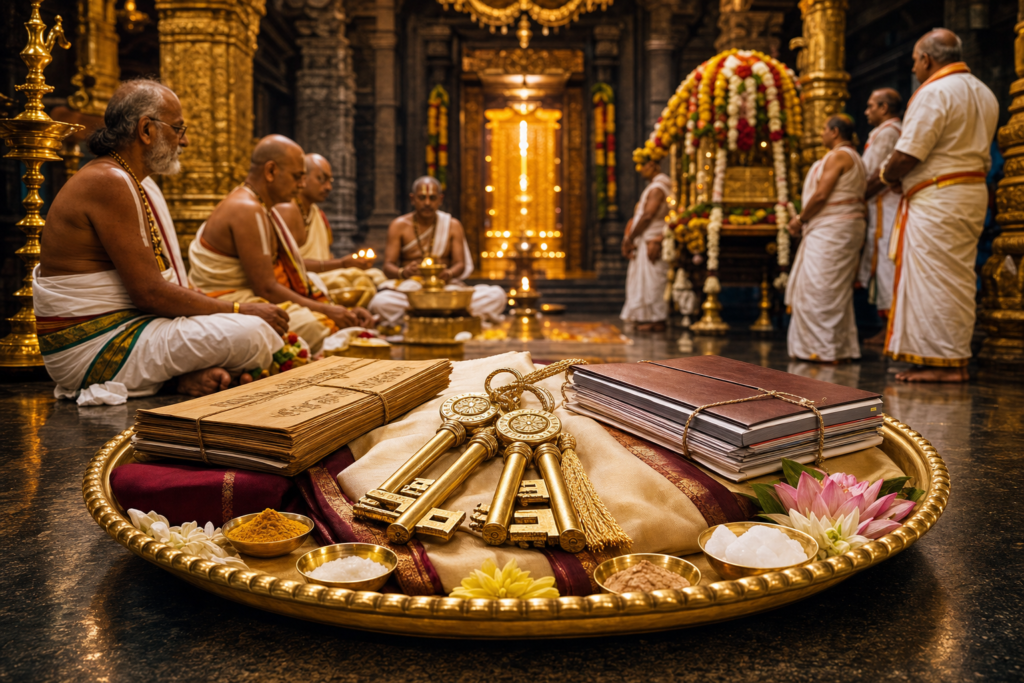
A particularly meaningful element of the festival is the handling of the temple keys, traditionally referred to as Lachana. The keys are ceremonially associated with Sri Pedda Jeeyar, Sri Chinna Jeeyar, and the TTD Executive Officer before being placed at the holy feet of Srivaru. In symbolic terms, the gesture teaches that authority over the temple’s treasury, records, and administration must ultimately be surrendered to Lord Venkateswara. The human hand may manage, but the sacred center authorizes.
Another important custom associated with the accounting festival is the opening of new books for the next accounting cycle. The older accounts are presented before the deity, and new records are ceremonially begun. This is a powerful ritual metaphor for continuity: the past is reviewed, responsibility is renewed, and the future is entered with humility. For devotees, this practice often feels relatable because every household, institution, and community must periodically examine how resources have been used and how duties must be carried forward.
Koil Alwar Tirumanjanam, scheduled for July 14, 2026, forms the ritual prelude to Aanivara Asthanam. The phrase is associated with the cleansing and sanctification of the temple interior. This ceremony is traditionally conducted several times a year before major festivals such as Ugadi, Vaikunta Ekadashi, the annual Brahmotsavams, and Aanivara Asthanam. Its purpose is both physical and sacred: the temple is cleaned, purified, and prepared as a worthy space for major worship.
During Koil Alwar Tirumanjanam, the sanctum and related areas are cleaned with great care. The deities are protected, and a fragrant mixture traditionally associated with ingredients such as sandalwood, camphor, turmeric, and other sacred substances is applied within the temple. The rite conveys a principle familiar across dharmic traditions: sacred space requires periodic renewal. Just as the mind is purified through sadhana and ethical discipline, the temple is ritually refreshed before major worship.
The cancellation of VIP Break Darshans on July 14 and July 17 should be understood in this context. These are not ordinary administrative interruptions but adjustments made to allow major rituals to proceed with discipline and dignity. Tirumala receives vast numbers of devotees, and even small changes in the schedule can affect travel plans. The advance notice allows pilgrims to approach the dates with practical awareness rather than confusion at the hill shrine.
For pilgrims, the most important practical guidance is straightforward. Those planning to visit Tirumala around July 14 and July 17, 2026 should review darshan availability, seva status, accommodation bookings, and transport schedules in advance. Devotees relying on VIP Break Darshan recommendations should not assume acceptance on these dates. Pilgrims with elderly family members, children, or fixed return travel should build additional flexibility into the itinerary.
Aanivara Asthanam also reveals the unique public character of the Tirumala temple. It is a major pilgrimage center, a historic Vaishnava shrine, a large religious institution, and a cultural anchor for devotees across India and the diaspora. The observance of an accounting festival at such a temple reminds society that dharma is not limited to prayer alone. It includes order, duty, transparency, stewardship, and the responsible use of resources offered by devotees.
This connection between devotion and accountability is especially relevant in contemporary religious life. Temples are often centers of worship, education, charity, food distribution, cultural memory, and community organization. When temple accounts are ritually placed before the deity, the act reinforces the idea that offerings belong to sacred service. The symbolic message is simple but profound: material resources gain spiritual value when they are administered with integrity.
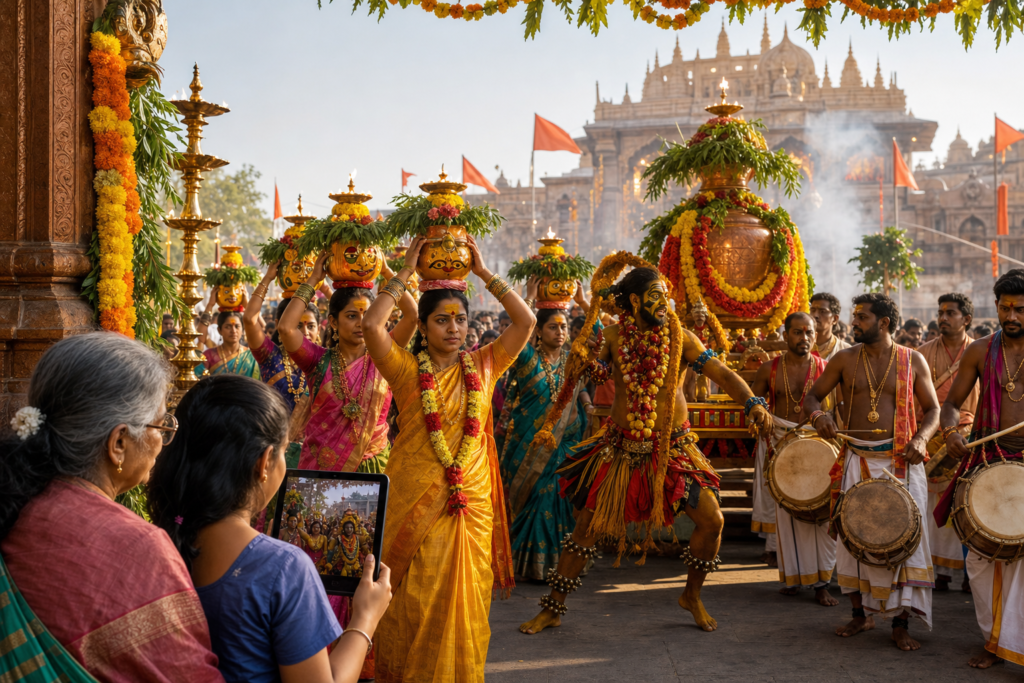
The evening Pushpa Pallaki procession traditionally associated with Aanivara Asthanam adds a more visibly devotional dimension to the day. Sri Malayappa Swamy, along with Sridevi and Bhudevi, is taken in procession in a flower-decorated palanquin through the temple streets. For devotees gathered in Tirumala, this procession is often the emotional culmination of the festival, where ritual order inside the temple expands into shared devotional experience outside it.
The festival also illustrates the inclusive strength of dharmic traditions. Hindu, Buddhist, Jain, and Sikh traditions each preserve, in different ways, the value of discipline, community service, ethical conduct, and reverence for sacred institutions. Aanivara Asthanam belongs specifically to the Sri Vaishnava and Tirumala ritual world, yet its larger lesson resonates across dharmic life: devotion must be joined with responsibility, and spiritual institutions must remain rooted in both sanctity and accountability.
For many devotees, Tirumala is not experienced only as a place of individual petition but as a civilizational space. The sound of Vedic recitation, the discipline of queues, the sight of temple servants performing inherited duties, and the continuing presence of rituals such as Koil Alwar Tirumanjanam and Aanivara Asthanam create a sense of continuity that extends beyond one lifetime. The pilgrim enters a stream of worship that has been shaped by generations.
From an academic perspective, Aanivara Asthanam may be read as a ritualized form of institutional legitimacy. The temple’s officers do not merely hold office by administrative appointment; their roles are ritually situated before the deity. The presentation and return of accounts, the handling of keys, the honoring of Jeeyar traditions, and the opening of new records together create a sacred grammar of governance. In this grammar, the divine is not symbolic decoration but the central authority before whom human service is measured.
From a devotional perspective, the same festival can be understood more simply. Lord Venkateswara is treated as the head of the temple household, and all accounts are placed before Him. This makes the festival deeply accessible even to those unfamiliar with technical Agamic details. Every family understands the seriousness of reviewing accounts, safeguarding keys, preparing for the next year, and seeking blessings before beginning a new phase of responsibility.
The 2026 observance therefore deserves attention for both spiritual and practical reasons. Spiritually, it reaffirms the sacred sovereignty of Sri Venkateswara over the institution that serves Him. Culturally, it preserves a historical memory from the administrative past of Tirumala. Practically, it affects darshan planning, especially because VIP Break Darshans are cancelled on July 14 and July 17 in connection with Koil Alwar Tirumanjanam and Aanivara Asthanam.
Devotees who approach the festival with this fuller understanding are likely to see more than a schedule change. The cancellation of certain darshan categories, the cleaning of the temple, the presentation of accounts, the offering of silk garments, the ceremonial keys, and the Pushpa Pallaki procession all belong to one integrated religious vision. The temple is cleansed, the accounts are placed before the Lord, service is renewed, and the community is reminded that dharma must be lived through both worship and responsibility.
In that sense, Aanivara Asthanam 2026 is not merely an annual Tirumala event. It is a public lesson in sacred administration, a devotional celebration of Lord Venkateswara, and a reminder that the strongest religious institutions endure by joining faith with order. For pilgrims, July 14 and July 17, 2026 should be marked carefully. For students of Hindu tradition, the festival offers a compelling example of how ritual, history, finance, governance, and bhakti can exist within a single sacred framework.
Sources consulted include the HinduPad source article at https://hindupad.com/aanivara-asthanam-2015/ and current reporting on Koil Alwar Tirumanjanam and TTD darshan advisories from Times of India at https://timesofindia.indiatimes.com/city/vijayawada/koil-alwar-tirumanjanam-held-ahead-of-ugadi-at-tirumala/articleshow/129638043.cms and https://timesofindia.indiatimes.com/city/vijayawada/ttd-cancels-vip-break-darshan-at-tirumala-on-march-17-and-19-for-ugadi-festivities/articleshow/129578362.cms. Devotees should verify final arrangements through official TTD communication before travel.
Inspired by this post on Hindu Pad.







Leave a Reply
You must be logged in to post a comment.