
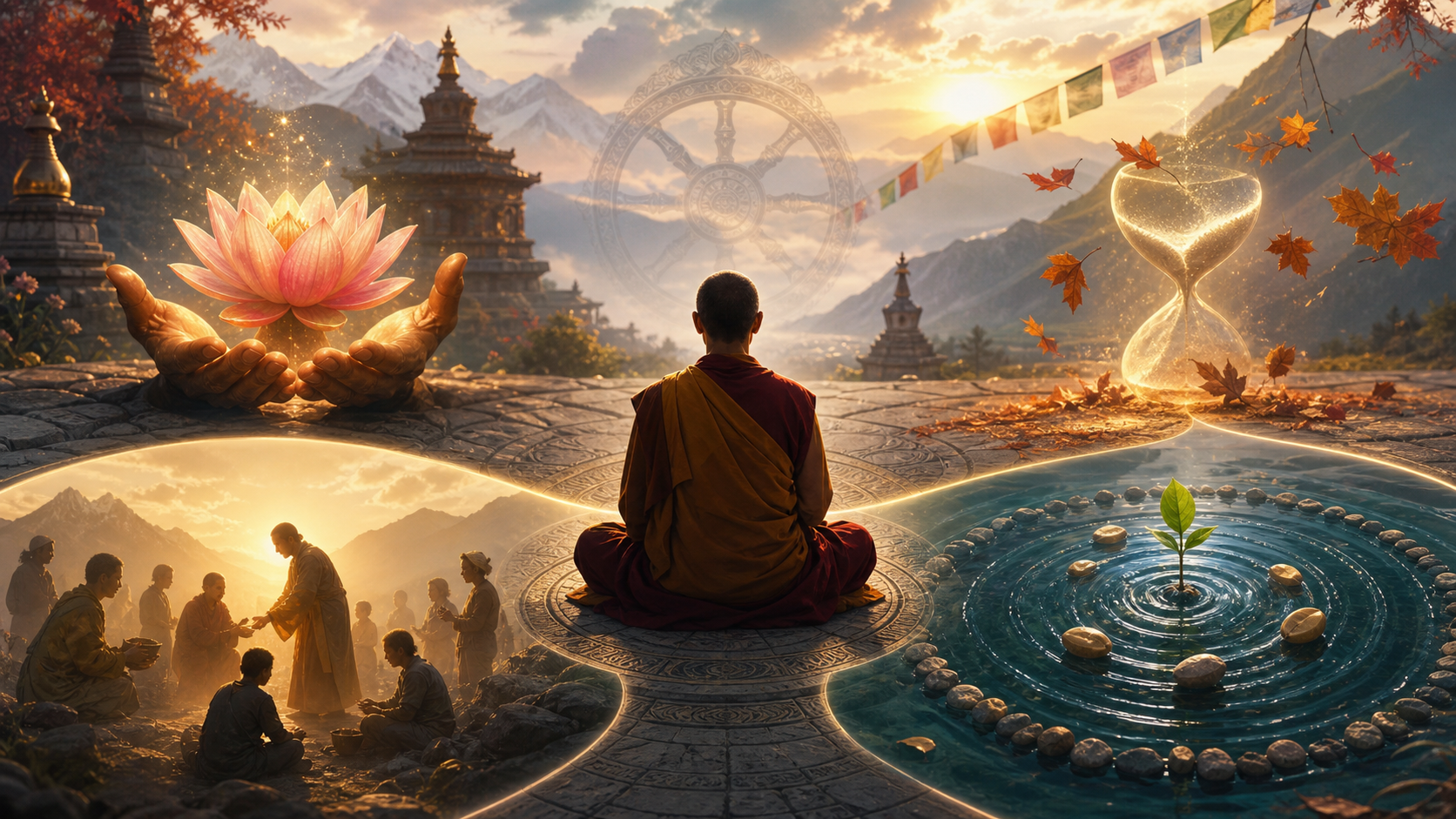
Four Thoughts That Turn the Mind Toward Dharma
The four thoughts that turn the mind toward Dharma form one of the most disciplined and practical foundations of Buddhist spirituality. They are not abstract religious ideas meant for occasional reflection, nor are they merely devotional themes belonging to one school or lineage. They are a systematic training in perception: a way of seeing human life, impermanence, suffering, and karma with enough clarity that spiritual practice becomes necessary rather than ornamental. In the ngöndro tradition, these contemplations prepare the mind for deeper practice by confronting the practitioner with the most basic facts of existence and the most urgent responsibilities of inner transformation.
Their relevance extends beyond sectarian boundaries. Across dharmic traditions, the same essential concern appears again and again: human life is rare, time is uncertain, actions carry consequences, and liberation requires disciplined insight rather than passive belief. Hindu, Buddhist, Jain, and Sikh traditions differ in metaphysical language and practice methods, yet each honors the need for ethical self-mastery, compassion, detachment, and awakening from habitual ignorance. The four thoughts therefore offer a shared spiritual grammar for anyone seeking a life shaped by Dharma, inner responsibility, and freedom from suffering.
When Does Human Birth Become Truly Precious?
A human birth is often called precious, but in the ngöndro teachings this preciousness is not based on intelligence, status, education, comfort, or biological superiority. It is not enough simply to be human. The value of human life rests in the rare opportunity to recognize suffering, examine its causes, and consciously enter the path of Dharma. A life becomes precious when it is used for awakening. Without that use, even the most comfortable life remains spiritually incomplete.
This distinction is important because every being naturally clings to life. Humans value life, animals value life, and all sentient beings resist pain and seek some form of safety. Yet Dharma does not call human life precious merely because it is cherished by the one who possesses it. Preciousness arises when life becomes an instrument of liberation. The opportunity must be applied, not merely admired. If a practitioner encounters teachings but does not use them to reduce attachment, confusion, aggression, pride, fear, and self-deception, the opportunity remains unused, like a fertile field left uncultivated.
The same principle applies when practice begins but remains unfinished. A person may feel inspired, take up meditation, study scriptures, receive instructions, and enter a spiritual community. Yet when the first plateau appears, the mind may become discouraged. The early enthusiasm fades, the practice no longer feels dramatic, and ordinary distractions regain their authority. This is a familiar experience in spiritual life. Progress often begins with hope, but it matures only through steadiness. A precious human birth is not proven by an inspiring beginning; it is proven by sustained transformation.
The deeper test is internal. Outwardly, the practitioner may appear unchanged. The same name, body, occupation, relationships, and social identity may continue. Inwardly, however, there should be a growing intimacy with the mind. The mind should become less foreign, less frightening, and less blindly followed. Thoughts and emotions should be recognized as workable phenomena rather than absolute commands. This is the beginning of genuine spiritual knowledge. Academic learning, professional expertise, and worldly skill may be valuable, but they do not automatically teach a person how to sit with fear, anger, jealousy, craving, loneliness, or mortality. Dharma becomes precious precisely because it trains the mind at that level.
In this sense, the responsibility for making life precious cannot be outsourced. A teacher may guide, a lineage may preserve methods, scriptures may illuminate the path, and a community may offer support. Yet the work must take place within the practitioner’s own mindstream. The measure is not how much spiritual language one knows, how many retreats one attends, or how strongly one identifies as a practitioner. The measure is whether the mind becomes clearer, kinder, less enslaved by grasping, and more capable of remaining with reality as it is.
The phrase töpa bor chok ma points toward the most complete meaning of a precious human birth: making this birth the last birth in samsara. Even when understood in a broad contemplative sense, the phrase carries immense weight. Human life becomes precious when it is directed toward final release from the cycle of confusion and suffering. Until that work is complete, preciousness remains a possibility rather than an achievement. The contemplation therefore produces humility. It does not allow easy self-congratulation. It asks whether life is actually being used for liberation.
Impermanence And Death As Personal Realities
The second thought turns the mind toward impermanence and death. This contemplation is often misunderstood as pessimistic, but its purpose is not morbidity. It is a discipline of honesty. Human beings know intellectually that death is certain, yet they usually live emotionally as if death belongs to others. News of illness, accident, violence, aging, and loss may be everywhere, but the ordinary mind quietly maintains the fantasy of exemption. The practitioner is asked to break through that fantasy.
Impermanence becomes spiritually powerful only when it becomes personal. It is not enough to observe that people die, civilizations change, relationships shift, bodies age, and possessions decay. The question is sharper: when will impermanence and death come to this very life? Will death come this year, this month, this week, tomorrow, this afternoon, or now? Such reflection is not intended to create panic. It is intended to expose procrastination. If death is possible at any time, then Dharma cannot be treated as a hobby postponed until the conditions are convenient.
Modern life makes this contemplation both difficult and necessary. Comfort, entertainment, productivity culture, and constant digital stimulation can hide the fragility of existence. A person may spend years managing schedules, opinions, possessions, and ambitions while rarely asking whether the mind is prepared to release them. The contemplation of death interrupts this sleep. It asks what kind of confidence would be needed if everything familiar had to be relinquished without negotiation. It asks whether attachments have been examined before they become sources of terror at the end of life.
Attachment is not the same as love. This distinction is central to mature Dharma practice and equally important across dharmic ethics. To become free of attachment does not require becoming cold, indifferent, or emotionally absent. It means relating without possessiveness. It means loving family, friends, teachers, students, community, body, and world without demanding that they remain permanently available to the ego’s need for security. When attachment is unprocessed, death feels like violent separation. When attachment is understood, love can remain spacious, grateful, and free from panic.
The contemplation of impermanence therefore becomes a compassionate discipline. It helps practitioners identify the places where clinging still swells up: children, spouse, reputation, home, body, career, beliefs, routines, and even spiritual identity. Each attachment can be studied without hatred and released without rejecting the object itself. This is a subtle point. Dharma does not ask one to sever wholesome relationships. It asks one to stop turning relationships into extensions of self-grasping. The result is not less care, but cleaner care.
Patrul Rinpoche’s assurance that “Nothing” is lost forever can be understood as a profound antidote to despair. In the dream-like movement of life, forms appear, dissolve, and reappear according to causes and conditions. The practitioner does not deny grief, but learns not to be crushed by the belief that love is annihilated when form changes. From this perspective, the end of one lifetime resembles the end of one day and the beginning of another. This does not make death trivial; it makes preparation meaningful.
In Words of My Perfect Teacher, contemplation of impermanence and death is presented as a gateway into Dharma. It gives urgency to practice, but also gives direction. A practitioner begins to understand that spiritual work is realized inside the mind, not in outer performance alone. Death strips away appearances. What remains is the quality of one’s mind, the force of karma, and the depth of realization cultivated through practice. This is why denial may comfort the ordinary mind, but it weakens the practitioner. Clear seeing is the protection.
Samsara And The Birth Of Compassionate Purpose
The third thought contemplates samsara, the cycle of conditioned existence marked by dissatisfaction, instability, and suffering. This contemplation widens the field of concern. After recognizing the preciousness of human life and the certainty of death, the practitioner turns outward and inward to the vast condition of sentient beings. Samsara is not merely a philosophical doctrine. It is visible in anxiety, illness, violence, hunger, loneliness, exploitation, grief, ecological harm, conflict, and the endless restlessness of beings seeking happiness in unstable conditions.
The contemplation is especially demanding because comfort can easily distort perception. If one’s own life is temporarily stable, it is tempting to assume that existence is manageable or even satisfactory. Yet somewhere else, someone equally sensitive is facing war, famine, displacement, disease, poverty, fear, or abandonment. The suffering of the human realm alone is immense. When the suffering of animals is included, the heart is asked to stretch further. Domesticated animals, farmed animals, hunted animals, abandoned animals, and countless beings unseen by human society endure fear and pain continuously. Traditional Buddhist cosmology also speaks of preta and hell realms, further expanding the scale of suffering beyond ordinary perception.
The point is not to become overwhelmed. The point is to allow compassion to mature beyond sentiment. A mind that reflects deeply on samsara becomes too large to be satisfied with private liberation alone. If all beings seek happiness and fear pain, then spiritual practice cannot remain self-enclosed. The suffering of others becomes relevant to one’s own path. This is the foundation of bodhicitta in the Mahayana tradition: the aspiration to attain awakening for the benefit of all sentient beings.
Gyalsé Ngulchu Tokmé expressed this moral tension with striking clarity: “Thinking of all the mother sentient beings who are suffering in samsara and then thinking about just your own liberation seems very odd.” The statement challenges any spiritual path that becomes refined self-interest. Even liberation, if imagined as a private escape, remains incomplete for those moved by the bodhicitta disposition. Compassion does not weaken the pursuit of liberation; it deepens it. It gives practice a purpose larger than self-improvement.
This insight resonates across dharmic traditions. In Hindu thought, the ideal of loka-sangraha emphasizes action for the welfare and cohesion of the world. In Jain dharma, ahimsa extends moral concern to all living beings with extraordinary rigor. In Sikh tradition, seva and sarbat da bhala express service and goodwill for all. In Buddhism, compassion and wisdom are inseparable. These traditions do not collapse into one another, but they converge in a shared ethical intuition: spiritual maturity must reduce harm and expand care.
The story of Asanga illustrates the transformative force of compassion. After years of solitary retreat without the expected vision of Maitreya, Asanga’s breakthrough came through an intense moment of compassion. What prolonged ascetic effort did not accomplish by itself was completed when the heart opened. The story is not an argument against discipline; it is a warning against discipline without tenderness. Obscurations are not purified by technique alone. The heart must be softened, widened, and made responsive to suffering.
For Vajrayana practitioners, this point is especially consequential. Without purification of obscurations, the world of Akanishtha remains hidden, and higher practice becomes vulnerable to egoic fascination. A practitioner may be attracted to advanced language, ritual complexity, and esoteric symbolism while still lacking the compassion that makes such practices fruitful. The contemplation of samsara restores proportion. It reminds the practitioner that spiritual power without compassion is incomplete, and spiritual knowledge without concern for sentient beings does not fulfill the purpose of Dharma.
Karma Must Be Guarded Like The Eyes
The fourth thought concerns karma, the lawfulness of action and consequence. To observe karma as one protects the eyes is a vivid instruction. The eyes are guarded instinctively because injury to them changes one’s whole relationship with the world. In the same way, ethical care protects the practitioner’s future experience, mental clarity, spiritual confidence, and capacity to benefit others. Karma is not presented as fatalism. It is a precise teaching on responsibility: actions of body, speech, and mind leave traces and shape experience.
This contemplation makes Dharma concrete. Without karma, spiritual life can drift into abstraction. With karma, every moment matters. Speech matters. Intention matters. Anger matters. Generosity matters. Resentment, deceit, envy, arrogance, and cruelty matter. So do patience, truthfulness, humility, restraint, compassion, and courage. The practitioner learns to treat small actions seriously because character is built through repetition. A single action may appear minor, but repeated patterns become tendencies, and tendencies become the architecture of future suffering or freedom.
Guarding karma also protects integrity. Many practitioners become interested in advanced practice before developing a stable ethical foundation. This creates insecurity later. When the mind has not been trained through the four thoughts, higher practices may not produce the expected transformation. Doubt then arises: perhaps the practice failed, the teacher failed, the lineage failed, or the community failed. Sometimes external problems do exist and must be addressed with clarity. Yet the deeper question remains unavoidable: was the foundation properly built?
A solid foundation allows spiritual fruit to ripen without constant second-guessing. The four thoughts build that foundation by disciplining the practitioner’s relationship with life, time, suffering, and action. Precious human birth gives gratitude and responsibility. Impermanence gives urgency and detachment. Samsara gives compassion and vast purpose. Karma gives ethical precision. Together, they prevent Dharma from becoming mere identity, culture, philosophy, or emotional comfort. They make it a path of transformation.
In practical terms, this means daily life becomes the field of practice. The practitioner studies irritation in conversation, grasping in relationships, pride in achievement, fear in uncertainty, laziness in routine, and compassion in the presence of suffering. The point is not to manufacture a spiritual personality. The point is to become honest enough to see causes and conditions as they arise. Such honesty is demanding, but it is also liberating. When karma is understood, life becomes workable.
Why These Four Thoughts Remain Essential
The four thoughts are sometimes treated as preliminary teachings, but “preliminary” should not be mistaken for elementary or expendable. They are preliminary in the sense that foundations are preliminary to a temple: without them, whatever is built later lacks stability. Advanced meditation, mantra, ritual, philosophical study, and retreat practice all require a mind already softened by impermanence, humbled by karma, expanded by compassion, and grateful for the rare chance to practice.
Their psychological sophistication is considerable. They confront denial, distraction, narcissism, despair, moral carelessness, and spiritual ambition. They also cultivate resilience. A person who has contemplated death is less likely to waste life casually. A person who has contemplated samsara is less likely to reduce spirituality to private comfort. A person who has contemplated karma is less likely to excuse harmful conduct. A person who has contemplated precious human birth is more likely to use favorable circumstances wisely.
The contemplations also offer a corrective to modern spiritual consumerism. Many seekers want practices that feel elevated, calming, or empowering, but may resist the disciplines that expose self-deception. The four thoughts do not flatter the ego. They ask whether life is being wasted, whether death has been faced, whether suffering has opened the heart, and whether conduct is being purified. This directness is precisely why they remain powerful. They do not merely comfort the mind; they re-educate it.
For a blog committed to unity among dharmic traditions, these teachings can be received as a bridge rather than a boundary. The vocabulary here is Buddhist, and the setting is ngöndro, but the ethical and contemplative concerns are widely dharmic. Human life must be used well. Death must be remembered. Suffering must awaken compassion. Action must be purified. These principles support mutual respect among Hinduism, Buddhism, Jainism, and Sikhism because they point toward shared disciplines of self-transformation and responsibility.
Ultimately, the four thoughts turn the mind toward Dharma by turning it away from carelessness. They do not reject the world, but they challenge the illusion that ordinary habits can deliver lasting peace. They do not deny love, but they purify love of possessiveness. They do not deny suffering, but they convert suffering into compassion. They do not deny individuality, but they place it within a larger field of karma, interdependence, and liberation. When contemplated deeply and repeatedly, they make spiritual practice urgent, intelligent, and humane.
The path begins when these reflections stop being ideas and become living questions. Is this human life being used well? Is the mind prepared for impermanence? Has the suffering of beings become real enough to awaken compassion? Are actions being guarded with the care given to one’s own eyes? Where these questions are taken seriously, Dharma ceases to be distant. It becomes the discipline of each day, the purification of each intention, and the gradual transformation of the mind toward wisdom and freedom.
Inspired by this post on Mangala Shribhuti.




Leave a Reply
You must be logged in to post a comment.