
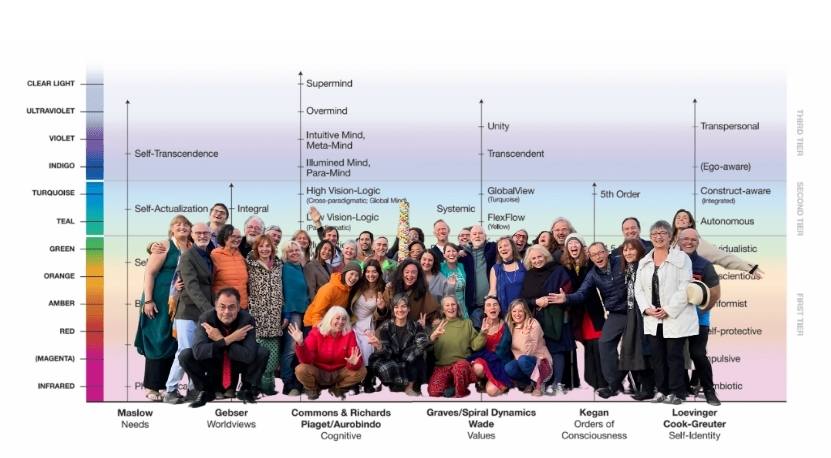
Spiritual awakening has never been a fixed historical object that can be preserved unchanged from one century to another. The disciplines of meditation, ethics, devotion, inquiry, and service remain timeless, yet the human context in which they are practiced continues to evolve. A seeker living in the 4th century, a practitioner shaped by the 19th century, and a contemporary person navigating digital overload, ecological anxiety, social fragmentation, and global interdependence do not face identical conditions. For this reason, a 21st-century awakening requires both fidelity to Dharma and an intelligent response to the modern world.
Integral Evolution offers one such response. It is not a rejection of older wisdom, nor is it a fashionable attempt to replace meditation with intellectual theory. It is better understood as a disciplined framework for bringing together spiritual realization, psychological maturity, ethical responsibility, cultural awareness, and systemic intelligence. In this sense, Integral Spirituality becomes a bridge: it honors ancient paths of awakening while asking whether inner transformation is actually visible in conduct, community, institutions, and service.
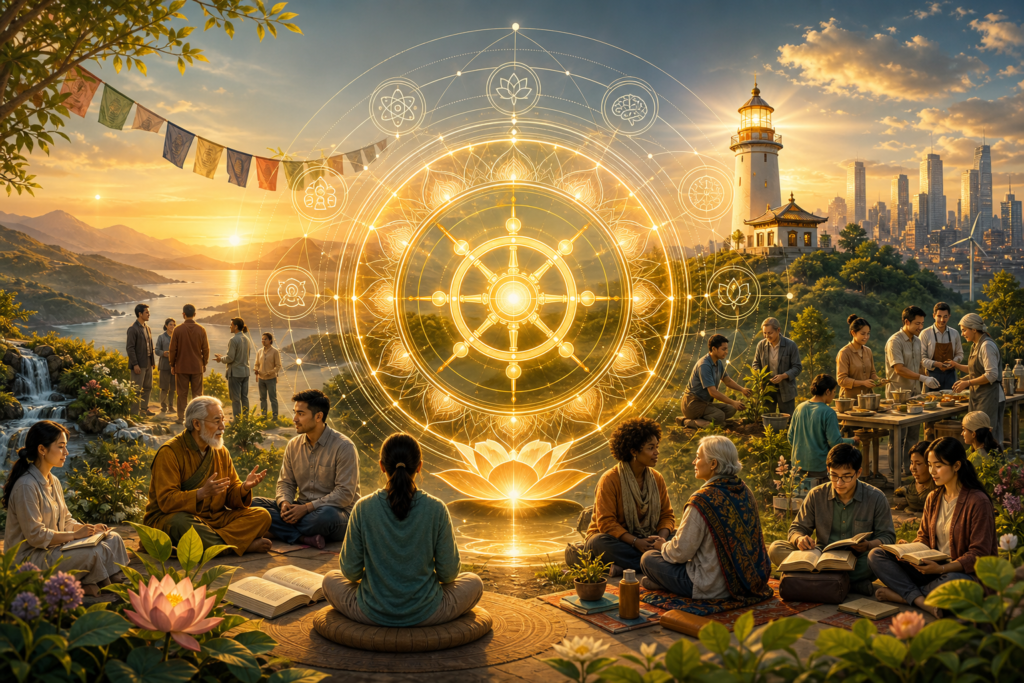
This approach has particular relevance for Dharmic traditions, including Hinduism, Buddhism, Jainism, and Sikhism. These traditions differ in metaphysics, ritual, vocabulary, lineage, and discipline, yet they also share deep concerns: liberation from ignorance, the purification of conduct, reverence for truth, disciplined practice, compassion, self-mastery, and the alignment of personal life with a larger moral order. Integral Evolution can therefore be read as a contemporary mandala in which many Dharmic insights are placed in constructive dialogue rather than competition.

Catherine Pawasarat Sensei’s reflections on Integral Evolution emerge from this need for a contemporary path. Her teaching draws attention to a basic but often uncomfortable fact: meditation alone does not automatically produce mature, compassionate, socially responsible human beings. A person may have refined states of concentration and still remain emotionally reactive, relationally immature, ethically confused, or unaware of social and ecological consequences. This is not an argument against meditation. It is an argument for a fuller understanding of what awakening demands.
Qapel, Acharya Doug Duncan, began teaching Integral Spirituality as early as the 1990s and later framed it as a necessary development for contemporary Dharma. Before his death in 2024, he described the movement beyond a merely sectarian religious identity toward Integral Evolution. He situated this as a fifth turning of the wheel of Dharma after Theravada, Mahayana, Yogācāra, and Vajryayana: a movement toward an Integral approach able to read the conditions of the present age. The point is not to erase lineage, but to ask how lineage can function with greater clarity in a changing world.
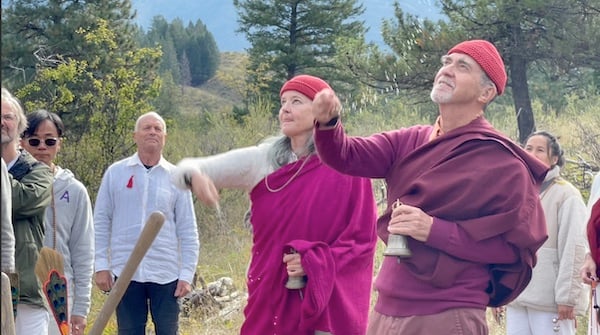
Integral living begins with evolution. The word should not be reduced to biological change or social progress in a simplistic sense. Here it points to the courageous unfolding of human potential across many dimensions: contemplative depth, moral discernment, emotional integration, intellectual rigor, relational skill, aesthetic sensitivity, ecological awareness, and practical responsibility. It recognizes that human development is uneven. A person may be brilliant in analysis but underdeveloped in empathy. A community may be rich in devotion but weak in governance. A spiritual institution may preserve sacred practice yet fail to address shadow, power, or accountability.
The strength of Integral Spirituality lies in its refusal to romanticize either the past or the present. It draws from science, developmental psychology, contemplative traditions, cultural studies, business, aesthetics, ethics, and embodied practice. At the same time, it admits its own incompleteness. This humility is essential. Any map of human growth is still a map, not the territory. The danger of every framework is that it can become an ideology. Integral Evolution remains useful only when it supports direct experience, clearer conduct, and compassionate action.

A vivid example helps explain why this framework matters. In the early 2000s, during a teaching in Berkeley, California, a student who had practiced Buddhism for decades asked why awakening had not yet occurred. The question was simple, direct, and deeply human. Many serious seekers know this tension. They have attended retreats, read scriptures, practiced meditation, served communities, and still sense that something central remains untransformed. The question is not merely personal disappointment; it is a diagnostic question for modern spirituality.
Qapel’s response pointed to a common pattern. Spiritual practice can become a way of improving the life the ego already wants, rather than a path of surrender into freedom. Meditation may reduce stress, soften suffering, add meaning, and make life more manageable. These benefits are real and valuable. Yet if practice merely decorates self-centered life, it does not release the deeper structures of grasping. Without renunciation, genuine surrender, and the willingness to let go of ego attachments, spiritual methods can remain therapeutic enhancements rather than vehicles of awakening.

This observation is not limited to Buddhism. Hindu yoga, Jain austerity, Sikh seva, and many forms of devotional practice can also be used either as transformative disciplines or as identity markers. A mantra may purify consciousness, but it can also become a badge of superiority. A temple, vihara, gurdwara, or community hall may cultivate humility, but it can also become a site of pride. Integral Evolution asks whether the fruit of practice is visible in reduced selfishness, greater clarity, and more skillful participation in the world.
The Bodhisattva ideal gives this inquiry a powerful ethical frame. Awakening is not merely an interior achievement. Its purpose is the alleviation of suffering and the liberation of beings. In the broader Dharmic family, this resonates with lokasangraha in the Bhagavad Gita, the Jain commitment to ahimsa, and the Sikh ideal of selfless service. Liberation and responsibility are not enemies. The more deeply one sees interdependence, the less plausible it becomes to treat spiritual realization as private possession.
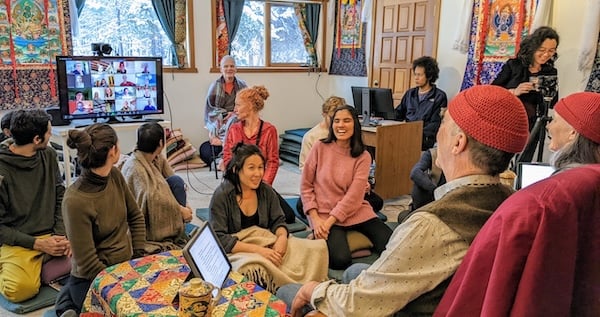
Integral Spirituality therefore challenges the artificial separation between the spiritual and the material. Namgyal Rinpoche’s teaching that there is no ultimate division between spiritual and material life captures this insight with precision. If consciousness expresses itself through speech, economics, ecology, governance, family, technology, and culture, then spiritual practice cannot be confined to the cushion. The marketplace, kitchen, classroom, office, village, city, forest, and digital public square all become fields of practice.
The planetary context makes this integration urgent. Climate change, social polarization, loneliness, technological acceleration, violence, ecological degradation, and institutional mistrust are not abstract problems. They shape nervous systems, families, communities, and spiritual life. A path that produces calm individuals but leaves collective systems untouched is incomplete. Conversely, activism without inner discipline easily becomes reactive, ideological, or exhausted. Integral Evolution seeks a union of inner transformation and outer responsibility.

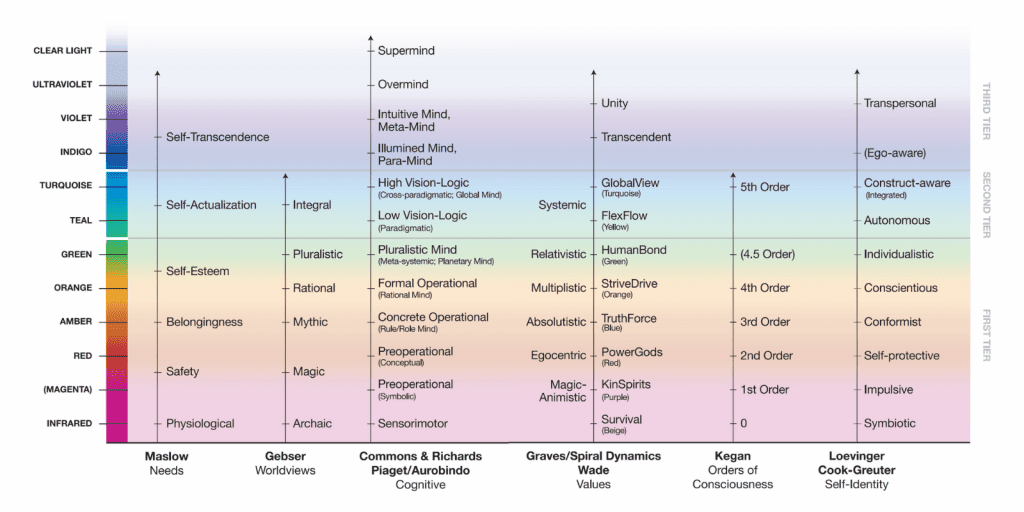
One of the best-known Integral formulations is the movement through waking up, growing up, cleaning up, showing up, opening up, and learning through failure. These terms are accessible, but they describe sophisticated developmental tasks. Waking up refers to direct spiritual insight: the movement from identification with surface experience toward deeper awareness. Through meditation, contemplation, mantra, prayer, inquiry, and disciplined attention, the practitioner encounters states of consciousness that reveal the limitations of ordinary egoic perception.
Yet waking up is not enough. Growing up concerns developmental maturity. Human beings grow through stages in cognition, morality, identity, values, faith, emotional regulation, and worldview. A person may have profound meditative experiences and still interpret them through immature psychological structures. This explains why spiritual communities sometimes witness contradiction: teachers or practitioners may speak beautifully about emptiness, Brahman, compassion, or nonviolence while behaving defensively, manipulatively, or irresponsibly. Integral analysis does not dismiss the spiritual insight; it asks whether development has kept pace with it.
Cleaning up refers to shadow integration. The shadow includes unexamined wounds, denied impulses, inherited patterns, unresolved shame, fear, anger, and the subtle strategies through which the ego protects itself. Every Dharmic discipline recognizes some version of this work, whether through klesha theory, samskara analysis, karma, confession, pratikraman, seva, tapas, or self-inquiry. Integral language gives modern practitioners a psychological vocabulary for an ancient task: the purification of obscurations that distort perception and conduct.
Showing up and opening up bring awakening into relationship and world participation. Spiritual insight must appear in how one listens, disagrees, serves, leads, repairs harm, handles money, uses technology, treats the vulnerable, and responds to criticism. Opening up also includes the recognition of multiple intelligences: cognitive, emotional, kinesthetic, ecological, aesthetic, moral, interpersonal, and contemplative. A complete mandala of human experience cannot be built from intellect alone, nor from devotion alone, nor from activism alone. It requires many capacities working together.
The final element, learning through failure, is especially important. Mistakes are inevitable in serious practice because growth exposes hidden assumptions. Failure can become either shame or instruction. When handled with humility, it becomes a method of refinement. A practitioner learns how to repair, recalibrate, apologize, study causes, and continue. This is not casual permissiveness. It is disciplined resilience. Dharmic traditions have long understood that transformation requires repeated effort, vigilance, and the willingness to begin again.
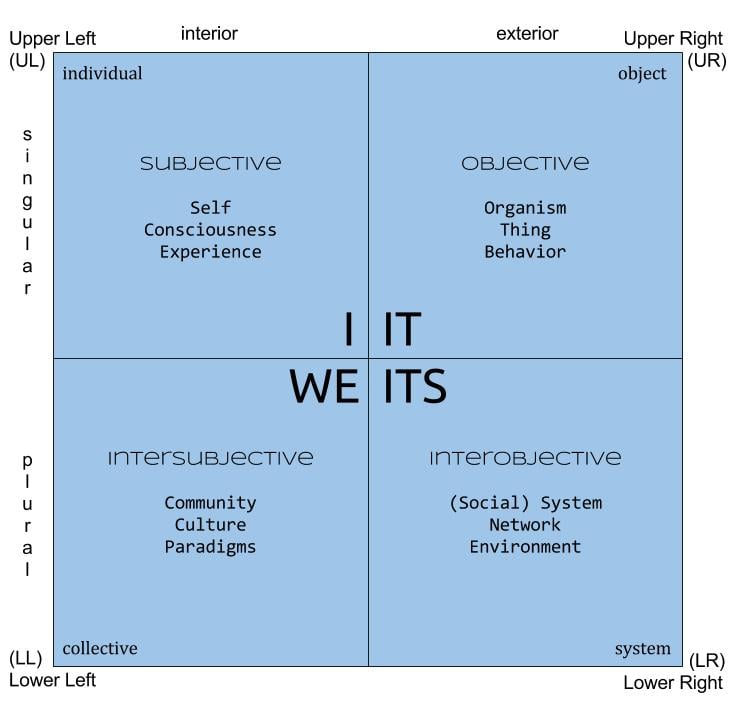
The Integral map also uses the four quadrants: I, WE, IT, and ITS. These categories are deceptively simple. The “I” refers to interior individual experience: consciousness, intention, emotion, identity, and insight. The “WE” refers to shared culture, relationship, language, meaning, and community. The “IT” refers to observable individual behavior, body, brain, skill, and action. The “ITS” refers to collective systems: institutions, technologies, economies, ecological networks, legal structures, and social organization.

This four-quadrant model is valuable because it prevents reductionism. If suffering is treated only as an interior problem, then social causes are ignored. If suffering is treated only as a systemic problem, then personal responsibility is weakened. If spirituality is treated only as culture, direct realization disappears. If it is treated only as private consciousness, ethics and society are neglected. A balanced Integral approach asks what is happening in all four dimensions.
Consider a community conflict. In the “I” quadrant, individuals may feel fear, hurt, pride, or confusion. In the “WE” quadrant, shared meanings and group narratives may be breaking down. In the “IT” quadrant, specific behaviors may need correction: harsh speech, avoidance, lack of discipline, or misuse of authority. In the “ITS” quadrant, the organization may lack transparent processes, role clarity, conflict-resolution structures, or ethical safeguards. A purely sentimental response will not solve such a problem. Neither will a purely bureaucratic one. Integral mapping helps reveal the whole field.

The same method applies to individuals. Every person has competencies and blind spots. Some are strong in meditation but weak in communication. Some are generous but disorganized. Some are intellectually rigorous but emotionally guarded. Some are devotional but resistant to critique. These less developed areas may be understood as holes in the mandala. Mapping them is not an exercise in self-condemnation. It is a practical method for seeing where energy leaks, where growth is needed, and where support from others can strengthen the whole.
For Dharmic unity, this insight is crucial. Hinduism, Buddhism, Jainism, and Sikhism each preserve distinctive gifts. Hindu traditions offer vast resources in metaphysics, ritual, yoga, bhakti, Vedanta, tantra, temple culture, and social philosophy. Buddhist traditions bring refined analysis of mind, suffering, emptiness, compassion, and contemplative method. Jain traditions preserve radical commitments to ahimsa, aparigraha, austerity, and karmic responsibility. Sikh tradition embodies devotion, courage, equality, seva, and disciplined remembrance of the Divine. Integral Evolution encourages these traditions to strengthen one another without flattening their differences.

This unity does not require artificial sameness. A mature Dharmic dialogue can acknowledge doctrinal differences while cooperating around shared ethical and civilizational concerns. The need today is not for shallow syncretism, but for intelligent solidarity. Integral Spirituality provides a language for such solidarity because it values multiple lines of development and multiple modes of truth. Philosophical inquiry, devotional practice, meditative realization, ethical discipline, community service, and ecological responsibility can all be honored as necessary dimensions of a larger human task.
The phrase “beyond the cushion” captures the practical demand of this path. Many practitioners know the paradox of retreat experience: clarity arises in silence, but old habits return in family life, work, politics, money, or disagreement. This does not mean the retreat was false. It means the insight has not yet been embodied across contexts. Meditation opens a doorway, but integration requires repetition, relationship, accountability, and service. The test of spiritual awakening is not only what happens in stillness, but what remains when conditions become difficult.

Such integration has emotional weight. Modern seekers often carry fragmentation: inherited trauma, cultural displacement, religious confusion, overstimulation, loneliness, and the pressure to perform identity in public. A purely academic system cannot heal this. Yet a purely emotional spirituality may lack discrimination. Integral Evolution is compelling because it asks for both warmth and precision. It invites the practitioner to care deeply while examining carefully; to feel fully while thinking clearly; to honor tradition while remaining responsive to new conditions.
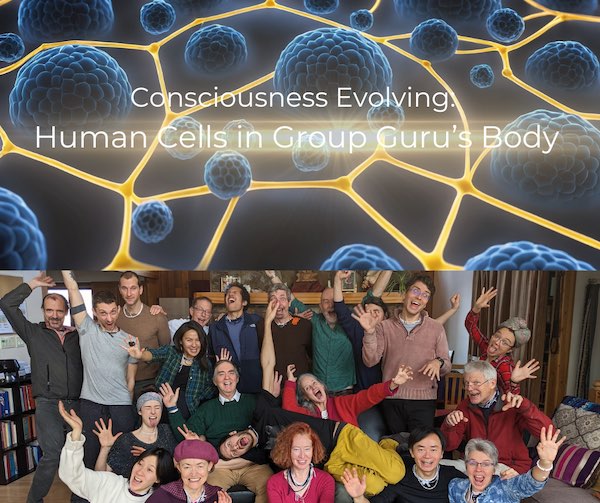
Community is indispensable in this process. A solitary practitioner can cultivate concentration and insight, but community reveals the hidden edges of character. It exposes impatience, pride, dependency, avoidance, competitiveness, and the longing to be seen. It also reveals generosity, courage, loyalty, tenderness, and shared aspiration. In this sense, sangha, satsang, sangat, and disciplined community life are not optional accessories. They are laboratories of awakening.

When a community becomes serious about Integral practice, it does more than gather for inspiration. It studies its own patterns. It asks where its culture is strong and where it is underdeveloped. It looks at governance, teaching, finances, ethics, inclusion, succession, education, ecology, and service. It examines whether its ideals are reflected in its systems. This is difficult work because institutions often prefer admiration to examination. Yet without such examination, spiritual communities can unconsciously reproduce the very suffering they intend to heal.
The image of a “Buddha field” expresses what can happen when enough disciplined, compassionate, and awake people practice together. The atmosphere of a community can raise the standard of conduct. Those who enter such a field sense that ordinary reactivity is not being rewarded. A different possibility becomes available: more honesty, more kindness, more restraint, more courage, more joy. In broader Dharmic terms, this resembles the power of sacred association, satsang, sangat, and the uplifting influence of noble company.
However, such a field is not created by charisma alone. It requires discipline, study, accountability, humility, ethical clarity, and the willingness to correct course. A community that depends only on inspiration will eventually weaken. A community that depends only on rules will become dry. Integral Evolution calls for both living wisdom and functional structure. It asks that awakening be supported by forms capable of carrying it into future generations.
The technical value of Integral Evolution lies in its diagnostic power. It helps identify whether a problem is primarily contemplative, psychological, relational, cultural, behavioral, or systemic. It also recognizes that most real problems are mixed. For example, ecological harm is not merely a policy issue. It involves desire, consumption, worldview, economic systems, technological design, and spiritual alienation from nature. Similarly, communal disharmony is not merely a failure of tolerance. It may involve historical wounds, identity formation, leadership failures, poor education, and immature emotional development.

For the 21st century, this complexity cannot be avoided. The age demands practitioners who are inwardly grounded and outwardly literate. They must understand meditation and media, scripture and psychology, devotion and governance, personal ethics and planetary systems. This does not mean every seeker must become an expert in every field. It means that spiritual culture must stop rewarding narrow development as if it were wholeness. The mandala must be rounded out collectively.
Integral Evolution also protects against spiritual bypassing. Spiritual bypassing occurs when lofty teachings are used to avoid unresolved pain, social responsibility, or difficult conversations. Statements about emptiness, karma, divine will, nonduality, or acceptance can be misused to silence necessary work. A mature Integral approach respects ultimate truths while still addressing relative realities. From the highest perspective, all phenomena may be empty or divine; at the human level, harm still requires repair, injustice still requires response, and suffering still calls for compassion.
This balance is deeply compatible with Dharmic reasoning. The traditions have long distinguished levels of truth, paths for different temperaments, and disciplines appropriate to different stages. The doctrine of adhikara in Hindu thought, upaya in Buddhism, anekantavada in Jainism, and the practical wisdom of seva in Sikh life all suggest that reality must be approached skillfully, not rigidly. Integral Evolution gives modern language to this ancient sensitivity to context.
At its best, Integral Evolution is therefore not a new sect, but a method of responsible synthesis. It asks practitioners to wake up through contemplative realization, grow up through developmental maturity, clean up through shadow integration, show up through service, open up through multiple intelligences, and learn from mistakes without abandoning the path. It treats personal liberation and collective renewal as inseparable. It insists that awakening must become visible in the world.
The call to collective awakening is not sentimental optimism. It is a sober recognition that individual transformation affects the field of relationship, culture, and systems. One mature person can change the tone of a family. A disciplined group can change the culture of an institution. A network of ethically grounded communities can influence society. The scale varies, but the principle remains: consciousness expresses itself through form.
For contemporary seekers, the practical question is direct: does spiritual practice make life more honest, more compassionate, more courageous, and more useful to others? If not, the practice may need a wider frame. Integral Evolution offers that wider frame without discarding the sacred disciplines that came before it. It asks that meditation mature into conduct, insight mature into service, devotion mature into humility, and community mature into a field of shared awakening.
A 21st-century Dharmic awakening must therefore be both ancient and new. It must drink from the deep wells of Hindu, Buddhist, Jain, and Sikh wisdom while responding intelligently to modern psychological, ecological, technological, and social realities. It must preserve the fire of liberation while learning how to illuminate homes, institutions, and nations. Integral Evolution names this task with clarity: the inner light must become strong enough, stable enough, and generous enough to transform the world it touches.
Inspired by this post on Planet Dharma.




Leave a Reply
You must be logged in to post a comment.