
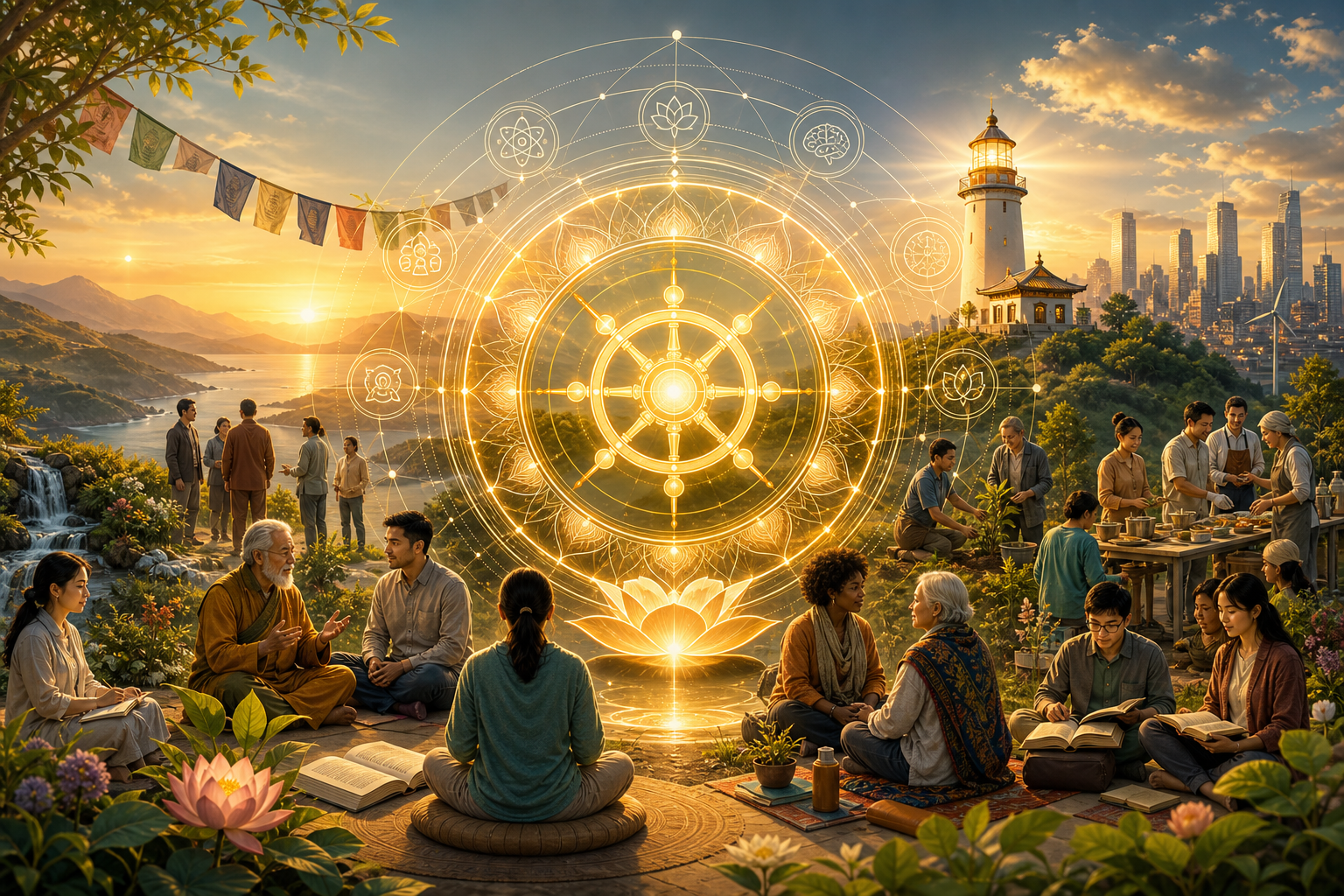
The future of Dharma cannot be understood as a rejection of inherited wisdom. It is better understood as a disciplined expansion of it. In this view, Dharma remains a living stream rather than a fixed museum object, carrying forward the insights of Buddhism while remaining open to the ethical, philosophical, and contemplative richness of Hinduism, Jainism, and Sikhism. The central question is not whether ancient traditions should be abandoned, but how their deepest truths can be preserved, clarified, and applied within the conditions of modern life.
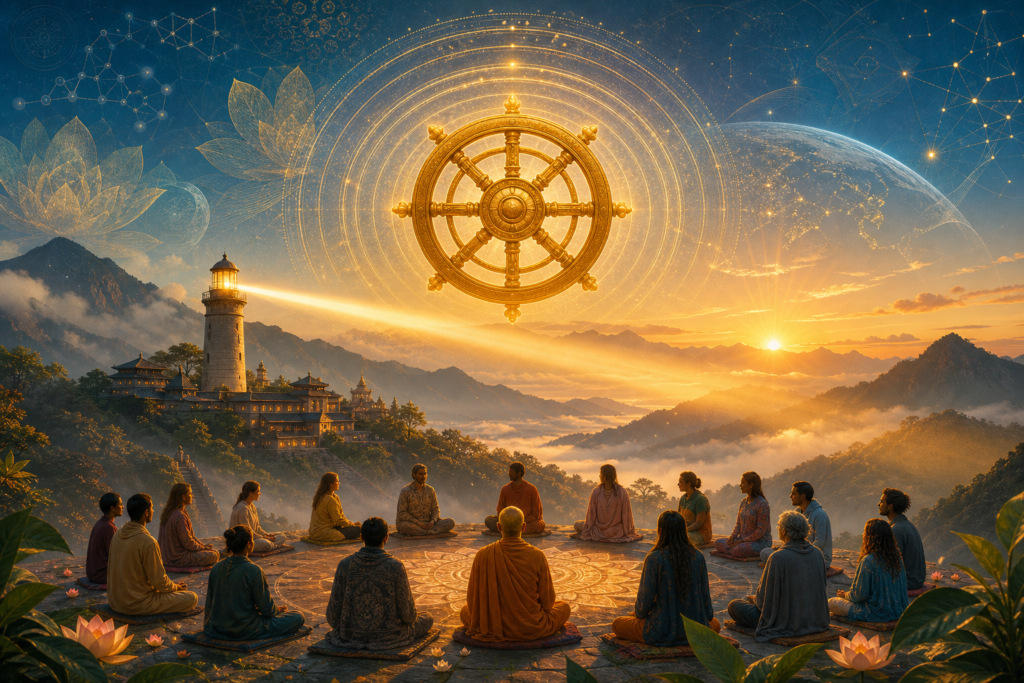
Qapel Doug Duncan’s final teaching on the future of Dharma, delivered on September 22, 2024, shortly before his passing, presented a bold framework for this challenge. The teaching described a possible “Fifth Turning of the Wheel of Dharma,” a new phase in which Buddhist realization is placed within a broader integral map that includes psychology, science, ecology, relationship, community, and social responsibility. The language is Buddhist, but the underlying concern is universal: how can awakening become fully embodied in the world rather than confined to meditation halls, scriptures, rituals, or private states of peace?
One of the most important principles in Buddhadharma is investigation. This principle gives Buddhism an unusual capacity for self-correction. The Dalai Lama has often emphasized that if Buddhist claims are shown to be incomplete or inconsistent with reliable discoveries, then Buddhism must re-examine itself. That attitude does not weaken Dharma. It strengthens it. A tradition that can investigate itself has the possibility of remaining truthful across centuries, cultures, and changing human needs.
This investigative spirit is also deeply compatible with the wider Dharmic civilizational ethos. Hindu darshanas developed through debate, commentary, refinement, and reinterpretation. Jainism cultivated anekantavada, the discipline of seeing truth from multiple standpoints. Sikhism integrated devotion, ethical action, community service, and spiritual equality into a powerful lived path. Across these traditions, Dharma is not merely belief. It is inquiry, discipline, conduct, realization, and service.
The First Turning of the Wheel of Dharma, associated with the Buddha’s earliest teachings and later preserved through Theravadin traditions, centered on suffering, its causes, its cessation, and the path to liberation. Its vocabulary includes karma, dukkha, Nirvana, anicca, and anitta. These teachings place attention on impermanence, causality, non-self, and the discipline required to see through the illusion of a fixed identity. In technical terms, this is a phenomenological training of perception: experience is observed closely enough that the presumed solidity of the self begins to dissolve.
The First Turning also emphasizes dependent origination, the interdependence of causes and conditions. Nothing appears in isolation. Thoughts, emotions, habits, relationships, social patterns, and even personal identity arise through networks of conditioning. This insight remains exceptionally relevant in modern life. A person struggling with anger, anxiety, comparison, ambition, or grief is not dealing with a private defect alone. Such experiences arise from biological conditioning, family patterns, cultural pressure, economic stress, memory, and perception. Dharma begins by teaching that these patterns can be seen clearly.
The Second Turning, associated especially with Nagarjuna, developed the teaching of shunyata, or emptiness. It deepened the earlier insight into non-self by applying emptiness to all phenomena. Samsara and Nirvana are not two ultimately separate realities. Their apparent difference depends on perception, ignorance, grasping, and realization. This is a radical philosophical move: liberation is not found by escaping the world as a separate object, but by seeing the world without the distortions of clinging and aversion.
This insight resonates with many Dharmic streams. Advaita Vedanta examines the mistaken identification of the Self with limited body-mind experience. Jain thought analyzes the bondage of jiva through karma and the possibility of liberation through purified perception and conduct. Sikh teachings call attention to haumai, ego-centeredness, and invite remembrance of the Divine amid active life. Though metaphysical claims differ, the practical concern is shared: ordinary perception is clouded, and spiritual discipline clarifies it.
The Third Turning, often associated with Asanga and Vasubandhu, pressed the inquiry still further. It did not merely say that phenomena are empty; it examined the subtle tendency to make emptiness itself into a position. “Empty of emptiness” points toward the removal of the final conceptual ground on which ego can stand. This is difficult because the mind prefers certainty. Even sophisticated spiritual concepts can become identity markers. A practitioner may stop clinging to possessions but begin clinging to being “advanced,” “nondual,” “renounced,” or “realized.”
The technical importance of this stage is considerable. It reveals how spiritual language can become a refuge for ego if not tested through direct realization and ethical embodiment. In contemporary terms, it warns against spiritual branding, performative wisdom, and intellectualized non-attachment. It asks whether insight has transformed perception, conduct, relationship, and responsibility, or whether it has merely produced a more subtle identity.
The Fourth Turning, identified in this framework with Tantrayana and Vajrayana developments, reintroduced the richness of form. If emptiness alone is misunderstood, the world can appear flat, abstract, or even irrelevant. Tantrayana insists that form itself must be included. The body, emotions, symbols, energies, relationships, beauty, conflict, and ritual imagination become fields of practice. The world is not rejected; it is transmuted through disciplined perception.
This is where the principle of “transcend and include” becomes crucial. Each new development does not simply erase the previous stage. It preserves what is essential while correcting what has become partial. The First Turning clarifies suffering and release. The Second deepens emptiness. The Third removes clinging to emptiness itself. The Fourth re-engages form as radiant, symbolic, and transformative. Evolution, in this sense, is not novelty for its own sake. It is a more comprehensive integration of reality.
The proposed Fifth Turning begins from the observation that many modern challenges cannot be fully addressed from within classical Buddhist categories alone. The issue is not that Buddhism is false or obsolete. The issue is that modern human beings live within psychological, ecological, technological, economic, political, and relational conditions that require additional maps. Modern science, developmental psychology, trauma studies, social science, environmental thought, and systems theory all reveal aspects of human conditioning that traditional spiritual institutions often did not analyze in detail.
This is especially visible in the problem sometimes called spiritual bypassing. A person may have genuine meditative experience yet remain immature in communication, unresolved in trauma, confused in intimacy, irresponsible with power, or unskilled in community life. Traditional realization does not automatically provide methods for conflict resolution, governance, emotional literacy, financial ethics, gender dynamics, ecological responsibility, or institutional accountability. These areas require their own disciplines.
The Zen ox-herding pictures offer a useful symbolic example. The final image often shows the practitioner returning to the marketplace after realization. The return is beautiful, but the social details are largely absent. What happens when the awakened practitioner faces marriage, illness, administration, money, leadership, disagreement, public criticism, cultural change, or political pressure? What skills are required when realization must function not in solitude but in family, community, workplace, and society?
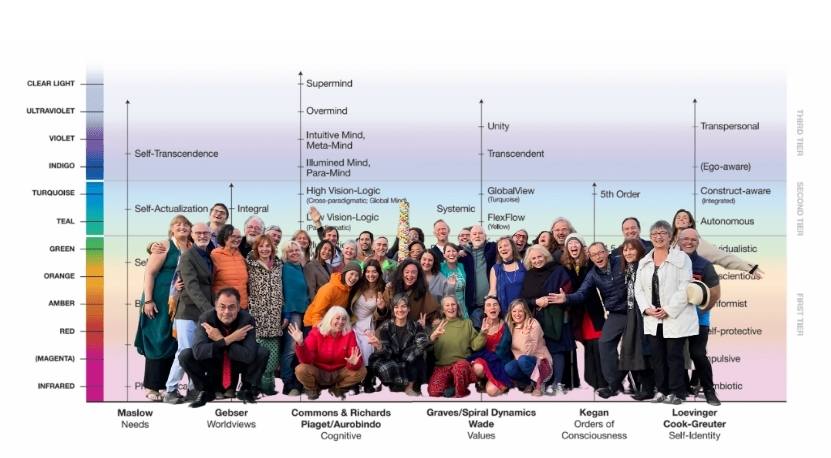
The Fifth Turning attempts to address that missing terrain. It proposes that the Dharma map must be placed within a wider integral map rather than merely adding modern ideas as decorative supplements to an older framework. This distinction matters. If modern psychology, science, and social knowledge are only used when convenient, the older map remains structurally unchanged. But if Buddhist insight is integrated into a larger model of human evolution, then awakening becomes part of a comprehensive discipline of life.
Integral Spirituality, associated in modern discourse with Ken Wilber, attempts such a synthesis. It aims to include contemplative realization, developmental stages, psychological shadow work, cultural context, systems thinking, and embodied practice. Qapel’s preferred term, Integral Evolution, gives the idea a still broader scope. Spirituality can sometimes sound separate from daily life, as though practice belongs to a shrine, retreat, monastery, or meditation cushion. Evolution includes the kitchen table, the workplace, the community meeting, the ecological footprint, and the unresolved emotional pattern.
From a Dharmic perspective, this wider frame is valuable because Dharma has never been only a private interior experience. In Hindu thought, Dharma includes cosmic order, social responsibility, personal duty, ethical restraint, and spiritual realization. In Buddhism, right speech, right livelihood, and right action belong to the path. In Jainism, ahimsa and aparigraha discipline the whole field of conduct. In Sikhism, seva and honest living bring spirituality directly into social life. Integral Evolution therefore need not be read as a break from Dharma, but as an attempt to recover its full breadth under modern conditions.
The technical challenge is integration without dilution. A serious integral approach cannot reduce Dharma to vague wellness language, nor can it flatten distinct traditions into a single sentimental slogan. Buddhism, Hinduism, Jainism, and Sikhism have different doctrines, lineages, metaphysics, disciplines, and histories. Unity among Dharmic traditions does not require erasing difference. It requires recognizing shared commitments to liberation, ethical refinement, disciplined practice, truth-seeking, and the transformation of human consciousness.
Such unity is particularly important today because many practitioners experience fragmentation. One part of life may be spiritual, another professional, another relational, another political, another digital, and another private. The result is often exhaustion and inconsistency. A person may meditate in the morning and become reactive online by noon. A person may study scripture but remain unable to listen during disagreement. A person may value compassion but participate in systems of consumption that damage the environment. Integral Dharma asks that these divisions be examined honestly.
The proposed Fifth Turning therefore shifts attention from individual awakening alone to collective awakening. This does not mean that personal practice becomes secondary. Without individual discipline, collective ideals become slogans. But the solitary model of the sage, monk, yogi, or mystic is no longer sufficient as the only image of spiritual maturity. Modern life requires awakened relationships, awakened communities, awakened institutions, and awakened cultures.
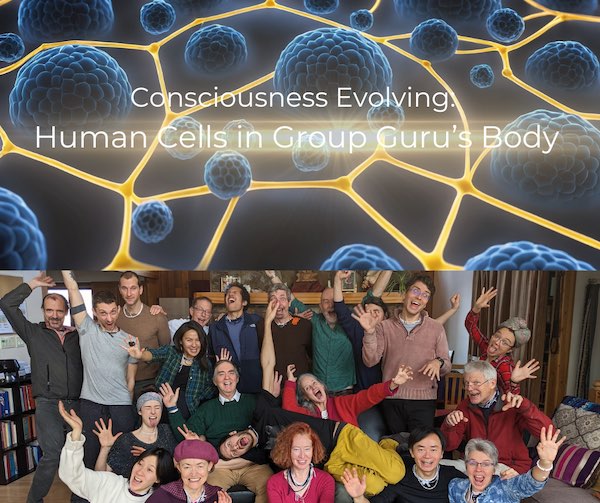
The idea of group mind is important here. Human beings often imagine themselves as separate entities negotiating with other separate entities. Dharma challenges that assumption. Buddhism analyzes non-self and interdependence. Hindu traditions speak in different ways of the underlying unity of existence. Jainism emphasizes the ethical seriousness of interrelation through non-harm. Sikhism affirms the Divine presence within all and expresses that insight through service and equality. These teachings converge in a practical recognition: the suffering of one is not finally isolated from the suffering of many.
Modern science also supports a relational view of life. Ecology shows that organisms exist within interdependent systems. Psychology shows that the nervous system is shaped by attachment, environment, and social regulation. Physics has destabilized simplistic assumptions about solid, independent objects, even if those discoveries should not be carelessly converted into spiritual slogans. Systems theory shows that behavior emerges through networks rather than isolated causes. The Dharma principle of interdependence becomes more, not less, relevant when read through these modern lenses.
At the level of lived practice, this means awakening must be tested in ordinary human situations. A contemplative state is meaningful, but so is the ability to apologize without collapse, disagree without hatred, lead without domination, serve without vanity, and act without indifference. A spiritual community becomes credible not because it uses sacred vocabulary, but because its members learn to embody clarity, compassion, accountability, and resilience under pressure.
The teaching also emphasizes four generative dimensions: a generative environment, a generative economy, a generative society, and a generative spirituality. These categories are technically significant because they prevent spiritual life from becoming narrow. A generative environment asks whether practice supports ecological balance. A generative economy asks whether resources circulate ethically. A generative society asks whether institutions cultivate dignity and responsibility. A generative spirituality asks whether inner realization matures into wisdom, compassion, and service.
This framework is especially relevant for Dharmic communities in the twenty-first century. Temples, monasteries, gurudwaras, Jain centers, meditation communities, and yoga institutions are not merely ritual spaces. At their best, they are educational, ethical, cultural, ecological, and social centers. They transmit memory, cultivate discipline, support families, preserve languages, train attention, provide service, and offer refuge during suffering. Their future depends on whether they can preserve sacred depth while responding intelligently to modern needs.
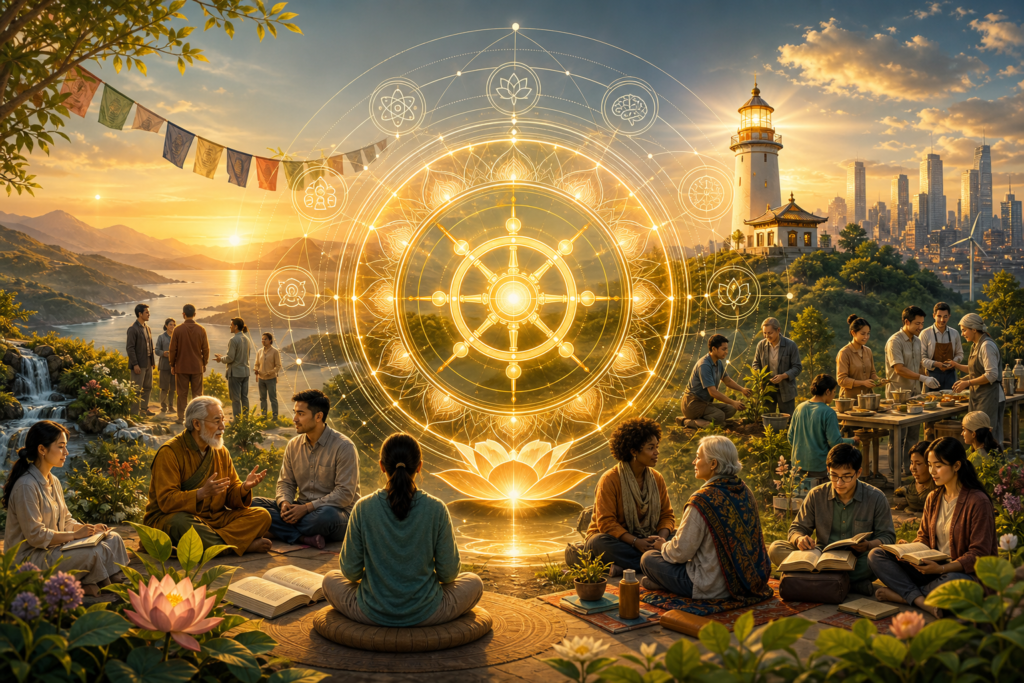
A mature Dharma center, in this sense, functions like a lighthouse. The metaphor does not require institutional promotion. It points to a broader principle: communities need visible reference points where practice, study, relationship, service, and disciplined inquiry can be integrated. Not everyone can live in a residential spiritual community. Not everyone can withdraw for long retreat. Many practitioners must build their Dharma within families, professions, cities, digital environments, and complex social obligations. They need examples that show how realization can be lived amid real conditions.
The lighthouse image also carries emotional force. Many sincere seekers know the feeling of practicing alone, reading texts without guidance, or carrying spiritual aspiration into environments that do not understand it. A living Dharma community can provide orientation without demanding uniformity. It can remind practitioners that the path is larger than personal mood and deeper than intellectual interest. It can also prevent isolation by showing that awakening is both intimate and shared.
However, the future of Dharma must avoid two errors. The first error is rigid traditionalism, in which inherited forms are preserved without examining whether they still transmit realization effectively. The second error is shallow modernism, in which ancient disciplines are stripped of rigor and repackaged as lifestyle accessories. Integral Evolution requires a more demanding path. It must honor lineage, scripture, ritual, meditation, ethics, and devotion while also incorporating psychology, science, social responsibility, and institutional transparency.
This balance is also essential for unity among Dharmic traditions. Hinduism, Buddhism, Jainism, and Sikhism need not be forced into sameness. Their differences are intellectually and spiritually meaningful. Yet their shared civilizational grammar includes karma, discipline, liberation, compassion, self-transformation, reverence for teachers, community responsibility, and the possibility that human life can be refined beyond egoic habit. A future-oriented Dharma discourse should strengthen these shared foundations rather than deepen sectarian separation.
The Fifth Turning, understood carefully, is not a claim that the old paths have failed. It is a recognition that each age asks new questions. Earlier generations asked how suffering arises, how selfhood is constructed, how emptiness is realized, and how form can become a vehicle of awakening. The present age asks how realization functions in psychology, ecology, technology, economics, pluralism, family life, gender, trauma, leadership, and planetary crisis. These are not distractions from Dharma. They are fields in which Dharma must prove its depth.
For practitioners, the practical implication is clear. Meditation remains necessary, but it is not sufficient by itself. Study remains necessary, but it must not become abstraction. Ritual remains powerful, but it must not replace ethical conduct. Community remains precious, but it must be held with accountability. Personal insight remains central, but it must mature into service. The path must move from cushion to conversation, from doctrine to decision, from realization to relationship.
The future of Dharma will likely belong to communities and practitioners capable of both reverence and courage. Reverence protects depth. Courage permits renewal. Without reverence, tradition becomes disposable. Without courage, tradition becomes immobile. The proposed Fifth Turning invites a disciplined synthesis: preserve the liberating insights of the past, include the knowledge of the present, and build forms of practice capable of serving future generations.
In this sense, the future of Dharma is not merely Buddhist, Hindu, Jain, or Sikh in a narrow institutional sense. It is Dharmic in the broadest and most responsible sense: committed to truth, liberation, non-harm, wisdom, self-transformation, service, and the integration of consciousness with life. The lighthouse needed for future generations is not only a building or a single institution. It is a way of living in which ancient realization and modern knowledge illuminate one another for the welfare of all beings.
Inspired by this post on Planet Dharma.



Leave a Reply
You must be logged in to post a comment.