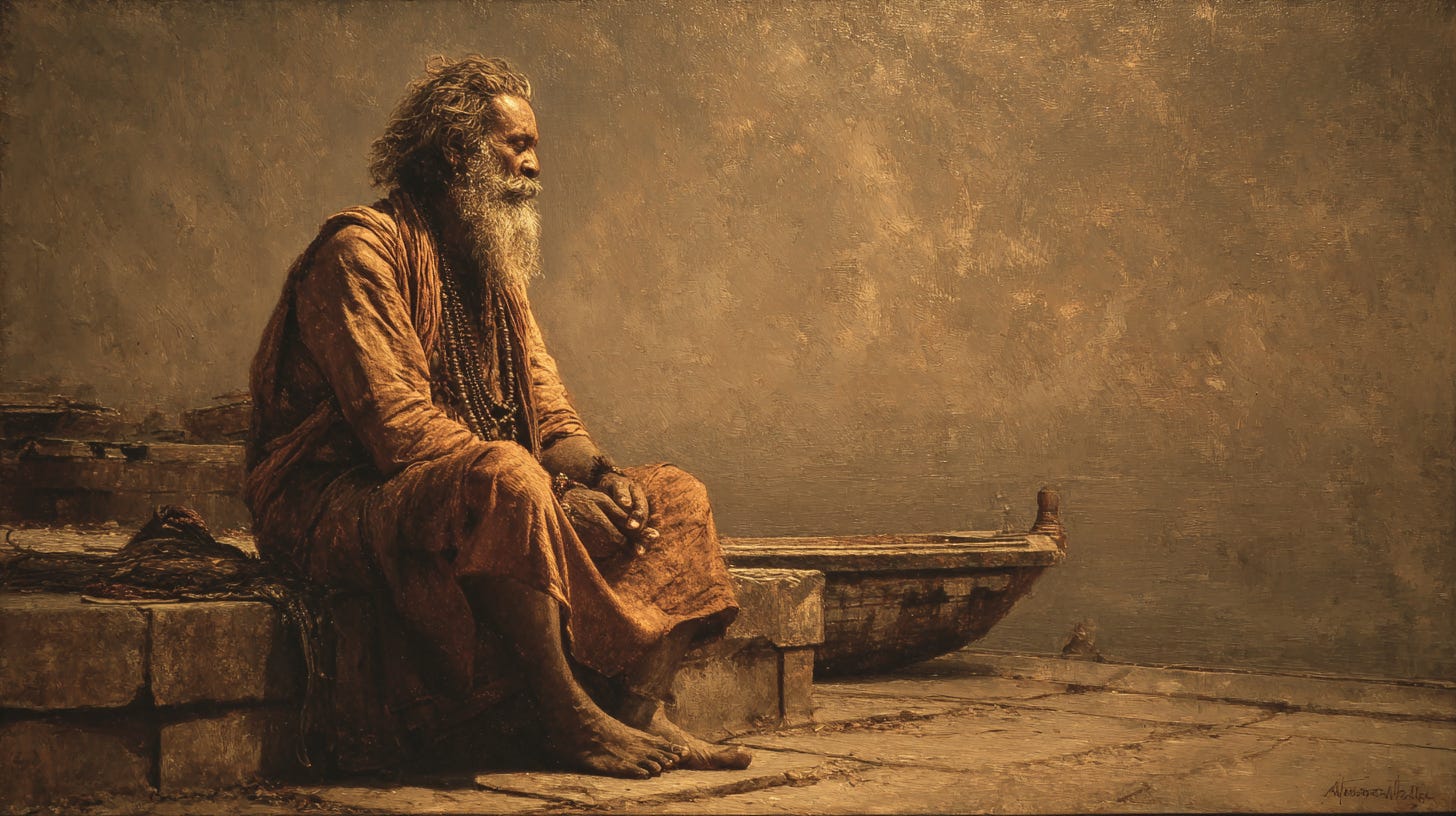
A contemplative dialogue with a reclusive ascetic of Kashicolloquially remembered as the “Mad Monk” or “Pagal Baba”unfolded a rigorous map of creation (sṛṣṭi), devotion (bhakti), and the nature of avatāra. Presented through a precise yet poetic metaphysics, the discourse linked inner yogic experience with an elegant geometry of manifestation, while continually directing seekers toward humility, unity, and spiritual maturity across the dharmic familyHinduism, Buddhism, Jainism, and Sikhism.
On the process of creation, the Sadhu described what yogis call Koola as Bhāvākāśathe “space of pure feeling.” In this Bhāvākāśa, a vision or vibration of bhāva first manifests; creation follows thereafter. At the root of sṛṣṭi stands Ichchhā (desire): it may express as kāma (ordinary desire) or as prema (divine love). Both generate creation, yet they do so with profoundly different texturesone channeling worldly emergence, the other radiating sacred unfoldment.
From the ocean of feeling (bhāva-rāśi), a specific desire-born vibration condenses as a bindu (seed-point). The bindu then moves into a triangle (trikona), also called Yoni, and can blossom in distinct inner loci: sahasrāra or ājñā (head), anāhata (chest), maṇipūra (navel-root), or mūlādhāra (root). According to the Sadhu, the site of this blossoming influences accessible qualities or colours (varṇas). From a tattvic standpoint, such talk of varṇasincluding references like Brāhmaṇa, etc.was framed as an account of elemental dispositions rather than any social ranking, aligning with a dharmic understanding that honours inner propensity and the dignity of all paths.
When bindu forms, the play of feeling becomes bhāva-śūnya: vibration pauses, and the interval between bhāva and bindu is termed śūnya (the Void). Piercing or discerning this śūnya transforms the vibration into bindu, wherein motion remains niruddha (restrained). As it develops, this motion becomes rekhā (a straight line). At its culmination, the motion resolves again into śūnya, after which the development of akṣara (imperishable syllable) arises.
The Sadhu mapped a sequence of measures (māna or māpa): bindu is one, the line two, the circle three, the cross four, and so onward up to ten. Notably, after nine, ten appears along with zero (śūnya). This is both a metaphysical and an experiential progressionan inner mathematics of becoming that mirrors classical Indian insights into number and the zero concept.
He elaborated the dynamism: a bindu becomes agitated into a line, like lamplight; the line, influenced by terrestrial gravitation, curves into a circle (vṛtta). With a completed circle, the centre manifests and a diameter (vyāsa) appears. Through rotational and revolutionary motion, two diameters arise and “meet” at the centre, which assumes the character of gravity (gurutva). Mastery over the early four measuresbindu, line, circle, crosssymbolizes a state wherein the body no longer yields to central gravitation; in traditional yogic language, this imagery points to siddhis described as passing through walls, mountains, and other obstacles, offered here as metaphors of interior freedom rather than sensational feats.
Spiritual progress, he observed, varies. Within his model, it was said that great adepts (Mahāpurushas) pierce different numbers of measures. A remark attributed to this framework claimed that Lord Buddha crossed eight measures and paused at the ninth. Read in a spirit of samvāda (respectful dialogue), such statements reflect one teacher’s map rather than a sectarian ranking. Indeed, across dharmic traditions, the language of attainment differsBuddhist śūnyatā, Jain kevala-jñāna, and Sikh realization of the nirguṇa-saguṇa One each articulate consummation uniquely, yet all affirm compassion, humility, and liberation as shared aims.
The Sadhu distinguished three broad kinds of śūnya for practical understanding: jātigata śūnya (linked to innate conditioning), Mahāśūnya (the vast transcendental interval), and Ananta Śūnya (Infinite Void). Wherever a movement completes, there is śūnya; the bindu rests there until fresh motion arises, pierces that śūnya, andupon completionmeets another śūnya. For contemporary seekers, this cyclical unfolding can be observed in meditation: in the ebb and flow of breath, thought, and awareness, pause yields potential, and potential flowers into clarity.
Turning to the essence of devotion, the Sadhu differentiated everyday religiositytermed bhūta-bhakti or bhautika-bhaktifrom śuddha bhakti. The former remains bound to saṁskāras (material conditioning) and ignorance; the latter requires the offering of manas and prāṇa with one-pointed absorption in the Divine. Such ripeness, he insisted, matures through sādhanā cultivated over lifetimes, reflecting a classic Vedic and Upanishadic ethos of steady practice.
On the path toward Bhagavān, duties born of svabhāva-prakṛti must first be resolved; this integrity enables jñāna. From genuine jñāna, true bhakti arises. Only when the mystery of Divine creation is intuited and the vastness of Divine power recognized does ahaṁbhāva or ahaṁkāra begin to dissolve. After śuddha bhakti dawns, viśuddha bhāva emerges, and bhagavat-sattā is said to reveal itself naturally. In lived terms, this arc resonates with Sikh sevā, Buddhist karuṇā, and Jain ahiṁsādistinct idioms of the same devotion-in-action that purifies the heart and unites communities.
Regarding avatāra, the Sadhu’s articulation was subtle. Bhagavān, perfect and complete in ṣaḍ-aiśvarya, does not “descend” or “ascend.” What scriptures call avatāra, he said, are eternally perfect portionsnitya-siddha aṁśa and kalāthat manifest for a purpose in the mortal realm. The mark of an authentic bhakta is exclusive awareness of Bhagavān, a love so complete that nothing appears apart from the Divine. While doctrinal forms differ, one can discern functional resonances across traditionsHindu avatāra, Buddhist bodhisattva, Jain Tīrthaṅkara, Sikh Gurueach guiding beings toward truth, compassion, and liberation without insisting on a single exclusive pathway.
These teachings invite seekers to read śūnya not as negation but as luminous interval, bindu as concentrated potential, and rekhā and vṛtta as the disciplined flow of consciousness from seed to fullness. Practically, breath awareness, mantra, study of the Upanishads, contemplation of śūnyatā, and service-oriented living cultivate the very bhakti that refines ego and reveals unity. In the spirit of Sanātana Dharma’s inclusivity, the discourse encourages Hindus, Buddhists, Jains, and Sikhs to recognize shared ethical and contemplative ground, strengthening mutual respect while honoring each tradition’s integrity.
Inspired by this post on Dharma Dispatch.