
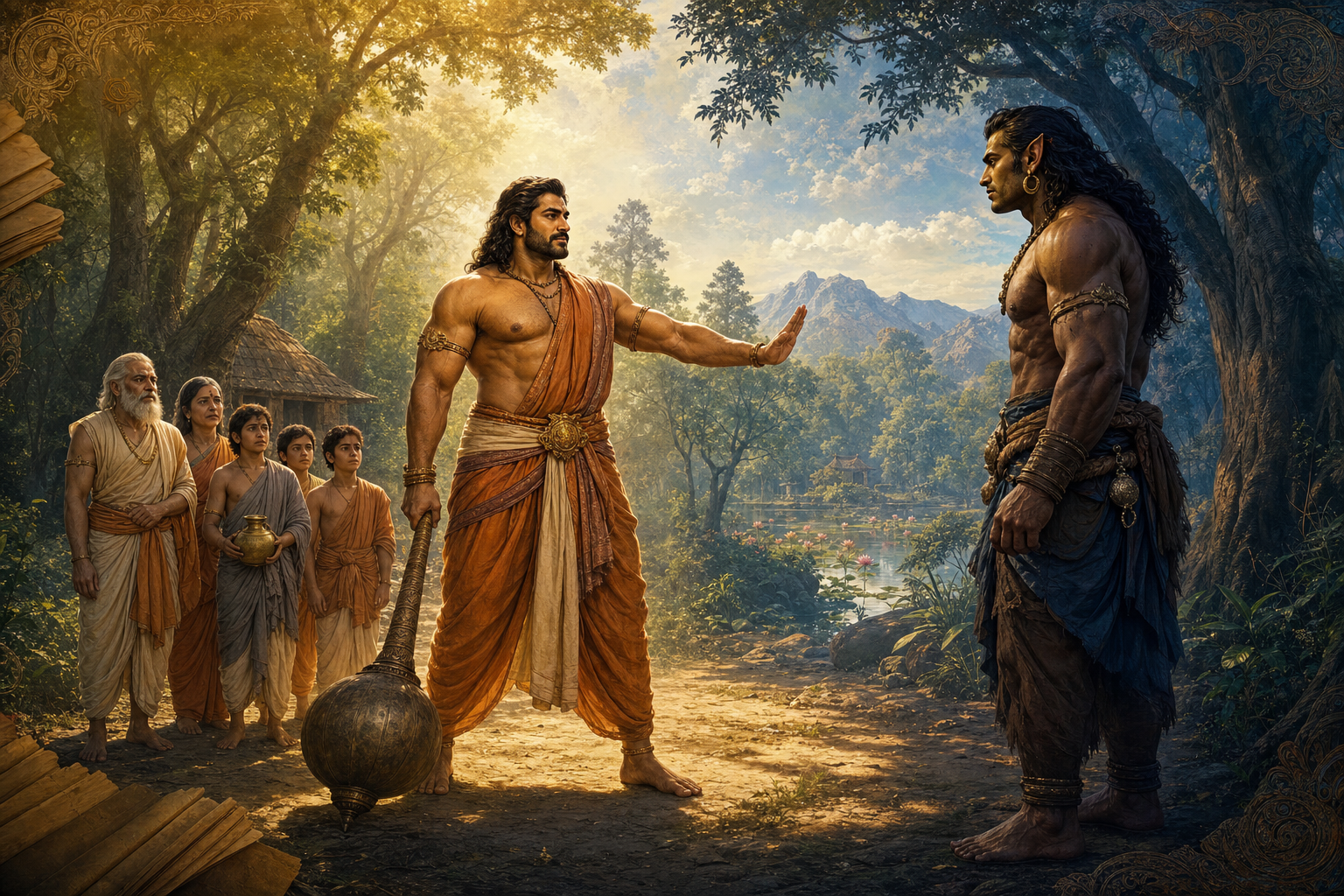
Few encounters associated with the Pandavas’ forest exile expose the tension between family loyalty and public responsibility as sharply as the confrontation between Bhima and Ghatotkacha. The episode contains danger, mistaken identity, a family forced into an impossible choice, and a father who must oppose his own son without ceasing to care for him. Its lasting power, however, depends on reading it with textual precision. The dramatic confrontation is not narrated as an episode in the Sanskrit Mahabharata itself. It comes from Madhyama-vyayoga, a one-act Sanskrit heroic drama traditionally attributed to Bhāsa, often written as Bhasa.
This distinction does not diminish the story. It reveals how Indian epic literature continued to live through performance, reinterpretation, and philosophical reflection. The Mahabharata supplies Bhima, Hidimba, Ghatotkacha, the Pandavas’ exile, and the relationships that make the encounter meaningful. Madhyama-vyayoga then creates a new crisis through which those familiar characters can be examined. Treating the play as a literary reworking, rather than silently inserting it into the epic, preserves both historical accuracy and the moral force of the narrative.
The epic background: Bhima, Hidimba, and their extraordinary son
The relationship begins in the Adi Parva, after the Pandavas escape from the house of lac and enter a dangerous forest. While Kunti and four of the brothers sleep, Bhima remains awake to guard them. Hidimba, a hostile rakshasa, sends his sister Hidimba—also rendered Hidimbi or Hidimva in English editions—to approach the travelers. She rejects her brother’s violent intention, warns the Pandavas, and expresses her desire to marry Bhima. After Bhima defeats her brother, Kunti and Yudhishtira permit the union under conditions that allow Bhima to continue fulfilling his obligations to the Pandavas.
Ghatotkacha is born from this union and matures with supernatural speed. The Adi Parva account describes him as exceptionally powerful, skilled in weapons, deeply devoted to the Pandavas, and accepted by them as virtually one of their own. Before departing northward with his mother, he promises to return whenever his father requires assistance. The family therefore lives apart, but the separation is not presented as rejection. It follows the terms under which Bhima and Hidimba formed their relationship, while Ghatotkacha’s promise establishes an enduring bond of service and affection.
The Mahabharata does narrate Ghatotkacha’s return during the Pandavas’ later twelve-year exile following the dice game. On a difficult Himalayan journey, Draupadi collapses from exhaustion. Bhima thinks of his son, and Ghatotkacha immediately appears, salutes the Pandavas and accompanying Brahmanas, and asks to be commanded. Bhima embraces him. Ghatotkacha then carries Draupadi while other rakshasas help transport the remaining travelers toward the hermitage of Nara and Narayana. The relevant passages are found in Vana Parva, Section CXLIII and Section CXLIV.
The canonical scene and the dramatic story should therefore be read together but not confused. The Mahabharata presents a trusted son responding promptly to his father’s call and relieving the suffering of the wider group. Madhyama-vyayoga imagines a more troubling encounter in which the same son must learn that loyalty without moral judgment can become dangerous. The epic establishes Ghatotkacha’s devotion; the play tests the quality and direction of that devotion.
Madhyama-vyayoga as Sanskrit heroic drama
Madhyama-vyayoga was first published in 1912 by T. Ganapati Sastri from manuscript material containing thirteen plays that he attributed to Bhāsa. A revised edition followed in 1917. The attribution became influential but has remained a subject of scholarly debate, as has the date of the work. It is therefore most accurate to describe the drama as traditionally attributed to Bhāsa rather than to present its authorship as an uncontested fact. Richard Salomon summarizes this textual history in his study, Like Father, Like Son: Poetic Strategies in “The Middle Brother”.
The word vyayoga identifies a type of one-act heroic drama. Such a play normally presents famous male figures, vigorous conflict, and elevated or martial emotion, while excluding a romantic contest as the central action. Its events unfold within a short period, commonly a single day. Madhyama-vyayoga follows this structure closely: a family is endangered, a protector intervenes, two formidable warriors confront one another, and the struggle concludes through recognition and reconciliation rather than catastrophe.
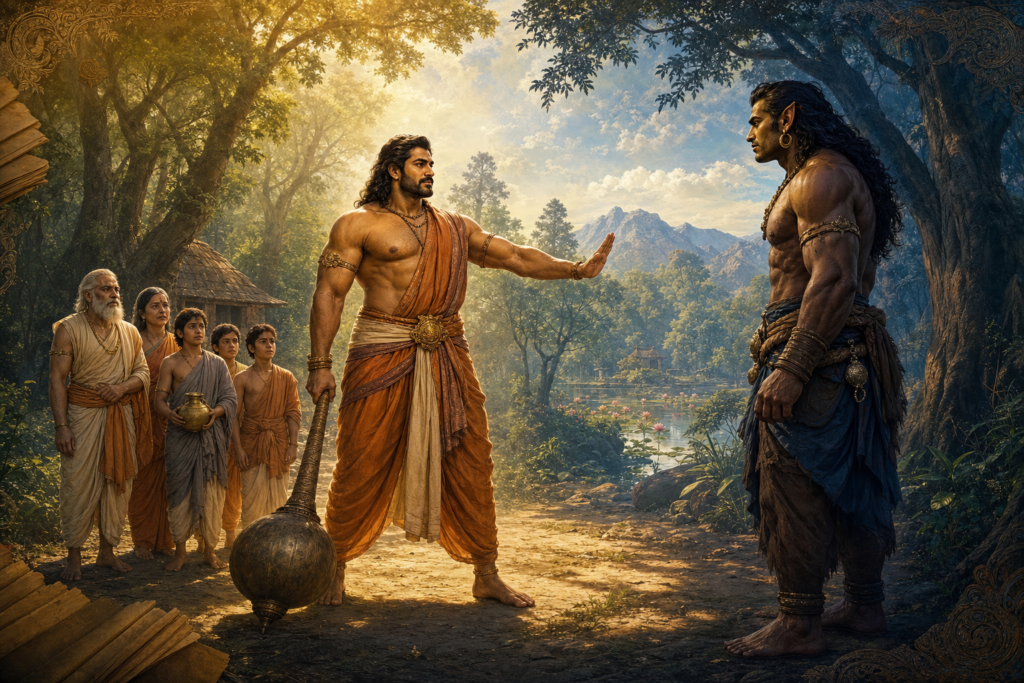
The play places its action during the Pandavas’ forest exile. Most of the Pandavas have temporarily gone to attend a rite associated with their priest Dhaumya, while Bhima remains responsible for guarding their hermitage and exercises nearby. Into this setting comes Kesavadasa, an elderly Brahmin traveling with his wife and three sons to attend a relative’s initiation ceremony. They are not merely anonymous sages threatened by general forest dangers. They are a specific household whose ordinary religious journey is suddenly transformed into a crisis of life, duty, and parental love.
Ghatotkacha intercepts the family and announces that his mother has ordered him to bring her a man so that she may end a fast. He offers a brutal condition: the parents, the wife, and two sons may leave if one son is surrendered. If they refuse, the entire family will be destroyed. The demand converts Ghatotkacha’s physical superiority into coercive power. It also creates the drama’s central ethical problem, because the family is forced to decide who should bear a cost that none of them freely created.
Ghatotkacha is not portrayed as wholly without conscience. He acknowledges that the deed is forbidden and that the people before him deserve respect. His language repeatedly shows intelligence, hesitation, and an ability to recognize virtue. Nevertheless, he suppresses those reservations because he believes obedience to his mother must prevail. His failure is therefore more instructive than simple cruelty would have been. He knows that the contemplated act is wrong, yet he treats a parental command as an adequate reason to proceed.
The family’s impossible choice
Kesavadasa first offers his own aging body to save his wife and sons. His wife then proposes that she should die so that her husband and children may survive. Ghatotkacha rejects both offers, declaring that neither a woman nor an old man will satisfy the command as he understands it. Each of the three sons subsequently volunteers to protect the others. The scene is filled with affection and courage, but it is important not to mistake coerced selection for free consent. Every offer is made under an immediate threat of collective death.
The emotional pressure becomes most severe when the father admits that he cannot surrender his beloved eldest son and the mother protects the youngest. The middle son then asks, in effect, who can value him if neither parent chooses him. The line remains painful because it exposes a fear familiar far beyond the ancient dramatic setting: the fear of being the family member who can most easily be spared. Yet the parents should not be reduced to caricatures. Both had already offered their own lives. The coercive situation magnifies an asymmetry of affection that might otherwise have remained unspoken.
The middle son accepts the role of victim and interprets his death as a means of preserving his elders. Before leaving, he asks to visit a nearby lotus pond. This moment is more than a request to quench thirst. Salomon’s textual analysis explains that the young man performs a water offering for himself because, expecting to die without descendants, he will have no son to perform the rite for him. The detail gives the scene unusual emotional depth: he prepares not only for physical death but also for the ritual absence that he believes will follow it.
Why the word Madhyama changes everything
The title turns on the Sanskrit word madhyama, meaning the middle one. It identifies the second of Kesavadasa’s three sons, but it is also applied to Bhima. Bhima is technically the second of the five Pandavas, not the numerical middle of all five. Within the dramatic convention, however, he belongs to the middle group between the eldest and youngest brothers and is also the middle of Kunti’s three sons, Yudhishtira, Bhima, and Arjuna. The epithet is therefore literary and relational rather than a simple exercise in counting.
When the middle son delays at the pond, Ghatotkacha loudly calls for Madhyama. Bhima hears the call and assumes that someone is summoning him. A single word consequently draws the protector into the crisis. The threatened young man and the absent warrior temporarily share one identity: both are the middle one. The drama uses this verbal overlap to replace the vulnerable Madhyama with the powerful Madhyama, transforming a coerced sacrifice into an opportunity for responsible intervention.
Recognition develops in stages. Bhima hears something familiar in Ghatotkacha’s voice, while Ghatotkacha feels instinctively drawn to the approaching warrior as though he were a relative. Each describes the other through corresponding images of lions, elephants, powerful arms, and extraordinary stature. The audience already knows that they are father and son, so the suspense does not depend on concealing their identities. It arises from watching two closely connected people fail to understand what is evident to everyone observing them.
Salomon identifies an especially refined literary technique in this scene. The Sanskrit term sadṛśa, conveying likeness, fitness, or appropriateness, occurs nine times at significant points in the short play. Bhima and Ghatotkacha also speak mirrored phrases and complete portions of divided verses. Their language resembles itself even before they consciously recognize each other. Kinship is made audible through repetition: physical form, speech, pride, courage, and verbal rhythm all indicate a bond that the characters cannot yet name.
This pattern complicates any easy claim that blood relation is either supreme or irrelevant. The play acknowledges that traits can pass between generations, but inherited strength is not the same as inherited wisdom. Ghatotkacha resembles Bhima physically and temperamentally, yet the final question is whether he can become like his father in disciplined conduct. Biological kinship supplies potential; ethical resemblance must be cultivated through choice, correction, and responsibility.
Dharma under pressure
Bhima responds first to the family’s danger, not to Ghatotkacha’s identity. He listens to Kesavadasa, assures the household that it need not fear, and orders the aggressor to release the intended victim. This sequence is crucial. Bhima does not intervene because someone has insulted his prestige, challenged his authority, or threatened a relative. He acts because a stronger being is coercing vulnerable travelers. His responsibility is activated by the injustice before him.
Ghatotkacha refuses because he has received his mother’s command. The play thereby brings several duties into collision: obedience to a parent, protection of a family, fidelity to a promise, the warrior’s obligation to defend those seeking refuge, and the general restraint against wrongful harm. Dharma appears not as a single rule mechanically applied but as a process of judging competing claims. Ghatotkacha’s error lies in treating one genuine obligation—respect for his mother—as though it automatically cancelled every other moral consideration.
The drama expresses these responsibilities through the social vocabulary of its ancient setting. It assigns special inviolability to the Brahmin household and presents Bhima’s Kshatriya identity as the basis of a protective duty. An academic reading should neither erase that varna-based framework nor repeat it without context. The broader ethical principle available to contemporary readers is that authority and ability impose a duty to protect those exposed to coercion. That principle can be applied without reproducing every feature of the play’s historical social order.
Bhima then offers his own body in place of the middle son. This is the decisive movement from sympathy to responsibility. He does not merely condemn Ghatotkacha or deliver an abstract lecture on dharma. He assumes the danger himself. The strongest person in the scene refuses to let the weakest person carry the cost. His action presents sacrifice as an ethical burden voluntarily accepted by someone capable of resisting, rather than a burden imposed on someone who lacks power.
The middle son initially rejects Bhima’s offer because he believes his life has already been pledged for the preservation of his family. Bhima nevertheless insists on replacing him. The exchange becomes a contest in generosity, but only Bhima has the power to dissolve the original coercion. The family members’ willingness to die is admirable as an expression of love; it does not make Ghatotkacha’s demand just. A noble response to an unjust choice does not transform the choice itself into dharma.
This distinction prevents the story from becoming a simplistic celebration of self-destruction. The heroic solution is not to identify the most expendable person efficiently. It is to reject the premise that an innocent person must be surrendered at all. Sacrifice acquires ethical meaning when it is freely undertaken to prevent harm, especially by someone with greater capacity. It becomes exploitation when a powerful party selects a weaker victim and then praises that victim’s compliance.
When Ghatotkacha names Hidimba as his mother, Bhima recognizes his son. He admires the young warrior’s filial loyalty but remains disturbed by his lack of compassion toward living beings. Knowledge of their relationship does not cause Bhima to withdraw his demand or excuse the threatened violence. Family identity changes the emotional texture of the encounter, but it does not change the moral status of the act. Kinship gives Bhima a deeper reason to guide Ghatotkacha, not a reason to protect him from accountability.
The ensuing combat is a stylized test appropriate to heroic drama. Ghatotkacha attacks with a tree, a mountain peak, wrestling strength, and a magical bond received through his mother. Bhima remains unharmed and breaks the magical restraint with a counteracting mantra. The confrontation displays their shared power, but it is not presented as uncontrolled hatred or an attempt at filicide. Bhima already understands who Ghatotkacha is and uses the contest to test, restrain, and educate him.
After proving that he cannot be taken by force, Bhima still honors his earlier undertaking to accompany Ghatotkacha. This act is as important as the victory. Ghatotkacha no longer possesses the power to compel him, yet Bhima does not use superiority as an excuse to abandon his word. Keeping the commitment also allows the conflict to reach its source and makes recognition by Hidimba possible. Integrity is shown most clearly when a promise is honored after external enforcement has disappeared.
Recognition, accountability, and repair
Hidimba immediately recognizes Bhima and reveals his identity to Ghatotkacha. The closing exchange also changes the meaning of her command. Ernest Paxton Janvier’s 1921 translation and notes understand the ambiguous instruction as a device intended to bring Bhima back to her, rather than as the play’s endorsement of an actual human meal. Because part of Hidimba’s explanation is delivered privately and elliptically, the safest interpretation acknowledges the dramatic stratagem without pretending that the threat experienced by Kesavadasa’s family was harmless.
Hidimba orders Ghatotkacha to honor his father. Ghatotkacha recognizes his mistake, identifies himself, and asks forgiveness for his insolence. Bhima responds by embracing him and blessing his strength and valor. The reconciliation does not erase the offense, but neither does accountability become permanent rejection. The father stops the danger, makes the truth known, receives the apology, and restores the son to relationship.
Bhima also directs Ghatotkacha to salute Kesavadasa. This detail moves the resolution beyond a private family reunion. The person who caused fear must acknowledge the person who suffered it. Kesavadasa, in turn, offers a blessing that Ghatotkacha may resemble his father in virtue and reputation. The final movement of the drama therefore converts physical resemblance into an ethical aspiration. Ghatotkacha has always possessed Bhima’s strength; he is now called to acquire Bhima’s responsible use of strength.
Bhima’s response to Hidimba also challenges judgment based solely on inherited category. He distinguishes her conduct from the frightening expectations attached to rakshasa birth. This does not turn the complex mythic category of rakshasas into a direct equivalent of any modern ethnicity or community. It does establish a clear principle within the scene: moral character must be assessed through action. Lineage, appearance, and social label cannot by themselves determine whether a person behaves with compassion or cruelty.
What the father and son reveal about moral development
Ghatotkacha is more compelling than a conventional villain because he already possesses several virtues in incomplete form. He is courageous, loyal, truthful about his purpose, respectful toward his mother, and proud of his father. His moral failure arises from a defective ordering of those virtues. Loyalty is allowed to overrule compassion, and obedience is separated from judgment. His apology shows that the defect is correctable. Dharma does not require a person to have made no mistake; it requires recognition, restraint, and transformation once the mistake becomes clear.
Bhima is likewise more than an embodiment of physical force. He listens before acting, offers himself before demanding sacrifice from another, recognizes kinship without surrendering principle, restrains his power during combat, keeps his commitment, and forgives after accountability. The scene presents strength as morally valuable only when governed by discernment. Unregulated power creates fear; disciplined power creates refuge.
The episode also raises a demanding question about parental responsibility. A child may inherit ability, reputation, and family loyalty without automatically inheriting the judgment needed to use them well. The responsible parent or mentor must therefore do more than celebrate resemblance. Guidance requires boundaries, explanation, example, and correction. Bhima intervenes after danger has begun but before irreversible harm occurs. His conduct suggests that affection becomes responsible when it helps a loved one distinguish loyalty from wrongdoing.
Modern readers may still feel the emotional weight of Bhima’s long separation from Hidimba and Ghatotkacha. The epic, however, frames their living arrangement through an agreed condition and preserves Ghatotkacha’s continuing bond with the Pandavas. It would be historically careless to impose every expectation of a contemporary household on that narrative world. The play nevertheless uses distance creatively: father and son know each other through reputation before they know each other through sustained personal recognition. Their conflict dramatizes the limitations of inherited identity without relationship.
The reunion is therefore not sentimental in a shallow sense. Father and son do not recognize one another and instantly avoid every difficult truth. Recognition passes through disagreement, struggle, confession, and repair. Their relationship becomes more meaningful because it can survive moral opposition. The play suggests that a mature family bond is not one in which wrongdoing is ignored, but one in which truth can be spoken without making reconciliation impossible.
Dharma above blood relations—or dharma guiding blood relations?
The phrase “dharma above blood relations” captures part of the lesson but can become too rigid. Family obligations are themselves part of dharma. Ghatotkacha’s respect for his mother and Bhima’s concern for his son are not moral distractions that must be eliminated. The deeper principle is that kinship belongs within a wider field of responsibility. Love for family cannot authorize harm to outsiders, while duty to outsiders need not require hatred or abandonment of family.
Ghatotkacha’s conduct demonstrates why obedience cannot serve as a complete moral defense. An instruction from a parent, superior, teacher, institution, or political authority does not become right merely because the source commands respect. Ghatotkacha already senses that the act is forbidden. His responsibility at that moment is to pause, examine the command, clarify its purpose, and refuse an interpretation that requires unjust harm. Reverence becomes ethically mature only when joined with discernment.
Bhima demonstrates the corresponding responsibility of power. He does not ask the frightened family to become braver while remaining personally safe. He places his own body between the aggressor and the intended victim. This principle applies to leadership in families, workplaces, religious institutions, and public life: greater capacity should produce greater accountability. A leader who transfers danger downward while preserving personal comfort reverses the moral logic of Bhima’s intervention.
True family loyalty also includes preventing a relative from causing harm. Bhima neither protects Ghatotkacha’s misconduct nor treats him as irredeemable. He opposes the act, tests the son’s strength, exposes the truth, requires respectful repair, and then embraces him. This is more demanding than either favoritism or public humiliation. It asks a family to defend ethical boundaries while preserving the possibility of moral growth.
The same conflict appears in recognizable modern forms. A relative may be asked to conceal misconduct to protect the family name. An employee may follow a harmful instruction because a manager issued it. An institution may expect a junior member to accept blame for a senior decision. A community may excuse an insider while demanding severe judgment for an outsider. Madhyama-vyayoga warns that loyalty becomes adharma when it requires an innocent person to absorb the consequences of someone else’s power.
A practical dharmic inquiry can begin with several questions. Who is exposed to harm? Which obligations are genuinely present, and which are merely convenient claims? Does a command align with compassion, truth, justice, and restraint? Can the more powerful person carry the cost instead of transferring it? What action will stop immediate harm, and what repair will be required afterward? These questions do not reduce dharma to a mechanical formula. They create the discipline needed for responsible judgment under pressure.
The play also offers a model of restorative accountability. First, Bhima interrupts the danger. Second, the wrongful demand is identified rather than minimized. Third, the threatened family is restored to safety. Fourth, Ghatotkacha acknowledges those he frightened and asks forgiveness. Finally, relationship is renewed after correction. Reconciliation without these steps would be denial; punishment without the possibility of reform would leave the moral development unfinished.
The middle son’s pain adds another indispensable lesson. Families and institutions often celebrate sacrifice without asking why the same person repeatedly becomes expendable. The quiet child, junior worker, dependent relative, or socially marginal member may be expected to surrender opportunity because resistance seems least likely. Responsible leadership notices this pattern before an emergency makes it explicit. The person most willing to endure loss should not automatically be chosen to bear it.
A wider Dharmic resonance
Madhyama-vyayoga belongs to Sanskrit Hindu literary culture and should not be presented as a common scripture of every Dharmic tradition. Its ethical concerns nevertheless resonate across traditions without erasing their differences. Hindu reflection on dharma examines rightly ordered duty; Buddhist ethics emphasizes intention and compassion; Jain thought subjects action to an exacting scrutiny of harm; and Sikh teaching joins seva with courageous protection of others. These frameworks are not interchangeable, but all resist the careless use of power and encourage disciplined responsibility toward living beings.
Unity among Hinduism, Buddhism, Jainism, and Sikhism does not require uniform theology or identical practice. It can grow through respectful attention to shared moral concerns: compassion, truthfulness, self-restraint, service, courage, and accountability. The forest crisis offers a productive meeting point because it asks a universal question without demanding a single doctrinal answer: what should a person do when loyalty to a loved one conflicts with the safety and dignity of another being?
The later Mahabharata epilogue and the meaning of sacrifice
Ghatotkacha’s later role in the Kurukshetra war gives the exile story additional emotional weight. During the night battle described in the Drona Parva, his power and command of illusion place the Kaurava army under severe pressure. Karna is compelled to use the single-use divine dart that he had reserved for Arjuna. Mortally struck, Ghatotkacha enlarges his body as he falls and causes further destruction among the opposing forces. The Pandavas grieve, while Krishna recognizes that the expenditure of Karna’s weapon has removed a mortal threat to Arjuna. These events appear in Section CLXXIX and the surrounding sections of the Ghatotkacha-badha narrative.
The term sacrifice should be used carefully in describing that death. The text presents battlefield duty, strategic calculation, familial grief, and conflicting judgments rather than a simple speech of voluntary martyrdom. Ghatotkacha fights courageously and turns even his fall into military benefit, but he is also deployed within a strategy shaped by the needs of more central warriors. The Mahabharata’s mixed framing should not be flattened into an uncomplicated slogan. It invites respect for his service while leaving readers uneasy about the human cost of collective victory.
This later episode also prevents the forest drama from being read as though Ghatotkacha existed only to die for the Pandavas. During exile he serves, protects, carries, fights, learns, and participates in family life. The dramatic encounter gives him moral interiority: he hesitates, reasons, makes a grave error, confronts his father, apologizes, and receives a blessing. Remembering that fuller character resists any interpretation that values a person only for the sacrifice eventually extracted from him.
Conclusion: strength becomes sacred through responsibility
The meeting between Bhima and Ghatotkacha remains powerful because it refuses to separate love from responsibility. Bhima protects strangers before knowing that the aggressor is his son. After recognition, he does not excuse the threat, but he also does not abandon the relationship. He offers himself, restrains rather than destroys, honors his word, requires repair, and embraces Ghatotkacha after the apology. His strength becomes meaningful because it is placed under the authority of dharma.
Ghatotkacha’s lesson is equally important. Obedience, courage, and family pride are not sufficient when compassion and judgment are absent. A person remains responsible for examining the moral quality of a command, even when that command comes from someone deeply revered. The drama’s resolution shows that such a failure need not define an entire life. Recognition can lead to accountability, and accountability can lead to restored relationship.
For contemporary readers, the practical benefit is a clearer way to think when affection and ethics collide. Family should be protected, but not through the injury of outsiders. Sacrifice may be honored, but never coerced from the vulnerable. Authority should bear risk rather than export it. Identity should be judged through conduct, not stereotype. Forgiveness should follow truthful acknowledgment rather than denial. Through these principles, the forest encounter becomes more than an exciting story: it becomes a disciplined study of how power, love, and responsibility can be brought into moral alignment.
Primary texts and scholarship: The narrative has been checked against Ernest Paxton Janvier’s public-domain translation of Madhyama Vyayoga, the Adi Parva account of Ghatotkacha’s birth, the Vana Parva account of his service during exile, the Drona Parva account of the response to his death, and Richard Salomon’s literary analysis of the play’s language and structure.
Inspired by this post on Hindu Blog.



Leave a Reply
You must be logged in to post a comment.