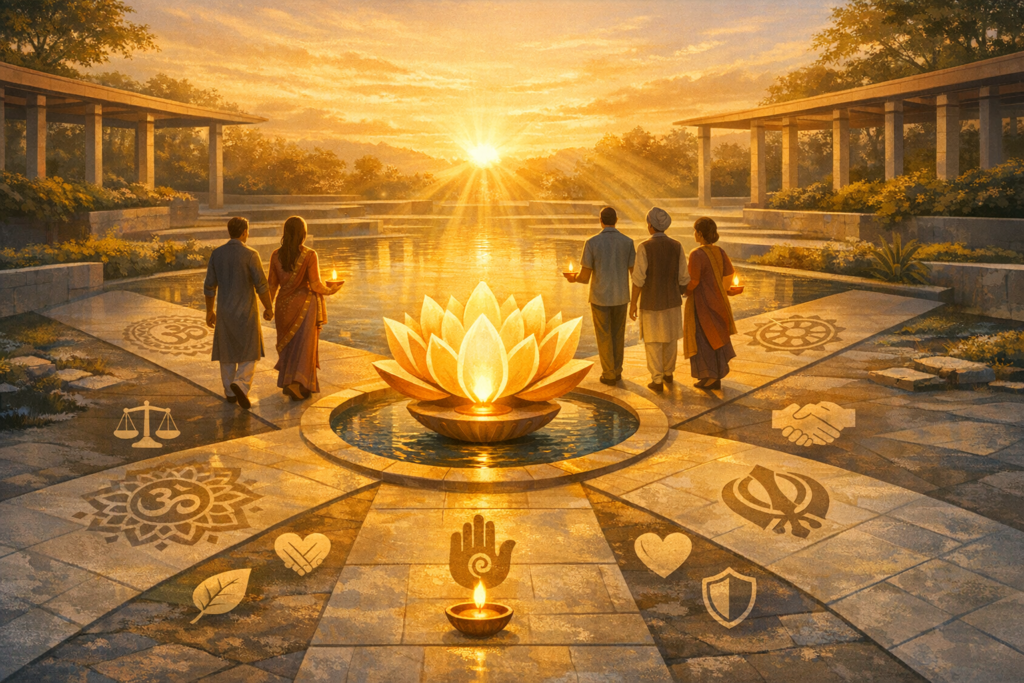
“Know that Bhagavan alone is real. Nothing else matters.” This aphorism distills a central insight of Hindu philosophy and spirituality: ultimate reality is singular, self-luminous, and the source, substance, and sanctuary of all existence. The statement appears across centuries of Hindu saints’ teachings, from the Upanishadic seers to Advaita, Vishishtadvaita, and Dvaita acharyas, and through the Bhakti Tradition’s poet-saints. Read with care, it is neither a denial of the world nor a reduction of ethical life; rather, it is a call to anchor perception, conduct, and contemplation in what the sages term the Real—Bhagavan.
In Hindu thought, “Bhagavan” denotes the Supreme Being endowed with six principal excellences—sovereignty, strength, glory, splendor, wisdom, and detachment—while also signifying the Absolute (Brahman) that is sat-chit-ananda (being-consciousness-bliss). Sectarian lenses focus this truth through forms such as Vishnu, Shiva, Devi, Surya, or the satguru; yet the teachings insist that Bhagavan is omnipotent, omniscient, and omnipresent. The Upanishads affirm this non-dual ground: “sarvam khalvidam brahma” (all this indeed is Brahman) and “īśāvāsyam idam sarvam” (all this is pervaded by the Lord). The Bhagavad Gita reinforces the same: “mattaḥ parataraṁ nānyat” (there is nothing higher than Me).
Philosophically, the statement “Nothing else matters” requires careful hermeneutics. Advaita Vedanta distinguishes between paramarthika-satta (ultimate reality) and vyavaharika-satta (empirical reality). From the paramarthika standpoint, only Brahman-Bhagavan is absolutely real; the world is mithya—dependent reality, neither absolute nor utterly unreal. In daily life, dharma, relationships, and duties carry profound significance; the point is not to deny them but to orient them toward the Real. In Vishishtadvaita, the world and souls are real as the body of Bhagavan; in Dvaita, they are eternally distinct realities under Bhagavan’s sovereignty. Across these schools, the counsel converges: fix the heart and intellect on the Supreme, and let conduct flow from that orientation.
This insight flowers within the plural ethos of Sanatana Dharma. The Ishta in Hinduism legitimizes diverse devotional choices—Krishna, Shiva, Devi, Rama, or the formless Absolute—without contradiction. As Swami Vivekananda emphasized, many roads can lead to the same summit when pursued with sincerity and discipline. Sri Ramakrishna Paramahamsa framed the principle succinctly: as many faiths, so many paths. In that spirit, the statement under discussion does not advocate sectarian narrowness; rather, it deepens unity in spiritual diversity by recognizing the One through the many. It naturally resonates with the dharmic value Vasudhaiva Kutumbakam—the world is one family.
Within Vedanta’s spectrum, distinct emphases help practitioners internalize the One Reality. Advaita, following Adi Sankara, illuminates the non-dual Brahman, pointing seekers toward direct knowledge (jnana) through viveka (discernment), vairagya (dispassion), shatsampat (six virtues), and mumukshutva (longing for liberation). Vishishtadvaita, associated with Ramanujacharya, describes a qualified non-duality—Bhagavan as the inner ruler of all, with the cosmos and souls as His attributes—nurturing love and surrender (prapatti). Dvaita, articulated by Madhvacharya, underscores an eternal difference between Bhagavan and jivas, strengthening personal devotion and service (seva). Chaitanya’s Achintya-bheda-abheda celebrates the inconceivable unity-in-difference, which poetically integrates head and heart.
Bhakti Tradition saints translate metaphysics into lived intimacy. Tulsidas beholds “Siyā Rāmamay sab jaga jānī” (knowing the world to be pervaded by Sita-Rama), while Mirabai sings of unconditional surrender. Andal’s verses melt duality in love; Tukaram’s abhangas transform toil into remembrance; Namdev sees the Divine in every threshold. Their shared testimony is experiential: Bhagavan alone is real, and everything else finds meaning by reflecting that reality. For countless practitioners, nama-japa, kirtan, and seva dissolve restlessness, sweeten relationships, and recalibrate priorities around the sacred center.
Jnana traditions converge from a different angle. Adi Sankara’s Atmabodha and Vivekachudamani train the intellect to discern the imperishable Self from the transient not-Self. The Mahavakyas—“tat tvam asi” (that thou art), “aham brahmasmi” (I am Brahman)—do not inflate the ego but invite the sublation of ego into pure awareness. Ramana Maharshi’s self-inquiry (“Who am I?”) refines attention until the root-I-thought subsides in its source. When the mind abides in that source, the sages say, the Real alone shines.
Raja Yoga provides a disciplined psychology of the same ascent. Patanjali’s system (yama, niyama, asana, pranayama, pratyahara, dharana, dhyana, samadhi) culminates in samadhi—a steady absorption where modifications of the mind cease. The practice of īśvara-praṇidhāna (consecration to the Lord) orients the entire path toward Bhagavan. In modern terms, such contemplative stability reduces mental rumination, gently quiets the default-mode network, and increases clarity and compassion—empirical correlates that neither exhaust nor replace the spiritual claim.
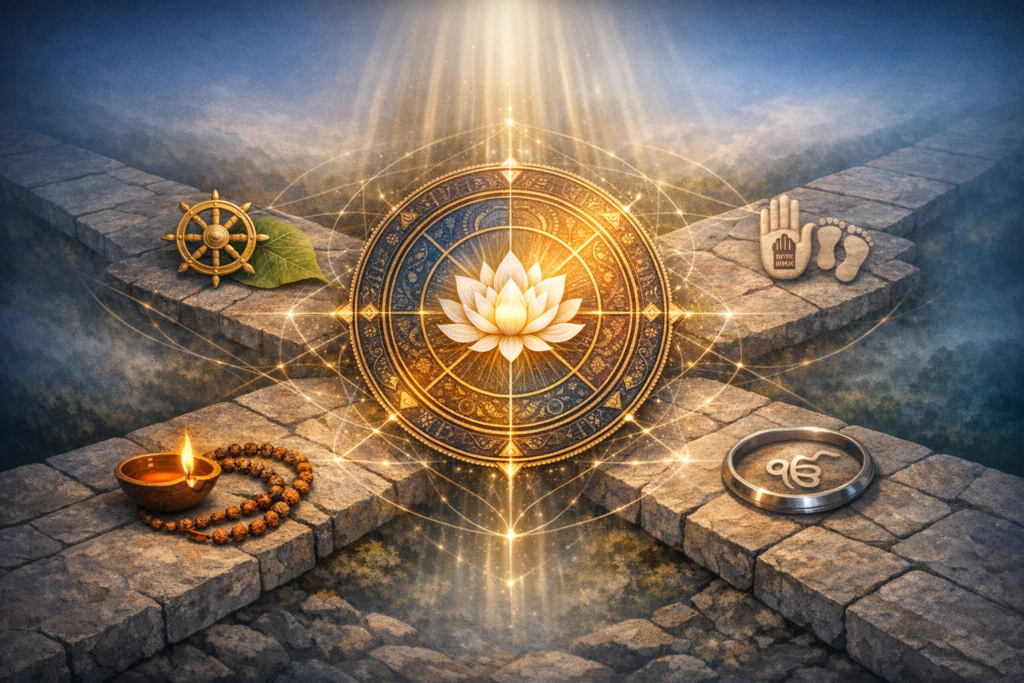
From a dharmic-unity perspective, the statement’s essence also resonates across Buddhism, Jainism, and Sikhism while honoring doctrinal differences. Buddhism points to the unconditioned—nirvana—and the suchness (tathata) beyond grasping, while refining compassion and mindful awareness. Jainism orients practice toward kevala-jnana (pure knowledge) and radical ahimsa, revering the Paramatman realized by the Tirthankaras. Sikhism proclaims “Ik Onkar”—One Reality—and affirms devotion to Waheguru through simran, seva, and honest living. In each stream, the counsel is similar: orient life around the Ultimate, and let conduct be purified in that light. This shared axial commitment fosters unity in spiritual diversity without erasing distinctive insights.
Scriptural anchors guide this orientation. The Bhagavad Gita declares, “aham sarvasya prabhavo” (I am the source of all), yet simultaneously affirms the sanctity of karma-yoga—performing one’s duty without attachment to results. The Bhagavata Purana lists nine limbs of devotion—shravanam, kirtanam, smaranam, pada-sevanam, archanam, vandanam, dasyam, sakhyam, atma-nivedanam—each a practical vector for centering life on Bhagavan. The Upanishads commend inquiry, meditation, and ethical discipline as prerequisites for stable realization. In synthesis, devotion, knowledge, and action are not rivals; they are mutually reinforcing when aligned with the Real.
Practitioners across India and the diaspora report convergent experiences. A householder juggling family and work in Bengaluru finds that a dawn round of nama-japa steadies attention through the day. A student in Toronto integrates Gita recitation with mindfulness, transforming exam anxiety into focused effort. A nurse in Kolkata chants silently between tasks, discovering that even brief remembrances of Bhagavan infuse compassion into clinical routines. Such vignettes do not substitute for rigorous sadhana but illustrate how everyday life becomes an instrument of remembrance when the center is clear.
The ethical arc of this vision is unambiguous. If Bhagavan alone is real, then honoring the Real requires satya (truthfulness), ahimsa (non-injury), daya (compassion), and dana (generosity). Dharma is not a postscript; it is the operational integrity of God-centered life. Far from apathy, “Nothing else matters” cautions against clinging—status, resentment, greed, and fear—and invites freedom in service. Karma-yoga reframes labor as worship; bhakti sweetens effort with love; jnana dissolves the egoic center that seeks rewards; together, they generate resilient equanimity.
Soteriologically, the traditions agree on the fruit of God-centered living: freedom from sorrow born of misidentification. In Advaita, it is jivanmukti, living liberation; in Vishishtadvaita and Dvaita, it is unwavering residence in Bhagavan’s grace and presence; in Bhakti Tradition, it is prema—love that knows no separation. The metrics are qualitative yet observable: reduction in compulsive reactivity, increase in stable joy, widened circles of care, and a spontaneous turn toward truth.
For those seeking a disciplined on-ramp, three integrated tracks are time-tested. First, shravana-manana-nididhyasana: guided study of the Upanishads, Bhagavad Gita, and Bhagavata Purana; contemplative reflection; and deep meditation. Second, bhakti-sadhana: nama-japa (with mala and count), kirtan, archana, and satsang, guided by the Ishta and nourished by the Bhakti Tradition. Third, karma-yoga and seva: consistent, skillful action without egoic residue, beginning at home and extending to community. A modest pranayama and asana routine supports attention hygiene; journaling clarifies intention; periodic retreats consolidate gains. When undertaken with sincerity and humility, these practices harmonize and progressively reveal the center that saints call Bhagavan.
Cultivating unity among dharmic traditions strengthens the ethos in which this realization matures. Shared practice platforms—scriptural dialogue, kirtan, meditation circles, and seva initiatives—highlight convergences while honoring distinctions. The Ishta philosophy safeguards freedom of approach; pluralism is not mere tolerance but an intentional embrace of many valid doors to the One. Sectarian triumphalism dissolves before the felt recognition that diversity is the very artistry of the Real.
At the heart of it all remains the refrain: Bhagavan alone is real. As understanding ripens, “Nothing else matters” no longer reads as a dismissal of life but as a crystalline prioritization: let every pursuit, relationship, and thought be illumined by the One who is the ground of being. Then worldly complexity becomes spiritually intelligible, and daily effort matures into offering. This is the wisdom of Hindu saints and sages, tested across centuries and open to all who seek the joy of dharmic unity.
Inspired by this post on Hindu Blog.