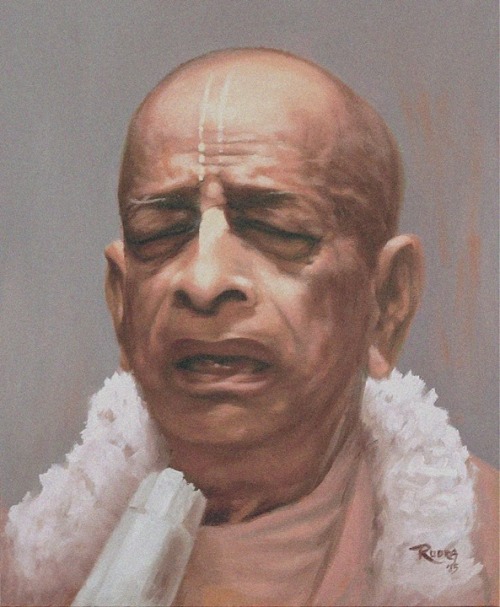
In 1976 at Vrindavan, a major festival day began at mangal arotik (pre-dawn worship) and extended until midnight, culminating in a vast Mathura pandal program honoring the Appearance of Lord Ram and drawing well over twenty thousand attendees. Across this demanding arc, Srila Prabhupada (A. C. Bhaktivedanta Swami Prabhupada) exemplified the Gaudiya Vaishnava synthesis of disciplined sadhana, fearless public preaching, meticulous scholarship, and humble servicean integrated leadership model that energized ISKCON (International Society For Krishna Consciousness) and the wider Hare Krishna Movement.
Udayananda, an eyewitness disciple, joined the extended morning walk through Vrindavan’s lanes as Srila Prabhupada preached vigorously for well over an hour. Gradually moving from the rear of the group to his side, he found himself entrusted with Srila Prabhupada’s cane when the acharya briefly stepped aside to pass water. In a moment that became a lifelong lesson, Udayananda instinctively tried to return the cane with his left hand. Srila Prabhupada paused and asked, “Left hand?”prompting an immediate correction. He then affirmed, “Always right hand.”
This brief exchange carried cultural and spiritual subtext. In classical Indian etiquette, the right hand is used in offering and receiving as an expression of care, cleanliness, and respectvalues that also anchor Vaishnava conduct. In a single, understated instruction, Srila Prabhupada transmitted a practical element of dharmic refinement, reinforcing how minute gestures can embody larger principles of reverence and seva (selfless service).
Immediately after the prolonged walk, Srila Prabhupada met dignitaries who had traveled from New Delhi, including the governor and state representatives. Those present observed an unwavering clarity as he engaged leaders on spiritual principles, social ethics, and dharmic responsibilityfirm yet courteous, lion-like in conviction yet lamb-gentle in demeanor. The sequence captured an often-overlooked dimension of his contribution: a public philosophy that could speak with precision to statecraft while remaining rooted in bhakti.
By evening, the day’s apex unfolded in Mathura at a sprawling pandal program (a public assembly in a temporary pavilion). Addressing the vast crowd, Srila Prabhupada began with a striking gesture of humility: “Because there are so many people here to hear Krishna’s pastimes, and they may not speak English, I am going to speak in Hindi, and I apologize.” He specified, “I apologize to my English speaking disciples.” The apology, simple and sincere, reflected the Vaishnava ethic of serving the audience before oneself and prioritizing accessible communication of Krishna-katha.
The gathering itself testified to the global surge of Gaudiya Vaishnavism. Devotees from Africa, England, Australia, America, and South America were present, their association evoking Bhaktivinode Thakur’s century-old vision: “When will Americans and Englishmen and Germans come with their hands raised high and say, ‘Jaya Sachinandana, Gaura Hari?’” In that moment, observers recognized a living fulfillment“The day has come!”as international communities joyfully embraced Krishna-bhakti through kirtan and service.
Despite public acclaim, Srila Prabhupada remained indifferent to fanfare. The focus never shifted from glorifying Krishna, guiding disciples, and widening the circle of compassion. This detachment from personal praise, paired with relentless effort, modeled a standard of leadership where results are offered upward, and one’s inner measure is devotion, not display.
Near midnight, the party returned to Fogel Ashram. Exhaustion was palpable. Udayananda, weakened by an untimely stomach illnesshaving eaten jalebis in the marketplaceattempted to rest but could not. Approaching 2:00 a.m., the Kṛṣṇa-Balaram temple’s twenty-four hour kirtan continued at a whisper, a lone mridanga gently pulsing as the holy name moved through the stillness. Circumambulating the temple, Udayananda noticed a light in Srila Prabhupada’s room.
Inside, Srila Prabhupada was dictating with a small recorderstill working. Udayananda distinctly heard: “Srila Visvanatha Chakravarti Thakur says in his explanation of the Gita…” Srila Prabhupada was translating and commenting on the Srimad-Bhagavatam and relating insights to the Bhagavad Gita, continuing the literary labor that undergirded ISKCON’s educational mission. The juxtaposition was stark: after a fourteen-plus-hour day of sadhana, meetings, and large-scale outreach, he quietly resumed scholarship with the same intensity.
Viewed analytically, the day forms a cohesive arc: sadhana and cultural refinement (the morning walk and right-hand instruction), civic engagement (dialogue with dignitaries), mass communication (the pandal lecture in Hindi with an inclusive apology), and rigorous textual work (late-night dictation on Srimad-Bhagavatam drawing upon Gaudiya Vaishnava commentators like Visvanatha Chakravarti Thakur). Few leaders embody all four vectors with equal strength. The integrated methodchanting, teaching, governing conversation, and writingreveals a repeatable model for sustaining spiritual movements across cultures and generations.
These qualities resonate across the dharmic family. The discipline of japa and kirtan aligns with the contemplative rigor seen in Buddhist mantra practice; the ethic of ahimsa and seva reflects Jain ideals of non-violence and service; the reverence for the Divine Name parallels Sikh devotion to Naam Simran. In each case, humility in communication, integrity in conduct, and compassionate outreach form shared pillars. Such convergence nurtures unity without erasing distinct identitiesan applied expression of Vasudhaiva Kutumbakam that strengthens interfaith respect among Hinduism, Buddhism, Jainism, and Sikhism.
For many observers, this singular day in 1976 captured why Srila Prabhupada is honored by followers as a jagat-guru: a teacher whose tireless pursuit of giving Krishna consciousness served not only a community, but the world. The metric was neither spectacle nor numbers; it was the steadfast transmission of wisdomon the path, on the dais, and at the dictaphoneso that seekers across languages and lands could approach Krishna with understanding and joy.
Account as recalled by Udayananda; preserved here for historical insight, devotional reflection, and cross-dharmic learning.
Inspired by this post on Dandavats.