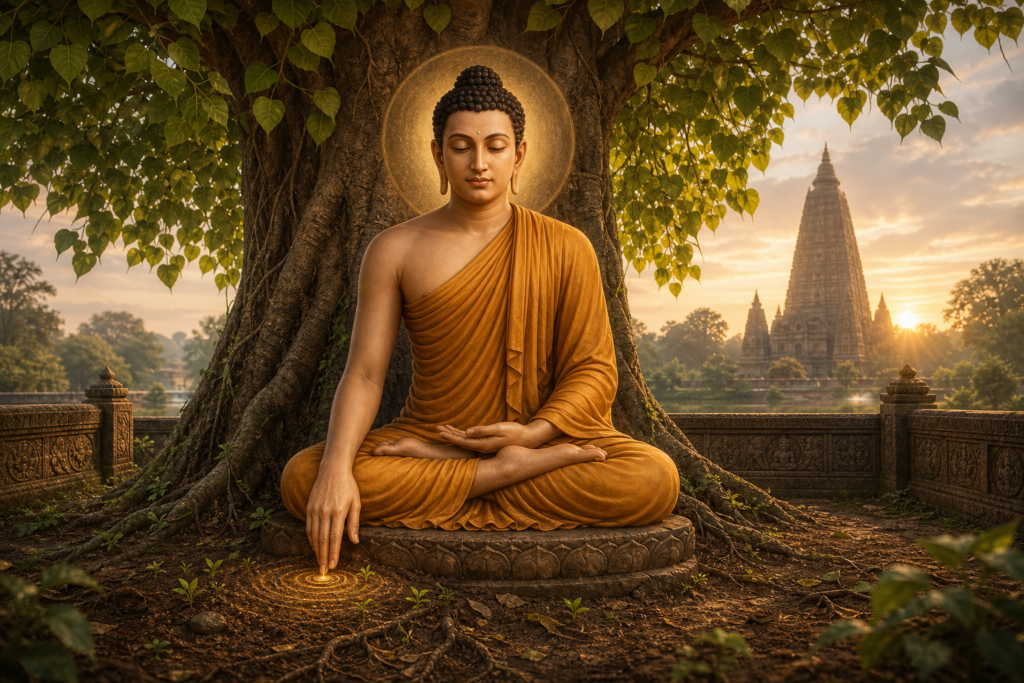
Madhava Dasar stands in Hindu cultural memory as a Brahmin exalted in morality, a disciplined householder-sage in the mold of Janaka, and a distinguished practitioner of sacred learning who harmonized textual mastery with living devotion. Hagiographical accounts consistently emphasize his comprehensive study of the four Vedas, the Vedic Vedantas, and the classical school of Vaiseshika, portraying an individual deeply grounded in śruti-based authority, reasoned inquiry, and contemplative practice. Such a portrait positions Madhava Dasar at the confluence of philosophy and bhakti, where wisdom becomes audible in song and devotion becomes intelligible as doctrine.
For those who seek clarity through queries such as “who is Madhava Dasar,” “Madhava Dasar Katha,” or “Madhava Dasar bhakti songs,” the traditional answer locates him within India’s long arc of devotional and philosophical synthesis: a learned Brahmana whose moral excellence and scriptural competence were not ends in themselves, but gateways to accessible spiritual teaching through katha (narrative) and kirtana (devotional singing). Rather than valorizing renunciation alone, the record associates him with the Janaka paradigmremaining engaged in worldly responsibilities while embodying inward freedom, ethical steadiness, and contemplative depth.
Accounts underline a rigorous scholastic base: study of the four Vedas provided a foundation in canonical revelation; immersion in Vedic Vedantas furnished a mature metaphysical and soteriological framework; and engagement with Vaiseshika introduced a finely grained realist ontology. In combination, these disciplines cultivate a composite vision: revelation (śruti), reflection (tarka), and realization (anubhava) are aligned to illuminate the path of dharma. The resulting intellectual posture is neither narrowly sectarian nor merely academic; it is integrative, practical, and soteriologically oriented.
Hagiography’s comparison with Janaka is significant. Janaka, celebrated in the Upanishads as a rajarshi (royal sage), models karma-yoga purified by insight (jñāna) and suffused with devotion (bhakti). To live “like Janaka” is to demonstrate that household lifeand by extension, civic responsibilityis not a barrier to spiritual realization. This framing clarifies why Madhava Dasar’s teaching is remembered as a unity of right conduct, contemplative discipline, and devotional sentiment.
The devotional corpus associated with Madhava Dasar is characterized, in traditional recollection, by clarity of moral voice and tenderness of sentiment. Bhakti songs in this stream often distill complex metaphysical insights into memorable poetic unitspadas, bhajans, and kirtanasorganized for congregational singing and personal reflection. Listeners are guided from narrative (katha) to principle (tattva) and from principle to practice (sādhana), reflecting a pedagogy in which music, memory, and meaning reinforce each other to anchor daily life in dharma.
This synthesis of jñāna (knowledge), karma (disciplined action), and bhakti (devotion) marks the hallmark of mature Hindu pedagogy. Knowledge without devotion risks aridity; devotion without knowledge risks sentimentality; action without either risks moral drift. Madhava Dasar’s remembered posture brings these strands into mutual illumination: devotion motivates disciplined living, disciplined living clarifies the mind for knowledge, and knowledge deepens and purifies devotion.
Philosophically, engagement with Vaiseshika signals a commitment to analytical clarity. The classical taxonomy of categories (padārthas) such as dravya (substance), guṇa (quality), karma (motion), sāmānya (generality), viśeṣa (particularity), and samavāya (inherence) equips the seeker with a precise vocabulary for describing reality’s structure. When this analytic lens is read in the light of Vedanta’s inquiry into the nature of Brahman, Ātman, and liberation (mokṣa), the devotional practitioner gains both metaphysical orientation and existential assurance. The intellectual task then becomes hermeneutical: to interpret experiential devotion within a rigorously articulated view of reality.
Such hermeneutics is traditionally pursued through a triadic discipline: śravaṇa (attentive hearing of scripture), manana (reasoned reflection), and nididhyāsana (steady contemplation). In bhakti settings, this triad is augmented by nāma-saṅkīrtana (sacred name recitation) and sevā (service), linking insight to rhythmic remembrance and ethical action. Madhava Dasar’s remembered emphasis on morality becomes the ethical ground on which contemplative composure and devotional warmth can securely rest.
Ethically, the portrait emphasizes steadfast truthfulness (satya), compassion (dayā), self-restraint (dama), and generosity (dāna). These virtues are not merely ancillary; they constitute the lived grammar of dharma. In the devotional songs associated with this lineage, ethical counsel often appears as intimate guidance: cultivate humility, honor the guru-shishya relationship, align speech with truth, and transform daily obligations into offerings. The affective tone is gentle yet firm, inviting transformation without coercion.
From a cultural perspective, the “Dasar/Dasaru” honorific signals a self-understanding as dāsaservant of the Divinean identity that dissolves egoic entitlement into devotional service. Across India’s bhakti movements, this dāsa identity nurtures vernacular theologieslocal languages and melodies serve as vessels for universal insights. While specific attributions and dates for Madhava Dasar vary in oral memory, the theological grammarservice, remembrance, and surrenderremains consistent and pedagogically potent.
Importantly, the values highlighted in Madhava Dasar’s remembered life resonate beyond Hindu sectarian lines and into the wider dharmic family. Compassion and non-harm align with Jain ethics; contemplative discipline and insight dovetail with Buddhist practice; musical remembrance and congregational singing find kinship with Sikh kirtan. Emphasizing shared dharmic virtuestruthfulness, compassion, self-mastery, servicenurtures unity-in-diversity and strengthens inter-traditional goodwill.
For contemporary practitioners, the practical arc suggested by this legacy is clear: begin with moral clarity, stabilize the mind through remembrance and contemplative discipline, deepen understanding through reasoned engagement with scripture, and allow devotion to infuse everyday action. In homes, study circles, and community gatherings, Madhava Dasar bhakti songs can function as living textschanted, contemplated, and appliedturning ordinary time into sanctified practice.
Methodologically, scholars and serious students may approach the corpus through multiple lenses: textual-historical (tracking attributions and variant recensions), literary (meter, imagery, and rhetorical strategies), musicological (rāga, tāla, and performance context), and philosophical-theological (interfaces among Vedanta, Vaiseshika, and bhakti praxis). Oral histories from tradition-bearers add invaluable context, while comparative studies across bhakti lineages illuminate shared motifs and distinctive accents.
In sum, the remembered figure of Madhava Dasar exemplifies an integrative pedagogy: scriptural fidelity without dogmatism, analysis without aridity, devotion without credulity, and ethical seriousness without harshness. The Janaka-like ethosfully present in the world yet inwardly freeoffers a practical ideal for householders and renunciants alike. As narrative (katha) and song crystallize philosophical vision into lived counsel, a balanced path emerges: one that upholds unity across dharmic traditions while honoring the plurality of languages, melodies, and methods through which Truth is sought and celebrated.
Inspired by this post on Hindu Pad.