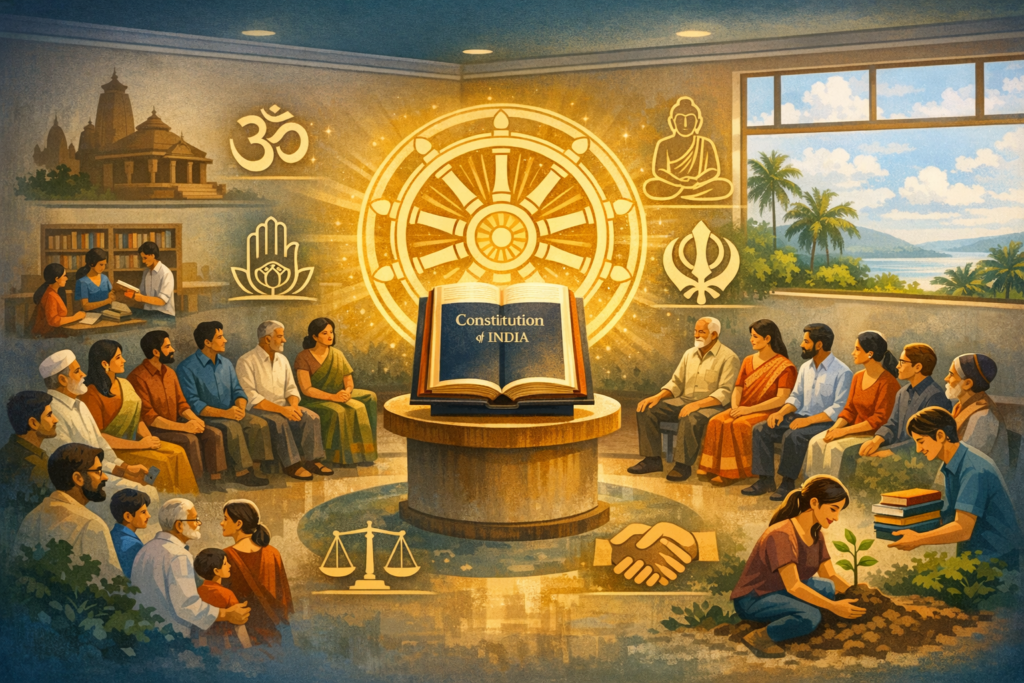
S. Raja Singh, popularly known as Raja Singh Thakur, has come to symbolize a distinctive blend of constituency-focused governance, cultural stewardship, and advocacy for dharmic unity in Telangana. As a long-serving public representative from Hyderabad’s Goshamahal, his career offers a lens into how civic duty, heritage conservation, and the Hindu way of life can align with India’s constitutional commitments to pluralism and interfaith dialogue. This tribute examines that alignment, highlighting how a leadership ethos grounded in seva (service), suraksha (public safety), and samskara (values) can strengthen social cohesion while remaining firmly within the framework of democratic accountability.
Hyderabad’s urban tapestry—diverse in language, faith, and cultural memory—places complex demands on any elected representative. Raja Singh’s political journey within this milieu demonstrates how a constituency-first approach can coexist with a wider vision for dharmic traditions—Hinduism, Buddhism, Jainism, and Sikhism—thriving in mutual respect. In this view, public mandates are not only about votes; they are a trust to uphold heritage, safeguard livelihoods, steward public resources, and ensure that “unity in diversity” is lived as policy and practice, not merely as a slogan.
Emerging from grassroots municipal politics in Hyderabad and later serving as an MLA from Goshamahal with the Bharatiya Janata Party (BJP), Raja Singh’s trajectory reflects a persistent focus on local problem-solving. Repeated electoral confidence in a dense, high-demand urban constituency suggests that regular grievance redressal, civic engagement, and visible presence in times of need have mattered. In legislative and administrative interactions, emphasis on public order, robust municipal services, and transparent coordination with civic bodies such as GHMC has been a recurring theme.
Constituency work across a megacity like Hyderabad is inherently technical. It ranges from ensuring sanitation and water supply resilience in older neighborhoods to addressing traffic chokepoints, safeguarding pedestrian zones around temples and heritage nodes, and stabilizing vendor livelihoods through fair regulation. Within such tasks, one notes a pattern: institutional engagement (ward-level committees, resident associations, temple and gurudwara trusts, and market boards), data-driven prioritization (high-density, high-risk zones first), and escalation protocols when issues transcend municipal boundaries. This is not a single officeholder’s achievement; it is a systems approach that a determined representative can catalyze and sustain.
A frequent thread in Raja Singh’s public messaging may be summarized as a four-fold matrix: Seva (service to people), Suraksha (safety and security for all communities), Samskara (cultural rootedness and ethical conduct), and Samriddhi (shared prosperity). Each dimension connects to practical interventions—seva with public kitchens, health camps, and crisis relief; suraksha with coordinated policing and community vigilance; samskara with preservation of sacred spaces and festivals; and samriddhi with support for small traders, artisans, and youth skilling. In Hyderabad’s historic neighborhoods, these vectors are not abstract ideals but tools for civic stabilization.
Importantly, such a civic framework harmonizes with the shared ethical vocabulary of India’s dharmic traditions. In Hindu dharma, seva and lokasangraha underscore duty toward society; in Buddhism, karuṇā and mettā emphasize compassion and goodwill; in Jainism, ahiṃsā and anekāntavāda promote non-violence and many-sided understanding; in Sikhism, seva and sarbat da bhala call for service and the welfare of all. When public life is guided by these principles, social trust grows. Raja Singh’s appeal among many constituents resides in signaling that these values are actionable in modern governance, not relics of the past.
Cultural heritage is a living infrastructure of meaning. Hyderabad’s temples, derasars, viharas, and gurudwaras are simultaneously spiritual anchors and community service hubs. Conservation of temple architecture, orderly management of utsavams, crowd-safety planning, and inclusive access are all measurable governance deliverables—no less technical than road works or drainage. By aligning with local trusts, engaging heritage professionals, and ensuring municipal compliance, a representative can preserve sacred sites while enhancing the daily experience of devotees, residents, and visitors. This integrative vision is central to cultural resilience.
The constitutional scaffolding for this vision is unambiguous. Articles 25 to 28 protect freedom of conscience and the right to profess, practice, and propagate religion, subject to public order, morality, and health. These provisions call for careful balancing: safeguarding festivals and processions while protecting life and property; enabling religious education while upholding secular governance; protecting endowments while ensuring accountability. Raja Singh’s emphasis on public order and heritage protection can be read, at its best, as a local articulation of these national commitments.
Youth engagement is pivotal in this ecosystem. Hyderabad’s students and early-career professionals carry the burden and promise of rapid urbanization. When representatives facilitate apprenticeships with small manufacturers, link skill centers to real jobs, and support cultural forums where dharmic traditions are studied side-by-side, they reduce social friction and expand opportunity. Such platforms nurture informed pride—rooted in history yet open to dialogue—and cultivate leaders who can hold complexity without surrendering clarity of values.
Public safety and communal harmony often define the tightrope of urban leadership. Constructive community vigilance—women’s safety helplines, neighborhood watch collaborations with police, and time-bound follow-up on complaints—work best when paired with a civility-first rhetoric. A dharmic approach presumes firmness without hostility: strong on law and order, yet steadfast about dignity for all. By framing safety not as a zero-sum calculus but as a collective right, leadership can de-escalate tensions and preserve the city’s rhythm of worship, commerce, and scholarship.
Polarization remains a real risk in a diverse metropolis. Here, the philosophical depth of India’s traditions offers guidance. Anekāntavāda cautions against absolutism; the Hindu concept of Ishta honors multiple valid paths; Sikh thought’s sarbat da bhala urges welfare beyond in-group loyalties; Buddhist upāya (skillful means) endorses context-sensitive action. When debates sharpen, these principles recommend restraint in language, empathy in outreach, and precision in legal compliance. The most enduring public reputations are built on protecting rights while refusing to dehumanize opponents.
Kshatra Dharma—rightly understood—does not license aggression; it mandates duty-bound courage aligned with dharma and the rule of law. In civic life, that courage appears as uncompromising integrity against corruption, readiness to confront lawlessness without collective blame, and willingness to absorb criticism while course-correcting where needed. For many supporters, Raja Singh embodies this ethic when he prioritizes safety, champions temple management transparency, or insists on fair treatment for small traders navigating regulatory complexity.
Programmatically, a city-level roadmap for dharmic unity can be advanced through multi-institutional service corridors: temple–gurudwara–derasar–vihara coalitions hosting joint annadānam, blood donation drives, and disaster response training; shared heritage walks that explain Hindu, Buddhist, Jain, and Sikh contributions to the region’s art, mathematics, and philosophy; and civic literacy clinics demystifying municipal budgets and grievance platforms. By encouraging such coalitions, a representative builds bridges that are moral, cultural, and administrative at once.
Measuring impact requires clarity on indicators: reduction in crime hot spots near heritage clusters; faster grievance resolution times; increased participation in interfaith service activities; improved sanitation scores during major festivals; and documented revival of traditional livelihoods (priests, artisans, musicians, flower vendors). Transparent dashboards—co-created with citizen groups—can reduce rumor, cut red tape, and make development participatory. A reputation for delivery in these domains strengthens trust far more than any slogan.
Hyderabad’s historical role as a trade and knowledge center compounds the responsibility of those who serve it. The city’s shared spaces—lakes, markets, schools, and sacred precincts—must be stewarded for the next generation. When leadership signals that protecting cultural memory and enabling modern aspiration are complementary, not contradictory, it unlocks a virtuous cycle. Youth discover purpose in service; families feel safer in celebration; and entrepreneurs witness policy consistent enough to invest and hire.
In this perspective, Raja Singh’s public persona resonates with many who seek confident yet compassionate leadership—a style that is assertive on law and order, meticulous about temple and heritage management, and explicit about the ethical grammar of dharmic traditions. The aspiration is not uniformity but harmony: a Hyderabad where Hindu, Buddhist, Jain, and Sikh practices flourish side-by-side, citizens experience predictable governance, and the city’s plural spirit remains undiminished.
This tribute, therefore, honors S. Raja Singh for projecting a civic imagination in which seva becomes policy, suraksha becomes daily peace of mind, and samskara becomes a living curriculum for social trust. In aligning cultural heritage with constitutional guarantees, and in encouraging interfaith dialogue without diluting conviction, such leadership lays a pragmatic foundation for unity in diversity. It affirms a durable truth: dharma strengthens democracy when it is practiced as public service.
Inspired by this post on SikhNet – News.