The Archaeological Survey of India (ASI) has submitted a scientific report to the Indore Bench of the Madhya Pradesh High Court indicating that the structure known as Kamal Maula Masjid, within the Dhar Bhojshala precinct of Madhya Pradesh, incorporates remnants from earlier temples. According to the submission, a range of architectural elements, sculptural fragments, and inscriptionstypical markers of temple architectureappear to have been repurposed in the mosque’s fabric, a phenomenon archaeologists describe as spolia.
Dhar Bhojshala holds a distinctive place in the cultural memory of central India. Frequently associated with the learned court of the Paramara ruler Raja Bhoja (11th century CE) and with the veneration of Saraswati (also locally remembered as Waghdevi), the site has long been regarded as a layered heritage complex. The physical ensemble in and around Dhar reflects successive construction and reuse across the Paramara period and the period of the Delhi and Malwa Sultanates, making it a textbook case in the archaeology of medieval India.
The ASI’s court-mandated inquiry is framed as a technical, evidence-led exercise rather than a commentary on contemporary claims. In such investigations, archaeologists routinely combine architectural documentation with epigraphic analysis, material characterization, and stratigraphic observation to understand how and when different components of a monument came together. The central question before the court concerns what the stones themselves recordthrough their forms, motifs, tool marks, and inscriptionsabout the site’s building history.
The report’s key inferencethat the mosque’s walls and supports include earlier temple fragmentsrests on multiple, mutually reinforcing indicators. These include carved members with profiles and mouldings typical of Hindu temple architecture; iconographic panels that align with temple decorative vocabularies; and inscriptions whose scripts, formulae, and dedicatory phrasing are consistent with earlier religious endowments. When combined, such evidence provides a robust basis to identify spolia and to situate it chronologically.
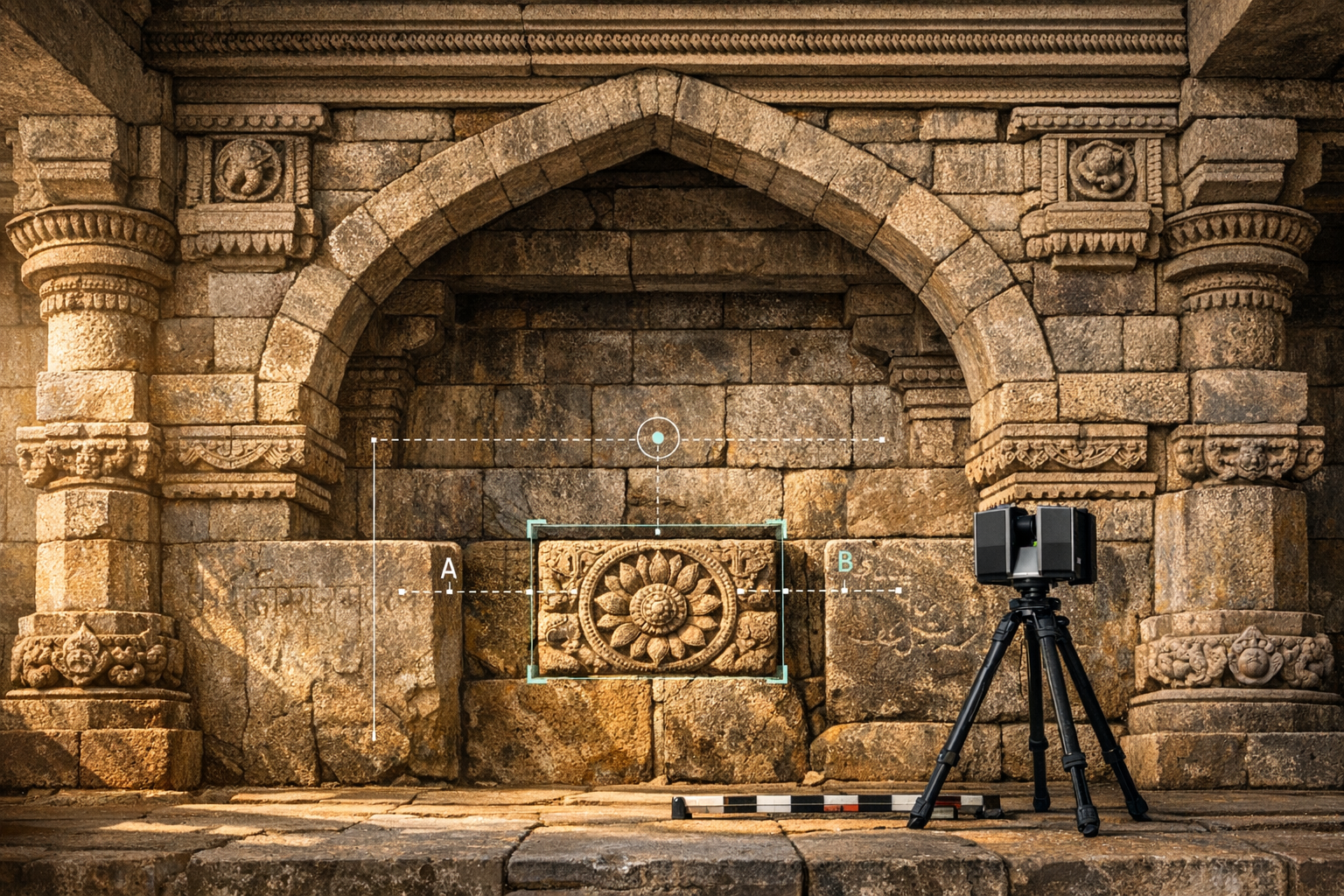
Methodologically, ASI surveys of this nature typically employ high-resolution architectural drawings, measured photography, and, where appropriate, 3D photogrammetry or laser scanning to capture mouldings, capitals, and friezes with millimetric accuracy. Epigraphers document and read inscriptions, noting script type (e.g., early Nagari forms) and paleographic features that aid dating. Petrographic or visual lithology studies can identify quarry sources and compare stone types across reused members. These standard archaeological workflows generate a chain of evidence that is transparent, reproducible, and suitable for judicial scrutiny.
Architectural evidence often speaks most clearly in the repetition of established temple profiles. Elements such as kapota and chhajja mouldings, kumbha and kalasha motifs on bases, bracketed capitals with lotus medallions, or remnants suggestive of amalaka and jangha friezes are among features commonly associated with temples of the 10th–12th centuries in the Malwa–Paramara sphere. When such elements appear in secondary positionsrotated, inverted, or built into later wallsthey strongly indicate reuse rather than original design intent.
Sculptural fragments embedded in masonry can further corroborate this sequence. Reliefs depicting floral scrolls, vyalas, kirtimukhas, or fragmentary deity panelsparticularly when defunctionalized as fillers or chocksalign with known temple iconographic programs. Even when images are partial, surviving attributes and stylistic canons permit cautious attribution to specific regional idioms.
Epigraphy adds a textual layer to the material testimony. Where stone members bear Sanskrit or Prakrit inscriptions in Nagari scripts, their orthography and formulaic contentnaming donors, deities, or tirthascan be compared with published corpora from Paramara Malwa. The presence of later Persian-Arabic epigraphy in other components of the same complex is equally important, not as contradiction but as evidence for successive historical phases. Together, these inscriptions help trace a palimpsest of uses and meanings.
It is essential to contextualize spolia within broader building practices. The reuse of earlier architectural material is well-attested globally, from Roman marbles in medieval basilicas to temple fragments in later Indian monuments. In the Indian context, spolia appears in sites across regions and periods, reflecting logistical pragmatism, availability of high-quality stone, and prevailing political economies of construction. The presence of spolia at Dhar Bhojshala thus situates the complex within a known architectural phenomenon rather than isolating it as an anomaly.
Comparative case studiesfrom the Quwwat-ul-Islam complex in Delhi to later mosques in Ahmedabad and Gaurdemonstrate that mixed-material monuments are archives of layered histories. Each site requires patient documentation, careful cataloguing of members, and interpretive restraint in drawing conclusions beyond the evidence. Dhar aligns with this methodological template: a stratified complex where earlier sacred architecture fed into later building campaigns.
Chronology at such sites is rarely singular. Distinguishing between construction chronology (when stones were first carved), reuse chronology (when they were reassembled), and usage chronology (how communities engaged with the site over time) is crucial. The ASI report’s emphasis on reused temple members speaks to the first two; the thirdpatterns of worship, instruction, and community memorybelongs to social history and living heritage.
Community recollections around Dhar Bhojshala underscore this distinction. For generations, the precinct has evoked devotion, scholarship, and reverence among diverse groups. Locally remembered practicessuch as distinct days of access for different communitiesreveal lived negotiations of space that have, at times, enabled shared dignity and reduced friction. These memories are part of the site’s intangible cultural heritage and deserve documentation alongside stones and scripts.
From a conservation perspective, the ASI’s findings invite a multi-vocal interpretation strategy. Clear, evidence-based signage can explain how to “read” spolia, highlighting mouldings, iconographic residues, and inscriptions without valorizing one period over another. A small on-site gallery or interpretive centre could present measured drawings, epigraphic facsimiles, and typological comparisons from Paramara Malwa, thereby transforming debate into learning.
Effective heritage stewardship also requires considered access frameworks. The Ancient Monuments and Archaeological Sites and Remains (AMASR) Act and associated rules provide protocols for conservation, maintenance, and public use of protected monuments. Within these frameworks, locally appropriate visitor managementguided by safety, respect, and inclusivitycan accommodate the sensitivities of a living, multi-period sacred landscape.
Judicial oversight is equally vital. The High Court’s engagement ensures that any administrative or conservation decisions remain grounded in verified evidence and due process. The court’s role is not to arbitrate faith but to ensure that state agencies, including the ASI, adopt rigorous, transparent standards that protect cultural heritage while respecting lawful rights and public order.
For students of archaeology and architectural history, Dhar Bhojshala now stands as a classroom in stone. The complex teaches methodsarchitectural typology, epigraphy, and material analysisalongside ethics: interpretive humility, awareness of community sentiment, and the responsibility to communicate findings without sensationalism. In this sense, the ASI report is not an end but a beginning for scholarly and civic education.
The site also offers an opportunity to reinforce the shared civilizational values that animate India’s dharmic traditionsHinduism, Buddhism, Jainism, and Sikhism. A unified interpretive narrative can foreground knowledge (vidyā), compassion (karuṇā), non-violence (ahiṁsā), and service (seva) as common ethical threads. Exhibits and guided tours that emphasize learning, dialogue, and mutual respect can transform visitors from passive spectators into mindful stewards of heritage.
Practical steps can translate these principles into policy. A multi-stakeholder “Site Interpretation Committee,” including representatives from local communities, scholars of archaeology and epigraphy, and heritage managers, could advise on signage, access, and educational programming. Periodic “open lab” dayswhere ASI teams share documentation methodswould demystify archaeological practice and build trust.
Digital humanities can amplify this transparency. A publicly accessible 3D model of select architectural members, high-resolution imagery of inscriptions with transliteration and translation, and a GIS map of find-spots would allow independent scrutiny and facilitate scholarly collaboration. Such initiatives align with global best practices (e.g., ICOMOS charters, the Nara Document on Authenticity) that encourage clear documentation and layered interpretation.
It bears emphasis that identifying spolia neither resolves nor predetermines policy on worship or management; those questions belong to law and administration, guided by public interest and safety. What the evidence does provide is clarity about the monument’s constructional historya factual platform upon which reasoned, inclusive decisions can stand.
In heritage terms, the presence of earlier temple materials in Kamal Maula Masjid situates Dhar Bhojshala within a long continuum of Indian building practice. Recognizing this continuity need not diminish the religious significance that different communities attach to the space. Rather, it can invite an ethic of shared care: preserving every historical layer, communicating findings accurately, and ensuring that contemporary use remains dignified and lawful.
Scholarly caution remains essential. While stylistic and epigraphic indicators offer compelling inferences, final datings and attributions are strongest when triangulated across disciplines and, where feasible, published in peer-reviewed venues. The ASI’s submission to the court is an important step; continued publication and collegial review will deepen confidence in the record.
Beyond the precinct, the Dhar case contributes to broader conversations on cultural heritage in India: how to narrate complex pasts; how to prioritize conservation amid living practice; and how to center constitutional values of dignity, equality, and fraternity in heritage policy. These are not abstract ideals; they shape the everyday experience of visitors, devotees, and residents around multi-period sacred sites.
If embraced thoughtfully, Dhar Bhojshala can model a balanced path forward. Evidence-led conservation can proceed alongside empathetic visitor management; interpretive candor can coexist with spiritual reverence; and the unity of India’s dharmic traditions can be expressed not by erasing difference but by honoring the many ways communities approach the sacred and the historical.
In sum, the ASI’s scientific reportindicating extensive temple spolia within Kamal Maula Masjid at Dhar Bhojshalaadds crucial, factual clarity to the site’s architectural biography. The finding aligns with known patterns of medieval spolia, underscores the need for rigorous documentation and careful interpretation, and invites a mature civic conversation guided by archaeology, law, and an ethic of shared guardianship. Preserving the integrity of every historical layer, while safeguarding the dignity of every visitor, is the surest way to honor the depth and diversity of India’s cultural heritage.
Inspired by this post on Hindu Jagruti Samiti.