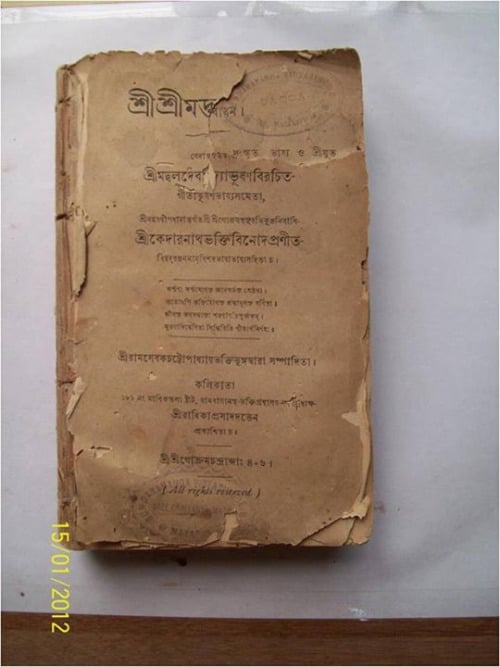
The Krittibas Ojha Bengali Ramayana preserves a compelling narrative absent from Valmiki’s text: Ravana, the rakshasa monarch and formidable adversary, officiates as priest for Rama’s worship of Durga. This episode, central to Bengali religious memory, intertwines ritual ingenuity, regional theology, and ethical paradox to illuminate a profound vision of dharma wherein knowledge, devotion, and righteous intent transcend enmity. It also offers an origin-story for Bengal’s autumnal Durga Puja, situating the practice within a larger tapestry of Shakta–Vaishnava synthesis and pan‑Dharmic values.
Composed in medieval Bengal, the Krittivasi Ramayan (often called the Krittibas Ojha Bengali Ramayana) exemplifies the vernacularization of Sanskrit epic literature and its localization through regional idioms and ritual motifs. While Valmiki situates Rama’s pre‑battle consecration in the Surya-focused Aditya Hridayam, Krittibas substitutes a Durga-centered liturgy that aligns powerfully with Bengal’s devotional environment, especially the Chandi-centric tradition and the cultural weight of Sharadiya Durga Puja.
The narrative arc unfolds with Rama preparing to confront Ravana and seeking the blessings of Durga. At this juncture, Krittibas introduces an arresting turn: Ravana, a Brahmana by descent (from the lineage of Pulastya through Vishrava) and a renowned devotee of Shiva and the Goddess, is engaged as purohit. The choice is both ritually logical and ethically provocative. Ritual competence (adhikara) in the story is tied not to partisan allegiance but to scriptural learning and spiritual attainment, foregrounding an expansive understanding of dharma.
In Bengali memory, this worship is Akalbodhanthe “untimely” or autumnal invocation of the Goddess, traditionally linked to Rama’s urgent need for Shakti’s grace outside the vernal season of Basanti Durga. Akalbodhan thus becomes both a theological assertion of Durga’s compassionate readiness and an etiological explanation for Bengal’s Sharadiya Durga Puja, anchoring a living festival in epic time.
The figure of Ravana as priest operates on multiple registers. Textually, it acknowledges his Brahmanical learning and tapas; ritually, it recognizes a hierarchy of skill and knowledge; ethically, it dissolves simplistic binaries of good and evil by insisting that even an adversary can act within dharma when stewarding sacred rites. This is not moral relativism but a nuanced affirmation that dharma is upheld by right action, correct intention, and scripturally sanctioned competence.
Manuscript families and oral performance traditions of the Krittivasi Ramayan exhibit variants of the episode. In some recensions, Ravana gives ritual instructions rather than officiating continuously; in others, his role centers on crucial procedural knowledge. Such variance is characteristic of premodern epic transmission in the subcontinent, where regional redactors and katha-vachakas integrated local liturgies, idioms, and devotional emphases without erasing the epic’s core narrative integrity.
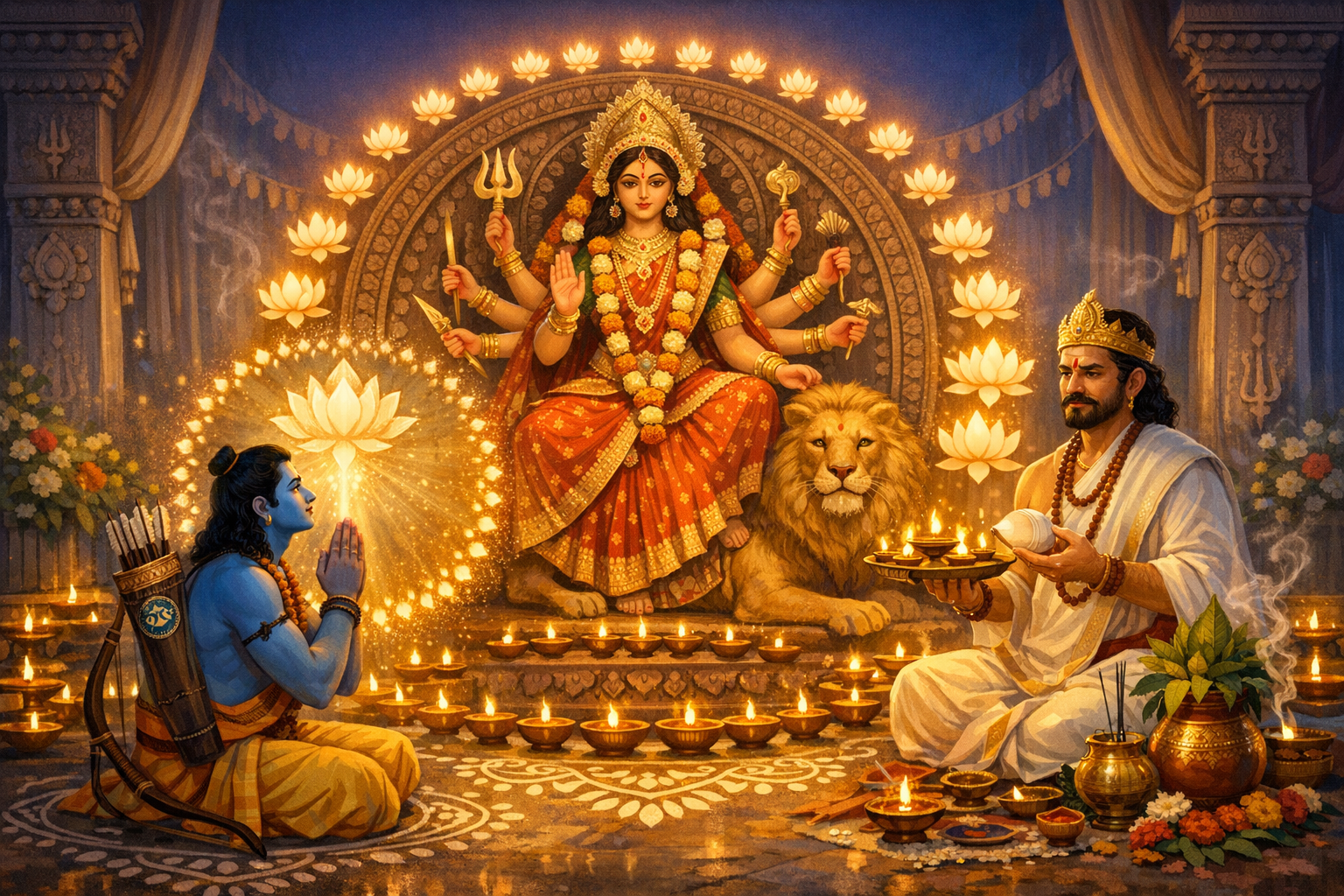
A famous associated motif in Bengal involves the worship of Durga with 108 lotuses. When Rama finds one lotus short, the narrative emphasizes his unwavering resolve: renowned as Kamalnayan (lotus‑eyed), he prepares to offer his own eye in place of the missing flower. Durga halts the act, revealing that devotion, not mere enumeration, perfects the ritual. Whether or not Ravana engineers the test in a given telling, the theological message prevailsbhakti conjoined with dharma outshines formal scarcity.
The broader ritual frame of Sharadiya Durga PujaSandhi Puja at the Ashtami–Navami juncture with 108 lamps, the recitation of the Devi Mahatmya (Chandi), and the Nabapatrika consecration sometimes associated with the Kola Bouresonates with the Krittibas narrative by highlighting timely invocation, ritual precision, and the Goddess’s immediate grace. These practices underscore how the Bengali Ramayana fuses epic time with seasonal festival, building a shared religious calendar out of literature, liturgy, and community memory.
Set against Valmiki’s Aditya Hridayam, the Krittibas episode demonstrates adaptive theology in practice. The pan‑Indian epic remains constant, yet the devotional lens shiftsSurya in one tradition, Durga in anotherwithout diminishing Rama’s stature or the integrity of the epic’s moral arc. Instead, the adaptation reflects a hermeneutic generosity: regional traditions articulate the same quest for cosmic support through their most intimate, living forms of worship.
Theologically, the episode stages a Shakta–Vaishnava dialogue within a single ritual moment. Rama, a Vishnu avatara, seeks Shakti’s empowerment; Ravana, a learned devotee of Shiva and the Goddess, safeguards liturgical correctness; Durga, celebrated as the cosmic potency, bestows victory only after devotion proves undistracted and ethically anchored. The arrangement affirms a doctrinal complementarity: Shakti does not compete with Vishnu but completes the cosmic circuit of protection and justice.
Ethically, Ravana’s priesthood reframes concepts of enmity and righteousness. Classical Dharma literature often distinguishes svadharma (role‑based duty) and sadharana dharma (universal virtues). Within this frame, ritual integrity supersedes political antagonism. The adversary can, for a sacred interval, become the ritual guardianan elegant lesson in restraint and moral clarity that elevates the sanctity of worship above tactical rancor.
For many devotees, the image of a warrior willing to sacrifice an eye to fulfill a single missing lotus evokes a visceral response. It renders the abstraction of ekagrata (one‑pointedness) into a personal, affective truth: unwavering focus, even in extremity, reveals the heart of devotion. Across Bengal, this affect is renewed annually in the pre‑dawn atmospheres of Mahalaya and the emotive cadence of Chandi Path, where households and communities align personal longing with liturgical time.
Historically, Sharadiya Durga Puja crystallized as a public, community‑facing celebration in early modern Bengal, engaging courtly patronage, regional literati, and later urban associations. Krittibas’s narrative provided a powerful mythic charter for this timing, legitimizing autumnal worship while linking communal festivity to epic purpose. The festival’s growthritually dense yet socially capaciousmirrors the narrative’s own synthesis of learning, devotion, and righteous courage.
From a ritual-technical angle, the episode privileges priestly competence, mantra‑shuddhi (purity of utterance), and kriya‑sampatti (procedural completion). Ravana’s role underscores that sacrificial authority derives from knowledge and vow, not factional allegiance. In doing so, it advances a jurisprudence of ritual that is both exacting in method and expansive in scope.
The iconography of the lotus and the eye deepens the narrative’s semiotics. The lotus signals purity arising from the world’s mire, while the offered eye connotes self‑gift, perception, and truth. Read together, they declare that ritual objects and inner states must converge; where objects fall short, the devotee’s own being becomes the offering.
This Bengali Ramayana episode also speaks to a wider Dharmic imagination. Its Shakta–Vaishnava complementarity resonates with Jain anekantavada’s many‑sidedness, with Buddhist upaya’s skillful means, and with Sikh ideals of nishkam seva united with shaurya. Far from diluting any tradition, the episode models a unity grounded in ethical action, disciplined practice, and reverence for multiple valid pathways to the Real.
Contemporary readers often draw two lessons. First, cultural forms thrive when epic memory and local ritual enrich each other; neither eclipses the other. Second, dharma is most luminous when enacted with generosityrecognizing skill in an opponent, honoring living traditions, and preferring ethical clarity to sectarian closure.
Placed back within the Ramayana’s martial crescendo, the episode reframes victory not as conquest alone but as alignment with cosmic order. Rama’s triumph follows not just strategy and valor but also rightful worshipdevotion turning strength into justice. Ravana’s brief priestly role, paradoxically, preserves the very law that will undo his reign, reminding audiences that even those in error can momentarily uphold the sacred when they act in truth.
In literary history, this scene demonstrates how regional retellings function as theological laboratories. Krittibas Ojha’s Bengali Ramayana refocuses the pre‑battle sacralization through Durga to resonate with Bengal’s living calendar, while maintaining the epic’s moral architecture. The result is not contradiction but complementarity: Valmiki and Krittibas disclose different facets of the same jewel.
Ultimately, the story of Ravana as Rama’s priest at Durga Puja stands as an enduring meditation on dharma, devotion, and unity. It affirms that ritual excellence is a common good, that devotion perfects method, and that the Goddess’s grace meets the devotee where earnestness overcomes scarcity. For communities across the Dharmic spectrum, it remains a reminder that wisdom, courage, and compassion are most powerful when sharedespecially across lines once drawn as boundaries.
Inspired by this post on Hindu Blog.