
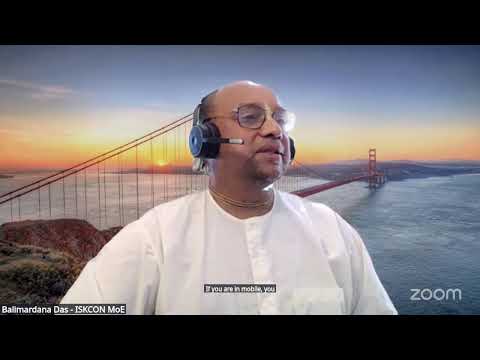

Video access: ISKCON MoE: Viplavah PAN America 2026 is presented through YouTube as a live-stream broadcast for viewers across the Americas. The video page should be consulted for its current start time, replay availability, caption options, and any event information added by the channel.
A Pan-American educational gathering: Viplavah PAN America 2026 brings the language of spiritual transformation into a contemporary digital setting. The available description identifies the program with ISKCON MoE, presents Viplavah as its central theme, and emphasizes a polished broadcast format intended for audiences throughout the Americas. This combination of devotional education, regional participation, and online distribution makes the program relevant not only as an event but also as a case study in how a religious tradition communicates knowledge across borders.
What the available listing establishes: The supplied material confirms the event title, its association with ISKCON MoE, its Viplavah theme, its 2026 framing, and its presentation as a live stream. It does not identify speakers, session titles, participating countries, precise learning objectives, or a detailed schedule. Those details should therefore be verified on the official video page rather than inferred. This distinction is important because responsible academic treatment separates confirmed information from interpretation, especially when a short announcement is expanded into a broader educational overview.
ISKCON’s educational context: The International Society for Krishna Consciousness was founded in New York in 1966 by A. C. Bhaktivedanta Swami Prabhupada. It belongs to the Gaudiya Vaishnava tradition, a devotional lineage centered on loving service to Krishna and historically associated with Chaitanya Mahaprabhu. Study of the Bhagavad-gita, the Bhagavata Purana, devotional theology, congregational chanting, ethical discipline, and practical service all occupy important places in this educational culture. A Ministry of Education setting places these elements within a more systematic conversation about teaching, learning, curriculum, leadership, and the transmission of tradition.
Why education matters in a living tradition: Religious education is more than the transfer of information. It influences how a community interprets scripture, forms character, prepares teachers, responds to social change, and connects inherited principles with contemporary experience. A strong educational program therefore has at least three dimensions: knowledge of texts and history, disciplined spiritual practice, and the ethical application of learning. Viplavah PAN America 2026 can be approached through this broader framework even when the short public description does not disclose the details of its individual sessions.
The significance of Viplavah: The Sanskrit noun viplava can convey upheaval, reversal, disruption, or far-reaching transformation. In a spiritual and educational context, it need not imply political revolt. It can instead describe a profound change in understanding, conduct, and purpose. The term has particular resonance in Vaishnava literary culture because Srimad-Bhagavatam 1.5.11 connects spiritually centered expression with a transformative intervention in human life. Used as an educational theme, Viplavah consequently suggests learning that changes the learner rather than merely enlarging a store of facts.
Transformation requires intellectual discipline: Inspiring language alone does not produce durable change. Transformative education requires careful reading, accurate citation, historical awareness, opportunities for questions, and a clear distinction between scriptural teaching, later commentary, institutional policy, and personal testimony. It also requires a method for translating ideas into practice. Viewers can therefore assess the program by asking whether its presentations define their terms, explain their sources, acknowledge interpretive choices, and identify realistic applications for individuals and communities.
What PAN America can represent: A Pan-American frame potentially brings together participants from North America, Central America, South America, and the Caribbean, although the supplied listing does not specify the countries represented. These regions contain different languages, migration histories, legal systems, educational institutions, and forms of ISKCON community life. A regional broadcast must therefore communicate across more than physical distance. It must also navigate differences in language, generational experience, local culture, access to temples, and familiarity with Gaudiya Vaishnava terminology.
A meaningful bridge for dispersed communities: For a student living far from a temple or established study group, an online event can feel like a bridge to a much larger learning community. For parents, educators, and community volunteers, it can provide language for questions they already encounter in daily life. Younger viewers may approach the tradition through digital media before entering a formal classroom, while older participants may value the ability to connect without travel. This emotional dimension matters because education becomes memorable when learners experience both intellectual clarity and a genuine sense of belonging.
The broadcast itself is part of the pedagogy: A polished live stream is not merely a camera pointed at a stage. It is a designed learning environment. Camera selection guides attention; graphics establish context; audio quality determines whether complex terms can be understood; moderation shapes participation; and transitions influence cognitive focus. If slides, quotations, or references appear on screen, their legibility directly affects comprehension. Production quality therefore has educational consequences, especially when presentations contain unfamiliar Sanskrit vocabulary, textual citations, institutional terminology, or detailed historical arguments.
Audio is the primary technical requirement: In lecture-oriented broadcasting, clear speech generally contributes more to learning than elaborate visual effects. Consistent microphone levels, minimal background noise, accurate synchronization, and intelligible pronunciation are essential. Multiple speakers create additional demands because their voices may differ substantially in volume and tone. A technically mature production normalizes these differences without making the sound unnatural. Viewers using phones, inexpensive speakers, or unstable connections particularly benefit from speech that remains clear under compression.
Streaming technology creates both access and uncertainty: YouTube commonly uses adaptive delivery to provide different video qualities according to connection conditions, but the available experience still depends on bandwidth, device capability, regional network performance, and settings chosen by the channel. Live transmission may also introduce delay between the event and the viewer. That latency becomes relevant during questions, polls, or moderated discussion. A response entered in chat may reach the production team after the conversation has moved forward, so clear instructions and deliberate pauses can improve meaningful participation.
Accessibility is educational infrastructure: Captions, readable graphics, adequate color contrast, careful pacing, and explicit descriptions of visual material allow more people to learn. Captions can support deaf and hard-of-hearing viewers, participants working in a second language, and anyone watching in a noisy environment. Automated captions may misrepresent Sanskrit names or specialized theological terms, making editorial review valuable when a corrected recording is prepared. The public listing does not confirm which accessibility features are available, so viewers should check the player controls and the channel’s updated information.
Time zones shape Pan-American participation: The Americas span numerous time zones, making a single live schedule convenient for some viewers and difficult for others. An archived replay can therefore be as educationally important as the original transmission. A well-organized recording becomes more useful when it includes a descriptive title, accurate summary, speaker information, chapters, references, and corrected captions. These features transform an event that occurs once into a resource that can support later classes, discussion groups, educator training, and individual study.
Live chat requires thoughtful governance: Digital participation can create immediacy and community, but it can also produce distraction, repetition, interpersonal conflict, or questions detached from the presentation. Effective moderation distinguishes sincere inquiry from disruption, protects participants from harassment, and routes substantive questions to an appropriate session. Published community guidelines can clarify expectations before discussion begins. If chat is enabled for Viplavah PAN America 2026, its educational value will depend less on message volume than on whether the interaction helps viewers understand the subject more accurately and respectfully.
Active viewing improves retention: The most productive approach is to treat the broadcast as a learning session rather than background entertainment. A viewer can record the main claim of each presentation, the sources used to support it, questions that remain unresolved, and one possible application. This compact method prevents inspiration from dissolving into vague impressions. It also makes later discussion more precise because participants can return to identifiable statements instead of relying entirely on memory or emotional reaction.
A practical hierarchy of claims: Not every statement in a religious program has the same status. A direct scriptural passage differs from a traditional commentary; both differ from a historical reconstruction, institutional recommendation, personal experience, or motivational illustration. Careful listeners can identify which kind of claim is being made and evaluate it accordingly. Historical claims benefit from dates and primary evidence, textual claims require context and interpretive explanation, and practical recommendations should identify the circumstances in which they are expected to work.
Scriptural literacy includes interpretation: Quoting a verse is only the beginning of serious study. A complete educational treatment considers the surrounding passage, the purpose of the text, the meaning of key terms, the role of commentarial traditions, and the relationship between principle and application. Translation choices may also affect understanding. Viplavah’s transformative promise is strongest when reverence for scripture is joined with transparent reasoning, allowing devotion and intellectual responsibility to reinforce one another.
Learning outcomes should be visible: A well-designed session makes clear what participants should understand or be able to do afterward. One presentation may clarify a theological concept, another may improve teaching practice, and another may help a community organize study more effectively. These are different outcomes and require different methods. Knowledge can be checked through explanation, practical competence through demonstration, and reflective growth through sustained observation and discussion. Without an identifiable outcome, even an eloquent presentation can be difficult to apply.
Education continues after the stream: Lasting value usually emerges through follow-up. Participants can revisit cited texts, compare notes, formulate questions, and discuss how an idea applies within their local circumstances. Educators may convert a presentation into a reading plan, while community leaders may identify a small and measurable initiative. A family might select one principle for shared study, and an individual learner might establish a regular period for reading and reflection. Such steps turn a digital encounter into a sustained learning process.
How educational quality can be assessed: Useful criteria include accuracy, clarity, source transparency, accessibility, relevance, respectful communication, and the feasibility of proposed applications. Diversity among presenters can broaden perspective, but representation alone does not guarantee educational depth. Likewise, polished production can support learning without replacing sound content. The strongest programs align purpose, scholarship, pedagogy, technology, and community care rather than treating these as unrelated concerns.
Dharmic unity without erasing difference: Hindu, Buddhist, Jain, and Sikh traditions are distinct and should not be compressed into a single theology. They contain different understandings of ultimate reality, selfhood, authority, liberation, devotion, and community identity. At the same time, constructive dialogue can recognize shared concerns such as disciplined practice, ethical responsibility, compassion, service, learning from qualified teachers, and the transformation of conduct. A Gaudiya Vaishnava program contributes most effectively to Dharmic unity when it speaks clearly from its own tradition while treating neighboring traditions with accuracy and respect.
Pluralism requires informed engagement: Respect is deeper than generic claims that all traditions are identical. It requires learning how communities describe themselves, avoiding caricatures, and distinguishing disagreement from hostility. An educational event can model this discipline by stating its commitments openly while maintaining intellectual fairness toward other paths. Such an approach protects the integrity of Krishna consciousness and also supports wider cultural harmony, because confidence in a tradition need not depend on diminishing another tradition.
Public religious communication carries ethical responsibilities: Digital media can move a short statement far beyond its original audience and context. Presenters therefore benefit from defining specialized language, avoiding unsupported generalizations, and recognizing how edited clips may circulate. Viewers have corresponding responsibilities: they can examine the complete presentation before reacting, verify quotations, and resist sharing fragments that distort the speaker’s meaning. These habits are part of media literacy and are increasingly important for any educational ministry operating at international scale.
Leadership becomes credible through service: In devotional education, expertise is not measured solely by the ability to deliver information. It is also expressed through humility, accountability, attentive listening, and service to learners. Teachers strengthen trust when they acknowledge uncertainty, correct errors, and distinguish enduring principles from context-dependent judgment. Learners contribute by asking focused questions and remaining open to correction. This reciprocal model makes education a shared discipline rather than a one-directional performance.
The promise and limits of digital reach: Livestreaming can reduce travel costs, connect distant communities, preserve teaching for later use, and give smaller centers access to wider educational conversations. It cannot automatically overcome language barriers, unequal connectivity, limited digital literacy, or the need for personal mentorship. Platform dependence also means that visibility, notifications, archives, and discussion tools remain partly controlled by a commercial service. A resilient educational strategy therefore combines online reach with local relationships, durable learning materials, and well-supported teachers.
A concise viewing framework: Before watching, viewers can verify the schedule, time zone, and replay status on the official page. During the broadcast, they can identify each session’s purpose, note its principal sources, separate factual claims from interpretation, and record unresolved questions. Afterward, they can review the original material, discuss it with knowledgeable members of the community, and choose one realistic application. This sequence supports critical attention without sacrificing devotional receptivity.
Details that still require confirmation: The short announcement does not establish the event’s complete agenda, named faculty, language options, registration arrangements, geographic representation, or whether the player will remain available as a permanent recording. It also does not confirm captions, live chat, chapters, downloadable resources, or certificates. These features should not be assumed. The YouTube page and any official ISKCON MoE materials linked there remain the appropriate places to verify operational information.
Why the broadcast deserves thoughtful attention: Viplavah PAN America 2026 represents more than the convenience of watching a religious program online. It points toward a central educational question: how can an inherited spiritual tradition communicate with rigor, warmth, and relevance across a geographically and culturally diverse audience? When scholarship, devotion, technology, accessibility, and respectful dialogue work together, a live stream can become a genuine learning community. Its deepest benefit is not simply that viewers receive information, but that careful learning may lead to clearer understanding, responsible practice, compassionate service, and stronger relationships across the Dharmic world.
Inspired by this post on Dandavats.


Leave a Reply
You must be logged in to post a comment.