
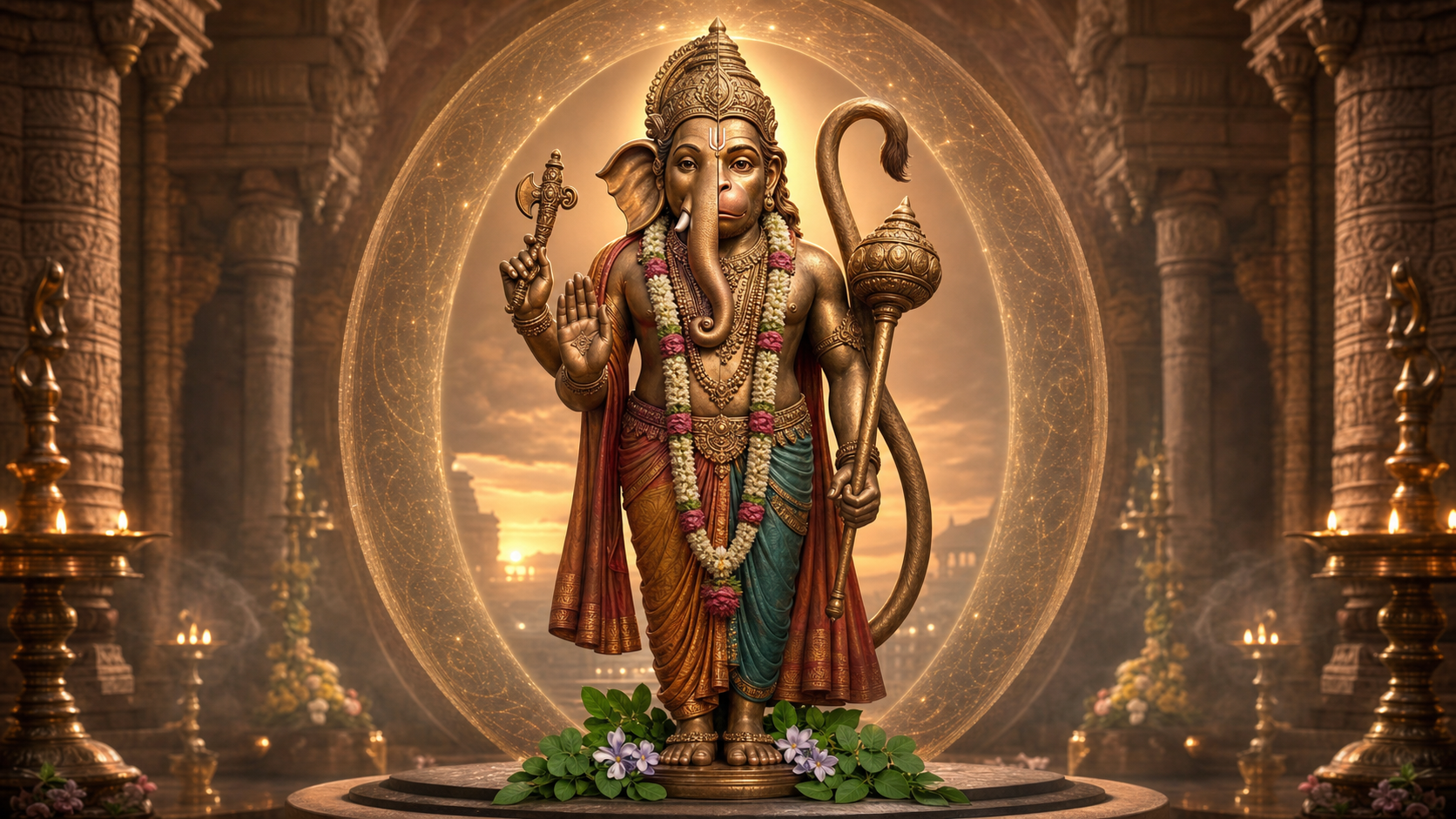
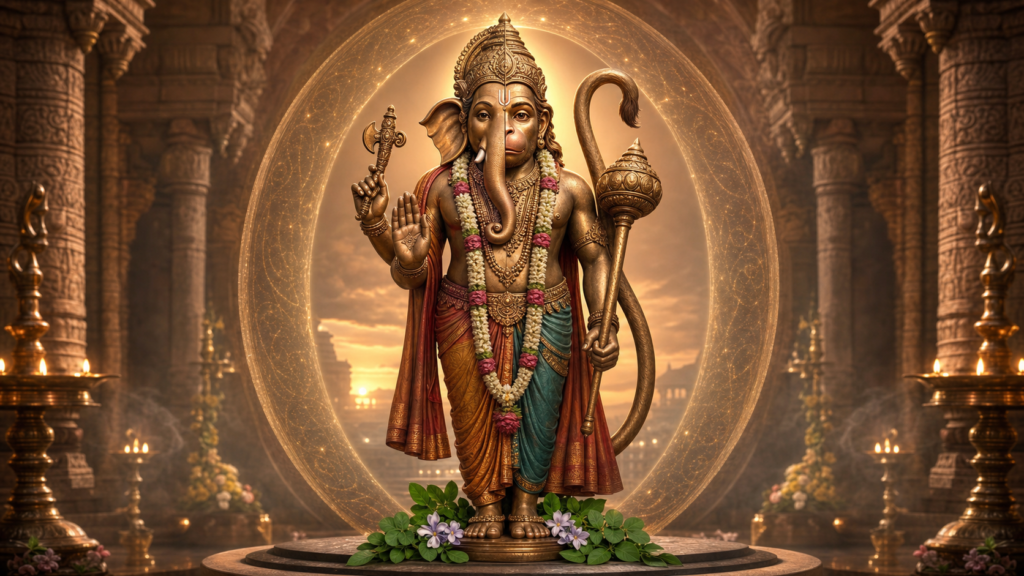
Adhyantha Prabhu is a striking example of modern Hindu sacred iconography: a single composite murti that brings together Ganesha and Hanuman. The image is visually memorable, yet its significance extends far beyond artistic novelty. Ganesha contributes the symbolism of auspicious beginnings, discernment and the removal of obstacles, while Hanuman embodies devotion, courage, disciplined strength and the completion of service. Their union presents spiritual life as a continuous movement from wise intention to faithful action.
The form is most closely associated with the Madhya Kailash Temple in Adyar, Chennai. It is also written as Aadhyanta Prabhu, Aadyanta Prabhu, Adyantha Prabhu, Adhiyantha Prabhu and Aadhyantha Prabhu because Indian names are transliterated into English in several ways. These spellings generally refer to the same Ganesha-Hanuman composite. Historical evidence should nevertheless be separated from devotional interpretation: the documented shrine is modern, while many of the theological meanings attached to it draw creatively upon much older Hindu symbols and ritual patterns.
The meaning of Adhyantha Prabhu
The name is commonly explained through the terms ādi, meaning beginning, and anta, meaning end. Prabhu may be translated as lord, master or sovereign. Adhyantha Prabhu can therefore be understood as the Lord of the beginning and the end. Temple-based interpretations carry the idea further: the composite represents the fullness of existence, encompassing initiation, effort, accomplishment and closure without fragmenting them into unrelated stages.
Ganesha is widely invoked before a ritual, journey, examination, artistic performance or important undertaking. His title Vighneshvara identifies him as Lord of obstacles, while his association with buddhi, or discerning intelligence, emphasizes the need to begin with clarity. Hanuman, by contrast, is remembered for bringing Rama’s mission to completion through courage, humility and unwavering devotion. A local explanation at Madhya Kailash consequently associates Ganesha with the opening of prayer and Hanuman with its successful conclusion. This should be understood as a meaningful temple tradition rather than a compulsory rule followed identically by every Hindu sampradaya.
An especially subtle interpretation links Ganesha with sound and Hanuman with breath. In the account recorded during field research at Madhya Kailash, human life begins with the sound of a newborn child and ends when breath departs. Hanuman’s relationship with Vayu, the deity of wind and vital movement, makes breath a particularly appropriate symbol for his half of the image. Ganesha and Hanuman thus frame embodied life between its first audible sign and its final breath. This explanation is local and theological rather than a universal definition found in every Hindu text, but it gives the composite considerable philosophical depth.
What Ganesha contributes to the composite form
Ganesha’s elephant head is among the most recognizable forms in Hindu art. Its symbolic interpretations vary, but it is regularly connected with intelligence, attentive listening, memory, adaptability and the ability to clear a path through difficulty. His broken tusk evokes sacrifice and the capacity to transform apparent loss into a means of knowledge. The goad, or ankusha, signifies direction and disciplined control, while the noose may represent the power to restrain harmful tendencies or draw the devotee toward a worthy goal.
Within Adhyantha Prabhu, these attributes establish the intellectual and ethical foundation of action. Removing an obstacle does not simply mean making every problem disappear. In a more demanding reading, Ganesha teaches that an obstacle must first be understood: some barriers should be overcome, some should be respected and others reveal that the chosen method requires correction. Wisdom therefore precedes strength. The image does not glorify activity without reflection; it places discernment at the beginning of purposeful work.
What Hanuman contributes to the composite form
Hanuman’s identity is inseparable from the Ramayana and his service to Rama and Sita. His extraordinary physical power is repeatedly governed by devotion, moral purpose and self-restraint. He crosses the ocean, searches Lanka, consoles Sita, confronts danger and carries the life-restoring mountain, yet his achievements are not presented merely as demonstrations of personal greatness. They are acts of seva directed toward a cause larger than the self.
The gada, or mace, expresses strength and readiness, while the raised tail found in many Hanuman images conveys energy and alertness. Anjali mudra emphasizes humility, reverence and devotion. These attributes prevent strength from becoming domination. Hanuman’s power is disciplined by loyalty, and his courage is joined to compassion and responsibility. Philip Lutgendorf’s scholarly study Hanuman’s Tale similarly emphasizes Hanuman’s mediating character and his wide appeal across regional and sectarian settings.
In Adhyantha Prabhu, Hanuman represents the sustained effort required after a good beginning. Insight alone cannot complete a duty, and enthusiasm without perseverance often fades. Hanuman supplies endurance, concentration and the willingness to continue serving when success is uncertain. If Ganesha helps establish the right direction, Hanuman supplies the disciplined movement that carries an undertaking toward completion.
The modern history of the Madhya Kailash image
Madhya Kailash is an urban Hindu temple in Adyar, Chennai, with Ananda Vinayaka as its presiding deity. A detailed temple-history account states that land for the temple was transferred in December 1977, that an important consecration took place in 1984 and that the idea of Aadhyanta Prabhu emerged after 1991. The account records a kumbhabhishekam for the composite deity in 1994. These dates place the shrine firmly within the history of late twentieth-century urban Hinduism.
The origin narrative is remembered through an experience during worship. Devotees reportedly perceived Hanuman together with Ganesha while arati was being performed before the temple’s Ganesha image. Temple organizers then explored whether the intuition could be expressed through a composite murti. They consulted scholars and worked with a sthapati, a specialist responsible for sacred architecture and image design. The process is significant because it united visionary experience, community deliberation, learned consultation, artistic skill and ritual consecration.
Joanne Punzo Waghorne’s Oxford University Press study, Diaspora of the Gods, provides an important ethnographic account of the installation and the explanations offered by devotees. The study situates Madhya Kailash within a broader examination of modern urban temples, showing that religious communities do not merely reproduce inherited architecture. They also develop new forms through which older theological principles can speak to contemporary circumstances.
Published accounts differ slightly over the chronology. The temple-history narrative records the composite deity’s kumbhabhishekam in 1994, whereas a devotional account of Ganesha states that a five-metal image was created and enshrined in 1993. The discrepancy may reflect separate stages of manufacture, installation and formal consecration, but the accessible sources do not resolve it conclusively. A careful history therefore describes the image as a creation of the early 1990s and notes the specific dates rather than forcing them into artificial agreement.
The form is sometimes described online as ancient or directly prescribed by scripture, but the available historical documentation does not establish such a claim. Adhyantha Prabhu draws upon ancient deities, durable theological themes and established precedents for composite sacred bodies, yet its documented Madhya Kailash embodiment is modern. Recognizing that modernity does not diminish its religious importance. Hindu traditions have long allowed regional communities, teachers, artisans and devotees to express enduring principles through new visual languages.
Composite deities as a Hindu visual language
Adhyantha Prabhu belongs conceptually to a wider family of composite forms without being identical to any of them. Ardhanarishvara joins Shiva and Parvati in one body, communicating an inseparability of masculine and feminine principles. Harihara and the South Indian Shankaranarayana unite Shiva and Vishnu, making sectarian difference visible while affirming a deeper sacred relationship. Madhya Kailash devotees themselves reportedly cited such forms while considering the Ganesha-Hanuman image.
A composite murti does not merely place two independent figures beside one another. It creates one visual body in which distinction remains recognizable but separation is overcome. The Ganesha half does not cease to be Ganesha, and the Hanuman half does not lose Hanuman’s particular character. Their unity therefore does not depend upon erasing difference. It demonstrates a specifically plural mode of sacred integration: identities can remain distinct while participating in a larger wholeness.
This point is essential for interpreting the image accurately. Adhyantha Prabhu is not a narrative claim that Ganesha transforms into Hanuman, nor does it establish a hierarchy in which one deity absorbs the other. It is an iconographic synthesis. The form places beginning and completion, reflection and action, intelligence and strength, auspiciousness and service within a single field of vision.
Reading the iconography in detail
The body is divided vertically so that the elephantine features of Ganesha merge with the simian features of Hanuman. Descriptions of the Madhya Kailash murti commonly identify Ganesha on the right and Hanuman on the left, although popular reproductions sometimes appear reversed and written sources do not always specify whether they are describing the deity’s orientation or the viewer’s. The theological meaning does not depend upon fixing a universal left-right rule for every later representation.
Artists distinguish the halves through recognizable attributes. Ganesha may be indicated by the partial elephant head, curving trunk, broken tusk, crown and implements such as the ankush. Hanuman may be identified through his facial profile, tail, gada and devotional gesture. Garlands and forehead markings may also preserve the ritual identities associated with each deity. The central seam is not simply a boundary; it is the place where two established visual vocabularies are deliberately made continuous.
The resulting asymmetry gives the image much of its force. Ganesha’s rounded, composed form is often read as stable and contemplative, whereas Hanuman’s posture carries the memory of movement, readiness and heroic service. The composite holds stillness and energy together. It suggests that contemplation need not produce passivity and that vigorous action need not abandon wisdom.
The Madhya Kailash murti is described as panchaloha, literally a five-metal alloy. Panchaloha has a long history in South Indian sacred metalwork, although the precise combination and proportion of metals can vary by workshop, period and ritual convention. Metal permits fine iconographic detail and is suitable for ceremonial bathing. Once consecrated, the murti is not regarded by devotees as an ornamental alloy alone; it becomes a ritually established locus of divine presence.
The shrine’s oval design extends the same symbolism into architecture. Waghorne’s fieldwork records explanations connecting the oval with the shape of the universe and, more suggestively, with an egg and the cycle of life. Images of multiple deities arranged around the shrine further communicate fullness and inclusion. The building therefore does not merely house the composite form. Its shape and decorative program amplify the idea that beginning, life, completion and cosmic totality belong to one continuous order.
Worship, offerings and the language of ritual
Ritual gives the iconography an embodied form. During the consecration documented in the scholarly account, devotees were permitted to pour sanctified water upon the vimana and the image. This participatory arrangement was noteworthy because such acts are often performed primarily by priests in South Indian temple settings. The episode should not automatically be treated as a statement about every present-day service, but it reveals how the shrine’s founding community connected theological inclusion with ritual participation.
The temple-history account describes an offering of nine tulsi leaves together with nine erukkam flowers, followed by arati. Tulsi is strongly associated with Vaishnava worship and is also offered to Hanuman in many communities. Erukkam, commonly identified with Calotropis, belongs to the ritual vocabulary surrounding Ganesha and other deities in parts of South India. Mixing the two offerings at one pair of sacred feet turns the theology of union into a physical ritual act.
The number nine has encouraged associations with the Navagrahas, the nine planetary powers recognized in Hindu ritual astrology. Popular devotional explanations sometimes state that Ganesha and Hanuman protect worshippers from adverse planetary influences and that Adhyantha Prabhu is therefore approached during periods of astrological concern. Such statements belong to the domain of faith and temple tradition; they should not be presented as scientific claims or as doctrines accepted uniformly across Hindu schools.
Even within the devotional account, worship is not a license to avoid moral responsibility. Karma continues to be lived through choices, consequences, duties and relationships. Prayer can provide clarity, courage and a disciplined orientation toward difficulty, but it does not validate negligence. This is one of the image’s most practical teachings: divine assistance and human effort are complementary, not competing, principles.
Darshan also changes the significance of the image. From an art-historical perspective, the murti can be analyzed through material, posture, attributes and composition. For a devotee, however, seeing the deity is also an encounter in which the sacred is believed to see the worshipper. The composite is consequently not exhausted by decoding its symbols. Its emotional power arises from the experience of standing before wisdom and strength presented as one compassionate presence.
A bridge between Shaiva and Vaishnava traditions
Ganesha belongs to the family of Shiva and Parvati and occupies an important place in Shaiva, Shakta, Smarta, Ganapatya and many nonsectarian settings. Hanuman is celebrated above all as the devoted servant of Rama, an avatara of Vishnu, although several traditions also associate him with Vayu and Rudra or Shiva. Their union therefore creates a natural bridge across multiple theological lineages without reducing either deity to a single sectarian label.
The setting of Madhya Kailash reinforces this integrative reading. Temple accounts describe a Ganapatya Panchayatana framework and the presence of forms associated with Shiva, Vishnu, Devi and Surya. Adhyantha Prabhu thus stands within a wider sacred landscape where different deities are not treated as mutually exclusive claimants. The image expresses unity through relationship rather than uniformity.
This approach offers a constructive model for unity among Dharmic traditions more broadly. Buddhism gives sustained attention to wisdom, compassion and disciplined practice; Jainism joins right knowledge with right conduct, self-restraint and ahimsa; Sikh tradition places seva, remembrance, humility and courageous responsibility at the center of lived faith. These are resonances rather than assertions of theological equivalence. Respectful comparison allows traditions to recognize shared ethical concerns while preserving their distinct scriptures, histories, practices and understandings of liberation.
Adhyantha Prabhu therefore does not teach that difference is unreal or irrelevant in every context. Its stronger lesson is that difference need not become hostility. Ganesha and Hanuman remain fully recognizable while sharing one sacred body. That visual grammar is especially relevant to communities seeking cohesion without demanding sameness.
A practical philosophy for everyday life
The composite can be read as a disciplined sequence for action. Ganesha asks whether an undertaking has been considered wisely: Is the intention ethical? Are the obstacles understood? Have the necessary people been heard? Hanuman then asks whether insight has become service: Is the work being performed with courage? Can effort continue without vanity? Will the task be completed responsibly rather than abandoned when recognition fades?
A student beginning an examination may need Ganesha’s clarity but also Hanuman’s sustained concentration. A professional launching a project requires careful planning as well as the humility to serve the team. A caregiver needs discernment to make difficult decisions and endurance to remain present. A community initiative needs an auspicious beginning, transparent execution and accountable closure. In each case, the image discourages the separation of intelligence from character.
The union also addresses a familiar psychological tension. Some people remain trapped in preparation because they fear imperfect action; others act quickly without reflection and create preventable difficulties. Adhyantha Prabhu places deliberation and courage in one body. The balanced devotee is neither immobilized by thought nor driven by uncontrolled force.
Its emotional appeal can be understood in similarly practical terms. Beginnings often contain hope and anxiety, while endings carry relief, gratitude, uncertainty or grief. The same composite presence accompanies both thresholds. It suggests that sacred support is not confined to the excitement of starting something new; it also belongs to perseverance, completion, release and transition.
Common misconceptions
Adhyantha Prabhu should not be confused with Panchamukha Ganapati or Panchamukhi Hanuman. Those are multi-faced forms with their own iconographic and theological histories. Adhyantha Prabhu is a vertically integrated composite of two deities and is organized around the relationship between beginning and completion.
The form should also not be described carelessly as an ancient murti discovered unchanged from remote antiquity. Its deities and underlying symbols are ancient, and composite iconography has deep historical precedents, but the well-documented Madhya Kailash form arose through a modern community process. Accuracy makes the example more interesting, because it demonstrates that living tradition can innovate without abandoning continuity.
Nor is the image merely a device for securing success. Ganesha’s obstacle-removing power does not guarantee that every desire is beneficial, and Hanuman’s strength is never detached from dharma and seva. The composite calls for ethical intention, disciplined action and acceptance of consequences. Reducing it to a promise of effortless results would remove the very responsibility its symbolism teaches.
Finally, the composite does not imply that every Hindu community must interpret Ganesha and Hanuman in precisely the same way. Hinduism contains regional, linguistic, philosophical and ritual diversity. Adhyantha Prabhu is best understood as a distinctive Chennai-centered expression whose significance can travel widely without being misrepresented as a universal ancient prescription.
Why Adhyantha Prabhu matters
For the study of Hindu temples, Adhyantha Prabhu demonstrates how tradition is continually made present. A visionary experience was discussed by a community, examined with scholars, translated by a sthapati into a technically coherent image, embodied in panchaloha, installed within purpose-built architecture and activated through consecration and worship. Every stage joined inherited authority with contemporary agency.
For devotees, the form offers a concise spiritual discipline. It teaches that a worthy beginning requires wisdom, a meaningful journey requires courage, and a successful conclusion requires gratitude and humility. Ganesha without Hanuman could be misread as insight without execution; Hanuman without Ganesha could be misread as energy without direction. Their union restores the necessary relationship between the two.
Adhyantha Prabhu ultimately presents unity as something stronger than visual fusion. It is the unity of thought and action, knowledge and devotion, strength and service, beginning and end. The murti’s modern history does not weaken that message; it reveals the creative vitality of Hindu sacred art. In a world often divided between rigid identities and shallow uniformity, the composite offers a more mature possibility: distinct forms can meet, retain their integrity and participate in a sacred whole.
Research note: The historical discussion draws primarily upon Joanne Punzo Waghorne’s academic study of modern Hindu temples, the detailed Madhya Kailash temple-history account and the independently published devotional record linked above. These sources agree on the identity and early-1990s emergence of the composite but differ slightly on the date of installation and consecration. Interpretive claims have therefore been identified as local tradition, broader Hindu symbolism or comparative analysis rather than being presented as undisputed ancient history.
Inspired by this post on Hindu Blog.

Leave a Reply
You must be logged in to post a comment.