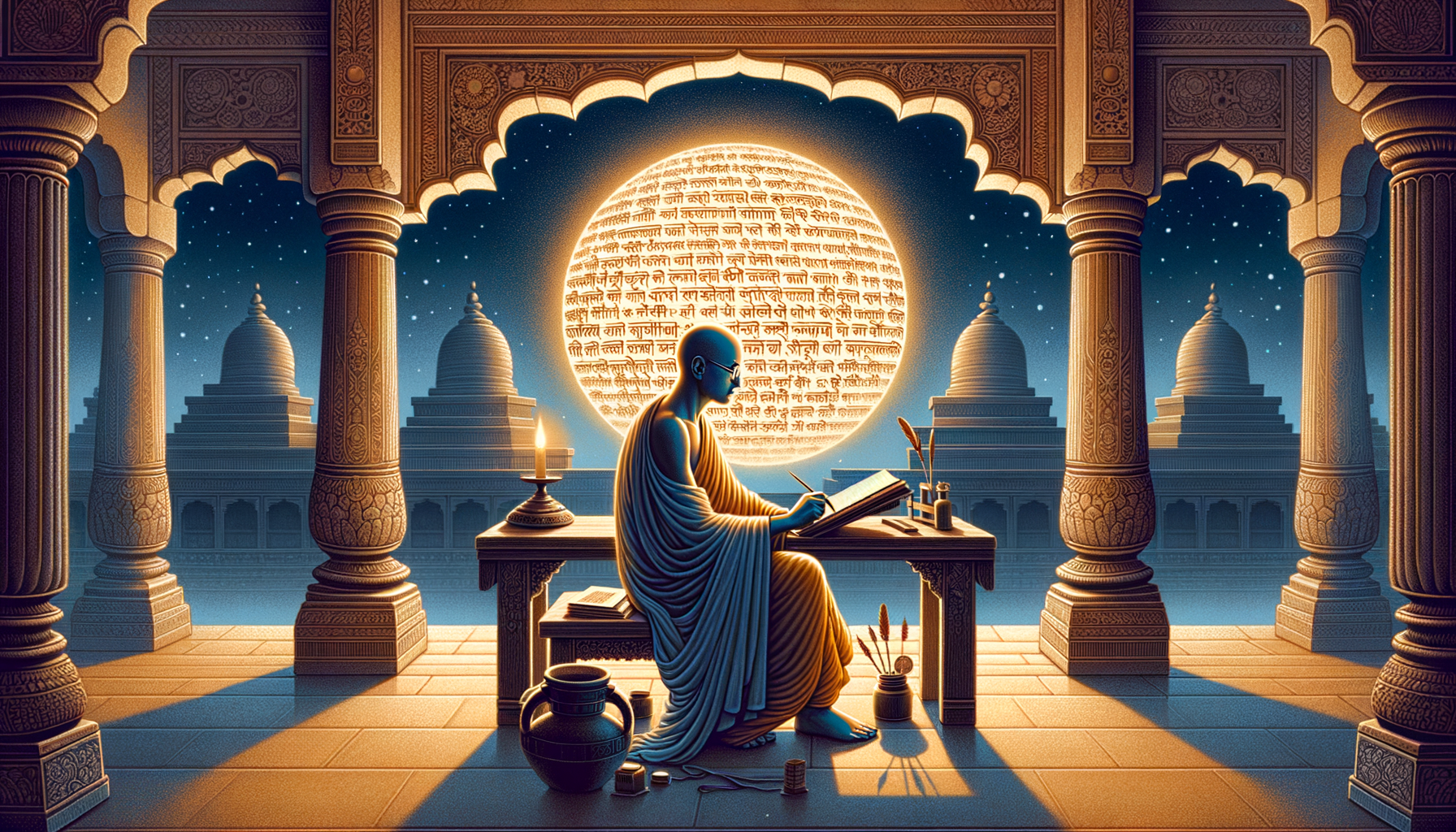
Jayadeva, a celebrated Sanskrit scholar and poet of the 12th century CE, is remembered as a towering figure from Vidarbha in present-day Maharashtra. A Brahmana by birth and rigorous training, he is renowned for far-reaching contributions to classical Sanskrit literature and the study of poetics. His era witnessed a flourishing of Indian intellectual and artistic pursuits, and his worksmost notably the Candralokareflect the refinement, confidence, and cultural vitality of classical India.
Traditional accounts situate Jayadeva within a lineage of disciplined learning that joined Vedic study with kavya and poetics. Such formation positioned him to articulate aesthetic principles with precision while remaining attentive to the lived experience of composition and recitation. The image that emerges is of a scholar grounded in śāstra who could also communicate with clarity to students and poets seeking both theoretical rigor and practical guidance.
The Candraloka occupies a distinguished position in Sanskrit poetics, synthesizing core insights of alaṅkāra and rasa into a coherent, teachable framework. Its accessible organization, illustrative verses, and sustained attention to aesthetic clarity helped embed it in pedagogical traditions across the subcontinent. For generations of readers, the text has functioned as a bridge between theory and practiceilluminating how poetic figures, suggestion, and aesthetic savor work together to produce lasting literary impact.
Jayadeva’s intellectual world was interwoven with diverse centers of learning where Hindu, Buddhist, and Jain scholars engaged a shared Sanskritic discourse. In that ecumenical milieu, works like the Candraloka offered a common language of aesthetics that enriched temple, monastery, and courtly literatures alike. Remembered within the broader lineage of Hindu gurus and saints for sustaining cultural knowledge, Jayadeva’s legacy exemplifies how Sanskrit poetics nurtured unity in diversity across dharmic traditions.
Many students of Sanskrit literature describe first encountering the Candraloka as an experience that clarifies elusive concepts and invites deeper reading of classical poetry. Its insights remain valuable today for anyone seeking to appreciate how form, meaning, and emotion converge in kavya. By revisiting Jayadeva’s concise formulations, modern readers gain both historical perspective and practical tools for interpretationan enduring testament to the text’s clarity, relevance, and unifying spirit.
Inspired by this post on Hindu Blog.