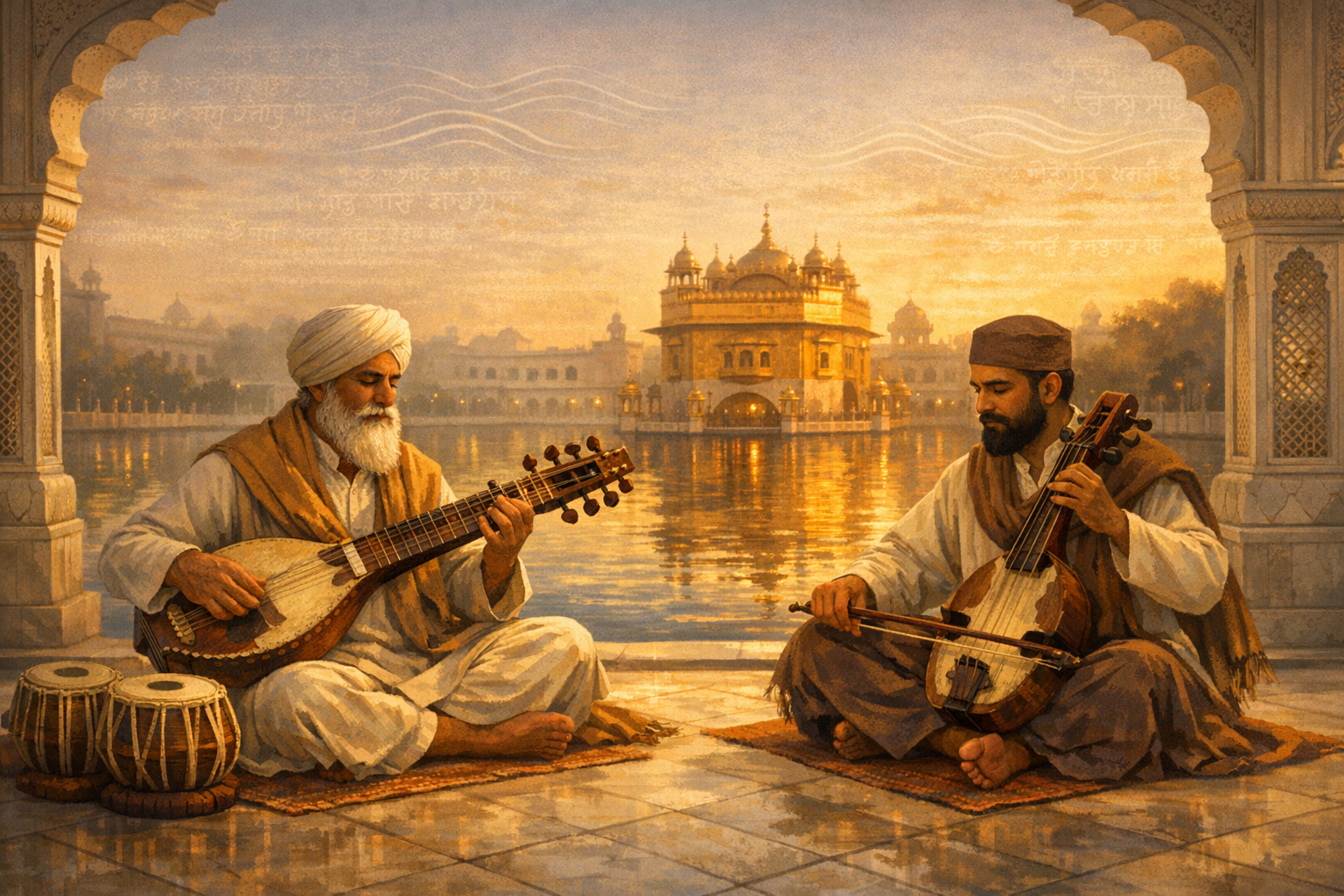
The phrase “Reclaiming the Rababi Voice” signals a return to a living, shared heritage in the subcontinent where devotional music wove together communities across faith and region. Within that heritage, the names Rai Balwand and Bhai Satta evoke a luminous moment in Sikh history: a pair of Rababi musicians whose composition, Ramkali ki Vaar, entered the sacred canon and preserved a powerful vision of spiritual succession, humility, and unity. Their legacy illuminates the relationship between scripture and sound, community and craft, and it underscores how Sikh kirtan belongs to a broader civilizational arc of dharmic traditions that prize compassion, truth, and the refinement of consciousness through music.
The Rababi tradition, rooted in the artistry of the rabab and other tanti saaz (string instruments), is intertwined with the earliest Sikh narrative. Bhai Mardana, the famed companion of Guru Nanak, exemplifies this lineage: a Muslim bard whose rabab voiced the shabad as the Guru traveled and taught. This cross-communal, hereditary craft continued in Sikh courts and congregations, where Rababisoften from Mirasi familiesdeveloped a rigorous yet supple performance practice known today as part of Gurmat Sangeet. Their role was not ancillary; it was constitutive of the experience of Gurbani as sung wisdom.
Among these lineages, Rai Balwand and Bhai Satta stand out for the composition credited to them within the Guru Granth Sahib: Ramkali ki Vaar. Referred to in tradition as “Satta and Balwand di Var,” the ballad praises the transmission of the Guruship from Guru Nanak through Guru Arjan, mapping a sacred genealogy of guidance. Their presence in the canon affirms that Sikh scripture preserves not only teachings but also the voices and tonalities through which the teachings have been remembered and loved.
Historically, the composition is tied to the era of Guru Ram Das and Guru Arjan, a time marked by institutional consolidation and the emergence of Amritsar as a spiritual center. Ramkali ki Vaar functions as a theological and historical testimony. It articulates core Sikh themesseva (selfless service), humility before the Divine Will, and the continuity of the Guru’s lightwhile reflecting the ethics of a courtly musical culture that balanced refinement with accessibility. By enshrining this Vaar, the tradition anchored itself not in a single community’s sound but in a shared musical-religious vocabulary.
Accounts of Rai Balwand and Bhai Satta frequently mention an episode of estrangement from the Guru’s household followed by reconciliation. Whether taken as history or parable, the narrative matters for what it teaches: the moral centrality of repentance, the transformative power of forgiveness, and the restoration of right relationship through music rendered in humility. In Sikh thought, such turns are not merely biographical; they are pedagogical, modeling how social harmony is rebuilt when pride yields to grace.
Textually, Ramkali ki Vaar displays the traditional ballad architecture of pauris, a structure that supports cumulative meditation as well as communal singing. Its rhetoric is heraldic yet intimate, poetic yet didactic. The Gurus are praised not as dynasts but as bearers of a single, unbroken light; succession is sanctified as transmission of wisdom rather than power. This vision resonates with the dharmic understanding of lineage as responsibility, a mantle carried for the benefit of all, beyond caste, creed, or clan.
Musically, the composition sits in Raag Ramkali, whose contemplative gravity places it among the most introspective modal environments of North Indian art music. In contemporary Hindustani classification, Ramkali is commonly grouped within the Bhairav thaat, marked by andolita (oscillated) komal rishabh and dhaivat, and frequently treating both madhyams with care. In Sikh kirtan practice, Ramkali bears a didactic and inward-turning character, well suited to compositions that call for discernment and ethical steadiness. Traditional renderings favor the timbral blend of rabab, saranda (attributed in Sikh lore to Guru Arjan), and rhythmic accompaniment such as jori or pakhawaj, emphasizing breath-like phrasing and textual intelligibility.
Kirtan in this idiom privileges melodic contours that mirror semantic inflection. Pauri cadences are shaped to leave the listener with a settled sense of resolution, while internal phrases encourage reflection on key terms and metaphors. Tempi can range from vilambit (slow) for exposition to madhya and drut for declamation, with taals such as chautaal, jhaptaal, and rupak often encountered. The overall effect, when led by skilled Rababis, is one of ethical attentionmusic as a schooling of the mind in humility and clarity.
Socially, the Rababi institution represented a stable, interdependent ecology. Rababis sustained gurdwara liturgies, life-cycle rites, and community gatherings, while the sangat, in turn, sustained their families and apprenticeships. This was not a transactional “gig economy” but a network of belonging, where the craft’s integrity required long, careful training and an intimate knowledge of raga, bani, language, and context. Such ecologies are historically notable across South Asiaakin to hereditary qawwals in Sufi dargahs or kirtankars in Bhakti lineagesyet distinctly Sikh in their scriptural anchoring and congregational ethos.
The twentieth century unsettled this ecology. Partition in 1947 displaced many Rababi families from East Punjab to Pakistan, fracturing patronage networks and severing everyday ties between musicians and sangats. In post-Partition India, Sikh kirtan gradually shifted toward harmonium-led ensembles and institutionalized ragis, reflecting broader forces of colonial modernity, new pedagogies, and changing acoustical expectations in expanding congregations. The musical map did not contract in intention, but the audible presence of the rabab-based timbre became rarer in public liturgy.
The harmonium’s risefacilitated by portability, ease of learning, and the instrument’s alignment with pedagogies introduced during the colonial periodreshaped performance practice. While the harmonium has been a vehicle for devotion for generations, the earlier tanti saaz palette carried unique articulations and phrasing conducive to the prosody of Gurbani and the gravitas of raag treatments such as Ramkali. A comprehensive approach to Gurmat Sangeet today benefits from honoring both the devotional continuity of harmonium-led kirtan and the distinctive disciplines kept by Rababi musicians.
In recent decades, scholars, ustads, and community ensembles have undertaken a measured revival of string-led kirtan. Archival work has expanded; rare recordings have been digitized; training in rabab, saranda, and dilruba has grown alongside renewed attention to the 31 primary raags of the Guru Granth Sahib and to older taali practices. These efforts are not antiquarian. They seek to restore depthto make audible once more a way of listening that fuses musical discernment with ethical formation.
Within a broader civilizational frame, the Rababi tradition speaks to the long-standing intimacy between Sikh, Hindu, Jain, and Buddhist communities in the subcontinent. Performance lineages have historically conversed across boundaries: the melodic thought-world of raag, the ethics of ahimsa and seva, and the shared veneration for realized teachers. Just as Vaishnava kirtan, Sufi sama’, Jain stavan, and Buddhist chant each cultivate interior refinement, so too does Sikh kirtan, with Ramkali ki Vaar offering a quintessential lesson in humility, repentance, and the unbroken transmission of light.
Rai Balwand and Bhai Satta thereby serve as bridges. Their composition documents how a community’s center of gravity remains spiritual, not sectarian; how a Muslim musical lineage could voice Sikh scripture without contradiction; and how the fixed categories of modern identity often fail to describe the fluidity that premodern devotional cultures took for granted. The result is a case study in interfaith harmony anchored in practice, not polemic.
For contemporary listeners, the return of Rababi timbres can be transformative. The first stroke of the rabab under Raag Ramkali often produces a palpable stillness, quieting interior noise and preparing the mind for meaning. As phrases arc toward the cadence of a pauri, the text’s ethical insights become sonically embodied: humility is not merely stated; it is felt. Listeners commonly describe a softened breath, a clarified attention, and a renewed readiness to serveresponses entirely consonant with Sikh ideals of remembrance and seva.
Reclaiming the Rababi voice today entails more than concerts. It calls for apprenticeship pathways for young musicians; support for instrument makers capable of crafting and maintaining rabab, saranda, and dilruba; scholarships for research into historical taals and raag vistar; and liturgical planning in gurdwaras that periodically features string-led kirtan. Equally vital are cross-border and diaspora initiatives that reconnect scattered Rababi families with archives, teachers, and congregations willing to sustain long-term learning.
Textual engagement remains essential. Ramkali ki Vaar deserves careful study in the original, with reliable interpretive aids to illuminate linguistic nuance, historical context, and theological emphasis. When paired with judicious musical rendition, study becomes a communal discipline: a shared ascent through listening, reflection, and re-commitment to virtues the Vaar extolstruthfulness, humility, and steadfast service.
The recovery of Rababi aesthetics also complements inclusive developments already underway in Sikh music-making, including the wider participation of women ragis and renewed attention to raag fidelity. Rather than framing older and newer practices as competitors, a more generous paradigm recognizes them as complementary vessels for the same shabad, serving different acoustical spaces, pedagogical needs, and congregational sensibilities.
Viewed through the lens of cultural preservation, the Rababi tradition is a textbook instance of intangible heritage at risk yet recoverable. Its techniques reside in human bodies and memories; its instruments require specialized knowledge to build and maintain; its aesthetics demand time, attention, and ethical seriousness. When communities prioritize these conditions, they do more than save an art form; they cultivate the very dispositionspatience, respect, and generositythat Ramkali ki Vaar invites.
Ultimately, Rai Balwand and Bhai Satta remind contemporary society that devotion is strongest when inclusive. The Vaar enshrined under Raag Ramkali demonstrates how spiritual authority travels along the channel of wisdom rather than blood, habit, or faction. Restoring the Rababi voice, then, is not a nostalgic project but a forward-looking one: it re-centers a musical-spiritual ideal in which dharmic traditions stand side by side, each enriching the other through shared commitments to truth, compassion, and service.
As communities continue this work, the benefits extend beyond the soundscape. Children encounter a heritage of disciplined beauty; elders hear once-familiar tones return; diasporic sangats find renewed cohesion around practices that feel both rooted and capacious. Most of all, the tradition’s original insight becomes audible again: that the shabad shapes character as surely as it shapes melody, and that interfaith harmony is not an abstract ideal but a practiced way of listeningand livingtogether.
Inspired by this post on SikhNet – News.