Clarity about the names “Hindu” and “Hinduism” begins with a simple observation: these are modern umbrella terms that attempt to describe a civilizational matrix rooted in Vedic knowledge and a spiritual identity that transcends labels. Within that matrix, many equate the tradition with Sanatana-dharma, a Sanskrit expression that more precisely names the “eternal” principles and practices that guide a dharmic life. Understanding how these terms arose, how they have been used historically, and how they operate today prevents confusion and fosters unity across the dharmic traditions of Hinduism, Buddhism, Jainism, and Sikhism.
From an etymological perspective, “Hindu” is primarily an exonym, first attested in Old Persian royal inscriptions as Hinduš, denoting the lands and peoples beyond the Sindhu (Indus) River. The phonetic shift from Sanskrit “s” to Old Persian “h” (Sindhu → Hindu) was standard, and the term subsequently traveled into Greek as Indos and Latin as India. Over centuries, Arabic and Persian writers adopted al-Hind and Hindū to indicate the subcontinent and, increasingly, its non-Muslim populations. This trajectory explains why “Hindu” functions as a geographic and civilizational marker at least as much as it denotes a single, bounded religion in the Western sense.
Historically, usage evolved from geography to identity. In the Persianate courts of medieval North India, “Hindu” often named local customs, languages (Hindavi), and communities not aligned with Islamic lawfrequently including Jains and Buddhists in practice. European travelers then generalized the term, and colonial-era scholarship standardized “Hinduism” in the late 18th to 19th centuries as a catch-all category (“Hindooism”) for a vast array of Indian beliefs and rites. This codification concealed internal diversity even as it provided a recognizable label. Recognizing this history helps explain both the reach and the limits of “Hinduism” as a modern descriptor.
By contrast, Sanatana-dharma is an endonym emphasized within Sanskrit literature, including the Mahabharata and Puranas, to signal teachings understood to be timeless and universal. Dharma here is not merely “religion”; it comprises cosmic order, ethical principles, self-cultivation, and duties appropriate to time, place, and one’s stage of lifeall anchored in Vedic knowledge (śruti and smṛti) and refined through reasoned interpretation (yukti). This is why many practitioners affirm that the “Hindu way of life” is most accurately described as Sanatana-dharma rather than as an exclusive sectarian confession.
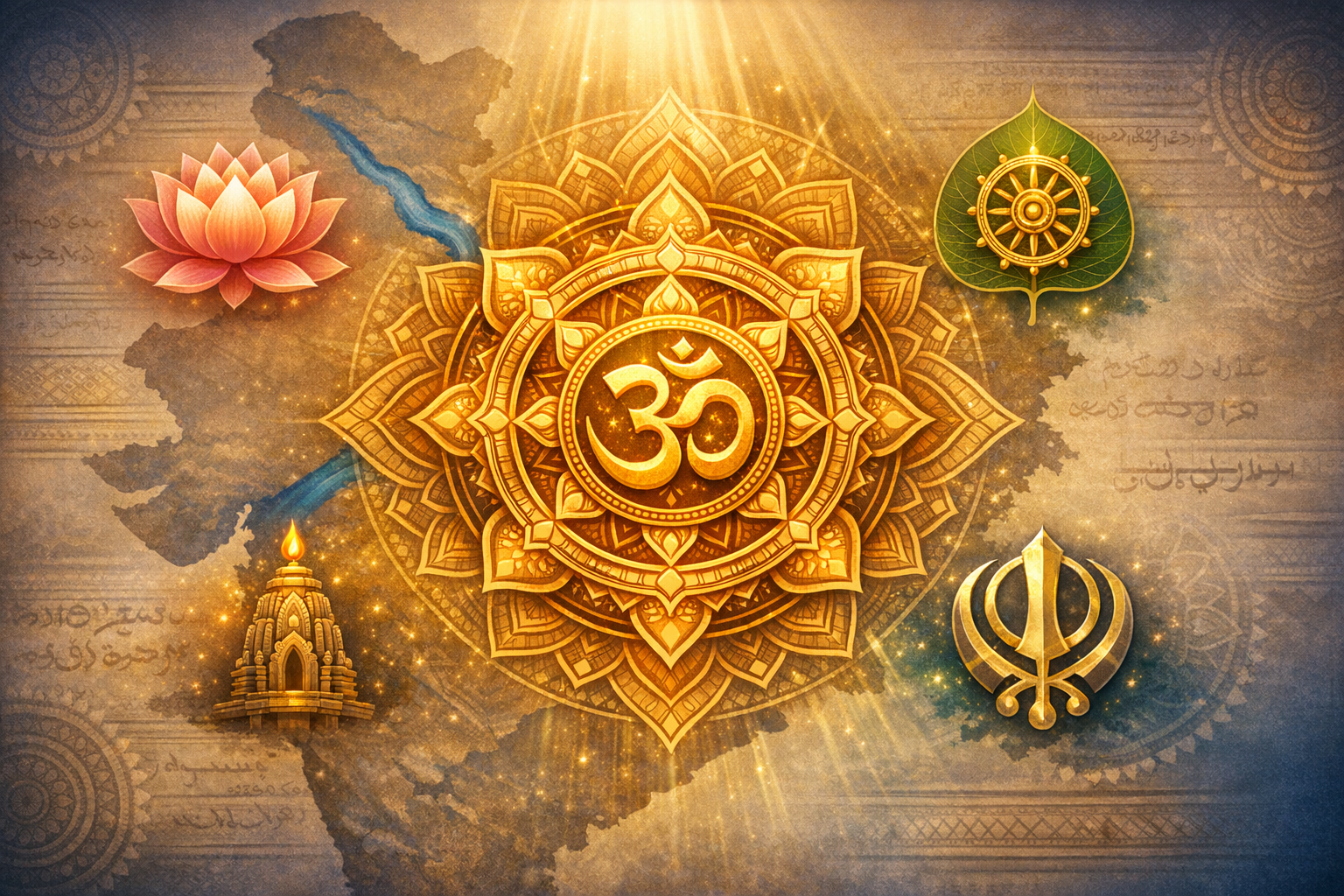
Pluralism is intrinsic to this dharmic vision. The Rig Vedic insightEkam sat vipra bahudha vadanti (“Truth is one; the wise speak of it variously”)frames an enduring ethos of religious pluralism. The concept of Ishta (chosen form or path) and the Ishta-devatā tradition normalize diversity in practice: bhakti, jñāna, karma, and rāja yoga all offer legitimate routes to realization. Such acceptance naturally extends empathy and kinship to related dharmic traditionsBuddhism, Jainism, and Sikhismwhich share overlapping commitments to ahimsa, karma, meditation, ethical discipline, and the guru-śiṣya mode of transmission. In this light, “Unity in spiritual diversity” is not a slogan; it is the civilizational default.
Vedic and Upanishadic teachings emphasize that spiritual identity (ātman) is beyond temporary designationsbeyond names, forms, and social labels (nāma-rūpa). Neti neti (“not this, not this”) captures this apophatic method: the Self is not exhausted by any single descriptor. For this reason, many Indian saints and teachers have historically declined to confine themselves to narrow denominational identities, focusing instead on the timeless principles of Sanatana-dharma that undergird a life of inquiry, compassion, and self-realization.
This raises a practical question: is the name “Hindu” merely a temporary designation? Historically and sociologically, yes“Hindu” names a civilizational family marked by Vedic roots, certain shared festivals and scriptures, and intergenerational institutions. Metaphysically, however, Sanatana-dharma points to an eternal ground that transcends all categories. The two terms therefore occupy complementary planes: “Hindu” describes a cultural-legal umbrella useful for dialogue, scholarship, and public policy, while “Sanatana-dharma” names the perennial principles orienting seekers toward liberation (mokṣa) and ethical living (dharma).
This complementarity also supports unity across dharmic lineages. Historically, these traditions routinely interacteddebating, refining, and learning from one anotherwhile maintaining distinct disciplines and goals. A dharmic framework recognizes this multilayered reality: distinct paths, shared philosophical themes, and a common ethic of mutual respect. The civilizational ideal of Vasudhaiva Kutumbakam (“the world is one family”) flows naturally from this framework, encouraging cooperation rather than competition among Indian spiritual traditions.
Modern law acknowledges elements of this civilizational unity without erasing distinct identities. For example, Article 25 of India’s Constitution, in a specific explanatory context, construes references to “Hindus” to include Jains, Buddhists, and Sikhs for certain legal matters. This is not theological homogenization; it is a practical recognition of overlapping cultural institutions and shared heritage. Such measures work best when paired with public discourse that affirms the uniqueness of each tradition alongside their deep kinship.
Practical usage benefits from contextual precision. When emphasizing shared civilizational history, the term “Hindu” (or “Hindu Dharma”) is appropriate. When discussing theological and philosophical first principles, “Sanatana-dharma” conveys the intended scope and depth more accurately. For scriptural study or lineage-specific practice, terms like “Vedic tradition,” “Vedanta,” or school names (e.g., Advaita, Dvaita, Nyaya, Yoga) help avoid ambiguity. In interfaith and intra-dharmic dialogue, inclusive phrases such as “the dharmic traditions of India” or “India’s spiritual traditions” signal respect for plurality while acknowledging common roots.
Many people encounter a practical dilemma in classrooms, surveys, or immigration forms that demand a single religious label. In such contexts, “Hindu” typically functions as a widely recognized self-description that communicates a broad civilizational identity. Yet in education, community life, and spiritual practice, deeper languageSanatana-dharma, Ishta, dharma, mokṣa, bhakti, and morecaptures the lived nuance that makes the dharmic world distinctive and capacious.
Ultimately, the Divine is not confined by denominational boundaries in the Vedic vision. “Hindu” provides a useful social and historical map; Sanatana-dharma names the terrain itself. Holding both levels togetherwithout reduction, rivalry, or erasuresupports a strong, inclusive, and intellectually honest understanding of the Hindu way of life and nurtures unity among all dharmic traditions. This balance preserves historical accuracy, honors lived diversity, and safeguards the eternal principles that animate the search for truth.
Inspired by this post on Dandavats.