
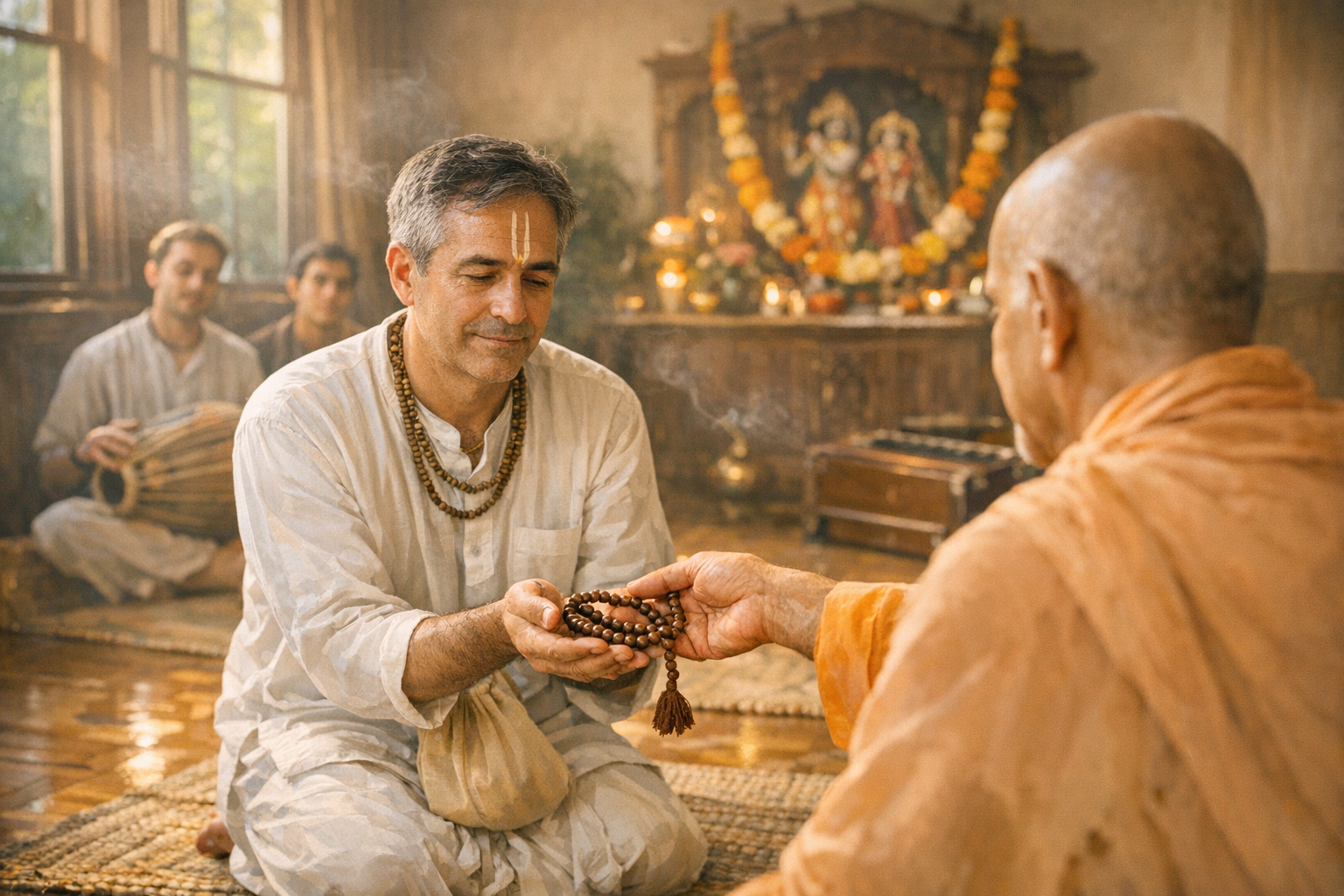
In the summer of 1971 at ISKCON’s Henry Street, Brooklyn temple, a seeker named Ezekiellater initiated as Usika Dasstood apart from a cohort largely in their twenties. Nearing fifty, he was remembered as crotchety, moody, and openly impatient with “you young people,” yet he simultaneously exhibited unmistakable steadiness in śāstra-based conviction and an unwavering, sincere reverence for Srila Prabhupada. The juxtaposition was striking: a temperament shaped by decades of lived experience coupled with a devotional posture marked by humility before the guru.
Contemporary accounts from that Brooklyn community note that July 1971 was a formative moment, when Srila Prabhupada visited and offered initiation (diksha). In Gaudiya Vaishnava practice, receiving a new spiritual name signals a samskara of identity reorientationservice-centered and devotional in aim. The suffix “Das,” meaning “servant,” situates the aspirant’s identity in bhakti and seva rather than in prior social labels. The notation “Swarup das (ACBSP)” found in related memoir material indicates initiation by A. C. Bhaktivedanta Swami Prabhupada, a practice used by many early disciples to affirm lineage and accountability within the guru-shishya tradition.
Placing the episode in historical context illuminates ISKCON’s early New York phase as a living laboratory of transnational Hindu spirituality. The Henry Street temple catalyzed rapid community formation, where diverse aspirantsstudents, artists, professionals, and late-in-life seekersfound a coherent path of practice in kirtan, japa, prasada, and philosophical study. Within that setting, an older newcomer like Usika complicated easy generalizations about the movement’s “youth culture.” He signaled that bhakti’s appeal was not merely countercultural but civilizational, bridging stages of life (ashramas) and speaking to the perennial needs of meaning, discipline, and surrender.
From a sociological standpoint, his personality profilecynical at times, exacting with peers, and unsentimentalcan be read as a pragmatic strategy formed by midlife trials. In new religious movements, older entrants often test ideas vigorously and press communities toward greater doctrinal coherence and procedural clarity. What many remembered in Brooklyn was precisely this paradox: brusque interpersonal style aligned with uncompromising fidelity to the practices Srila Prabhupada outlined. The combination often challenged younger devotees to grow in patience while benefiting from the steadiness that age and experience can contribute to collective spiritual life.
Doctrinally, Gaudiya Vaishnava initiation orients the practitioner along three axes: sound (nama-japa and kirtan), service (seva as an embodied theology), and relationship (the guru-shishya bond as the spine of spiritual progress). Receiving a name such as “Usika Das” embeds these commitments at the identity level, foregrounding sevā-bhāva over self-assertion. Practically, this identity realignment reshapes daily rhythmsearly-morning sadhana, dietary purity, regulative principles, and scriptural engagementan exacting regimen for any age, and potentially transformative for someone entering devotional life in midlife.
The Henry Street recollections also underscore leadership dynamics. Accounts repeatedly point to Srila Prabhupada’s capacity to hold together individuals across generationsoffering gentle instruction, clear philosophical grounding, and a devotional method scaled to a wide range of temperaments. Within this frame, a devotee like Usika became both a beneficiary and a contributor: a beneficiary of compassionate guidance and a contributor of gravitas, realism, and procedural seriousness to a youthful community learning how to institutionalize ideals.
Read through a dharmic lens, the narrative resonates beyond Gaudiya Vaishnavism. The emphasis on disciplined practice and compassionate service aligns with the Sikh ethic of seva, the Buddhist valorization of sangha and mindfulness, and the Jain commitment to ahiṃsā and vows (vratas). Such convergences point to a broader unity within dharmic traditions: plurality of methods without loss of ethical center, and diversity of ages and life-stories woven into a shared quest for liberation, wisdom, and social harmony. The Brooklyn temple thus becomes a microcosm not only of Hindu Dharma’s adaptability but also of dharmic pluralism’s capacity to build cohesive, multi-generational communities.
At the level of lived experience, generational friction often refines values. Younger practitioners, confronted by Usika’s frank critiques, cultivated resilience, courtesy, and forbearance. He, in turn, was steadied by the communal cadence of nama-sankirtana, prasada, and daily sadhanaan environment that redistributes personal edges into purposeful service. The result was a reciprocal pedagogy: youth bringing energy and innovation; elders contributing memory, prudence, and a reality-tested devotion that strengthens institutional spine.
Historically, 1971 Brooklyn also marks an early node in the Hindu Diaspora in US story, where devotional Hinduism adapted to American urban life while remaining text-anchored and practice-driven. The Henry Street case illustrates how tradition migrates: mantras travel across oceans, but it is the daily disciplinechanting, study, and sevathat indigenizes spirituality in new geographies. In this light, Usika’s journey testifies that devotional transformation is not age-bound; it is anchored in sincerity, continuity of practice, and loyalty to the guru’s instructions.
Three durable insights emerge. First, age diversity is a civilizational asset: it multiplies perspectives while stabilizing norms. Second, sincerity in the bhakti tradition routinely outperforms personality quirks; what endures is steadiness in sadhana and fidelity to the guru-shishya tradition. Third, dharmic unity is practice-proven: service, discipline, and compassion form a common core that allows Hinduism, Buddhism, Jainism, and Sikhism to recognize each other’s strengths without collapsing distinct identities.
Remembered today, the “strange story” of Usika Das is less strange than instructive. It shows that devotion matures differently across life stages, that reverence for Srila Prabhupada could coexist with blunt speech and exacting standards, and that a temple’s vitality grows when intergenerational bonds are intentionally cultivated. Above all, it affirms a dharmic truth: when practice is steady and service-centered, differences of age, style, or temperament become complementary threads in a unified spiritual tapestry.
Inspired by this post on Dandavats.
