
-
Powerful Krishna Consciousness Education: Nurturing Devotion from Childhood

Krishna Consciousness education in early childhood emphasizes that devotion can be nurtured from the earliest years through association, play, worship, and loving community. Srila Prabhupada’s teaching on devotee association provides the foundation for helping children grow in bhakti through daily experience rather than abstract instruction alone. The article explains how devotional play, Deity worship, kirtan,…
-
Krishna ABC Kids: A Powerful Cultural Bridge for Early Alphabet Learning
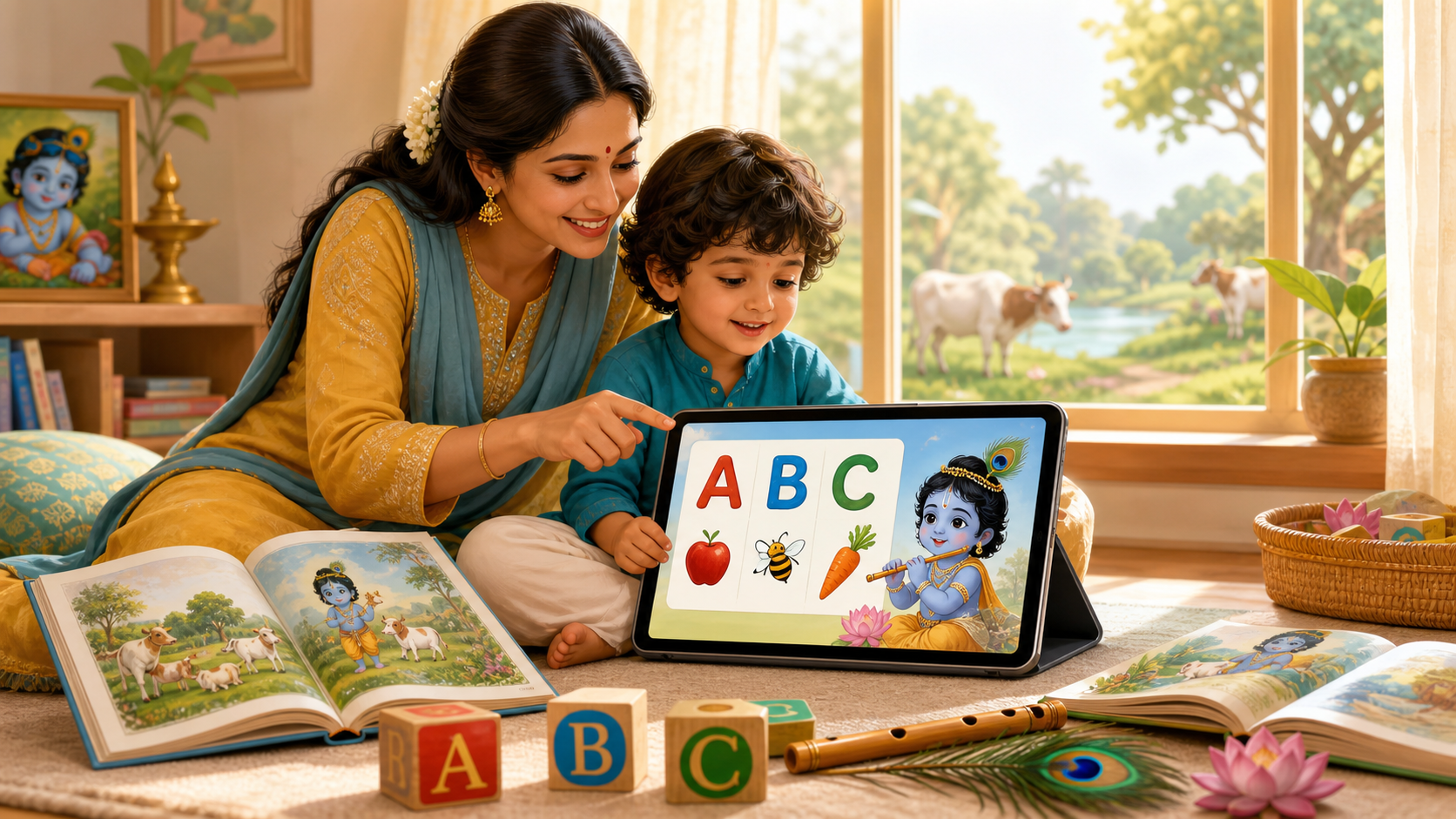
Krishna ABC Kids is best understood as a culturally rooted early learning app that connects ABC education with Krishna-themed visual storytelling. It can help young children approach alphabet learning through familiarity, warmth, repetition, and emotional engagement. The app’s strongest educational value would come from clear letter recognition, sound association, vocabulary building, and parent-guided use. For…
-
O Dharmaputri Review: Powerful Dharma Lessons for Raising Rooted Gen-H

This reflection on O Dharmaputri! Indian Heart, Yogic Wings examines how Hindu Dharma can be transmitted to Gen-H with depth, clarity, and emotional intelligence. It argues that the challenge is not the absence of wisdom in the tradition, but the difficulty of passing that wisdom in ways young people can understand and inhabit. The discussion…
-
Protecting Young Hearts: HJS Awareness Session at Shri Seervi Samaj, Thane

An HJS-led awareness session at the Shri Seervi Samaj Youth Meet in Thane examined relationship risksoften framed in public discourse as ‘love jihad’through a rights-based, behaviour-focused lens. The lecture emphasized youth safety, digital literacy, and legal awareness while rejecting stereotyping and prioritizing interfaith harmony. Participants learned how constitutional protections, the Special Marriage Act, POCSO, and…
-
From ‘Laziness’ to Nervous System Regulation: Trauma, Dopamine, and Dharmic Paths to Change

Many people who call themselves lazy are living with nervous systems tuned by early unpredictability, not moral failings. This article reframes apathy and inconsistency through neurosciencehighlighting neuroplasticity, allostasis, dopamine dynamics, executive function, and polyvagal theory. It explains why high-pressure contexts can boost performance while calm routines feel draining, and how this is a state-dependent pattern…
-
Healing Childhood Trauma While Parenting: Evidence-Based Ways to Break Cycles and Build Secure Bonds

Parents healing from childhood trauma often second-guess even thoughtful choices, wondering whether they are doing too much or not enough. This article reframes those doubts using evidence from attachment science, showing why “good enough” caregiving plus reliable repair predicts secure bonds more than perfection does. It offers concrete guidance on consent-based affection, co-regulation grounded in…
-
Raising God-Conscious Children: Parenting as Daily Seva and a Living Practice of Dharma

Parenting as service to God reframes the household as a sacred space where love, responsibility, and everyday choices become a living practice of dharma. Grounded in social learning research, the approach emphasizes that children internalize what they observe, making adult role modeling decisive. Practical routinesbrief daily prayer or mindfulness, ethical storytelling, shared meals with gratitude,…
-
Evidence-Based Parenting: Letting Kids See Sadness to Build Resilience and Trust

A mother who once hid her grief learned that children sense unspoken emotions and benefit from honest, boundaried disclosure. When she allowed her tears to be seen, her children responded with tenderness, not fear, and misattributions (“Is it my fault?”) diminished. Developmental psychology and dharmic wisdom converge here: emotion coaching, secure attachment, and co-regulation show…
-
Phone Down, Eyes Up: Reclaiming Presence from Digital Distraction to Heal Family Bonds

Attention is the most valuable gift in modern family life, yet smartphones and notifications constantly divert it. This essay analyzes one family’s shift from reflexive checking to intentional presence, grounded in attention science and dharmic wisdom. It explains how intermittent rewards, attention residue, and the mere presence of a phone undermine working memory, trust, and…
-
Protecting Young Minds: HJS urges strict student screen-time limits to Goa CM Sawant

Hindu Janajagruti Samiti (HJS) has urged Goa CM Dr Pramod Sawant to adopt strict, evidence-informed limits on student screen time amid rising concerns about digital addiction. The analysis explains what constitutes problematic digital use, why adolescents are especially vulnerable, and how excess screen exposure harms sleep, attention, eye health, and learning. It outlines a practical,…
-
From Escape to Empowerment: Evidence-Based Lessons on Healing After Abuse and Compassionate Parenting

A rigorously trauma-informed narrative traces how a mother of four left an abusive relationship, navigated complex post-separation dynamics, and transformed pain into durable wisdom. The analysis integrates evidence-based insights on coercive control, adolescent autonomy, grief processing, and autonomy-supportive parenting. It demonstrates why attempts to control outcomes often backfire and how steady, compassionate presence promotes intrinsic…
-
Always Being the Easy One: How Self-Abandonment Breeds Burnoutand How to Heal

This essay analyzes the hidden costs of being the “easy one,” reframing people-pleasing as self-abandonment with measurable impacts on the nervous system. It integrates research on masked neurodivergence in girls, allostatic load, anniversary reactions, and polyvagal theory to explain how chronic appeasement sustains burnout and trauma. Through a third-person narrative of pregnancy loss, NICU stress,…
-
Rewriting the Inner Voice: How Repeated Kind Words Rewired a Childhood Shaped by Fear

A childhood shaped by fear and emotional abuse was gradually rewired through patient, repeated affirmations. A caregiver’s disciplined practiceguided by a grandmother’s wisdomreplaced a shame-based inner voice with self-compassion and resilience. The approach aligns with cognitive reframing, somatic regulation, and dharmic principles of compassionate speech across Hinduism, Buddhism, Jainism, and Sikhism. Practical steps emerge: keep…