
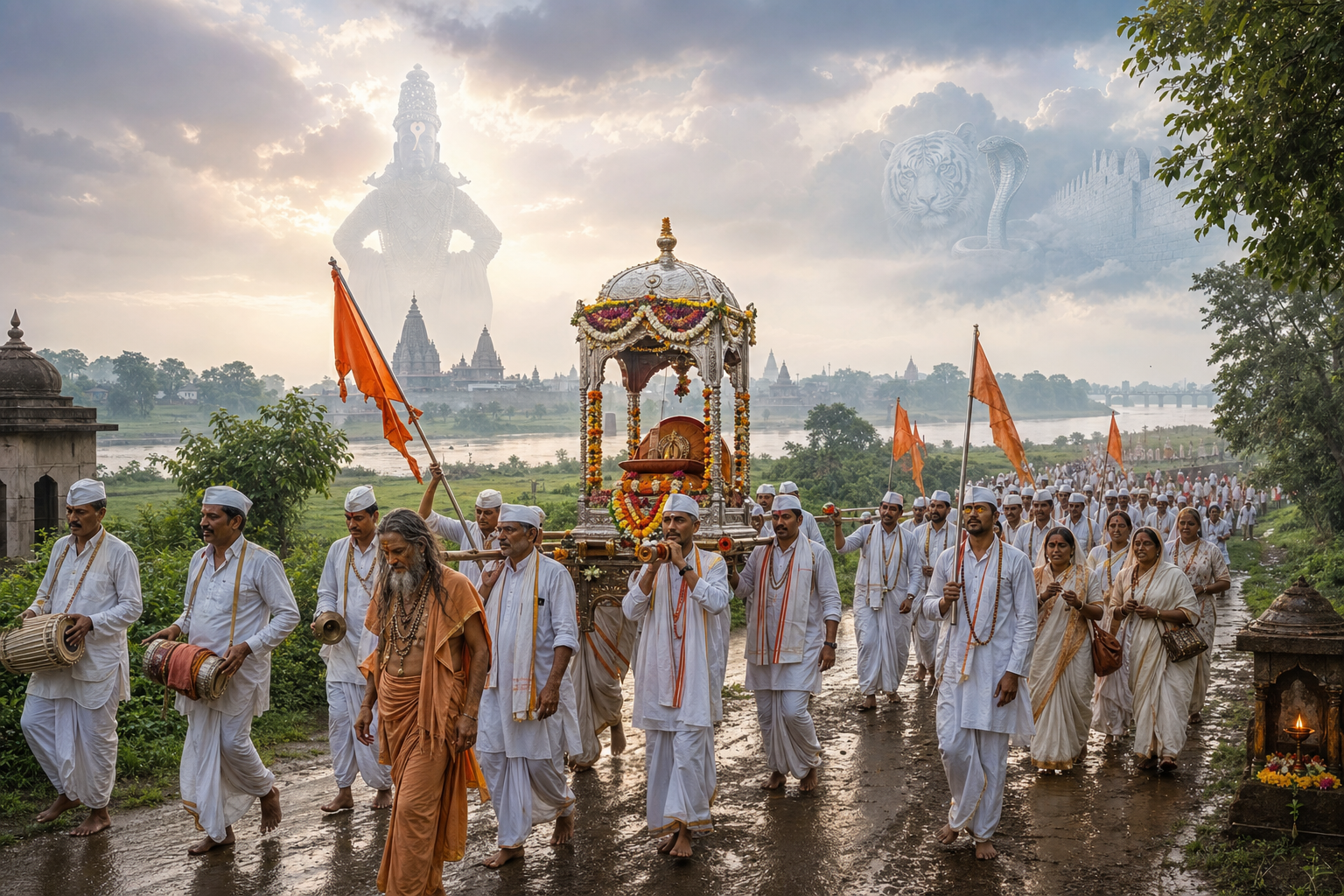
Ram Krishna Hari! The Sant Changdev Maharaj Palkhi Sohala 2026 belongs to the wider devotional landscape of the Pandharpur Ashadhi Wari, one of Maharashtra’s most enduring public expressions of bhakti, discipline, community, and sacred memory. In this tradition, the palkhi is not merely a ceremonial palanquin; it is a moving symbol of lineage, paduka-seva, shared austerity, and collective longing for the darshan of Vithoba at Pandharpur.
Sant Changdev Maharaj occupies a distinctive place in the Warkari sampradaya because his remembered life joins two powerful streams: the yogic inheritance associated with tapas, siddhi, and inner mastery, and the bhakti inheritance that places humility, surrender, and the grace of the guru above spiritual display. The Changdev Palkhi therefore carries more than a saintly memory. It carries a philosophical lesson: the highest spiritual accomplishment is not domination over nature or the body, but the refinement of ego into devotion.
For 2026, the Ashadhi Wari season is especially important because Ashadhi Ekadashi falls on July 25, 2026, according to current published festival calendars. Major Wari schedules reported for Maharashtra place Sant Tukaram Maharaj Palkhi’s departure from Dehu on July 7, 2026, and Sant Dnyaneshwar Maharaj Palkhi’s departure from Alandi on July 8, 2026, with arrival at Pandharpur immediately before Ashadhi Ekadashi. Devotees planning to join the Sant Changdev Maharaj Palkhi should verify the local palkhi timetable through the relevant temple trust, local Warkari mandals, or district-level announcements, because smaller and regional palkhis often publish route details closer to departure.
The word Palkhi refers to the palanquin that ceremonially carries the paduka or sacred sandals associated with a saint. In the Warkari imagination, paduka are not treated as a mere relic. They represent the saint’s path, teaching, and continuing spiritual presence. The act of walking behind a palkhi transforms devotion into movement: the feet become instruments of remembrance, the road becomes a mandala, and the destination becomes both Pandharpur and an inward state of surrender.
The Pandharpur Wari is associated most prominently with Sant Dnyaneshwar Maharaj of Alandi and Sant Tukaram Maharaj of Dehu, yet the larger pilgrimage tradition includes many other palkhis, dindis, kirtankars, village groups, mathas, and devotional lineages. This broader network is crucial for understanding the Sant Changdev Maharaj Palkhi Sohala. The Wari is not a single procession alone; it is a vast devotional ecology in which multiple saints, regions, castes, occupations, and family traditions meet under the name of Vithoba.
In Warkari practice, the chant, the cymbal, the mridang, the tulsi mala, the saffron flag, and the dust of the road all function as spiritual technologies. They create rhythm, discipline attention, and dissolve social distance. A pilgrim may arrive as an individual, but the Wari trains the body to move as part of a shared vow. This is why the procession has endured for centuries: it is at once a pilgrimage, a school of ethics, a cultural archive, and a public rehearsal of equality before Vithoba.
Sant Changdev Maharaj is remembered in devotional literature as a powerful yogi linked with Vateshwar and the sacred geography of the Tapi and Purna river region near present-day Changdev in Jalgaon district, Maharashtra. Traditional accounts describe him as a practitioner of extraordinary austerity and yogic accomplishment. These accounts belong to the hagiographical world of the bhakti tradition and should be read with sensitivity: their purpose is not modern biography alone, but moral and spiritual instruction.
The most famous narrative connected with Changdev Maharaj is his encounter with Sant Dnyaneshwar, Sant Nivruttinath, Sant Sopan, and Sant Muktabai. According to the Warkari tradition, Changdev, proud of his yogic powers, sent a blank message to the young siblings. Sant Dnyaneshwar responded with sixty-five verses of profound Vedantic insight, later revered as Changdev Pasashti. The story then places Changdev on a tiger, holding a serpent like a whip, while the siblings approach him seated upon a moving wall.
The symbolism is unmistakable. A tiger and serpent represent mastery over fear, instinct, and elemental force. A moving wall represents something even more radical: when consciousness is established in truth, even the inert becomes responsive to divine will. The narrative does not humiliate Changdev as a person; rather, it humbles the egoic assumption that siddhi is the summit of spirituality. The deeper achievement is jnana joined with bhakti.
In this tradition, Sant Muktabai’s role is especially significant. Changdev’s transformation is not completed by spectacle, but by instruction, correction, and surrender before wisdom. Muktabai becomes the guru figure who directs him beyond residual pride. This detail is spiritually and culturally important because it places a woman saint at the heart of a major Warkari teaching narrative. The unity of dharmic traditions is strengthened when such voices are remembered with clarity and reverence.
The Sant Changdev Maharaj Palkhi 2026 can therefore be understood as a living commemoration of transformation. It recalls the passage from yogic power to devotional humility, from isolated accomplishment to community participation, and from self-display to seva. In the language of spiritual practice, it is a movement from ahamkara, the hardened sense of ego, toward samarpana, the offering of self at the feet of the divine.
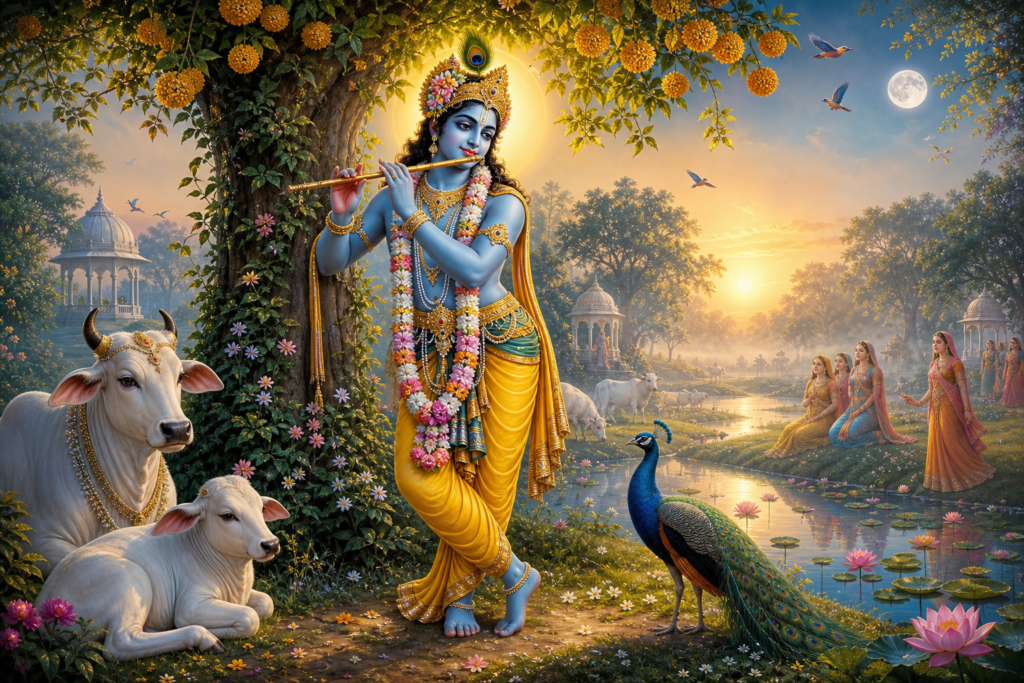
Ashadhi Wari itself is rooted in the worship of Vithoba, the beloved form of Krishna-Vishnu standing on the brick at Pandharpur, accompanied by Rakhumai. The Warkari tradition accepts devotion as a path open to householders, farmers, artisans, scholars, laborers, women, saints, and seekers from different social locations. Its poetry repeatedly emphasizes humility, compassion, remembrance of the divine name, moral restraint, and service to others.
This inclusive character makes the Wari especially relevant in the present day. It offers a model of dharmic unity without erasing diversity. Shaiva, Vaishnava, Nath, bhakti, yogic, and local village traditions find space within the devotional world of Maharashtra. The story of Changdev Maharaj, with its yogic depth and Warkari resolution, shows that Sanatana Dharma is not a narrow system of one temperament or one method. It makes room for tapas, kirtan, jnana, seva, pilgrimage, silence, and song.
The technical structure of a palkhi procession also deserves attention. Devotees usually walk in organized groups called dindis. Each dindi may have its own discipline, leadership, route arrangement, resting pattern, and devotional responsibilities. Food, water, medical assistance, sanitation, and shelter require coordinated planning. The Wari appears spontaneous to an observer, yet its continuity depends on careful organization, inherited roles, and local hospitality along the route.
Walking in the Wari is not a casual religious outing. It demands physical preparation, respect for collective discipline, and awareness of changing weather during the monsoon period. Pilgrims commonly prepare with simple footwear or by walking barefoot according to personal vow, light luggage, basic medicines, rain protection, identity documents, and attention to hydration. Elderly devotees and first-time participants are advised to join through a recognized dindi or local Warkari group rather than walking without support.
The devotional discipline of the road includes naam-smaran, bhajan, kirtan, abhang recitation, darshan, and seva. The repeated chants of Vithoba and the memory of saints such as Dnyaneshwar, Tukaram, Namdev, Muktabai, Chokhamela, Eknath, and Changdev create a shared field of remembrance. The pilgrim’s fatigue becomes part of the offering. The rain, mud, crowd, and long distance are not interruptions to devotion; they become the practical form through which devotion is tested.
For many families, the Wari is also an intergenerational inheritance. Elders recall earlier journeys, children learn the sound of abhang before they understand its philosophy, and villages along the route experience the procession as an annual renewal of sacred hospitality. This emotional continuity gives the Sant Changdev Maharaj Palkhi Sohala its force. It is not only about remembering a saint from the past; it is about allowing that saint’s lesson to re-enter public life each year.
From an academic perspective, Changdev Maharaj’s remembered life should be approached through the combined lenses of hagiography, regional religious history, yogic symbolism, and Warkari devotional practice. Literal, symbolic, and ritual meanings often coexist in such traditions. A miracle story may not function as a modern historical report, yet it can preserve a community’s insight into pride, knowledge, guru-bhakti, and liberation. The Wari keeps these teachings embodied rather than abstract.
The sacred geography associated with Changdev also deepens the meaning of the palkhi. The village of Changdev in Jalgaon district is linked with the confluence of the Tapi and Purna rivers, and the Changdev Maharaj temple is associated with regional pilgrimage memory. River confluences in Hindu sacred geography often mark meeting points of energies, communities, and narratives. In the case of Changdev Maharaj, the geography itself mirrors the saint’s legacy: yoga meets bhakti, austerity meets humility, and local devotion joins the wider Wari.
The spiritual lesson of the Sant Changdev Maharaj Palkhi 2026 is particularly relevant for a time that often celebrates power, visibility, speed, and personal achievement. Changdev’s story asks a sharper question: what is the value of power if it does not ripen into wisdom? The Wari answers through walking. Every step reduces the distance between the individual and the divine, but it also reduces the distance between one person and another.
This is why the Palkhi tradition remains socially powerful. It creates a devotional commons in which food is shared, strangers are addressed with respect, and the names of saints become bridges across social difference. The blog’s broader objective of unity among dharmic traditions is naturally supported by this vision. Hindu, Buddhist, Jain, and Sikh traditions all preserve, in their own idioms, the disciplines of humility, compassion, restraint, pilgrimage, satsang, and reverence for realized beings. The Wari offers a specifically Maharashtrian Hindu expression of values that resonate across the dharmic family.
The Sant Changdev Maharaj Palkhi Sohala should not be reduced to spectacle, tourism, or folklore. It is a living practice that joins body, memory, scripture, song, ethics, and public devotion. To walk with the palkhi, serve the pilgrims, listen to abhang, or even study the tradition respectfully is to encounter a civilization that transmits philosophy through movement and community rather than through books alone.
In 2026, those who follow the Sant Changdev Maharaj Palkhi toward Pandharpur participate in a tradition that speaks with unusual clarity. Yogic attainment must bow before wisdom. Wisdom must flower into humility. Humility must express itself as seva. Seva must expand into social harmony. This is the enduring message carried by the palkhi, and it is why the cry of Ram Krishna Hari! continues to move hearts across Maharashtra and beyond.
Sources consulted for date and background verification include public 2026 Ashadhi Wari and Ekadashi reports from Maharashtra Times and The Economic Times, along with general reference material on Pandharpur Wari, the Varkari tradition, Sant Dnyaneshwar, Changdev Maharaj, and Changdeva temple history.
Inspired by this post on Hindu Pad.


Leave a Reply
You must be logged in to post a comment.