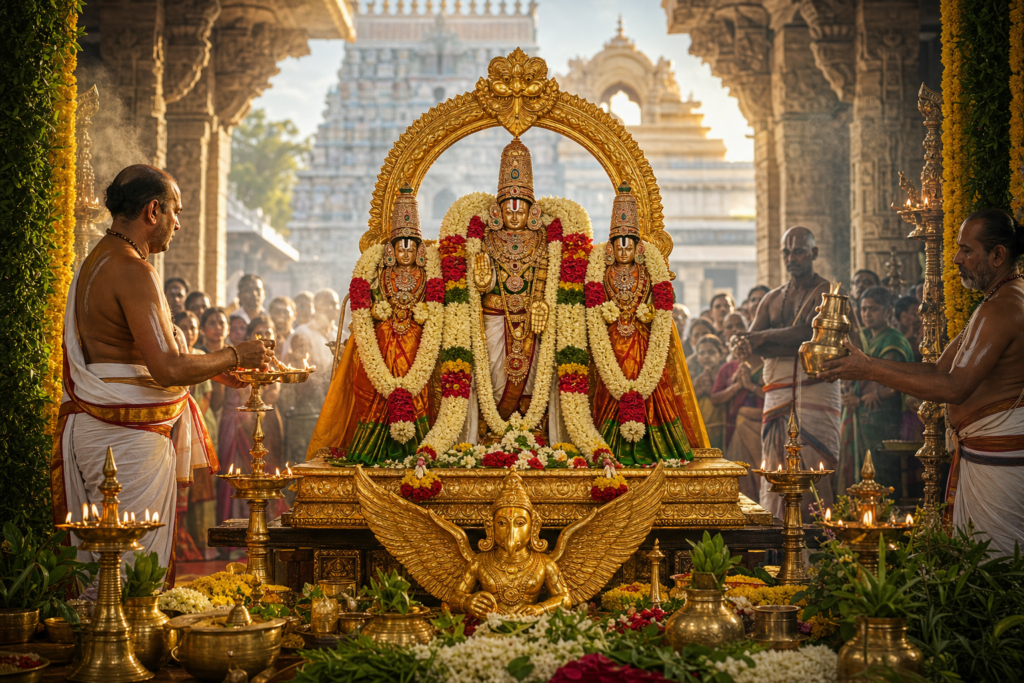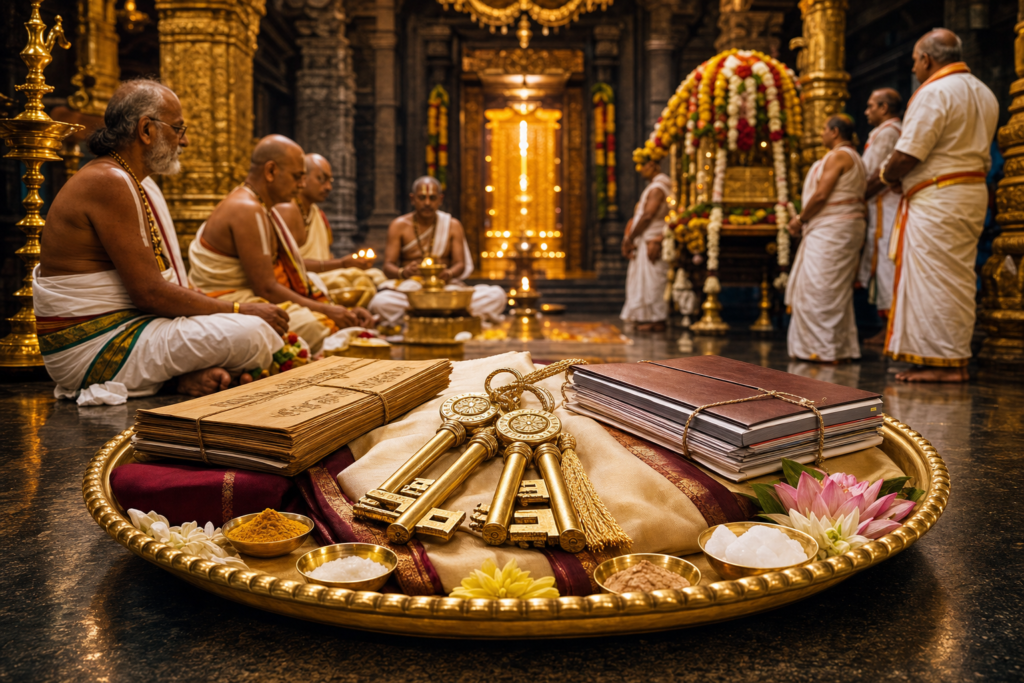
Across the dharmic world, divine dance functions as a precise language of cosmology, devotion, and aesthetics. It encodes philosophical insights into movement, rhythm, and gesture, and it unifies practice and metaphysics in a way that remains both technically rigorous and emotionally resonant. In temples and cultural spaces alike, dance is treated not merely as performance but as darshanan embodied contemplation of the sacred.
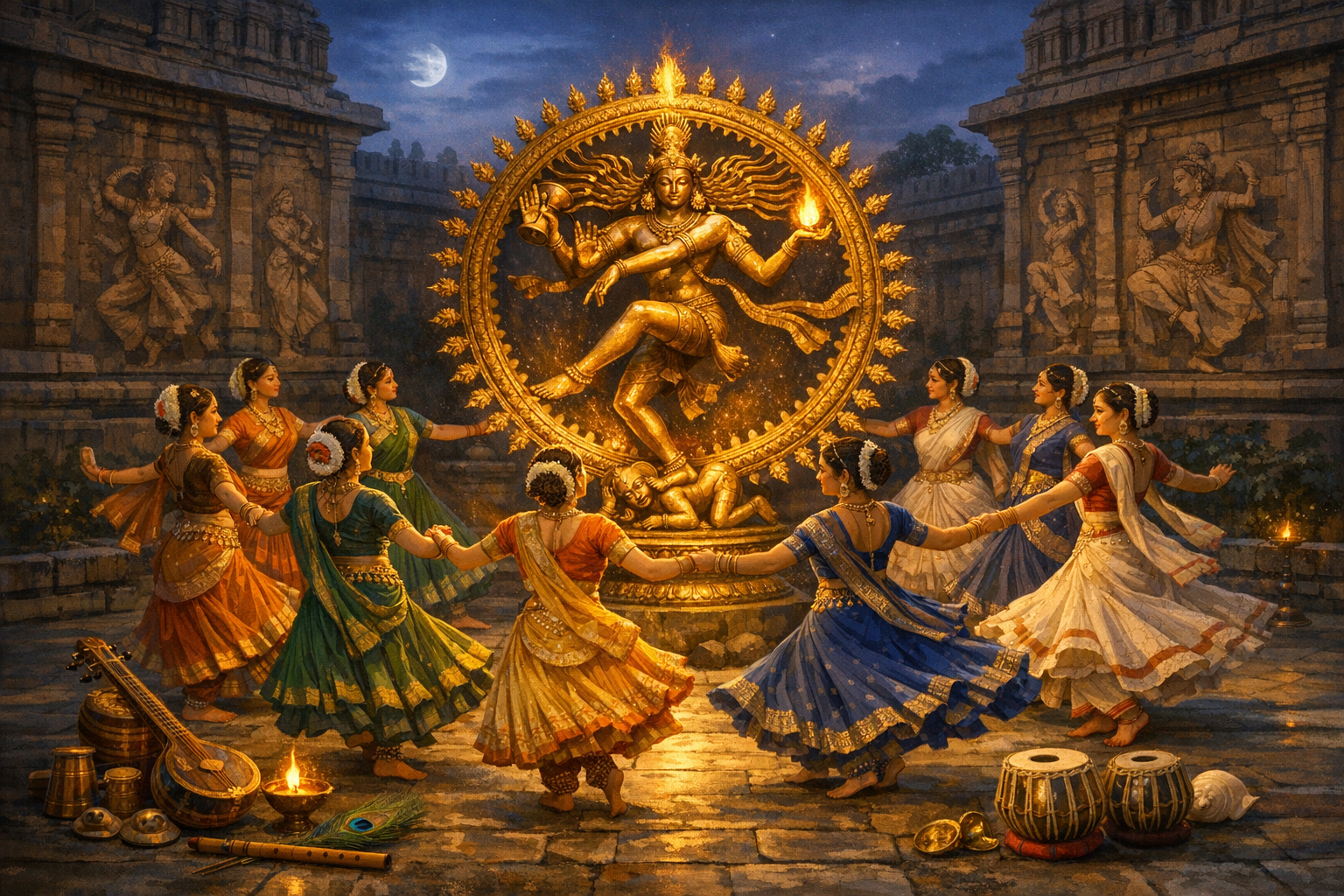
At the heart of this tradition stands Shiva as Nataraja, the cosmic dancer whose iconography is among the most technically dense and symbolically rich in Indian art. The prabhamandala (flaming aureole) signifies the universe in perpetual motion; the damaru in the raised right hand intimates primordial vibration (nada), time, and linguistic order; the left hand holding agni signals dissolution; the front right hand in abhaya mudra assures protection; and the front left hand elegantly points to the uplifted foot, a locus of refuge and grace. Underfoot, Apasmara, the dwarf of forgetfulness, conveys the subjugation of ignorance as a precondition for liberation.
Nataraja’s dance expresses Shiva’s pañcha-kṛtyacreation (sṛṣṭi), preservation (sthiti), dissolution (saṁhāra), concealment (tirobhāva), and grace (anugraha)mapping cosmic cycles to kinetic form. In this view, motion is not accident but ontology: the universe is rhythm (spanda), and dance becomes the grammar through which r̥ta (cosmic order) is continuously sustained.
The damaru’s symbolism extends to sound and knowledge. Traditional accounts hold that its pulse yielded the fourteen Maheshvara Sutras foundational to Sanskrit phonology. This places music, language, and metaphysics on a single continuum in which Shiva’s beat becomes an algorithm for realityan idea echoed in the doctrine of nāda-brahman (ultimate reality as sound).
In temple liturgy and oral traditions, Nandikeshvara is honored as a master of abhinaya and rhythm. While the damaru is an attribute of Shiva in Nataraja iconography, Nandikeshvara is celebrated in performance theory and lore as the archetypal drummer who keeps time for the cosmic dance. This distinction elegantly preserves iconographic accuracy while acknowledging the living performance culture around Shiva’s worship.
The classical framework that renders divine movement intelligible is codified in the Nāṭya Śāstra. Its architecture unites nr̥tta (pure dance), nr̥tya (expressive dance), and nāṭya (dramatic enactment), guided by abhinaya’s four modalitiesāṅgika (body), vācika (speech/music), āhārya (costume/ornament), and sāttvika (inner affect). Rasa theory maps emotional flavors to aesthetic realization, translating theology into affective experience across the navarasa.
Material culture inscribes this theory in stone and bronze. The Chola Dynasty perfected the Nataraja bronze as a portable theology, while temples such as Chidambaram carved the 108 karaṇas of the Nāṭya Śāstra into gopura panels, transforming doctrine into public pedagogy. Brihadeeshwara Temple and related Chola monuments exhibit this synthesis of devotion, sculpture, and dance as an integrated civilizational project.
Ritually, festivals like Arudra Darshan (celebrated under the Ardra/Thiruvathirai nakshatra in Mārgaśīrṣa/Margazhi) foreground the metaphysical core of the Nataraja cult. For practitioners, the predawn abhishekam and dance offerings form a multi-sensory sādhanā in which sound, scent, light, and movement converge as a single act of worship.
Complementing the dynamism of tāṇḍava is the gentler lāsya, traditionally associated with Pārvatī. This dialectic does not reduce to masculine and feminine stereotypes; rather, it codifies two interdependent energiesvigorous revelation and graceful unfolding. Together, they model a non-dual aesthetics where creation and compassion co-operate in a single choreography.
Shakti traditions present pivotal dance theologies through Durga and Kali. The icon of Kali in wild tāṇḍava upon Shiva’s repose dramatizes the moment when unbridled power recognizes its own ground in consciousness and yields to harmony. In practice, Navratri’s community dancesmost notably Garba and Ghoomarembody this Shakti principle as rotating mandalas around a lamp (garbha dīpa), symbolizing life, fertility, and the presence of Devi at the center of communal life.
Vaishnava traditions articulate divine dance as sweetness (mādhurya). Krishna’s Raas Leela in the Bhagavata Purana interprets the divine as an infinite capacity for relation. The circle of gopis is an epistemology: the more the center multiplies love, the more the periphery experiences wholeness. In living repertoire, Kathak’s narrative virtuosity and Odissi’s tribhaṅga geometry render this theology in line, curve, and spin.
Krishna’s Kalinga Nartanasubduing the serpent Kaliya upon the Yamunaoffers a second grammar of grace: aesthetic poise under moral pressure. This motif remains a favorite in Bharatanatyam and Odissi, where controlled elevation, rhythmic precision, and expressive abhinaya communicate ethical victory through musical time.
Vishnu’s Mohini avatāra, though episodic in Purāṇic lore, informs the cultivated softness of Mohiniyattam. Here, circularity, flow, and delicacy are technical ends in themselves, realized through subtle torso mobility (attil) and restrained facial expression. The idiom’s geometry, breath, and pacing align with a theology of compassionate allure.
Ganesha appears in multiple dancing forms (Nritya Ganapati), where asymmetrical balance and buoyant gait symbolize obstacle-clearing through joyful intelligence. As patron of beginnings and arts, Ganesha’s dance aligns creativity with auspiciousness, inviting performers to transform stage entry into a rite of passage.
Saraswati’s vīṇā aligns music with knowledge; in the Nāṭya Śāstra’s integrated vision of saṅgīta (gīta, vādya, nr̥tya), sound and movement are co-constitutive. In this schema, a well-tuned ensembleveena or bansuri with mṛdaṅgam or tabladoes not accompany dance; it completes dance.
Classical forms propagate these theologies in regionally distinct grammars. Bharatanatyam leverages angular clarity, weight shifts, and a codified adavu system to articulate both tāṇḍava and lāsya. Its abhinaya canvases (varṇam, padam, jāvali) render theological nuance through micro-expression and sahṛdaya (shared sensibility) with the audience.
Odissi’s sculptural tribhaṅga and chowka stances, with serpentine torso articulations, closely mirror temple reliefs and bronze iconography. Kuchipudi integrates nr̥tta virtuosity with dramaturgy, including the celebrated tarangam balancing on the rim of a platean athletic metaphor for yogic equipoise amid flux.
Kathak foregrounds tatkār (footwork), pirouettes, and delicate nayika-bhāva to bring Krishna-līlā alive, while Kathakali fuses dance with a theatrical mask-aesthetics and the power discipline of Kalaripayattu. Mohiniyattam emphasizes spiral kinetics and sustained lilt, exemplifying the aesthetics of compassionate grace.
In eastern and northeastern idioms, Sattriya (rooted in Assam’s Vaishnava monasteries or sattra) offers devotional drama-dance tightly interwoven with kīrtana and textual recitation, while Chhau stylizes martial motifs into masked choreography that often interprets episodes from the epics and Purāṇas. In Kerala, Chakyar Koothu refines narrative abhinaya and Sanskrit/Prākrit dramaturgy in a temple-theatre setting, and Odisha’s Gotipua traditions preserve fluidity and acrobatic grace foundational to later Odissi codification.
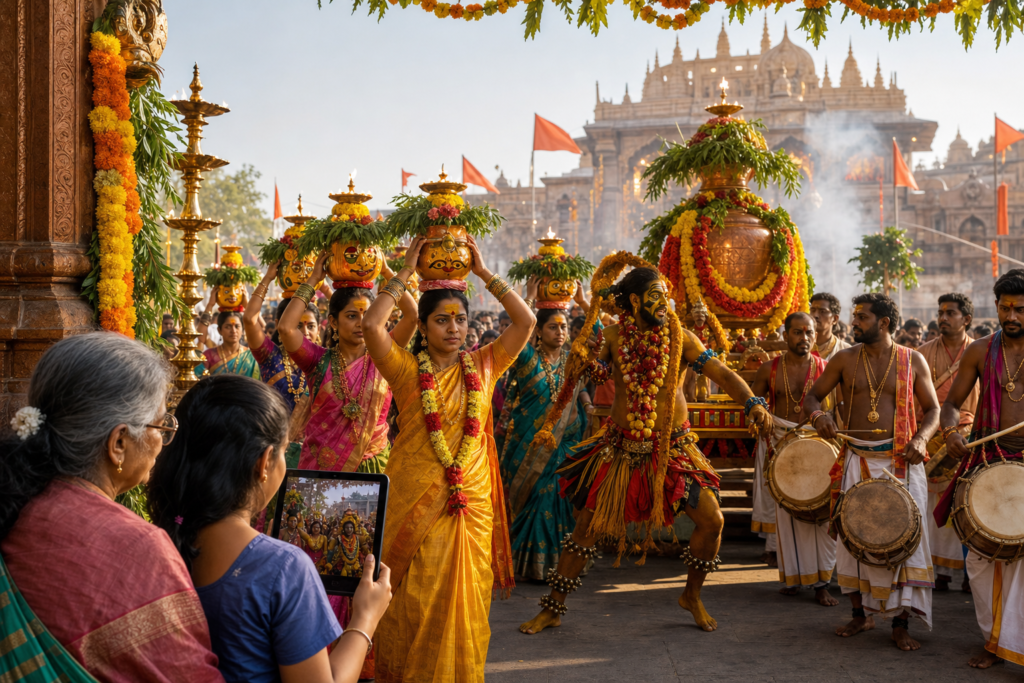
Beyond the classical canon, folk repertoires such as Garba, Ghoomar, Bihu, and Giddha function as living liturgies of season and community. Their circular formations, call-and-response songs, and rhythmic cycles translate theological principlescenter, circumference, and relationinto accessible movement ecologies.
The dharmic family’s unity becomes especially visible when mapping sacred movement across traditions. In Vajrayana Buddhism, Cham dances dramatize protector deities and meditative states, integrating mudra, mantra, and mandala as a single soteriological process. The shared iconographic vocabulary with Hindu formse.g., Mahākāla’s fierce compassionsignals an underlying continuity of symbols and aims.
Jain communities historically patronized dance-drama and musical arts in courtly and mercantile milieus, and contemporary devotional events sometimes include choreographed cultural offerings that emphasize ethical themes of ahiṁsā, restraint, and truth. While formal temple ritual centers on contemplative stillness before the Tirthankaras, the broader Jain cultural sphere demonstrates how movement-based arts can serve values of clarity and compassion.
In Sikh tradition, communal expression often foregrounds shabad kirtan (devotional singing) and the martial artistry of Gatka, whose circular footwork, weapon flow, and breath control exhibit an embodied discipline akin to dance in structure and training. Harvest and community celebrations regularly feature Bhangra and Giddha, reinforcing a shared dharmic ethos that honors courage, joy, and service.
Musical instruments reinforce these theologies of motion. The damaru signals primordial beat; the mṛdaṅgam and tabla stabilize temporal architecture; the veena and bansuri open melodic pathways for rasa to arise; the śaṅkha frames transitions with auspicious vibration; and kartāl/cymbals punctuate communal time. Together, they establish a sonic geometry within which sacred movement achieves its intended clarity.
Pedagogy reflects this integration. Training in adavu or tatkār is inseparable from breathwork, alignment, and an ethical discipline parallel to yama and niyama. The dancer’s sādhana stitches technique to temperament, cultivating steadiness of gaze (dṛṣṭi), economy of motion, and the internalization of tala as lived time.
The stage becomes an altar when performance is offered as seva. Whether during temple utsavams, community festivals, or sabha circuits, the intention to consecrate effort transforms repertoire into ritual. Audiences often report that the first glimpse of a Nataraja bronze on stage or the opening strains of a Krishna vandana yields an immediate shift in attentionan affective quiet that enables perception of meaning in motion.
Historically, this synthesis traveled widely. From the Chola sea-lanes to Southeast Asia, motifs of Nataraja, Somaskanda, and Vaishnava iconography appear in sites including Angkor Wat temple Cambodia, where narrative reliefs and ritual pathways integrated dance with royal and sacred spaces. These exchanges underline dance’s role as a diplomatic and devotional bridge across the dharmic ecumene.
In contemporary scholarship and practice, care is taken to maintain iconographic fidelity alongside creative renewal. Thus, for instance, acknowledging that the damaru belongs to Shiva in the classic Nataraja murti while celebrating Nandikeshvara’s canonical place in abhinaya theory exemplifies how tradition grows by precision, not by erasure.
Above all, divine dance cultivates unity across Hinduism, Buddhism, Jainism, and Sikhism by translating ultimate concernstruth, compassion, courage, and liberationinto shared rhythms and forms. The grammar may vary by region and lineage, but the syntax remains coherent: motion as revelation, time as teacher, and art as a path to the heart of Dharma.
Viewed technically, aesthetically, and spiritually, the “divine dance” is both archive and aspiration. It records a millennium-spanning research program in movement sciences, musicology, dramaturgy, and theology, and it continues to invite practitioners and audiences into a refined experience of attention, joy, and ethical clarity. In that shared experience, the dharmic traditions recognize themselvesas many steps in one circle.
Inspired by this post on Hindu Pad.