
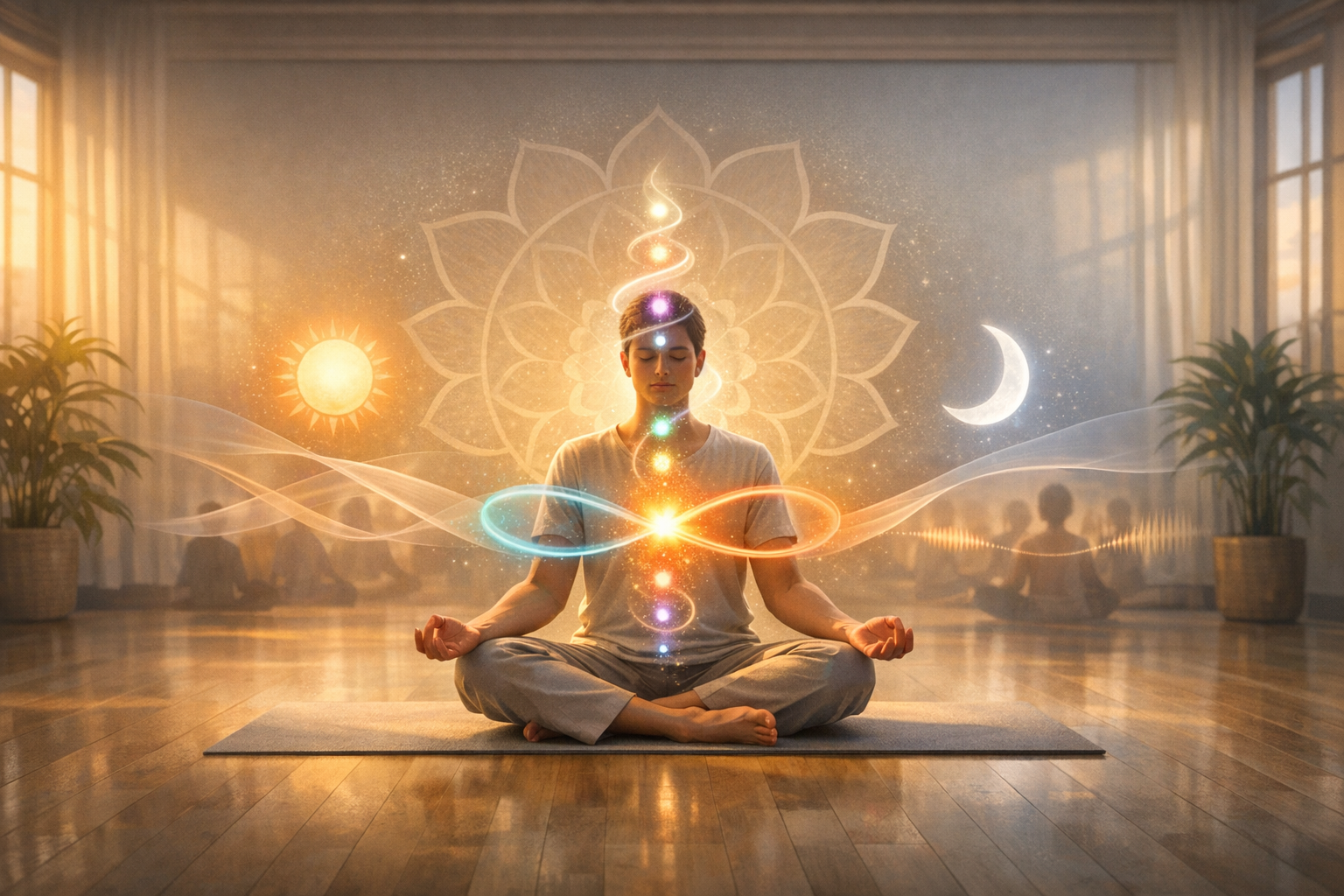
Yoga, from the Sanskrit root yuj (“to yoke, to unite”), is a comprehensive discipline that aligns body, breath, and mind into a coherent path of practice. Rather than mere exercise, it integrates ethical living, postural stability, breath regulation, sense refinement, and meditation. Its seeds are present in Vedic literature and the Upanishads; classical systematization appears in the Yoga Sutra of Patañjali, while later Hatha treatisesHatha Yoga Pradipika, Gheranda Samhita, and Shiva Samhitadevelop the somatic and energetic methods that inform contemporary schools across Hindu, Buddhist, Jain, and Sikh contemplative circles.
In modern life, practitioners commonly combine Yoga and meditation to cultivate stress resilience, emotional balance, and clarity of attention. This synergy reflects the original intent of the tradition: to steady the fluctuations of the mind (citta-vritti-nirodha) while refining the body-breath system so that stillness becomes both accessible and sustainable. Many beginners describe feeling grounded, clear, and connected after even a short, well-sequenced session.
A useful map that connects diverse styles is the eight-limbed framework (Ashtanga) of yama, niyama, asana, pranayama, pratyahara, dharana, dhyana, and samadhi. Yama and niyama articulate ethical foundations found across dharmic traditions; asana and pranayama stabilize and energize; pratyahara and dharana cultivate interiorization and steadiness; dhyana deepens meditative absorption; and samadhi describes non-dual clarity. With this map in view, the principal types of Yoga discussed hereHatha Yoga, Kundalini Yoga, Ashtanga Yoga, Kriya Yoga, and Jivamukti Yogacan be understood as complementary emphases within one integrated science.
The principal types of Yoga frequently encountered by contemporary practitioners include Hatha Yoga, Kundalini Yoga, Ashtanga Yoga, Kriya Yoga, and Jivamukti Yoga, each emphasizing distinct methods while serving the same aim: a steady, compassionate, and lucid mind.
Hatha Yoga is the somatic and energetic pillar of the tradition. Etymologically associated with “sun” (ha) and “moon” (tha), it seeks to balance complementary forceseffort and ease, heating and cooling, activation and receptivityso that prana flows harmoniously. Core methods include asana (postures), pranayama (regulation of breath), mudra and bandha (gestural and energetic seals), and shatkarma (cleansing procedures) described in the medieval manuals.
A typical Hatha session progresses from centering to joint mobility, through standing and seated asanas, into supine/backbending or inversion work as appropriate, then toward pranayama and short dhyana. Alignment-based approaches attend to joint stacking, muscle engagement, and breath pacing to make postures stable, comfortable, and safe (sthira-sukham-asanam). Props such as blocks and straps enable accessibility without diluting rigor.
From a physiological lens, Hatha Yoga cultivates strength, flexibility, balance, and autonomic regulation. Slow diaphragmatic breathing increases heart rate variability (HRV), an indicator associated with stress resilience. Peer-reviewed studies report benefits for back pain, anxiety, and sleep when sequences are appropriately dosed and taught, underscoring that Hatha is both a stand-alone practice and a foundation for all other types of Yoga.
Kundalini Yoga emphasizes the awakening of kundalini-shakti, poetically described as a latent, coiled potential at the muladhara chakra. Practice aims to clear the nadis (ida, pingala, sushumna) so prana ascends through the chakras, refining perception and stabilizing meditative awareness. While the imagery is symbolic, practitioners consistently report increased vitality, focus, and devotional feeling when methods are applied with steadiness and care.
Kundalini protocols often use set-based kriyas that combine rhythmic pranayama (e.g., kapalabhati, bhastrika, and long deep breathing), mantra recitation, targeted asanas, mudras, and bandhas. The structure may feel musicaleffort builds, plateaus, and resolves into restso that energy is intentionally mobilized and then integrated in silence. Inclusive lineages exist, from classical laya yoga sources to modern presentations; all elevate attention, breath, and mantra as primary tools.
Because some techniques are stimulating, prudent progression and qualified guidance matter, especially for those with cardiovascular, ocular, or neurological conditions. The underlying intent, however, remains shared across dharmic traditions: non-harming (ahimsa), clarity, and compassion. Whether framed as prana rising in sushumna or as deepening samatha-vipassana, the arc converges on steadiness of mind and ethical conduct.
Ashtanga Yoga in the vinyasa lineage of K. Pattabhi Jois is a dynamic, heat-building system organized into progressive series. Its method emphasizes tristhanaposture, breath (typically ujjayi), and drishti (gaze)synchronized through counted vinyasa movements. The Primary Series (Yoga Chikitsa) is a therapeutic baseline; subsequent series refine strength, flexibility, and nervous-system regulation through increasingly sophisticated patterns.
The athletic cadence of Ashtanga cultivates stamina, coordination, and focus; many practitioners describe a moving meditation in which awareness becomes absorbed in breath and count. Intelligent modificationsshorter holds, props, or tempo changesallow beginners and experienced students alike to practice safely. Over time, this rhythm often extends naturally into seated pranayama and dhyana after savasana.
The term Ashtanga also names the eight-limbed path described by Patañjali. In that classical sense, yama and niyama articulate universal virtues, asana and pranayama refine the psychophysical field, pratyahara and dharana withdraw and stabilize attention, dhyana matures as uninterrupted flow of awareness, and samadhi reveals non-dual insight. All major schools, including Hatha, Kundalini, Kriya, and Jivamukti, can be located within this architecture.
In the Yoga Sutra (2.1), Kriya Yoga is defined concisely as tapas (disciplined effort), svadhyaya (self-study and mantra recitation), and Ishvara-pranidhana (surrender to the highest). This triad functions like a catalytic core: steady effort refines the body-mind, reflective study aligns intention, and devotion safeguards humility. Practiced daily, it integrates seamlessly with asana, pranayama, and dhyana.
In modern usage, Kriya Yoga also refers to a meditative pranayama lineage associated with Lahiri Mahasaya and later popularized by Paramahansa Yogananda. Its heart is a refined breathwork routine sometimes called kriya-pranayama, applied with inner mantra and attention along the spine. The rationale is elegantly simple: elongate and smooth the breath, quieten the mind, and turn awareness inward to witness consciousness itself.
Because transmission-based instructions vary by lineage, guidance from a competent teacher is recommended for advanced techniques. The spirit of Kriya remains ecumenical and harmonious with the broader dharmic tapestry, complementing Hindu devotional forms, Buddhist calm-abiding and insight, Jain samayik, and Sikh simran through a shared commitment to compassion, sobriety of mind, and service.
Jivamukti Yoga is a contemporary, vinyasa-oriented method that explicitly weaves philosophy, bhakti, meditation, and ethical living into strong asana classes. Established by Sharon Gannon and David Life, it emphasizes ahimsa, sound (nāda), meditation, scripture study, and devotion, often integrating mantra, kirtan, and reading from texts like the Bhagavad Gita or Yoga Sutra. Its pedagogy encourages practitioners to carry Yoga off the mat through compassion-centered choices.
In practice, Jivamukti fosters a sense of community and shared purpose, aligning with the dharmic ideal of Vasudhaiva Kutumbakam‘the world is one family.’ Many students report that philosophical inquiry and devotional arts enrich physically demanding sequences, creating a balanced cultivation of strength, empathy, and reflective insight.
Across all styles, dhyana is the keystone. Whether seated after Hatha alignment, following an Ashtanga vinyasa flow, within a Kundalini kriya, or through Kriya Yoga pranayama, meditation stabilizes attention and clarifies perception. Simple anchorsbreath at the nostrils, a steady mantra, or the natural pause after exhalationhelp attention return again and again to presence.
Pranayama refines the bridge between body and mind. Foundational methods include nadi-shodhana for balancing ida and pingala, ujjayi for breath lengthening and pacing, bhramari for soothing the nervous system, and gentle kumbhaka to cultivate equanimity. Evidence from clinical trials suggests pranayama can improve emotional regulation, sleep quality, and markers of autonomic flexibility when practiced regularly.
Yogic anatomy uses the language of nadis, chakras, and prana to describe experiential subtleties. While distinct from biomedical models, these maps resonate with observations about the diaphragm, vagus nerve, baroreceptor reflexes, and neuroendocrine rhythms. Rather than competing explanations, they operate as complementary lenses: one phenomenological and practice-based, the other empirical and instrument-based.
Choosing the right style benefits from honest self-assessment. Those seeking careful alignment and accessible progressions often thrive in Hatha contexts; those drawn to rhythmic endurance may prefer Ashtanga vinyasa; those inspired by mantra and energetics may gravitate toward Kundalini or Kriya; those who value integrated philosophy and devotion may resonate with Jivamukti. Any of these can be paired with seated dhyana to ensure balance.
A beginner-friendly progression might start with two Hatha sessions weekly to learn foundational asana and breath, add one gentle Ashtanga-inspired vinyasa day for stamina and coordination, explore a short Kundalini or Kriya pranayama set midweek for energetic clarity, and reserve time each day for 10–20 minutes of quiet dhyana. Over months, duration and depth can expand without sacrificing steadiness or safety.
Consistent home practice flourishes with simple structures: a clean, quiet space; a fixed start time; a short, repeatable sequence; and a journal to note sleep, energy, and mood. Many practitioners find that even on demanding days, five minutes of nadi-shodhana followed by mindful sitting resets attention and cultivates patience in daily relationships.
Safety remains essential. People with uncontrolled hypertension, glaucoma, recent retinal procedures, serious spinal disc pathology, or pregnancy should consult qualified guidance before attempting intense inversions, forced breath retentions, or abdominally compressive practices. Pain signals warrant modification or cessation; progress is measured in consistency and clarity, not in dramatic postures.
In tracing the arc from Vedic hymns to medieval Hatha manuals to modern studios worldwide, the enduring thread is transformation through disciplined kindness and attentive presence. Across Hinduism, Buddhism, Jainism, and Sikhism, the cultivation of ethics, concentration, and insight forms a shared civilizational strength. Yoga’s diversity of methods is not a fragmentation but a testament to its inclusivity and adaptability.
A common misconception treats Yoga and meditation as separate pursuits; in practice, they are two sides of one path. Another assumes that different styles compete; in reality, they specialize and complement one another. When practice is grounded in yama and niyama, refined through asana and pranayama, and quieted in dhyana, the result is a balanced life marked by clarity, steadiness, and compassionate action.
With this integrated perspective on Hatha Yoga, Kundalini Yoga, Ashtanga Yoga, Kriya Yoga, and Jivamukti Yoga, the path ahead is straightforward: choose one entry point, begin gently, honor the breath, and return daily. The tradition has always promised that sincere, steady practice reveals its own evidencecalm vitality, an open heart, and a mind ready to serve the whole.
Inspired by this post on Hindu Pad.







