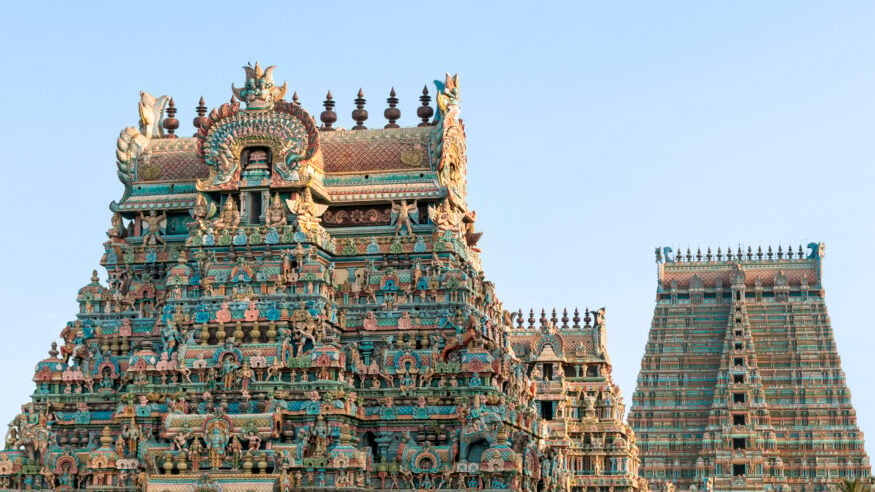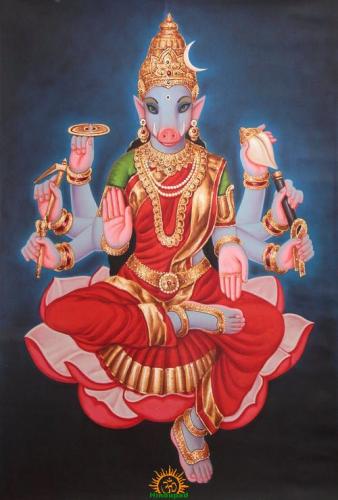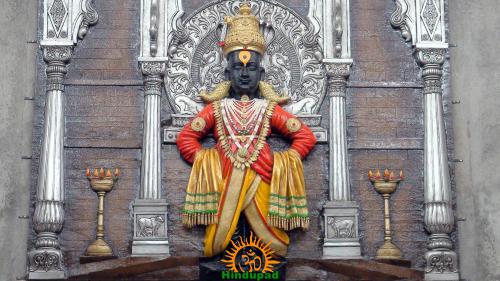
The chudamani, literally the crest jewel, occupies the apex of divine adornment in Hindu iconography. Positioned at the summit of a deity’s crown or hair arrangement, it is more than decoration; it signals the culmination of spiritual power, the focal bindu of presence, and the visual cue that completes the sacred composition of the murti. Within Hindu sculptures and temple architecture, this luminous point concentrates meaning, guiding the gaze upward toward transcendence and divine consciousness.
Etymology and literature reinforce this significance. In Sanskrit, chuda indicates crest or topknot, and mani denotes jewel. The term’s cultural depth is memorably attested in the Ramayana, where Sita entrusts her chudamani to Hanuman as an irrefutable token of identity and truth. In this scene the ornament functions as proof, pledge, and prayer, encapsulating both personal devotion and metaphysical assurance.
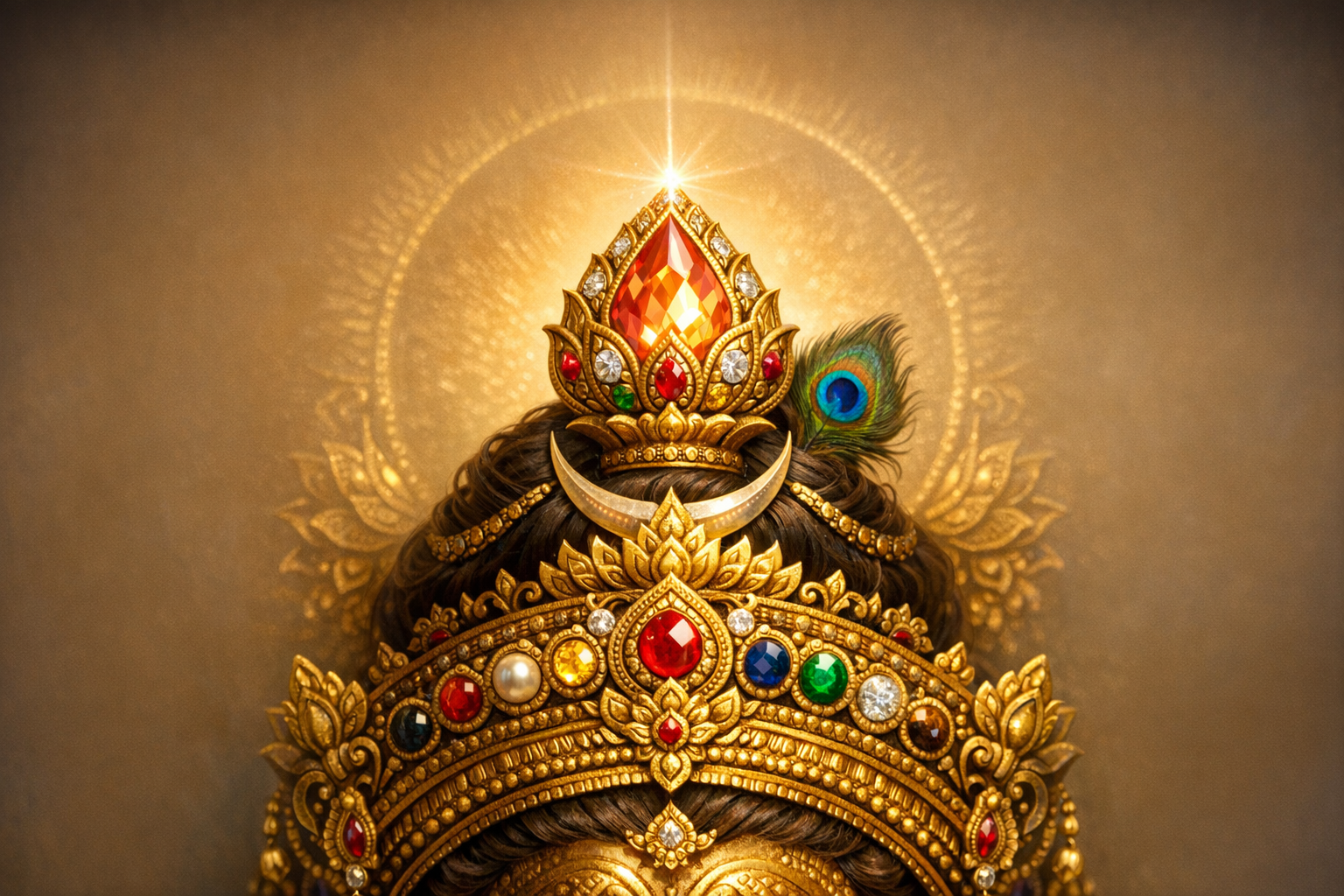
Across sectarian traditions, the chudamani adapts to distinct crown types while retaining a shared purpose. Vaishnava icons often wear the karaanda-makuta or kiritamukuta that culminates in a crest jewel; Krishna’s mor-mukut, with its peacock plume apex, serves a parallel crestal function. Shaiva images frequently display the jata-makuta where the crescent moon, known as chuda-chandra, becomes the luminous crest. In Shakta imagery, goddesses appear with towering crowns whose uppermost jewel concentrates shakti, visually announcing sovereignty and auspiciousness.
Shilpa Shastra and Agamic prescriptions offer technical clarity about this apex element. Texts such as Manasara, Mayamata, and Silparatna detail proportions for the mukuta, often specifying an axial alignment that terminates in the ratna at the summit. The chudamani is frequently conceptualized as a lotus-bud or faceted gem set above a tiered crown, its diameter, profile, and height harmonized with canonical tala measurements. Even in painted traditions, a minute highlight or jewel-dot at the crown’s peak operates as the notional chudamani, ensuring iconographic completeness according to established canons.
Symbolically, the chudamani visualizes the bindu at the sahasrara, the crown center of awareness. It signifies one-pointedness, tejas or radiant potency, and the axis mundi that ascends through the deity’s form. Read with the prabhamandala or halo, the crest jewel marks the moment where embodied divinity opens into cosmic infinitude. Thus, viewers are led from the foundational base of the icon through ascending registers of form, gesture, and emblem to the quiet blaze at the crown a journey from gross to subtle that culminates in stillness.
Materiality intensifies meaning. In living ritual contexts, crowns historically bore chudamani set with gold, rock crystal, ruby, diamond, emerald, or navaratna arrays executed in kundan or granulation. South Indian bronzes often model the jewel in copper alloy using lost-wax casting, sometimes with inlay or mercury gilding to suggest gemstone brilliance. Painted images simulate sparkle through pinpoint highlights, while wood or stucco icons incorporate glass cabochons to convey lustre. Whatever the medium, the craft aims at a convincing illusion of concentrated light at the peak.
Historical and regional idioms showcase rich variety. Gupta and post-Gupta sculpture develop conical crowns that naturally seek a jeweled apex; Pala-Sena works in Bengal and Bihar refine high mukutas whose crests are crisp and lotus-like. Chola bronzes of Tamilakam, exemplars of Hindu sculptures, commonly crown Vishnu with the karaanda-makuta capped by a bud-form chudamani, while Nataraja’s dynamic coiffure balances the crescent as a crestal sign. Hoysala and Vijayanagara traditions multiply crown tiers before resolving them elegantly at the jewel. Beyond India, related apex motifs appear in Khmer, Javanese, and Sri Lankan images, where the head’s summit carries a concentrated flame, lotus, or jewel form.
Cross-Dharmic continuities underscore a civilizational unity of vision. In Buddhist traditions, the ushnisha and its flame-like finial serve as an enlightenment apex analogous in function to the chudamani’s crowning point of awareness. Jain imagery emphasizes the perfected state through the sirascakra and chhatra above the Tirthankara’s head, again highlighting the summit as a site of spiritual consummation. In Sikh heritage, the kalgi or crest plume on royal turbans historically signified sovereignty and moral authority. While each tradition remains distinct, these apex signs collectively affirm a shared Dharmic intuition: the head’s summit is where realization is signaled, celebrated, and remembered.
Temple ritual keeps this symbolism alive. During alankara and abhishekam with panchamrita, priests carefully cleanse and reset the crown and its crest jewel as part of the Shodasha Upachara sequence. On festival days, special kireeta-abhisheka ceremonies may be performed for utsava murtis, with the chudamani gleaming as the visible pledge of royal dignity offered back to the deity. In prana pratishtha, textual injunctions and priestly memory converge to ensure the apex ornament aligns with mantra, mudra, and measure.
Aesthetically and emotionally, the crest jewel becomes the viewer’s final resting place of the gaze. Many find that darshan naturally rises toward the crown, where the chudamani’s sparkle or painted highlight yields a small but arresting sense of completion. This experience is both refined and relatable: the mind, tugged upward by symmetry and light, discovers quietude at the very point the image resolves into brilliance.
Iconographic literacy enriches viewing. In Vaishnava images, look for the karaanda-makuta tapering into a bud-form jewel; in Shaiva forms, attend to the chuda-chandra that crowns the jata-makuta; in Shakta images, notice the tall mukuta and its culminating gem that proclaims shakti. In painted ragamala, Pahari, or Rajput works, a tiny specular accent at the crown may encode the entire metaphysics of ascent. Such observations make museum visits and temple darshan more rewarding, connecting formal design to lived devotion.
Conservation and curatorial practice face predictable challenges. Organic lac used in stone-setting can fail over time, gilt layers may abrade, and replacement jewels can complicate provenance. Responsible display balances material care with interpretive clarity, ensuring that labels and lighting help modern audiences perceive how a small crest jewel anchors the entire theological narrative of a sculpture.
Taken together, the chudamani embodies an elegant synthesis of craft, canon, and contemplation. It gathers complex ideas sovereignty, auspiciousness, enlightenment, and the upward journey of awareness into a single radiant point. Read within Hindu iconography and alongside allied Buddhist, Jain, and Sikh apex signs, it offers a shared Dharmic vocabulary of ascent and completion. As a result, this seemingly modest ornament becomes the crown of meaning in sacred art: the final word in form, and the first invitation to transcendence.
Inspired by this post on Hindu Blog.