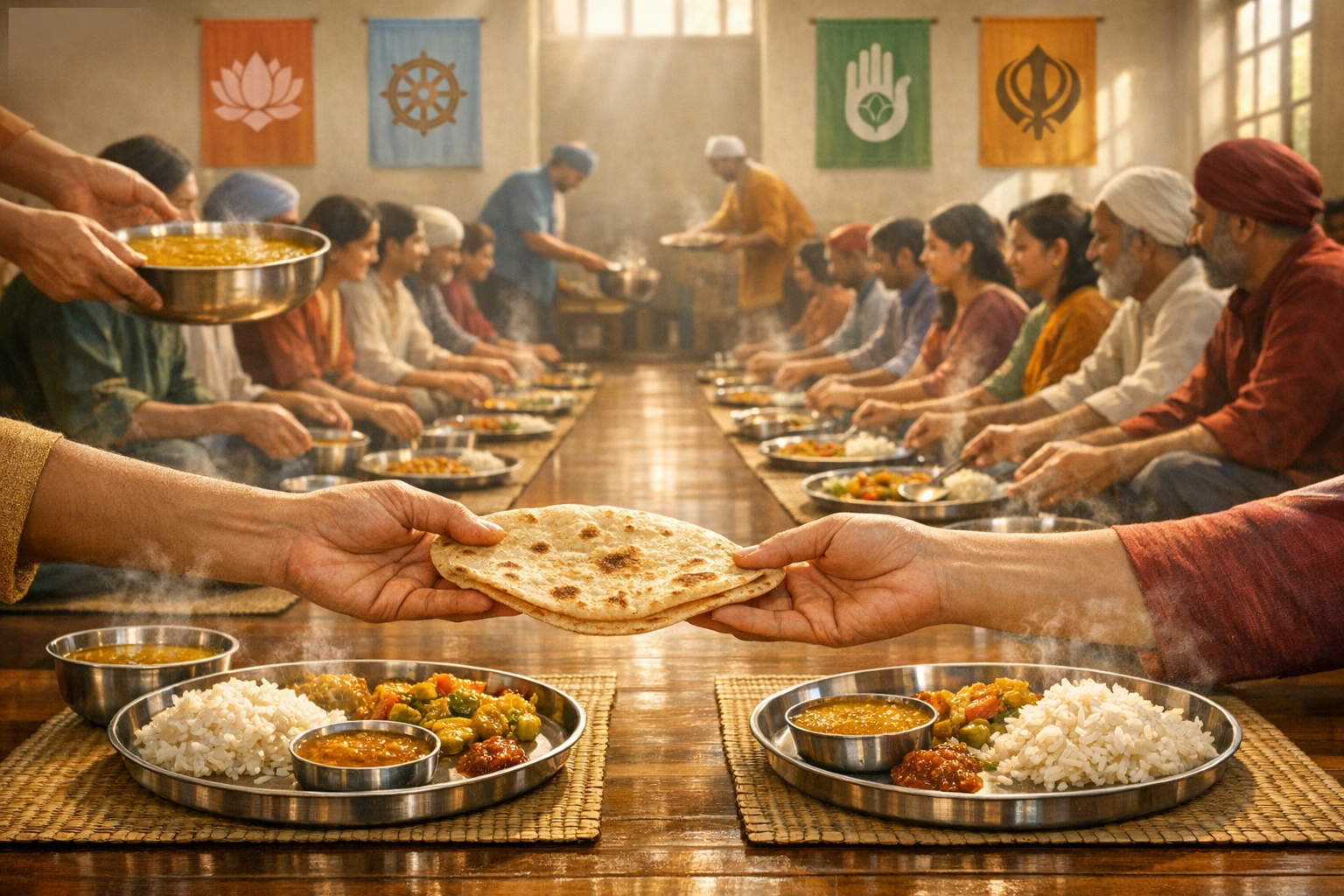
Across Hinduism and the wider dharmic family, the sharing of food is encoded not merely as charity but as a civilizational technology of reconciliation. In texts, temples, and community life, the act of eating together is intentionally designed to dissolve enmity, soften social boundaries, and restore trust. This cultural grammar of commensality frames food as a carrier of sanctity, a vehicle of dana (generosity), and a practical pathway to peace. The tradition persists because it is both spiritually compelling and empirically effective: shared meals reduce social distance, activate prosocial norms, and create conditions for dialogue.
The philosophical foundations within Hindu thought identify food with the sacred. Annam Brahma signals that nourishment is not only material fuel but a manifestation of the divine order that sustains all beings. Under this view, to feed another is to honor the same life-principle one bears. The axiom Atithi Devo Bhava extends this ethic to interpersonal encounters: a guest, including the unexpected or the unfamiliar, is to be received as a form of the divine. Taken together with Vasudhaiva Kutumbakamthe world as one familythese principles render the table a site of moral equality where suspicion yields to kinship.
Dharmashastra and allied literature formalize these intuitions into practice. Hospitality rites such as madhuparka (ceremonial offering of a sweet mixture) and the daily householder’s duty of anna-dana (food-giving) situate feeding at the heart of social ethics. The duty is framed without narrow exclusions; many texts commend feeding the poor, the traveler, and even one’s adversary when approaching in need. The intention (bhava) of the giver is pivotal: food should be pure (sattvika), offered without humiliation, and served before questions are askednorms that minimize friction and maximize dignity.
Ramayana narratives illuminate how hospitality and shared sustenance function as diplomatic bridges. Rama’s reception by Guha, the Nishada chief at Sringaverapura, is a paradigmatic moment in which suspicion dissolves into fraternity through the protocols of welcome and provisioning. In bhakti retellings, Śabarī’s humble offering of forest berries symbolizes how pure-hearted sharing erases status hierarchies and forges an unbreakable bond. Elsewhere, alliances with Sugriva and the acceptance of Vibhishana demonstrate that gestures of trustoften accompanied by rites of acceptance and communal eatingcan reconfigure relationships from rivalry to cooperation.
Bhagavad Gita’s analysis of food quality (Gita 17.8–10) adds a psychological dimension to peacemaking. Sattvika foodfresh, light, and nourishingcultivates clarity (sattva), patience, and empathy, qualities essential for de-escalation and dialogue. Rajasic and tamasic foods, associated with agitation or inertia, are understood to perturb mind and body. Hinduism thereby links culinary choices to emotional regulation and ethical conduct, making diet a strategic variable in conflict transformation.
Temple culture operationalizes these ideals at scale. Offerings become prasadagrace shared without discriminationand anna kshetras, bhandaras, and community kitchens institutionalize open commensality. Standing shoulder to shoulder in a prasada queue or sitting in rows for a festival meal equalizes status, creates benign contact between strangers, and familiarizes participants with a shared ritual rhythm. Observers repeatedly note how the simple choreography of receiving, passing, and partaking can erode wariness more effectively than debate.
Sikh, Jain, and Buddhist traditions reinforce and universalize this dharmic consensus. The Sikh langar enshrines radical equality: all sit together, all are fed the same, and service (seva) rotates through the community. Jain anna-satras (free food centers) and anna-kshetras vivify ahimsa by nourishing life impartially, while Buddhist dana practices cultivate generosity and interdependence between lay communities and the Sangha. These sister traditions converge on one lesson: shared, vegetarian food offered with humility is a reliable grammar of peace in a plural society.
Contemporary social science helps explain why these practices work. Commensalitythe anthropological term for eating togetherreduces intergroup anxiety by replacing abstract categories with concrete, synchronized activity. Sharing a meal encourages mimicry and temporal alignment (passing, serving, tasting), which are associated with endorphin and oxytocin pathways that promote trust. Warm, lightly spiced vegetarian food enhances parasympathetic activation (rest-and-digest), helping participants feel safe. When framed by sacred narratives and stable ritual cues, these physiological effects compound into durable social bonds.
Ritual design is crucial. Traditions privilege vegetarian (sattvika) menus to widen inclusion across dietary norms and to minimize ethical friction. Seating patterns that mix groups, the practice of serving others before oneself, and the dignifying language of blessing (prasada, bhog, maha-prasada) mediate status differences. Frugal abundancesimple dishes offered generouslypreempts competition and signals that everyone’s need is already accounted for, a powerful antidote to scarcity-driven hostility.
Field experience from festivals and day-to-day temple life corroborates these mechanisms. Whether at a Kumbh Mela bhandara, a village annadanam, a Durga Puja bhog, or a gurudwara langar, participants routinely report that awkwardness wanes within minutes. The ambient sound of ladles against steel plates, the shared pace of service, and the reciprocity of “please take more” reframe the encounter as cooperative rather than competitive. Many who arrive as strangers leave as acquaintances; those who arrive as skeptics often return as volunteers.
Ethically, the dharmic canon cautions against instrumentalizing food-sharing as mere optics. Dana must be anchored in humility (amanitvam), non-violence (ahimsa), and truthfulness (satya). In practical terms, that means inviting without coercion, honoring dietary constraints, prioritizing the vulnerable in seating and service, and ensuring transparent sourcing. These safeguards align intention and impact, preserving the moral authority that makes shared food persuasive in the first place.
In applied peacemaking, the method scales from households to cities. Neighborhood temples and gurudwaras can host interfaith langar-style meals; Jain anna-kshetras can coordinate with local Buddhist and Hindu organizations for weekly community kitchens; schools can introduce mixed-seating festival lunches that teach Vasudhaiva Kutumbakam experientially. Across settings, the format is simple: sit together, serve each other, eat the same food, and linger long enough for conversation to begin.
The cumulative picture, visible from the Ramayana to modern community kitchens, is consistent and testable: when food is sacralized as gift, offered with dignity, and shared without distinction, enmity loses the conditions it needs to endure. Hinduism and its dharmic counterparts have preserved this insight not as abstraction but as replicable ritual. In an age of polarization, this civilizational wisdom remains strikingly contemporary: a warm, common mealprasada, langar, danastill melts the ice that argument rarely can.
Inspired by this post on Hindu Blog.