
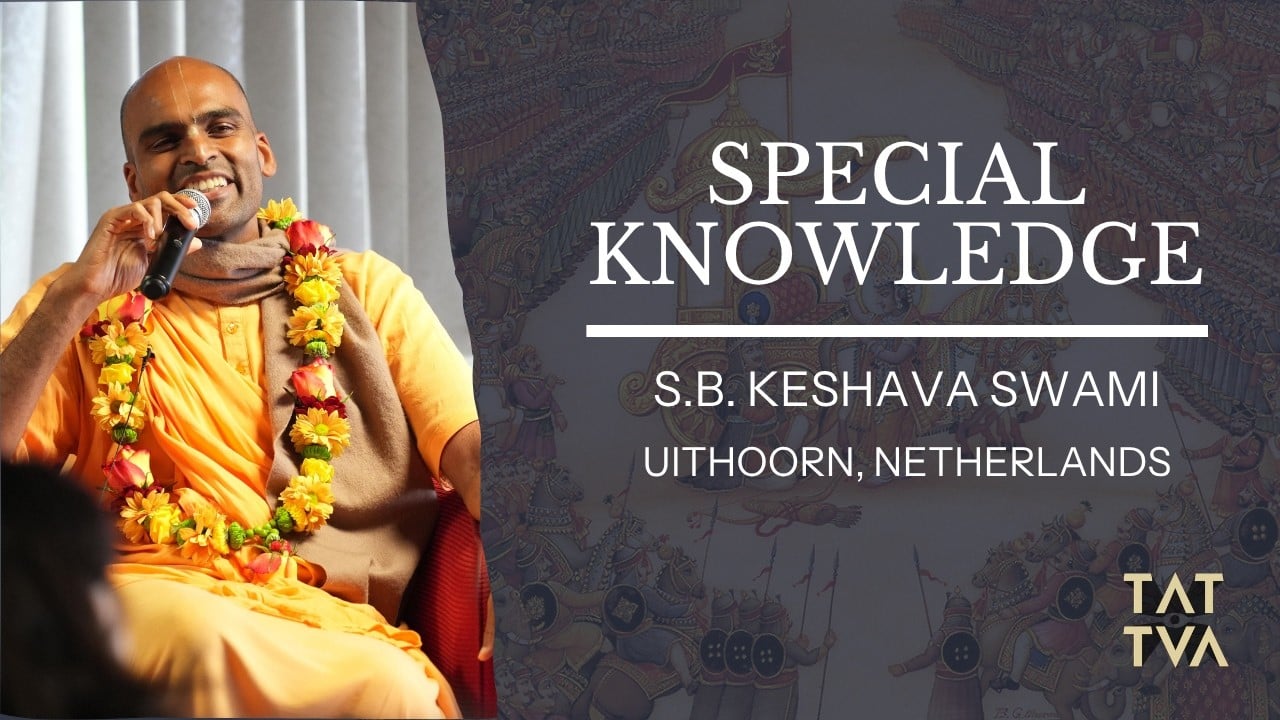
On 28.05.2025 in Uithoorn, the Netherlands, a welcome gathering honored HH SB Keshava Swami (Svayam Bhagavan Keshava Swami). Organized under the banner Tattva by Keshava Maharaja, the program foregrounded the theme Special Knowledge and invited the local dharmic community—families, students, and seekers from multiple traditions—to consider how sacred learning matures into lived wisdom. The setting—intimate, attentive, and intergenerational—highlighted a question that is both classical and contemporary: what makes knowledge truly transformative?
Situated within the Gaudiya Vaishnava lineage yet articulated for a diverse audience, the discussion approached special knowledge not as information accumulation but as a disciplined, ethical, and devotional refinement of perception. In this framing, knowledge is rigorous because it demands verification in conduct and relationship; it is generous because it culminates in service; and it is relevant because it addresses fragmentation in modern life with practices that integrate heart, intellect, and community.
A precise lens for this theme arises from the Sanskrit distinction between jnana (conceptual understanding) and vijnana (realized, experiential knowledge). In the Bhagavad Gita, the measure of understanding is embodiment—insight becomes complete only when it is expressed in character and action. Within bhakti-yoga, this maturation rests on attentive hearing about Sri Krishna, contemplative assimilation of teachings, and practical service that aligns intention with behavior.
From the standpoint of Indian epistemology, three complementary pramanas—pratyaksha (direct perception), anumana (inference), and sabda (authoritative testimony)—anchor reliable knowing. Gaudiya Vaishnavism privileges sabda-brahman as preserved and explained through parampara (lineage) and corroborated by the concordance of guru, sadhu, and shastra. This triangulation tempers naive empiricism and untethered speculation alike, fostering discernment that is faithful to revelation and critically alert to context.
In the bhakti framework, special knowledge unfolds through sadhana that is both systematic and humane: sadhu-sanga (uplifting association), nama-kirtan (sacred sound), svadhyaya (structured scriptural study), and seva (selfless service). Classical descriptions outline a progressive interior reordering—from shraddha (nascent trust) through steadiness and taste to mature love—in which attention clarifies, ethical reliability deepens, and responsibility toward others becomes joyful rather than burdensome.
This trajectory is psychospiritual as much as theological. By observing the gunas (sattva, rajas, tamas) that color mind and behavior, practitioners diagnose reactive patterns and cultivate sattva as a stable platform for devotion. Practical supports—regulated routines, mindful breath, careful speech, and early-morning study—quiet habitual turbulence, enabling insight to penetrate beyond sentiment into durable conviction.
While rooted in Vaishnava praxis, the theme resonates across dharmic traditions. In Buddhism, the triad of sila, samadhi, and prajna culminates in seeing things as they are; in Jainism, anekantavada refines perspective-taking and its enumerations of jnana distinguish scriptural from direct knowledge; in Sikh tradition, gurbani and naam-simran nurture gian that transforms community life. Each path honors disciplined learning united with compassionate action—an alignment central to Sanatana Dharma’s unity-in-diversity.
Diaspora gatherings such as the Uithoorn welcome function as living laboratories of this integration. Children hear timeless katha in a European town; professionals navigate demanding schedules while preserving time for kirtan; elders transmit living memory of temples and teachers. Participants often report that the shared cadence of sacred sound softens alienation and turns difference into affinity, making the community itself a medium of knowledge transmission.
In practical terms, three commitments consistently convert instruction into realization. First, daily contact with shastra—especially Bhagavad Gita and Srimad-Bhagavatam—anchors meaning and vocabulary. Second, guided participation in the nine limbs of bhakti stabilizes attention and clarifies motivation. Third, reflective dialogue in satsanga exposes blind spots and prevents privatized, idiosyncratic interpretations from hardening into dogma.
Ethically, realized knowledge expresses as humility, gratitude, and service. Its measure is not rhetorical flourish but relational beauty: patience under pressure, truthfulness without aggression, and steadiness that inspires trust. In civic settings, this ethos becomes responsible speech, care for neighbors, and ecological restraint—concrete ways devotion widens into public good.
A comparative lens highlights common ground without erasing difference. Vaishnava reliance on sabda-pramana sits fruitfully alongside Buddhist attentiveness, Jain intellectual non-violence, and Sikh seva, while the shared civilizational value Vasudhaiva Kutumbakam frames these paths as complementary contributions to a humane order. Where exclusivist claims arise, dharmic reasoning returns to experience, compassion, and the plurality encoded in the term Ishta—allowing persons and communities to honor their chosen disciplines while respecting others.
Seen this way, special knowledge is not secretive; it is special because it integrates the whole person and heals fragmentation. It is rigorous because it submits understanding to practice and community verification. It is generous because it culminates in giving—of time, attention, and skill—in service of the Divine and the common good.
For attendees in Uithoorn on 28.05.2025, the welcome for HH SB Keshava Swami was both celebration and syllabus. Channel: Tattva by Keshava Maharaja provided a convening frame, but the curriculum unfolded in careful explanations, measured singing, and the quiet afterglow of shared conversations. The enduring lesson is simple and demanding: learn deeply, live gently, and let wisdom be measured by how much unity it cultivates across Hinduism, Buddhism, Jainism, and Sikhism.
Within the Hare Krishna Movement and ISKCON communities across Europe, programs of this kind serve as continuing education. They reinforce the guru–shishya relationship, clarify Gaudiya Vaishnavism’s theological contours, and offer a calm counter-narrative to the velocity of digital culture. In Uithoorn, that educational function was palpable in the thoughtful pacing, the inclusive welcome, and the way complex ideas were rendered discussable for newcomers and seasoned practitioners alike.
Inspired by this post on Dandavats.











Leave a Reply
You must be logged in to post a comment.