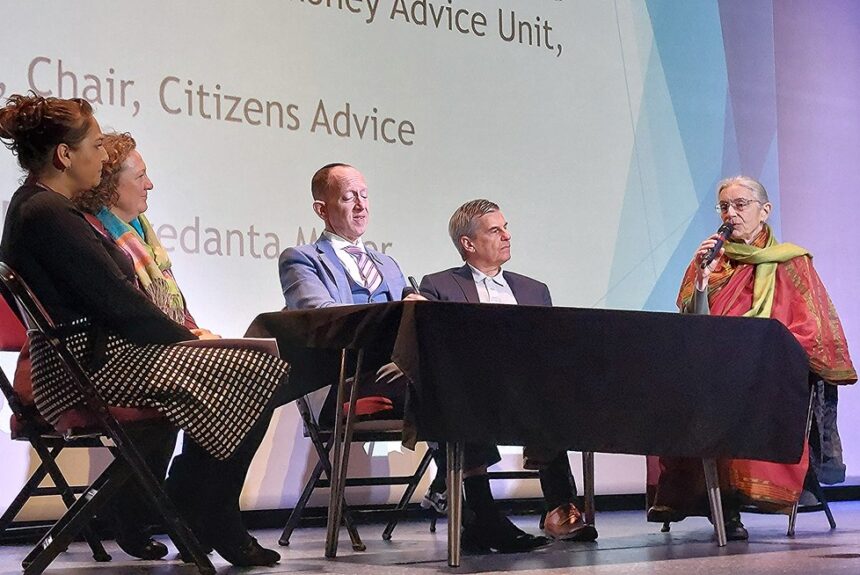
The Hertsmere Community Conference at the Wyllyotts Theatre in Potters Bar convened civic, faith, voluntary, education, health, and business leaders to strengthen community cohesion and interfaith collaboration across the borough. Among the invited panelists was Temple President Her Grace Visakha dasi, representing the Krishna temple community (ISKCON, Bhaktivedanta Manor).
The conference gathered a wide range of delegates from all sections of Hertsmere’s community to collectively learn, network, and explore opportunities for collaboration. The format encouraged structured dialogue, practical problem-solving, and relationship-building intended to translate discussion into sustained joint action.
As a multi-faith and multi-ethnic area, Hertsmere benefits from initiatives that foster mutual understanding and shared purpose. A borough-level community conference of this nature situates local prioritiessuch as social inclusion, youth opportunity, health and wellbeing, and cultural heritagewithin a framework of cooperation that reaches beyond institutional boundaries.
Interfaith dialogue formed a central thread, not as an end in itself, but as a catalyst for concrete community outcomes. Evidence from social psychology and community development indicates that regular, meaningful contact across difference, supported by common goals and institutional endorsement, measurably increases trust, reduces prejudice, and builds the bridging social capital required for resilient neighborhoods.
Contributions from Her Grace Visakha dasi highlighted how dharmic valuesahimsa, seva, satya, daya, and maitriprovide a shared ethical vocabulary for collaboration. Framed through the lived practices of Hinduism, Buddhism, Jainism, and Sikhism, these principles align naturally with civic aims, affirming that spiritual convictions can serve the common good without compromising distinct identities.
A dharmic lens strengthens unity in diversity by emphasizing responsibilities alongside rights. In Jain teachings, non-violence and careful stewardship encourage environmental and interpersonal care; in Buddhist traditions, karuna and mindful awareness nurture empathy and dialogue; Sikh practice enshrines sarbat da bhala, the welfare of all; Vaishnava bhakti, central to ISKCON and the Krishna temple community, translates devotion into compassionate service. These convergences invite practical cooperation across communities.
From panel dialogue and audience interventions, five programmatic pillars emerged as especially actionable: faith literacy and open-house exchanges; shared seva such as community kitchens and food relief; youth leadership and creative arts; elder inclusion and mental health signposting; and environmental stewardship expressed through green events and public spaces.
Faith literacy builds confidence and dispels misconception. Open-house days at temples, gurdwaras, monasteries, and community centerssupported by clear briefings for visitors, artifact displays, and short talkscan normalize questions, illuminate commonalities, and reduce hesitation that often inhibits constructive contact.
Shared seva is a proven bridge. Community kitchens that honor diverse dietary normsdrawing on practices such as prasadam and langarmodel dignity and hospitality while addressing food insecurity. Coordinated service days further allow residents to volunteer together across traditions, creating friendships that extend beyond formal events.
Youth leadership programs can pair civic skills with cultural confidence. Mentored cohorts from different schools and faith-society groups can co-design micro-projects in arts, sport, and digital storytelling, culminating in showcases at venues such as Wyllyotts Theatre. Such initiatives expand horizons, strengthen belonging, and channel energy toward constructive public life.
Elder inclusion and wellbeing require gentle, consistent attention. Interfaith befriending networks, multilingual signposting to local health and advice services, and transport support around events reduce isolation while acknowledging practical barriers that seniors disproportionately face.
Culture and heritage programming enrich the civic calendar. Curated heritage walks, festival open evenings, classical and folk performances, and storytelling sessions can be scheduled around major observances across Hindu, Buddhist, Jain, and Sikh traditions, ensuring that representation remains balanced and that discovery is mutual.
To ensure accountability, collaboration benefits from clear measurement. Social cohesion can be tracked through a portfolio of indicators, including participation diversity and frequency, volunteer hours shared across communities, cross-organization project density, event accessibility metrics, and qualitative markers such as trust, belonging, and perceived fairness captured through pre- and post-engagement surveys.
Mixed-methods evaluation deepens insight. Social network analysis can quantify new connections formed between institutions; reflective interviews and community panels can surface nuanced feedback; simple longitudinal dashboards can display trend lines over a year, enabling rapid learning loops and course correction. Data protection and ethical consent practices should remain integral to this process.
Good governance sustains momentum. An interfaith and civic steering group with a concise terms of reference, rotating facilitation, equity-aware budget allocation, and transparent reporting can oversee a shared annual plan. Training for volunteer leads in safeguarding, inclusive facilitation, and conflict sensitivity strengthens delivery quality.
Accessibility must be designed in from the outset. Step-free access, hearing support, quiet spaces, childcare options, and transport reimbursement reduce participation barriers. Clear attention to language accessibilitythrough plain English, translated summaries where feasible, and visual aidswidens reach across Hertsmere’s communities.
Communications should emphasize shared purpose and practical invitation. Multi-channel messaginglocal press, community newsletters, places of worship, schools, libraries, and social mediahelps residents connect opportunities with their daily routines. Careful scheduling around major religious dates and school terms maximizes inclusion.
Environmental stewardship links local action to global responsibility. Vegetarian and vegan catering, reusable service ware, public-transport incentives, and waste-sorting stations express ahimsa in contemporary practice and signal care for future generations.
Wyllyotts Theatre, Potters Bar, proved an apt venue for this borough-wide gathering, combining accessibility with cultural familiarity. Bringing stakeholders together in a neutral public space reinforced the message that collaboration is both possible and expected.
Participants described a palpable sense of solidarity as stories of service, resilience, and everyday kindness circulated across tables. For many residents, the opportunity to hear how diverse traditions approach the same civic challenges translated abstract respect into concrete trust.
A practical 90-day action window can focus on mapping partners, convening a working group, piloting a single open-house day across multiple sites, and coordinating one shared seva project addressing food security or youth enrichment. Publishing a simple calendar and contact list ensures transparency and reduces duplication.
Within six to twelve months, partners can expand into a quarterly interfaith dialogue series with thematic depth, a youth ambassadors program linked to schools and community groups, and an annual community arts showcase at Wyllyotts Theatre. Basic monitoring of participation diversity, feedback quality, and partnership density will confirm traction.
Over twenty-four months, expected outcomes include stronger bridging social capital, higher volunteer retention across organizations, improved signposting to local services, and a reliable coalition ready to cooperate during emergencies. These outcomes translate conference goodwill into the durable civic capacity that Hertsmere’s residents deserve.
The Hertsmere Community Conference demonstrated how interfaith collaboration, grounded in dharmic values and civic pragmatism, can advance social cohesion without diluting spiritual integrity. With Temple President Her Grace Visakha dasi’s contribution on the panel and the collective will of diverse delegates, the borough now holds a credible blueprint for inclusive, measurable, and hopeful community engagement.
Inspired by this post on Dandavats.