
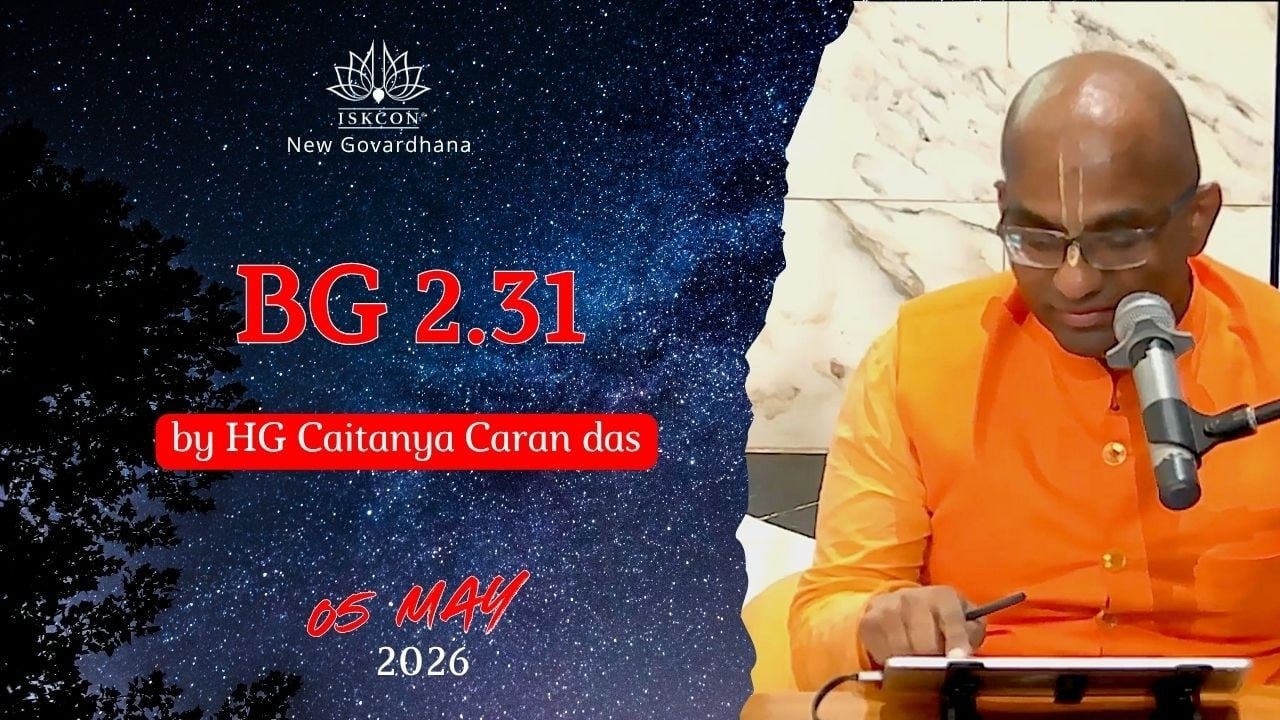
On Tuesday, 05 May 2026, ISKCON New Govardhana Temple hosted a Bhagavad Gita class by HG Caitanya Caran das, offering a rigorous yet accessible exploration of how Bhakti-Yoga illuminates contemporary life. Set within the Gaudiya Vaishnava tradition of the Hare Krishna Movement, the session framed Sanatana Dharma as both a lived ethic and a contemplative science, inviting participants to engage the text not only devotionally but also analytically.
The Bhagavad Gita remains a cornerstone of Vedic philosophy for its layered synthesis of action, knowledge, and devotion. In this class, the Gita’s architecture was presented as an integrated pathway: Karma-Yoga refines intention and conduct, Jnana-Yoga clarifies identity and discernment, and Bhakti-Yoga harmonizes both by centering the heart on Krishna. This triadic model reflects a vision of unity in spiritual diversity that resonates across Hinduism, Buddhism, Jainism, and Sikhism.
HG Caitanya Caran das emphasized a time-tested pedagogy that blends pramana (authoritative knowledge) with critical reflection and lived practice. Scriptural fidelity was balanced by contemporary examples, enabling attendees to connect philosophical claims to workplace decisions, family responsibilities, and civic ethics. The method cultivated a habit of inquiry grounded in clarity, compassion, and responsibility.
A central theme was the Gita’s progressive scaffolding: Karma-Yoga disciplines engagement with the world (BG 2.47; BG 3.9), Jnana-Yoga purifies understanding through self-knowledge (BG 4.38), and Bhakti-Yoga culminates the journey by surrendering egoic centrality to divine remembrance and service (BG 18.66; BG 12.13–14). Rather than isolated lanes, these are mutually reinforcing streams that stabilize conduct, refine insight, and anchor the emotions.
On Karma-Yoga, the class unpacked nishkama karmaaction without grasping for resultsas a rigorously ethical stance rather than passivity. BG 2.47 delineates rights over effort but not outcomes, encouraging skill, responsibility, and steadiness. BG 3.9 reframes work as sacred offering, reducing the psychological volatility that follows attachment to praise, profit, or control. This orientation helps professionals lead with integrity under uncertainty.
Psychologically, the three gunassattva, rajas, and tamaswere presented as dynamic qualities shaping attention, mood, and choice. Practical guidance focused on cultivating sattva through disciplined routines, mindful consumption, and intentional association. Small, repeatable habitssuch as scheduled study, digital boundaries, and reflective pauseswere outlined as levers for shifting inner ecology in line with the Gita’s counsel.
Jnana-Yoga was clarified as atma-tattvadiscerning the self from fluctuations of body and mind. BG 4.38 presents knowledge as a purifier, not in abstraction but in service of ethical clarity and freedom from reactive patterns. This strand complements Karma-Yoga: as identity becomes less entangled with transient impulses, agency becomes more lucid and less fragile.
Bhakti-Yoga, the Gita’s culmination, centers loving remembrance and service to Krishna as the organizing principle of life. Verses such as BG 9.22 assure providential care for those absorbed in devotion, while BG 12.13–14 lists the relational virtuesnon-enviousness, compassion, and steadinessthat translate inner devotion into social grace. The class emphasized daily practices like sravanam (systematic hearing), kirtanam (sacred sound), smaranam (remembrance), japa (mantra meditation), and seva (service) as an integrated sadhana.
Attention training featured prominently. BG 6.26 recommends gently returning a wandering mind to its chosen focus, a principle mirrored in modern attentional science. Breath regulation and mantra repetition were highlighted for stabilizing attention and softening stress responses. Participants often report a tangible sense of calm and clarity as kirtan subsidesan embodied anchor that makes philosophical insight experiential.
The session also articulated a dharmic bridge across traditions. Buddhist mindfulness (sati) cultivates non-reactive awareness, Jain anupreksha deepens reflective ethics through non-violence, and Sikh simran and seva align remembrance with community uplift. These family resemblances demonstrate unity in spiritual diversity and affirm religious pluralism without erasing distinctive theologies. The Gita’s call to lokasangrahaworking for the welfare and cohesion of society (BG 3.20–3.26)harmonizes naturally with these shared commitments.
Ishta, the recognition of a chosen form or emphasis in worship, was presented as a philosophical safeguard for pluralism. By honoring diverse temperaments and vocations, Ishta aligns personal practice with universal respect. This orientationrooted in Sanatana Dharmaencourages interfaith dialogue, protects conscience, and promotes the civilizational ethos of Vasudhaiva Kutumbakam, the world as one family.
Ethics and leadership received concrete application. BG 3.21 underscores exemplar-based influence: leaders shape norms through conduct more than slogans. In organizational life, the Karma-Yoga frame supports transparent decision-making, service-oriented leadership, and resilience under scrutiny. Devotional humility tempers ambition, preserving both mission focus and interpersonal trust.
Ecological and community consciousness were woven into practice. Offering work as worship motivates stewardshipcare for land, animals, and shared resourcesas expressions of gratitude. Devotional communities like New Govardhana demonstrate how spiritual practice, education, and service can reinforce each other in an environment conducive to contemplation and collective well-being.
To operationalize insights, a simple practice blueprint was proposed: daily japa with attentive breath; a structured reading of 5–10 Gita verses with translation and commentary; brief reflective journaling on one actionable insight; weekly satsanga for discussion and accountability; and periodic seva aligned with skills and community needs. This routine makes philosophy cumulative and measurable, not episodic.
Common questions were addressed through the Gita’s analytic lens. On free will and destiny, choices shape tendencies even within constraints, and Bhakti refines the chooser. On grief and change, steadiness grows through remembrance, community support, and service. On digital distraction, habit design and sacred pauses create cognitive space for discernment and devotion.
The pedagogical arc closed by returning to experience. Many attendees describe a felt shiftfrom scattered attention to grounded presencewhen sacred sound, breath, and meaning converge. This shift is not merely affective; it recalibrates priorities, making ethical courage and compassion more reliable.
Situated in northern New South Wales, ISKCON New Govardhana Temple continues to be a locus where Vedic learning, kirtan, and seva cohere. The Bhagavad Gita class by HG Caitanya Caran das exemplified how scriptural depth and lived practice can meet the demands of contemporary life without diluting tradition.
In sum, the session affirmed that the Gita’s synthesisKarma, Jnana, and Bhaktiremains a robust framework for personal clarity, relational integrity, and social contribution. Rooted in Krishna-bhakti yet welcoming dialogue with Buddhism, Jainism, and Sikhism, this approach advances unity in spiritual diversity and a practical commitment to lokasangraha. The result is a path that is philosophically sound, emotionally intelligent, and civically responsible.
Inspired by this post on Dandavats.







