Set in Tohana, a crossroads town in Haryana’s Fatehabad district, the Amrit Sanchar conducted under the devotional banner “Prabh Milnae Ka Chao” embodied the Sikh ideal of disciplined devotion, community equality, and spiritual courage. The phrase “Prabh Milnae Ka Chao” (a heartfelt longing to meet the Divine) resonates deeply with the gurbani-infused ethos of the gathering, aligning personal yearning with the communal path codified in the Sikh Rehat Maryada. In form and spirit, the ceremony presented a precise, time-honored method of Khalsa initiation while cultivating interfaith goodwill consistent with broader dharmic values shared across Hinduism, Buddhism, Jainism, and Sikhism.
Historically, Amrit Sanchar originates in the epochal Vaisakhi of 1699 at Anandpur Sahib, when Guru Gobind Singh inaugurated the Khalsa, uniting spiritual sovereignty (piri) with temporal responsibility (miri). In Tohana, this lineage of courage and compassion took a living form: participants oriented themselves not merely toward personal salvation but toward Sarbat da Bhalauniversal welfareanchoring private discipline within social service, kirtan participation, and the egalitarian institution of langar.
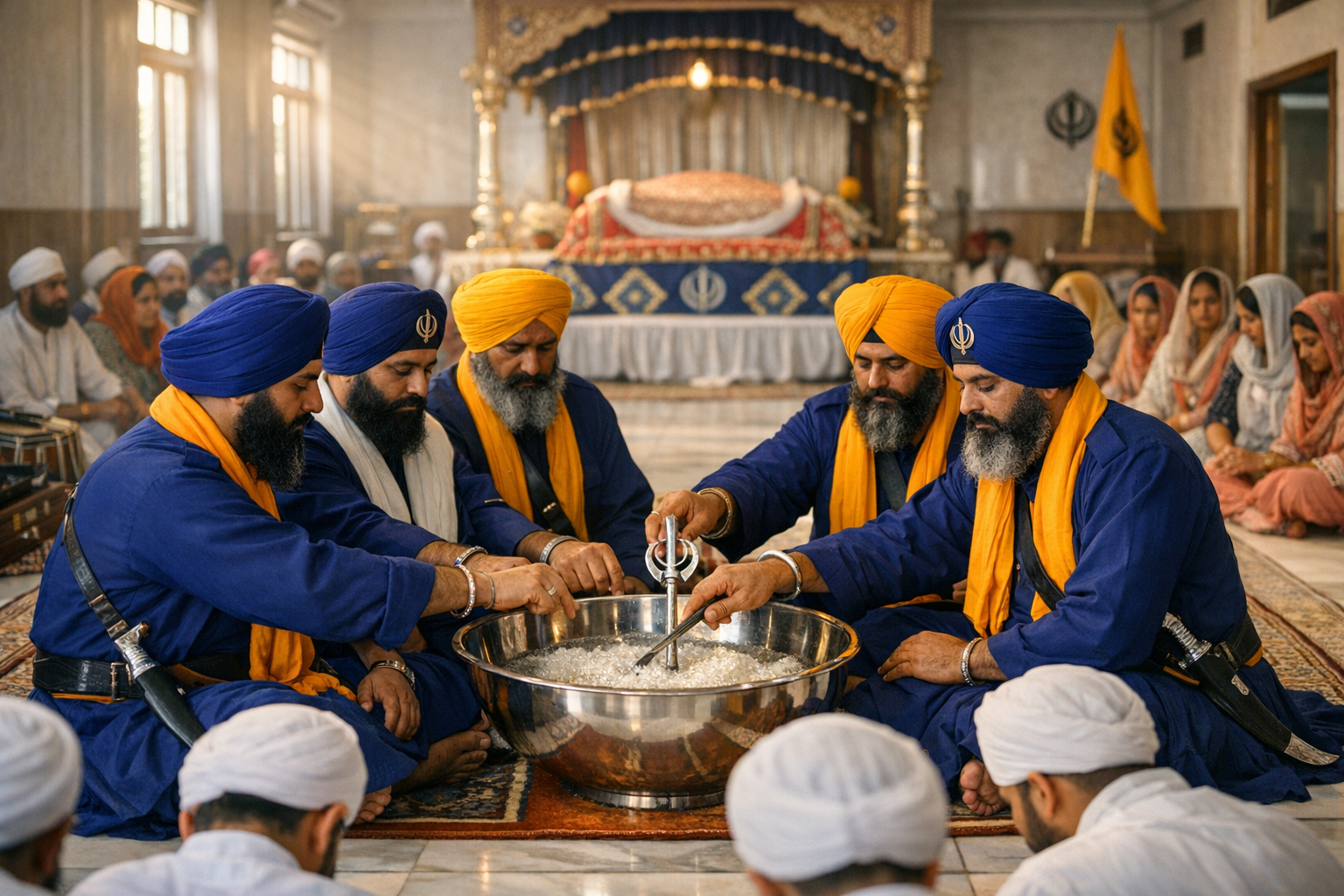
Ritual architecture grounded the experience. In the sanctified space of the gurdwara, the sangat gathered before Sri Guru Granth Sahib with reverence and a shared focus on hukam (divine ordinance). The ceremony was conducted by the Panj Piarethe Five Belovedwhose collective role signifies spiritual authority vested in the disciplined, not the merely individual. Their coordinated conduct and liturgical precision shaped a contemplative environment in which devotion and duty were indissoluble.
The preparation of Amrit followed the canonical method: in a steel or iron vessel (bata), clean water and patase (sugar crystals) were stirred with a double-edged sword (khanda) while five banis were recitedJapji Sahib, Jaap Sahib, Tav-Prasad Savaiye, Benti Chaupai, and Anand Sahib. This synthesis of shabad (divine Word) with steel symbolically fuses tenderness and strength, humility and vigilance, a union the Khalsa vows to manifest in daily life. The sangat’s collective attention during this moment reinforced that initiation is communal in import, even when experienced personally.
Administration of Amrit to each initiate proceeded with careful adherence to Rehat Maryada. Panj Piare gave five palmfuls to drink and sanctified the eyes and kesh (unshorn hair), sealing the relationship between the initiate and the Guru’s discipline. The aspirants affirmed fundamental vows, including commitment to the Five Ks and avoidance of kurehits that compromise Sikh discipline. The ethos of equality remained centralwomen and men participate equally, receive the same discipline, and embody the same sovereign identity, typically adopting the honorifics Kaur and Singh.
The Five KsKesh, Kangha, Kara, Kachhera, and Kirpanbear layered meanings with both practical and ethical dimensions. Kesh affirms acceptance of the natural form and trust in hukam; Kangha instills order and cleanliness; Kara, the steel bracelet, symbolizes restraint and perpetual remembrance; Kachhera sets standards of modesty and readiness; Kirpan mandates the defense of dignity and the protection of the vulnerable. Together they translate inner conviction into visible, disciplined practicean outward grammar of inward resolve.
Post-initiation discipline (rehat) centers on Nitnem. The daily liturgical cyclemorning recitation of Japji Sahib, Jaap Sahib, and Tav-Prasad Savaiye; evening Rehras Sahib; and night Kirtan Sohilastructures attention, memory, and intention. This regimen stabilizes the mind, fosters resilience in adversity, and sustains the luminous ideal expressed in “Prabh Milnae Ka Chao”: longing for the Divine becomes a methodical, durable practice rather than a passing sentiment.
Within the wider ceremony, kirtan served as both pedagogy and prayer. Raga-based singing of shabad brings language, breath, and emotion into alignment, making doctrine experiential and accessible. Thematically, the longing signified by “Prabh Milnae Ka Chao” found voice in congregational melody; participants frequently reported a deepened sense of inward quiet, ethical clarity, and communal warmthoutcomes consistent with Sikh teachings that elevate shared devotion above private attainment.
Langar extended these principles into a social form. Communal dining erased markers of caste, class, gender, and status, reasserting a central tenet of Sikhismthat spiritual equality demands social equality. Observers in Tohana noted that the langar’s inclusivity functioned as living theology: nourishment of the body, humility of service, and fellowship of the sangat cohered into a civic ethic that outlasts the event itself.
Ethical commitments were articulated unambiguously. Initiates pledged to maintain kesh, refrain from intoxicants including tobacco, uphold sexual fidelity, and avoid kutha (ritually slaughtered meat), reflecting the Rehat Maryada’s insistence on clarity, self-restraint, and reverence for life. These prescriptions, when seen in context, protect attention, conserve vitality, and anchor freedom in responsibilitytraits the Khalsa idealizes as essential for personal integrity and public trust.
Tohana’s demographic positionproximate to Punjab and embedded in Haryana’s agrarian rhythmsmade the ceremony’s communal dimension especially resonant. Participation spanned generations, with youth encountering a framework for identity formation that is principled yet compassionate, and elders witnessing the renewal of a lineage rooted in Guru Gobind Singh’s founding vision. The local setting underscored that spiritual sovereignty is enacted in ordinary places and daily duties, not only in moments of high ceremony.
Comparative dharmic perspectives highlighted convergences without erasing distinctions. Like the Sikh Amrit Sanchar, Hindu upanayana, Buddhist upasampadā, and Jain dīkṣā each employ disciplined vows, ethical guardrails, and contemplative practice to orient the self toward truth. In Tohana, this was framed as unity in spiritual diversity: distinct doctrines, shared virtuesahimsa, satya, seva, and inner cultivationfostering mutual respect among Hindu, Buddhist, Jain, and Sikh communities.
Governance of practice was visibly careful. The gurdwara management ensured liturgical fidelity, appropriate preparation of the space, and clear guidance to initiates about attire (including head covering and kachhera) and conduct. Emphasis on Maryada maintained consistency across individuals and safeguarded the ceremony from improvisations that might dilute meaning or sow confusion.
Social and emotional outcomes formed a quiet but durable layer of value. Participants frequently experienced the pairing of discipline with uplift: Nitnem’s cadence supported mental clarity; kirtan’s resonance soothed reactivity; seva turned compassion into habit. The visible markers of Khalsa identity, far from serving mere symbolism, functioned as practical cues in moments of moral choicereminders to align impulse with principle.
At the ethical core stood Sarbat da Bhala. The ceremony’s culmination in Ardas and hukamnama situated private vows within a public horizon of care. By orienting the self to collective welfare, the Khalsa discipline addressed not only inner transformation but also civic cohesionan approach that strengthens intercommunal harmony in diverse settings such as Tohana and beyond.
From a pedagogical standpoint, the event in Tohana demonstrated an effective sequence for transmission: scriptural immersion, ritual clarity, ethical instruction, musical embodiment, and communal service. Each layer reinforced the others, creating a whole greater than the sum of parts. As a living tradition, Amrit Sanchar succeeds by uniting knowledge (gyaan), practice (abhiyaas), and compassion (daya) into a durable path.
Thematically, “Prabh Milnae Ka Chao” provided an interpretive lens for the entire gathering. Longing was not framed as lack, but as a refined form of attention that orients the heart toward Ik Oankar’s oneness. Within this lens, discipline becomes a gift rather than a burden; vows become avenues of freedom; identity becomes service rather than self-display.
In interfaith terms, the ceremony offered a constructive model. Clear identity, firmly held, did not preclude hospitality or cooperation. Attendees from neighboring traditions recognized familiar ethical contourstruthfulness, non-harm, generosity, mindfulnessunderscoring the blog’s mission of unity among dharmic traditions. Such recognition strengthens societal resilience against sectarianism by illuminating shared foundations.
Practical guidance surfaced naturally for prospective initiates at future samagams. Preparatory bathing, appropriate attire, readiness to keep the Five Ks, and openness to Nitnem establish a solid base. Post-initiation, maintaining daily recitation, participating in seva and langar, and seeking sangat keep the initial fervor sustainable. In this sense, initiation is a beginning rather than an endan adoption of a method that matures over time.
The Tohana Amrit Sanchar, aligned with “Prabh Milnae Ka Chao,” thus functioned on multiple levels: as a precise rite of passage into the Khalsa; as a communal re-affirmation of equality and service; and as a regional expression of dharmic harmony. Its intellectual clarity, ritual integrity, and social warmth together illustrated how Sikh discipline speaks powerfully to modern aspirationsoffering structure without rigidity, devotion without insularity, and identity without antagonism.
In conclusion, the ceremony’s impact can be summarized as disciplined longing brought to life: a path that begins with yearning and proceeds through method, community, and service toward abiding serenity and civic responsibility. For Tohana, this translated into renewed bonds across neighborhoods and generations. For the broader dharmic family, it offered a living demonstration that unity in spiritual diversity is not a slogan but a practicesustained daily by Nitnem, gladdened by kirtan, and fulfilled in seva.
Inspired by this post on SikhNet – News.