Vaisakhi 2026 stands at the intersection of history, spirituality, and community life, marking both the birth of the Khalsa in 1699 and the Punjabi agrarian new year anchored to the Sun’s ingress into sidereal Aries (Mesha Sankranti). Observances are expected in mid-April, with many communities likely gathering on April 13–14, depending on local sunrise and solar ingress calculations. Across gurdwaras and public squares worldwide, the day signals renewalof commitment to Waheguru, to seva, and to the ideal of sarbat da bhala, the welfare of all.
Historically, Vaisakhi acquired decisive significance when Guru Gobind Singh called the faithful to Anandpur Sahib in 1699, summoning five volunteers whose courage and devotion inaugurated the Panj Pyare. Through Khande di Pahul (Amrit Sanchar), a new collective identity emergedKhalsauncompromisingly devoted to truth, equality, and justice, and expressed in the Five Ks (Kesh, Kara, Kanga, Kirpan, Kachera). This transformation fused spiritual discipline with social courage, and it continues to shape Sikh life in 2026.
Beyond its Sikh centrality, Vaisakhi also reflects older agrarian rhythms in Punjab, where the harvest, fairgrounds, and seasonal exchange framed community life. In households and mandis, new ledgers historically signaled a fresh economic cycle, mirroring the festival’s broader symbolism of ethical renewal and right conduct in commerce and community.
Technically, the Vaisakhi date is tied to solar astronomy. The festival coincides with the Sun’s transit into sidereal Aries. Indian calendrical traditions often compute this using the Lahiri ayanāṁśa, with observance aligned to regional sunrise. Because of time-zone differences and calendrical preferences (Bikrami vs. Nanakshahi), Vaisakhi may fall on either April 13 or 14 in 2026 across global Sikh communities. Such diversity is longstanding and reflects the breadth of practice within a shared spiritual core.
Gurdwara observances typically center on kirtan (including Asa di Var at dawn), the collective Ardas, and a Hukamnama guiding the sangat for the year ahead. Many communities schedule an Akhand Path culminating on Vaisakhi morning, bringing families together in contemplation of Gurbani and in recommitment to daily nitnem. The fragrance of kara prasad and the echo of “Waheguru” form a sensory continuum linking childhood memories with present vows.
Amrit Sanchar often anchors Vaisakhi programs. Under the guidance of the Panj Pyare, initiates receive Amrit and undertake the Khalsa discipline. The ceremony encodes core principles: equality of all participants regardless of background, the indivisibility of spiritual and ethical life, and a dignified code of conduct visible in the Five Ks. The ethical clarity and communal accountability embedded in this rite continue to nurture resilience and purpose for practicing Sikhs worldwide.
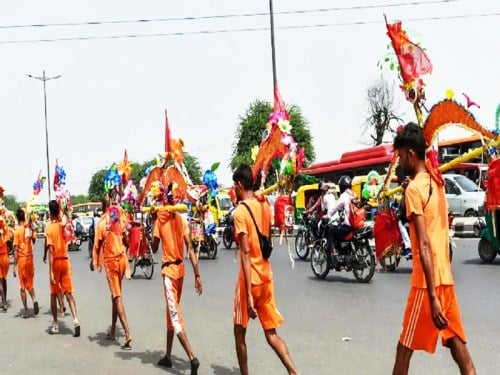
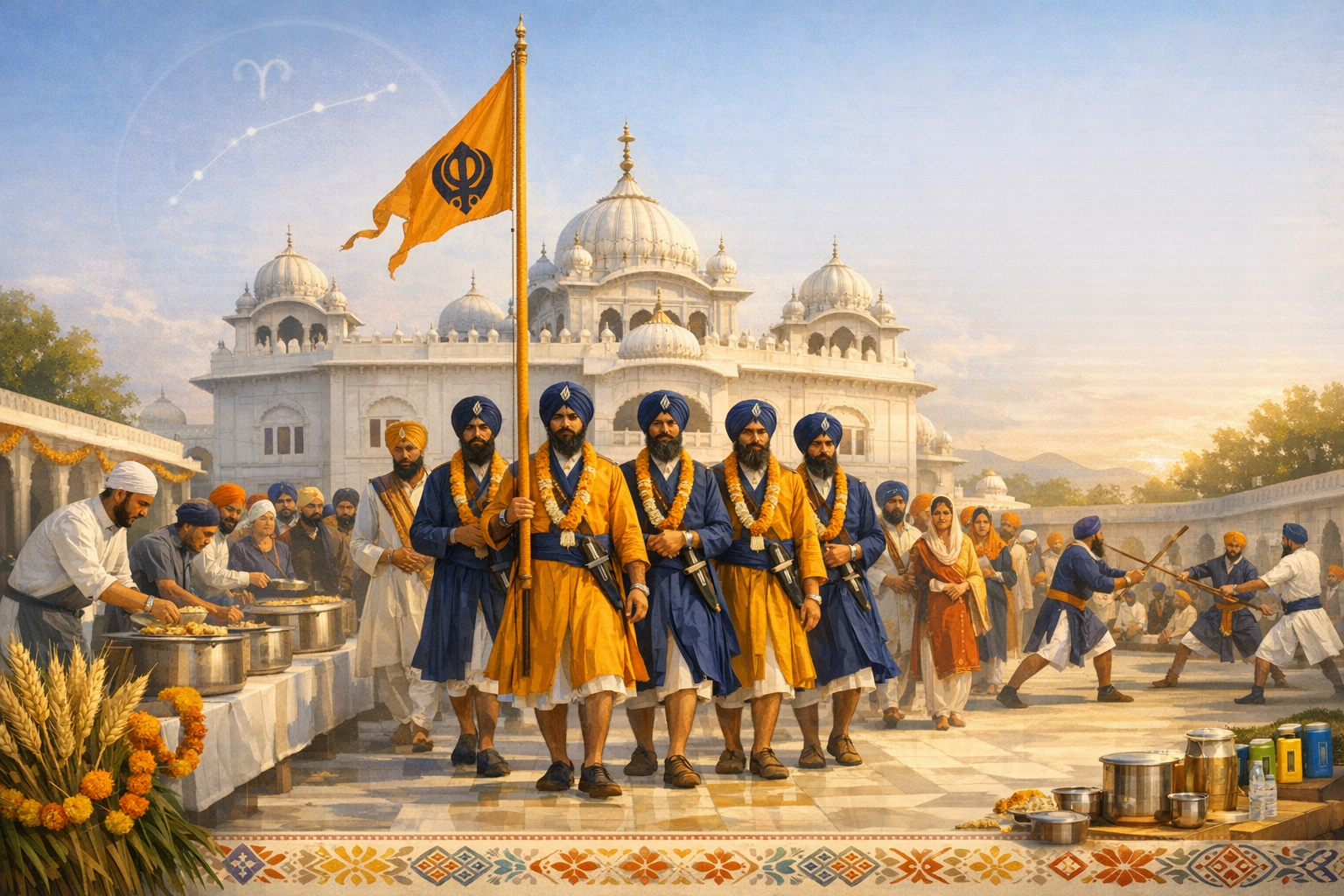
Nagar Kirtan processions translate the spirit of Gurbani into a public ethic. Led by the Panj Pyare and the Nishan Sahib, the sangat sings shabads while volunteers distribute refreshments, manage footpaths, and demonstrate gatka. Such processions (often concluding with Ardas) transform roads into spaces of remembrance, gratitude, and learning, offering a living pedagogy of humility, compassion, and community order.
The langar embodies Sikh ethics in action. Open to all and maintained through seva, it dissolves social barriers and affirms dignity through shared food and shared labor. On Vaisakhi, kitchens often scale up remarkably; coordinated teams handle procurement, cooking, service, and cleanup, ensuring that abundance is matched by efficiency, hygiene, and gratitude.
Cultural expressionsBhangra, Giddha, and vibrant fairgroundsextend the celebratory arc. While kirtan speaks devotionally, these forms recall agrarian joy, collective effort, and seasonal thresholds. Together, devotional and cultural dimensions present an integrated vision of life in which spiritual insight and daily labor cohere.
Geographically, Vaisakhi radiates from sacred hubs such as Anandpur Sahibwhere the Khalsa was revealedto major gurdwaras around the world. The day inspires both pilgrimage and local gatherings. Whether in Punjab’s heartland or in global diasporic centers, the continuity of practice affirms a transnational Sikh identity rooted in Gurbani and lived through seva.
In 2026, many communities will also facilitate remote participation through live kirtan and program streams from gurdwaras and heritage organizations. Time-zone awareness matters: those following from abroad often coordinate Hukamnama timing and Ardas with local sunrise or the hosting gurdwara’s schedule. Such digital inclusion reflects a long-standing Sikh responsiveness to contextmeeting contemporary needs without diluting spiritual depth.
Vaisakhi aligns with a constellation of dharmic observances that share the same solar anchor: Mesha Sankranti, Vishu in Kerala, Puthandu (Varusha Pirappu) in Tamil Nadu, Pohela Boishakh in Bengal, and Rongali Bihu in Assam. This calendrical convergence illuminates a wider ethos of unity in spiritual diversity. While practices and theologies differ, the shared rhythm of the solar year reinforces cross-community kinship and mutual respect among Hindu, Buddhist, Jain, and Sikh traditions.
Seen through this lens, Vaisakhi contributes to a broader dharmic conversation about ethical livingahimsa, dana or seva, truthful living, humility, and stewardship. Each tradition articulates these values in its own language; together they compose a civilizational harmony that respects distinct paths while celebrating a common commitment to human dignity and the sacred.
Relatable experiences situate these ideals in daily life. Many elders recall waking before dawn, covering their heads, and walking hand-in-hand with children to the gurdwara as the first strains of kirtan filled the air. Families remember the warmth of kara prasad in the palm, the quiet anticipation before Hukamnama, and the shared laughter of community mealsmemories that consistently return with Vaisakhi’s light each year.
For 2026, households often prepare by refreshing personal and family routines: reciting Japji Sahib and Sukhmani Sahib, organizing seva rosters, and reviewing community commitments for the months ahead. The aspiration toward chardi kalaever-rising spiritbecomes a practical plan guided by Gurbani: clearer intentions, steadier discipline, and kinder relationships.
Visitors to gurdwarasSikh and non-Sikh alikebenefit from simple etiquette: cover the head, remove footwear, wash hands, sit respectfully in the darbar, and receive kara prasad with both hands. In langar, sit on the floor alongside everyone, avoid food waste, and thank the sevadars. Such shared discipline fosters a lived equality that is central to the day’s meaning.
Environmental stewardship has become an essential element of large Vaisakhi gatherings. Communities increasingly prioritize reusable utensils, responsible food sourcing, and structured waste management. Procession routes often include hydration and first-aid stations; volunteers coordinate traffic, accessibility, and cleanup, ensuring that devotion is matched by civic care.
Public safety planning typically integrates with municipal services. Organizers map crowd flows, stage emergency response points, and communicate clear routes. This attention to order is an extension of Maryadadevotional discipline radiating outward into social responsibility.
Youth engagement gives Vaisakhi its forward momentum. Workshops on kirtan, gatka, Gurbani pronunciation, and Sikh history equip younger participants to carry tradition with confidence and creativity. Many students also support logistics, digital broadcasting, and sustainability projects, learning leadership as seva in practice.
It is also important to situate Vaisakhi correctly within India’s festival tapestry. While it coincides with multiple new-year observances, it remains uniquely formative for the Khalsa Panth. Respecting both its singular Sikh significance and its place in a shared solar-calendar matrix sustains accuracy and interfaith goodwill.
For those participating from home in 2026, a meaningful observance might include early morning simran, listening to live kirtan, reading the day’s Hukamnama from a local or trusted gurdwara, and organizing family sevasuch as preparing meals for neighbors or arranging donations to community kitchens. The heart of Vaisakhi remains interior renewal expressed in outward compassion.
In its essence, Vaisakhi 2026 invites a disciplined joy: to remember the Khalsa legacy at Anandpur Sahib, to celebrate seasonal abundance with gratitude, and to weave spiritual insight into the practical threads of daily life. Within the wider dharmic family, it also affirms a valuable lessonpaths may differ, yet ethical purpose, reverence for the sacred, and care for community make a shared home.
Inspired by this post on SikhNet – News.