
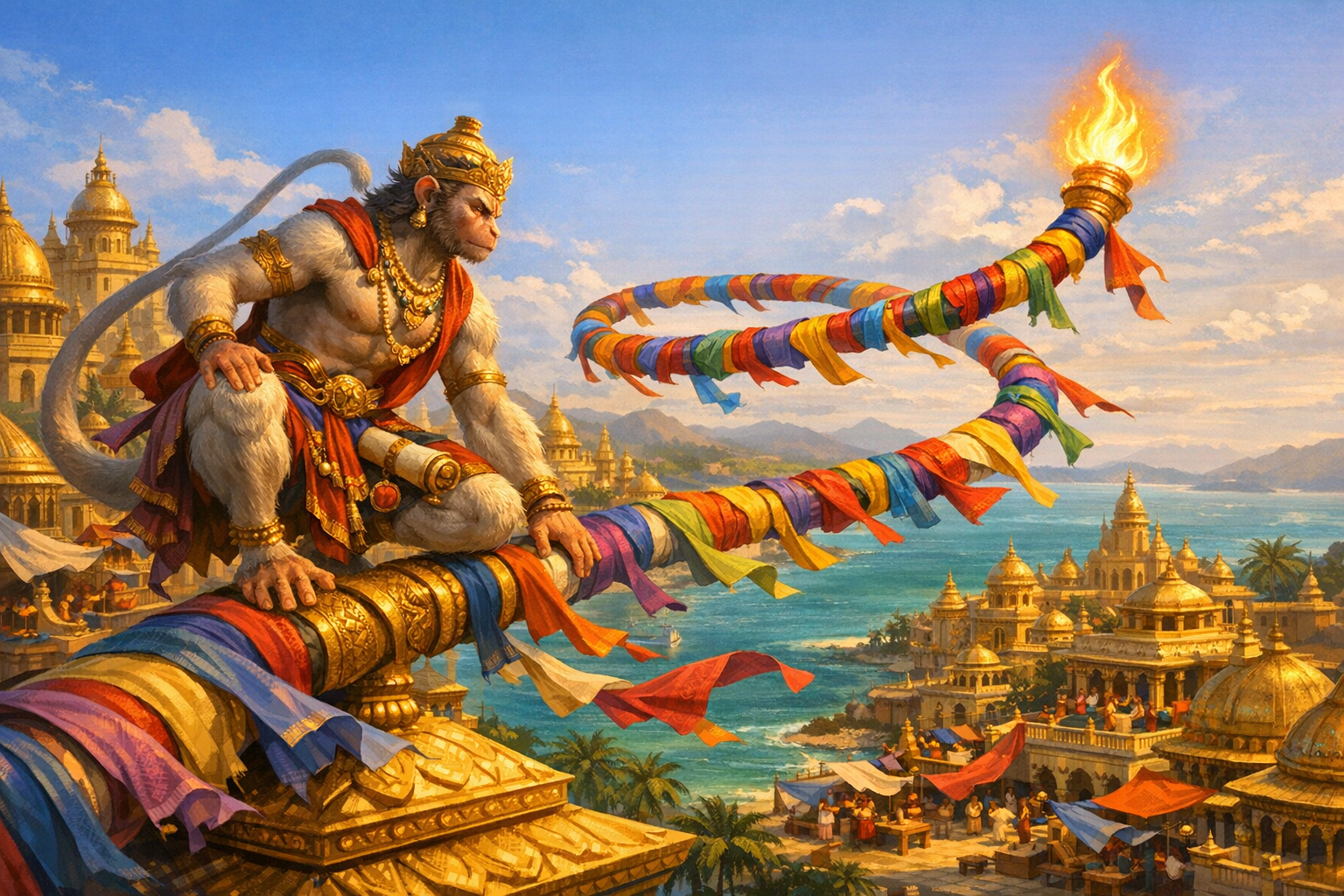
Across the Indian subcontinent, the Ramayana lives not only in manuscripts but in memory, song, theatre, and playful proverb. Among the most beloved popular retellings is the irreverent, affectionate episode often summarized as ‘the day Lanka lost its clothes for Hanuman’a comic expansion of the Lanka Dahan that reveals how folk imagination sharpens ethics with laughter.
At its core, the narrative pivots on Hanuman’s tail. After leaping across the ocean and meeting Sita, Hanuman allows himself to be captured in Ravana’s court as Rama’s dūta, an envoy. In many texts, humiliating the envoy is already adharma; yet Ravana orders that Hanuman’s tail be wrapped and lit as punishment. What ensues in folk performance is a tour de force of wit.
Valmiki’s Sanskrit Ramayana presents the Lanka Dahan with moral clarity and dramatic economy: Hanuman, protected by boons and devotion, uses the flames meant for his shame to set the city ablaze, sparing temples and the innocent, and returns to Rama with decisive proof of Sita’s plight. The canonical scene is somber and heroic.
Folk Ramayana retellings, however, often insert an exuberant prelude. As servants begin to bind cloth to the monkey-god’s tail, Hanuman quietly expands it through yogic siddhi. More cloth is demanded. Bales are unfurled, storehouses emptied, markets stripped, andso the village punchline goesLanka loses its clothes before it ever catches fire. The joke lands because it exposes tyranny’s wastefulness and turns humiliation into spectacle.
Variants multiply this comic inflation. In some regions the rakshasis requisition garments door-to-door; in others, palace heralds order donations ‘for royal punishment,’ prompting a satirical procession in which citizens surrender scarves, turbans, and sari-borders until even courtly drapes and banners are torn down. The tail becomes a living ledger of excess, each fresh wrap a receipt that will be ‘paid back’ when the flames return to their senders.
Classical aesthetics clarifies why such scenes endure. The Nāṭyaśāstra isolates hasya rasalaughteras a distinct mode of experience that dilates the heart, disarms fear, and readies audiences to absorb ethical truth. By placing hasya before the vīra (heroic) blaze of Lanka Dahan, performers restructure reception: laughter first, resolve next, and finally moral comprehension that adharma consumes itself.
The envoy motif matters. Dharmaśāstra and epic practice hold the dūta sacrosanct; even in the Mahābhārata’s Udyoga Parva, insulting a messenger is condemned. Folk humor amplifies this principle not by reciting injunctions but by making Ravana’s breach ridiculous. The longer the tail grows, the more public resources it squanders, and the more obvious becomes the ruler’s lapse in rajadharma.
Cloth carries layered semiotics. As alankāra, it signals rank and modesty; as commodity, it encodes labor and wealth; as metaphor, it is the thin veil that conceals moral truth. When Lanka is said to be ‘stripped,’ the laughter registers a deeper intuition: arrogance disrobes itself. The body politic, not just the city’s wardrobes, is left exposed.
Fire, too, is doubly read. As Vāyuputra, Hanuman bears elemental kinship with wind; flames may dance on the surface yet leave him unscathed. Some traditions add that Agni withholds his bite out of reverence, or that Sita’s blessings and the recitation of Rāma-nāma serve as protective kavaca. Thus the blaze becomes tapas-likepurifying, discerning, and exactingrather than merely destructive.
Comparative textuality situates the comic prelude. Tulsidas’s Ramcharitmanas, Kamba Ramayanam in Tamil, the Krttivasi Ramayana in Bengali, and the Adhyatma Ramayanam in Malayalam each narrate Lanka Dahan with distinct emphases; the endless-tail cloth gag, by contrast, proliferates above all in oral performance, village kathā, and seasonal Ramlila sketches, where improvisation thrives.
Folklorists describe such growth as motif accretion and comic hyperbole. A simple narrative hinge‘bind and burn the tail’invites an accumulative structure: more cloth, more donors, more absurdity. The result resembles an ‘ever-expanding object’ tale known across world folklore, yet inflected here by Indic aesthetics and dharmic ethics.
Performance ecologies make the humor tangible. In Yakshagana and its tala-maddale debates, hasyagāra clowns trade quips with warriors; in Tamil terukkuṭṭu and kattai koothu, the kattiyakkaran breaks the frame to parody power; in Gujarati Bhavai and North Indian Swaang, rustic repartee keeps kings honest. These forms routinely relocate Rama-kathā into the present tense of marketplace and monsoon, tailor and tax.
On Ramlila stages, the Lanka episode often unfolds as participatory carnival. Stagehands parade bolts of fabric; a mock municipal crier inflates the ‘cloth tax’; a chorused refrain counts the tail’s revolutions. Children giggle at the spectacle even as elders nod at the subtext: when rulers punish out of spite, society pays twiceonce in treasure, once in dignity.
Regional Ramayanas beyond India corroborate the comic-cunning blend. In Southeast Asian dramaturgies such as the Thai Ramakien and the Cambodian Reamker, Hanuman’s agility, mischief, and strategic wit are foregrounded; the burning of Lanka is less a spasm of rage than a calibrated lesson that unmasks pretension. The spirit aligns with the Indic folk gag even where details differ.
A social-historical lens highlights material plausibility. Lanka in the epics is saturated with wealthratna-studded mansions, gold-plated gates, fine textiles. Redirecting such abundance to a punitive ritual dramatizes how authoritarian vanity converts prosperity into fuel. The laughter is edged with critique: clothing that once dignified citizens becomes kindling for power’s display.
Gendered perspectives inflect certain variants. Some songs imagine women of Lanka reluctantly surrendering odhnis and sari-pallu, others show them smiling slyly as they aid the messenger wronged. The ambiguity invites reflection on complicity and conscience under coercive rule, without shaming everyday people who must navigate survival.
Dharmic pluralism further reframes the scene. Jain retellings such as the Paumacariya reconfigure the war to minimize slaughter and relocate agency, while Buddhist Jātaka analogues recast Rāma as a Bodhisattva whose conduct educates rather than annihilates. Sikh and Hindu devotional traditions alike valorize fearlessness in service of righteousness. Read together, these currents favor interpretations of Lanka Dahan that emphasize exemplary courage, restraint, and moral pedagogy over spectacle.
From a legal-ethical angle, the cloth gag functions as jurisprudential satire. It literalizes the ‘costs of punishment’ model known in political theory: when sanctions are misaligned with dharma, enforcement drains the commons. Audiences learn to question not discipline per se, but disproportion, humiliation, and the breach of envoy protections that wise polities uphold.
Symbolism consolidates the teaching. Cloth equals status; stripping equals exposure; fire equals discernment; wind equals freedom of movement and thought. When these signs are recombined through hasya rasa, the community rehearses a compact: protect messengers, prize counsel, and laugh tyrants back into proportion long before revolt becomes necessary.
Modern media sustain the cycle. Radio kathā, comic books, television serials, and digital Ramlila streams preserve the canonical arc while welcoming the folk flourish. Memes of ‘endless tail, endless bills’ translate the old joke into civic pedagogy, reminding audiences that governance anchored in dharma conserves, while ego consumes.
In learning settings, the episode proves remarkably integrative. Students can trace textual strata across Valmiki Ramayana, Ramcharitmanas, and Kamba Ramayanam; map performance conventions in Yakshagana and terukkuṭṭu; apply rasa theory from the Nāṭyaśāstra; and compare dharmic ethical frameworks across Hinduism, Buddhism, Jainism, and Sikhism. The comic prelude becomes a seminar in civilizational coherence.
Ultimately, ‘the day Lanka lost its clothes for Hanuman’ is not mere slapstick. It is civilizational memory disciplining power with delight, showing how a living Ramayana mobilizes humor, aesthetics, and ethics to turn an insult to an envoy into a luminous argument for dharma. One laughs, then one understands.
Inspired by this post on Hindu Blog.
