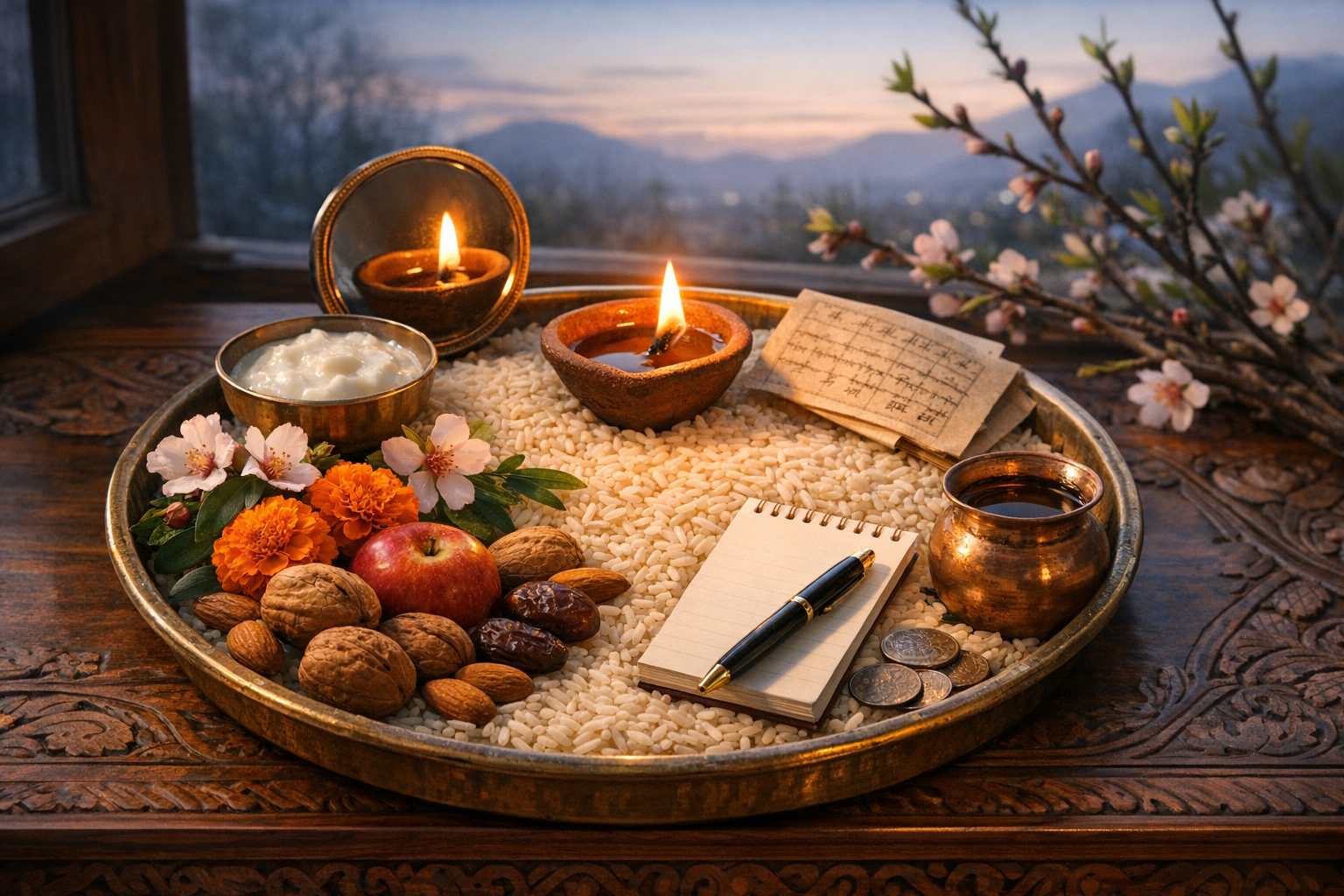
Thaal Barun (Thal Barun) is the Kashmiri Pandit household rite of arranging a sanctified tray the night before Navreh, the Kashmiri New Year. Anchored in the agrarian and scholastic rhythms of Kashmir, this observance synthesizes prosperity, learning, memory, and aspiration into a single tableau to be seen at daybreak. Within the larger Hindu calendar, Navreh corresponds to the advent of Chaitra and aligns with the spirit of Chaitra Shukla Pratipada (Chaitr Sud), situating Kashmiri tradition within a broader Indic understanding of renewal, auspicious beginnings, and mindful intention.
For 2026 (IST), community almanacs note two observance tracks in practice. Thaal Barun for Sonth is on March 13, with Sonth on March 14. The Thaal Barun that directly precedes the Kashmiri New Year (Navreh) falls on March 18, with Navreh observed the following morning. Because tithi observance can vary by local panchang and location, families commonly consult a trusted priest, temple, or regional almanac to confirm muhurta details for their area while retaining the overall sequence of night preparation and morning darshan.
Historically and culturally, Navreh has been read as a civilizational pivot that blends Kashmir’s seasonal turn with the intellectual cycle of study, planning, and resolve. Scholarly discussions often reference the broader Kashmiri sacred ecology, wherein springs, rivers, mountains, and household shrines form a network of sanctity that informs domestic ritual practice. In this context, Thaal Barun ritualizes the threshold between the waning cold and the renewed fecundity of spring, placing gratitude, foresight, and dharmic conduct at the heart of the Kashmiri New Year.
Etymologically, Thaal Barun signifies the act of laying out or arranging a thalia deliberate domestic consecration that transforms an everyday tray into a multi-sensory almanac. The tray is not merely decorative; it is a curated index of values and aspirations that the family collectively beholds at dawn. This practice underscores a key Kashmiri Pandit insight: renewal is as much an inner ethical reset as it is a calendrical transition.
A traditional Navreh thaal commonly includes a foundational bed of uncooked rice symbolizing abundance and the fertility of the land. A small bowl of fresh curd signifies purity, auspiciousness, and the continuity of life. A lit lamp invokes jyotiillumination, insight, and the dispelling of avidya (ignorance)while a mirror invites introspection so that change begins with truthful self-appraisal.
Complementing these items are coins or currency as a prayer for honest livelihood, a new pen and notebook to honor learning and conscientious record-keeping, fresh flowers representing impermanence and beauty, and seasonal fruits or nutsespecially akhrot (walnuts)that stand for strength, wholeness, and the pledge to nurture family well-being. Many families also include the local panchang or a printed almanac leaf for the new year, integrating cosmic timekeeping into the household’s practical planning.
The night routine generally follows a simple but methodical sequence. After cleaning the thaal and the space of observance, families perform a brief sankalpa (vow of intent), spread the rice bed, place the bowls, flowers, coins, pen, and notebook, and set the mirror so it will be the first reflective sight at dawn. Lighting the lamp concludes the preparation, and a moment of silence or recitation of simple shanti mantras aligns the household’s mind with the ritual’s purpose. The thaal remains undisturbed through the night.
Morning observance begins before sunrise, when family members, freshly bathed, assemble for the first darshan of the thaal. The sighting is performed in silence or with soft recitation, often followed by a small tilak, distribution of prasad (frequently curd, fruit, or sugar), and readings or discussion from the panchang to frame the year’s practical and spiritual aims. In some lineages, walnuts are later offered at a household shrine, a local spring, or river, interlacing domestic worship with Kashmir’s sacred waterscape.
In the Kashmiri seasonal cycle, Sonth marks the felt arrival of spring; many households observe a dedicated Thaal Barun the previous night to welcome this turn with gratitude. In 2026, that sequence is noted as March 13 (Thaal Barun for Sonth) and March 14 (Sonth). The Thaal Barun immediately preceding the Kashmiri New Year is on March 18, providing a second, explicitly calendrical moment of renewal centered on Navreh the following morning. Both observances share the same grammar of preparation and darshan, while serving complementary seasonal and calendrical meanings.
Household practices vary by lineage, district tradition, and diaspora context. Some families include a small kalasha of water, others add a favorite scripture verse or a family deity’s image, and diaspora communities adapt with locally available fruits and flowers while preserving the ritual’s intent. The unifying principle remains consistent: begin the year by seeing, honoring, and integrating the essentialsfood, light, learning, self-knowledge, and community memoryinto daily life.
Comparative perspectives across Dharmic traditions enrich understanding and unity. Thaal Barun’s logic resonates with Vishu kani in Kerala and Puthandu kani in Tamil households, where the first sight of an auspicious arrangement sets the tone for the year. Similarly, Ugadi and Gudi Padwa center on Chaitra Shukla Pratipada and emphasize a thoughtful beginning grounded in panchang readings and household rites. These parallels illustrate a shared Indic ethic: renewal is cultivated through conscious seeing, reflective planning, and gratitudean ethos equally appreciated across Hindu, Buddhist, Jain, and Sikh communities in observances of seasonal and spiritual turning points.
In contemporary practice, families increasingly emphasize sustainability and ahimsa-aligned choices: locally sourced flowers and produce, reusable lamps, and minimal plastics. Such choices dovetail with Dharmic commitments to care for the living world, making the ritual not only spiritually resonant but also ecologically mindful. When young members help assemble the thaal, the rite becomes intergenerational, transmitting values through hands-on participation and story-sharing.
For those seeking procedural clarity, three practical guidelines are widely followed. First, treat the thaal as a living symbolprioritize freshness, cleanliness, and intentional placement. Second, align with local panchang timings for the night set-up and morning darshan, especially if the tithi overlaps midnight. Third, allow household memory to guide details: retaining one’s family-specific inclusions preserves continuity within the larger shared framework of Kashmiri Pandit custom.
Seen as a whole, Thaal Barun before Navreh is a distilled philosophy of beginnings: it binds the cyclicity of time to the ethics of daily life, honors Kashmir’s sacred landscape, and celebrates knowledge as the compass for the new year. In 2026, with Thaal Barun dates noted for both Sonth and Navreh, the ritual offers two luminous thresholds for reflection and resolve. By aligning sight, intention, and action at dawn, Kashmiri Pandit households affirm a timeless pledge to begin well, live thoughtfully, and sustain unity across Dharmic traditions.
Inspired by this post on Hindu Pad.