On 14 April 2026, communities across Odisha observe Pana Sankrantialso known as Maha Vishuva Sankranti and Meru Sankrantias the Odia New Year and the first day of Baisakh in the solar calendar. Revered as a convergence of cosmology, climate, and culture, this day is anchored in the precise astronomical transition of the Sun into the sidereal sign of Aries (Mesha Sankranti/Mesha Sankramana), while embodying enduring values of dana (charity), seva (service), and ecological mindfulness.
Astronomically, Pana Sankranti occurs at the Sun’s ingress into 0° of sidereal Aries, the foundational point of the nirayana (sidereal) zodiac used in much of Hindu calendrical calculation. While the tropical (sayana) zodiac fixes the vernal equinox in March, the sidereal framework recognizes a precessional offset (ayanamsa), which currently places Mesha Sankranti in mid-April. The term “Vishuva” in Maha Vishuva Sankranti recalls a historical alignment with equinoctial balance; due to precession, that balance point is now separated from Mesha Sankranti by several weeks, yet the cultural and ritual centrality of the day remains intact.
Calendrically, the distinction between solar and lunar reckoning is essential to understanding why this day inaugurates the Odia solar year. In the solar system of reckoning, a month is counted from “Sankranti” to “Sankranti,” whereas in the lunar system it may be counted from “Purnima (Full-moon) to Purnima” (Purnimanta tradition) or from Amavasya to Amavasya (Amanta tradition). Maha Vishuva Sankranti is therefore both the first day of Baisakh and the commencement of the Odia solar year, even as other regions that follow lunar starts (e.g., Ugadi/Gudi Padwa) have already marked their New Year earlier in Chaitra.
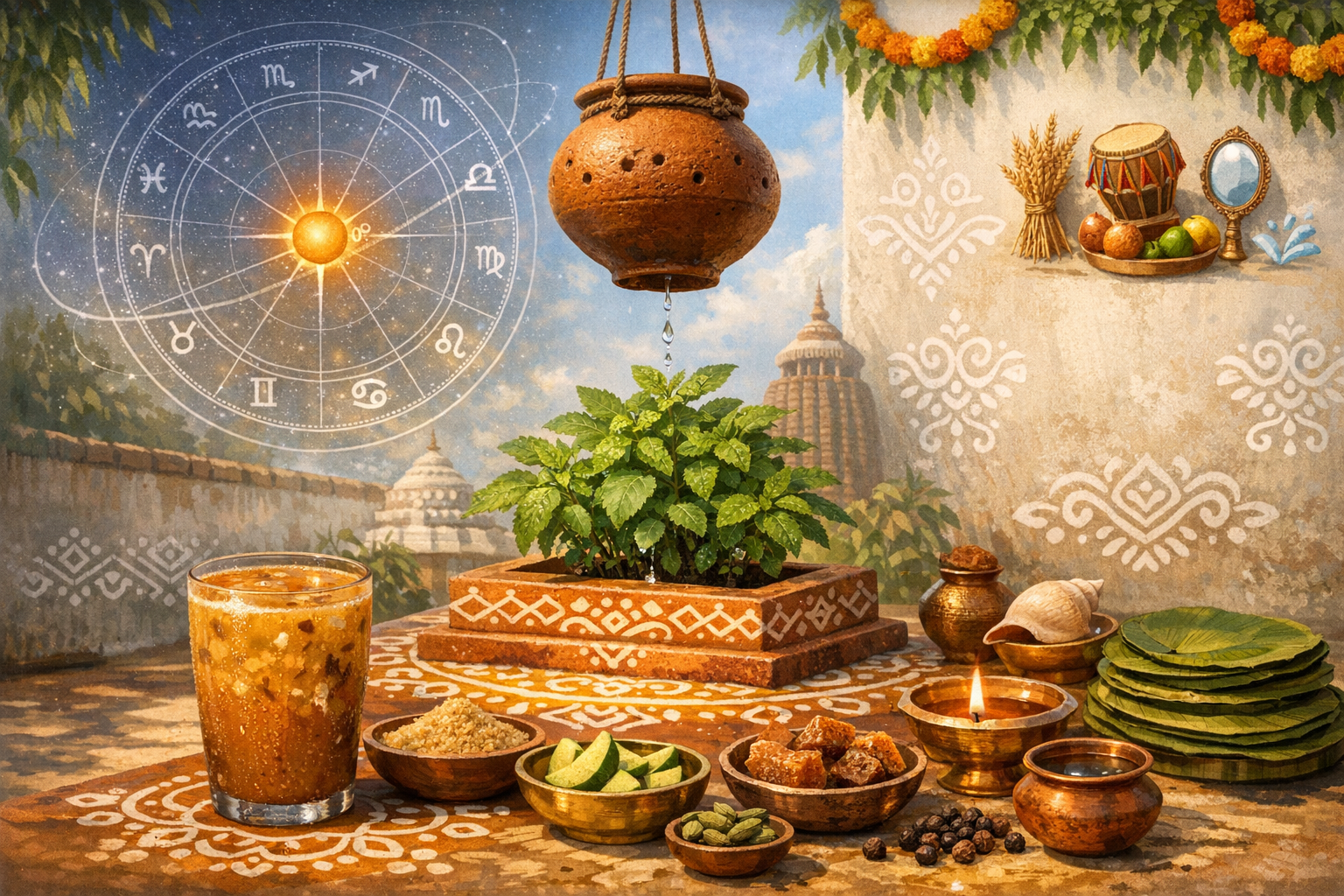
The festival derives its popular name from pana, a traditional cooling beverage that households prepare and share generously. This practice symbolizes jala-dana (offering water), an ethic especially resonant at the onset of grishma (summer). Families often suspend an earthen pot with tiny holescommonly called Basundhara thekiover a Tulasi plant, allowing a gentle, continuous drip (basudhara) that cools the plant and the surrounding earth, embodying gratitude toward nature and a quiet, everyday form of ecological stewardship.
Across Odisha, pana is lovingly prepared in several regional stylesbela pana (with bael/wood apple pulp), chhatua pana (with roasted gram flour or sattu), dahi pana (with curd), and ambā pana (with raw mango). Sweetened with jaggery and refined with spices such as black pepper and cardamom, these nourishing recipes support hydration and digestion in the warmer season. Offered first to deitiesespecially Jagannath, Vishnu, or the household’s Ishta Devatapana is then shared with neighbors and passers-by, transforming nutrition into seva and community bonding.
Simple home observances align devotion with wellbeing. Many households begin with a purifying snana (bath), light a deepa, and recite hymns to Surya such as Aditya Hridayam or the Surya Gayatri. Pana is prepared with clean, seasonal ingredients; a Basundhara theki is hung over Tulasi; and dana is undertakenwater, food, and essentials shared with those in need. This sequencesnana, japa, danamirrors the widely recommended vrata pattern for a Sankranti day and helps integrate spiritual intent with tangible social care.
Community traditions add performative and pilgrim dimensions. In several districts, the renowned Danda Nata ritual theatre culminates around this time, and local temples celebrate Maha Vishuva Sankranti with special darshans and yajnas. The meru motifrooted in the symbolism of Mount Meru as the axis mundiis evoked in processions and ritual designs, underscoring the cosmic register of what is, at heart, a profoundly local and familial celebration.
Panchang guidance emphasizes the Sankranti-kala (the exact ingress moment) and the related Punya Kala/Maha Punya Kala windows, traditionally favored for snana, japa, homa, and dana. As the precise timing varies by longitude, consulting a regional panji or panchang is prudent. Many customs encourage restraint in commencing material undertakings exactly at the ingress, while elevating charity, meditation, and ritual bathing as the primary observances during the sanctified period.
The seasonal logic of Pana Sankranti is as meaningful as its astronomy. With temperatures rising across the subcontinent, the focus on cooling foods, water conservation, and care for plantsespecially Tulasiturns ritual into practical resilience. The day’s signature beverage represents culinary wisdom tuned to climate, while the slow-drip earthen pot models a gentle, low-tech approach to micro-ecological care that households can sustain throughout summer.
Pana Sankranti also sits within a wider pan-Indic matrix of solar New Years that cluster around mid-April. On or near 14 April, multiple regions celebrate cognate transitions: Vaisakhi in Punjab (a landmark for Sikh tradition), Puthandu in Tamil Nadu, Vishu in Kerala, Rongali Bihu in Assam, and Pohela Boishakh (Bengali New Year) in West Bengal and Bangladesh. Nepal marks the New Year in the Bikram Samvat calendar in mid-April, and Sri Lanka celebrates the Sinhala and Tamil New Year at this time as well. In Southeast Asia, Theravada Buddhist-majority countries (e.g., Thailand’s Songkran, Laos’ Pi Mai, Cambodia’s Chol Chnam Thmey) observe water festivals that echo the same solar shift, illuminating a shared civilizational rhythm across dharmic and adjacent cultures.
This broader alignment highlights a unifying principle central to dharmic traditionsrenewal through right conduct. Whether expressed as pana distribution, langar, anna-dana, or water-sharing, the core act is compassion in community. While Jain communities observe their New Year after Deepavali, the ahimsa and dana emphasized during Pana Sankranti resonate strongly with Jain ethics, offering common ground for collective reflection and service. In this way, Pana Sankranti becomes more than a regional New Year; it stands as a platform for unity among Hindu, Buddhist, Jain, and Sikh communities through shared values and season-conscious care.
From a technical perspective, calendrical authorities compute Mesha Sankranti when the Sun’s sidereal longitude equals 0° Mesha under a specified ayanamsa (in India, the Lahiri ayanamsa is commonly used). The offset between tropical and sidereal zodiacsapproximately 24° in the current eraexplains why the tropical vernal equinox occurs in March while the sidereal solar New Year commences in mid-April. This computational clarity enriches ritual understanding, linking observed custom with transparent astronomical rationale.
For families in Odisha and the Odia diaspora, sensory memory is central to the day: the earthy aroma of bael and jaggery, the sight of water droplets nourishing Tulasi, the cool feel of terracotta against the palm, and the hum of neighbors exchanging pana and blessings. These experiences reinforce cultural continuity while inviting thoughtful adaptationssuch as sourcing local, seasonal ingredients in new geographies, observing Sankranti-kala by local time zones, and upholding the dana ethos in community kitchens and neighborhood drives.
Responsible observance today can also foreground sustainability. Earthen or metal pots, leaf plates, and reusable tumblers reduce waste; planting and tending heat-resilient native species complements the Basundhara theki; and structured water-sharing initiatives support both people and urban biodiversity. Each of these practices turns the symbolic language of the festival into durable environmental action.
Frequently asked distinctions further situate the day. Is Pana Sankranti the same as Mesha Sankranti? YesPana Sankranti is the Odia, ritual-rich expression of Mesha Sankranti (Mesha Sankramana). Why is it later than Ugadi? Ugadi and Gudi Padwa follow the lunar calendar (Chandramana), marking the New Year in Chaitra, whereas Pana Sankranti follows the solar calendar (Sauramana), inaugurating Baisakh. Does one observe the festival only in Odisha? While its culinary and ritual idiom is distinctly Odia, the underlying solar transition is recognized across India, with region-specific names and practices.
In essence, Pana Sankranti 2026 offers a rare synthesis: astronomical precision, seasonal intelligence, and an ethic of shared wellbeing. By honoring the Sun’s sidereal new beginning, cooling and conserving water, strengthening neighborhood bonds through pana and dana, and recognizing sister festivals across the dharmic world, communities affirm a common heritage of renewalgrounded, compassionate, and wise.
Inspired by this post on Hindu Pad.