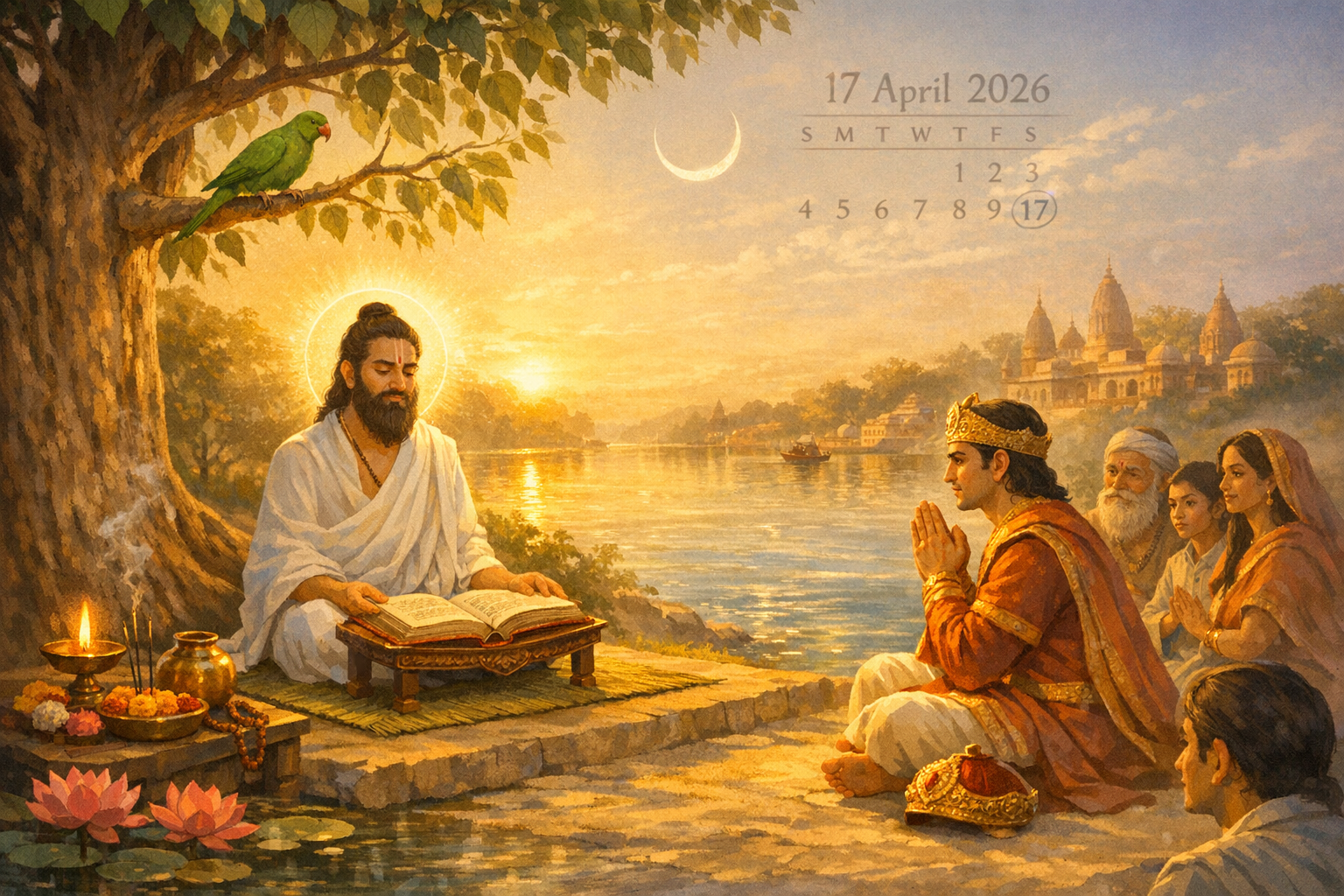
Muni Shukadeva Jayanti, also known as Shukdev Jayanti, commemorates the birth of Shukadeva Muni, the self-realized son of Sage Veda Vyasa and the principal narrator of the Bhagavata Purana. In 2026, the observance falls on Friday, 17 April. According to regional calendrical conventions, the Jayanti aligns with Vaishakh Amavasya in the North Indian (Purnimanta) system and with Chaitra Amavasya in Amavasyant traditions prevalent in several parts of peninsular and western India. This convergence anchors the festival in a pan-Indic lunar framework while recognizing legitimate diversity in Hindu calendar practice.
Shukadeva Muni occupies a pivotal place in the sacred literature of India. Revered as a parama-hamsaan exemplar of spontaneous renunciation and unwavering inner equipoisehe is celebrated for expounding the Bhagavata Purana in seven days to King Parikshit on the bank of the Ganga. In the textual transmission preserved by tradition, Shukadeva’s discourse to Parikshit became the version recounted by Suta at Naimisharanya, ensuring that devotion (bhakti), knowledge (jnana), and dispassion (vairagya) were woven together for seekers across generations.
The name “Shuka” (parrot) is both etymological and symbolic. Ancient narratives portray him as born realized, detached from social markers from the very outset of life. A well-known account describes how he wandered freely, unclothed and unperturbed, indifferent to praise or blame, illustrating the Bhagavata’s vision of spontaneous freedom from dualities. Hagiographic traditions also connect him with King Janaka of Mithila to illustrate the highest test of non-attachment: equipoise that remains unshaken in palace or forest alike.
For practitioners, the spiritual heart of Muni Shukadeva Jayanti is the rededication to the Bhagavata Purana, a text that harmonizes deep metaphysics with accessible devotion. The narrative arcfrom cosmology and practice to the luminous Krishna-lilapresents bhakti not as sentiment alone but as a disciplined pathway that culminates in freedom from fear and sorrow. In honoring Shukadeva Muni, devotees honor the synthesis he represents: devotion integrated with discernment, tenderness guided by truth, and renunciation suffused with compassion.
Calendrically, the 2026 observance date of 17 April reflects the standard sunrise rule used in most regions for determining festival days: the tithi (Amavasya) prevailing at sunrise governs the observance. Because lunar tithis can begin or end between civil midnights, local panchanga recommendations may vary slightly. Accordingly, those wishing to observe the Jayanti may verify the Amavasya vyapti with a trusted regional almanac, especially in locales spanning multiple time zones or high latitudes.
Suggested home observance involves a simple, reverential sequence. A morning snana (ritual bath) and a clear sankalpa (intention-setting) anchor the day. A picture or symbol of the Guru-parampara may be placed alongside an image of Bhagavan Veda Vyasa and a suitable icon or inscription invoking Shukadeva Muni. A brief avahana (invocation) and panchopachara (fivefold offering with incense, lamp, water, flowers, and naivedya) provide a focused liturgical frame. Throughout, the mantra “Om Namo Bhagavate Vasudevaya” is recommended for japa, aligning the mind with the Bhagavata’s devotional current.
Parayana (recitation) is central on this day. Many begin with the traditional mangalacharana verses and then select thematically resonant passages: for example, sections highlighting the Atmarama ideal, the nature of bhakti as the supreme means of spiritual fulfillment, and the episodes that bring out compassion and non-attachment. Some households choose a saptaha-style plancommencing on the Jayanti and reading daily for a weekwhile others recite key chapters in a single sitting. Local Vaishnava mathas and sabhas often organize satsangas, kirtans, and public readings to make the message accessible to all age groups.
Fasting and diet are observed in a spirit of sattva. Where health permits, devotees may keep a light upavasa or phalahara (fruit and light fare), concluding with a saatvik meal after the evening worship. Acts of dana (charity), notably annadana, distribution of Bhagavata copies, or support for community reading circles, are encouraged as expressions of gratitude and as vehicles for transmitting wisdom to the next generation. Families frequently engage children with the timeless story of King Parikshit receiving seven days of teachingan instructive reminder that spiritual awakening is always timely when guided by the right teacher.
Beyond liturgy, the day offers a reflective lens on renunciation and responsibility. Shukadeva’s teaching demonstrates that bhakti does not cancel rigorous inquiry; rather, it deepens and directs it. His example indicates how inner freedom can coexist with sensitive engagement with societythrough teaching, upliftment, and steady remembrance of the Divine in daily action. This integration is increasingly relevant in modern life, where attention is scattered and the need for ethical clarity is acute.
Inter-traditional resonance is equally significant for the broader dharmic family. Shukadeva’s complete non-attachment echoes the Jain emphasis on aparigraha and brahmacharya. The serene, insight-driven liberation he embodies parallels the Buddhist ideal of steadfast mindfulness and release from craving. His unwavering devotion expressed through wisdom and service aligns with Sikh teachings on simran (remembrance), truthful living, and humility. Observing Muni Shukadeva Jayanti, therefore, becomes a moment to celebrate shared dharmic valuescompassion, self-restraint, truth-seeking, and reverence for the inner lightacross Hinduism, Buddhism, Jainism, and Sikhism.
Community traditions frequently associate the Bhagavata recitation with the Ganga’s sanctity, and many identify Shukratal (in present-day Uttar Pradesh) as a commemorated site for Shukadeva’s discourse to Parikshit. While geographical attributions vary among sampradayas, the unifying thread is the purifying power of hearing (śravaṇa) and reflecting (manana) on sacred teaching in the company of seekers. Such gatherings foster solidarity and mutual care, making the Jayanti a lived expression of unity in diversity.
Practical planning for 2026 is straightforward. The festival occurs on 17 April (Amavasya). Those in North India can mark it as Vaishakh Amavasya per the Purnimanta system; those observing Amavasyant calendars will identify it as Chaitra Amavasya. Households and temples may announce evening kirtan or discourses to accommodate working devotees, while schools and community centers can host child-friendly storytelling sessions focused on virtues such as humility, patience, and truthfulnessqualities foregrounded throughout the Bhagavata.
Common questions arise each year regarding textual focus and ritual detail. Any sincere engagement with the Bhagavata Purana is appropriate on this Jayanti; beginning with the opening invocations and a thoughtfully chosen section that inspires consistent practice is recommended. Mantra-japa with “Om Namo Bhagavate Vasudevaya,” even for a modest fixed count, serves to unify attention and intention. As to fasts and offerings, the guiding principle is non-harm and inner clarity; sattva in food, speech, and thought is more crucial than ritual complexity. Finally, because calendar calculations can differ by longitude and tradition, consulting a reliable local panchang ensures alignment with the regional observance.
In essence, Muni Shukadeva Jayanti 2026 offers a luminous opportunity to rediscover the Bhagavata Purana as a complete pathwhere devotion refines discernment, and discernment safeguards devotion. Observed on 17 April, on Vaishakh Amavasya (Purnimanta) or Chaitra Amavasya (Amavasyant), the day honors the sage who embodied fearlessness, simplicity, and boundless compassion. Marking the Jayanti with thoughtful reading, quiet japa, gentle restraint, and community sharing extends Shukadeva’s message into lived reality, nurturing unity across dharmic traditions while deepening personal commitment to truth and kindness.
Inspired by this post on Hindu Pad.