Matsya Jayanti will be observed on 21 March 2026 at Sri Vedanarayana Swamy Temple, Nagalapuram (Tirupati district, Andhra Pradesh), a distinguished Vaishnava kshetra dedicated to Vishnu as Matsya Narayana (Vedanarayana). Falling in the Chaitra Month of the Hindu calendar, the celebration honors the first Avataar of Vishnu and the safeguarding of the Vedas and dharma during the cosmic flood, a theme that anchors both temple ritual and local tradition.
As announced for the day’s observances, the Lord will be awakened at 5:00 AM with Suprabhata Seva, followed by Tomala Seva and Archana. From 7:00 AM to 8:30 AM, morning puja and public darshan customarily continue. Through the forenoon, sevas typically include vishesha Alankarana, Sahasranama Archana, Naivedyam, and Maha Mangala Harati. In the evening, the program often features Veda Parayanam, a brief utsava within the temple precincts as permissible, and Ekanta Seva to conclude the day. Exact timings and any additional arrangements are released locally by the devasthanam.
Matsya Jayanti vrata emphasizes shraddha, satvika ahara, and japa such as Om Namo Narayanaya, together with recitation of Bhagavata Purana (Skandha 8, Adhyaya 24) describing the Matsya avatara. Devotees commonly perform Archana, offer tulasi, and seek Abhishekam or Snapana Tirumanjanam darshan to the utsava-murti, aligning with Vaishnava Agama traditions that frame the day’s worship sequence and community participation.
Textual and philosophical sources situate the Matsya narrative across layers of Indian thought: early attestations in the Shatapatha Brahmana and the Mahabharata, followed by elaborations in the Matsya Purana and the Bhagavata Purana. Across these tellings, Vishnu as Matsya guides Vaivasvata Manu, retrieves the Vedas from the asura who concealed them in the ocean, and anchors the boat of life with serpent Vasukian allegory for the preservation of wisdom, ethical order, and ecological balance that remains resonant in contemporary practice.
The epithet Vedanarayana expresses a local theology in which the deity is directly linked to the restoration of Vedic knowledge, rendering the temple a living archive of sacred memory. Epigraphic and stylistic features associate the complex with the Vijayanagara Empire, whose patronage profoundly shaped South Indian Temple Architecture, ritual calendars, and institutional endowments. In this milieu, Nagalapuram stands out for harmonizing theology, ritual, and spatial design.
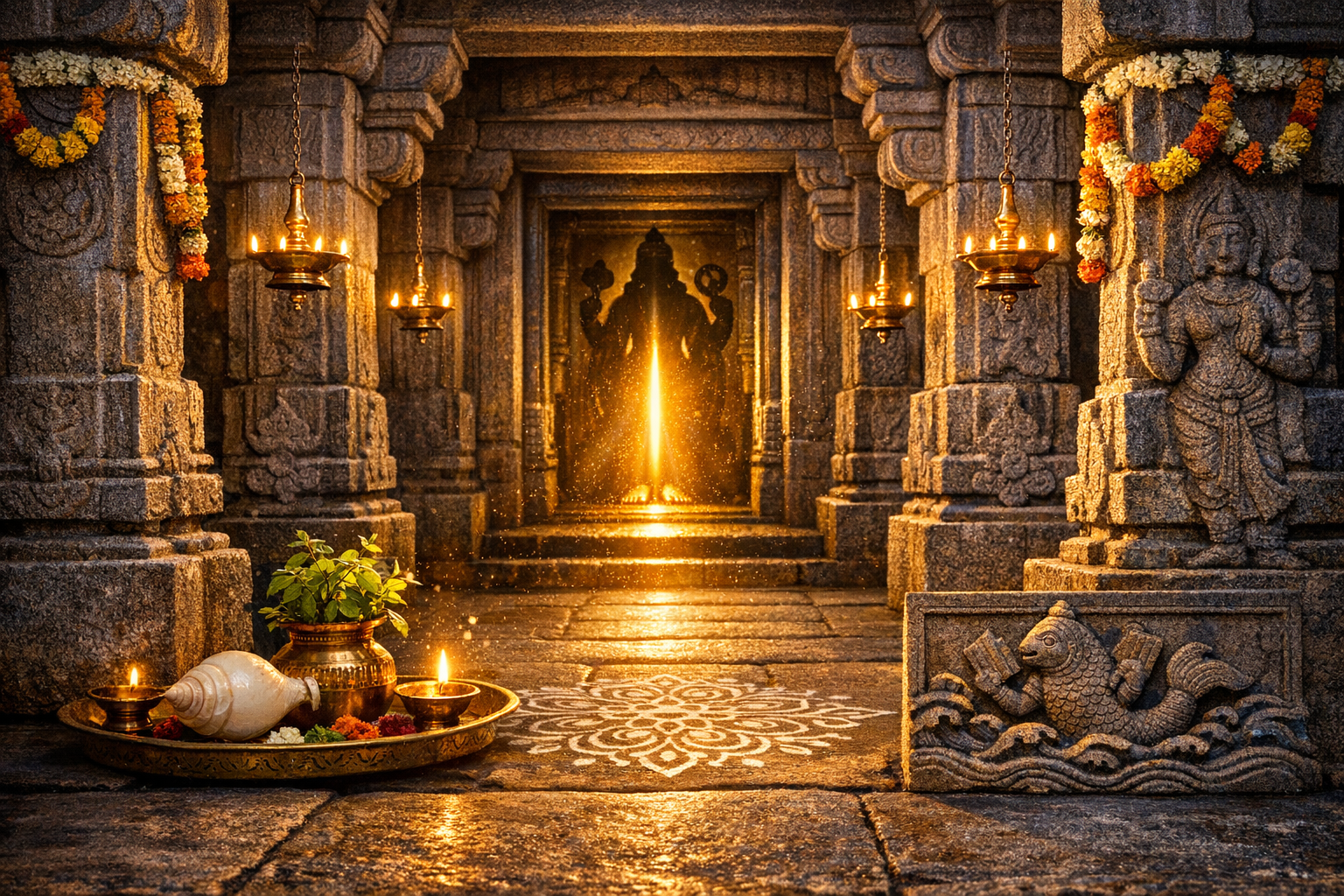
Nagalapuram is celebrated for an equinoctial solar event popularly called Surya Puja. Around the March equinox on three successive evenings, a shaft of sunlight at sunset traverses the aligned gateways and corridor axes to the sanctum, progressively illuminating the deitytraditionally feet, chest/navel, and forehead. Minor shifts from atmospheric refraction, local horizon, and longitudinal placement mean the phenomenon often appears a few days on either side of the astronomical equinox. This elegant display of celestial geometryembedded in sacred spaceexemplifies India’s cultural astronomy and its integration with ritual time-reckoning.
For many pilgrims, the first golden beam touching the Lord’s feet evokes quiet awe and a renewed commitment to dharma. The experience illustrates how astronomical theories and architectural precision blend with devotional life, transforming the temple into a place of worship, a cultural observatory, and a pedagogical center all at once. Such alignment between sky and sanctum invites contemplation on cyclical time, cosmic order, and human responsibility.
The themes of Matsya Jayantiprotection of life, stewardship of waters, and preservation of knowledgespeak across dharmic traditions. Buddhism venerates a pair of golden fish among the Ashtamangala as a symbol of fearlessness and freedom from the ocean of samsara; Jainism foregrounds ahimsa and care for all jivas, including aquatic life; Sikh practice centers seva and reverence for sarovars as spaces of purification and service. Observing Matsya Jayanti at Nagalapuram thus becomes an invitation to shared ecological responsibility and unity in spiritual diversity, strengthening bonds among Hinduism, Buddhism, Jainism, and Sikhism.
Home observances may include a simple upavasa, jaladhara to a Vishnu shaligrama or image, chanting of Vishnu Sahasranama, and charity directed to water conservation, lake rejuvenation, or anna-dana. Integrating personal vrata with tangible community welfare honors the spirit of the avatara: to restore, preserve, and uplift. Families often choose to read the Matsya narrative together, anchoring collective memory and intergenerational learning.
Pilgrim guidance is prudent given expected footfall near the equinox period. An early arrival facilitates participation in Suprabhata Seva, while adherence to dress codes and queue discipline supports collective darshan. The use of minimal plastic, mindful disposal of offerings, and respect for silent zones around the garbhagriha are encouraged. Because sunset visibility depends on weather, the spiritual fruit of the day is found equally in sankalpa and seva irrespective of sky conditions.
Access to Nagalapuram is available by road from Tirupati and the Chennai region of Andhra Pradesh, with local transport and basic amenities on hand. For seva tickets, darshan windows, or day-of adjustments, devotees should refer to on-site notices and instructions issued by the temple administration. Planning around midday heat, arranging hydration, and accommodating elders and children enhances the overall experience and safety.
Commemorating Matsya Jayanti at Sri Vedanarayana Swamy Temple on 21 March 2026 synchronizes mythic memory with cosmic rhythm. The day’s sevas, the philosophy of avatara, and the temple’s equinoctial design converge to reaffirm a core ideal of Sanatana Dharma: the perpetual safeguarding of knowledge, life, and harmony for the welfare of all. In celebrating Matsyathe primordial guardian of wisdom and watersdevotees participate in a tradition that is devotional, architectural, and cosmological at once.
Inspired by this post on Hindu Pad.