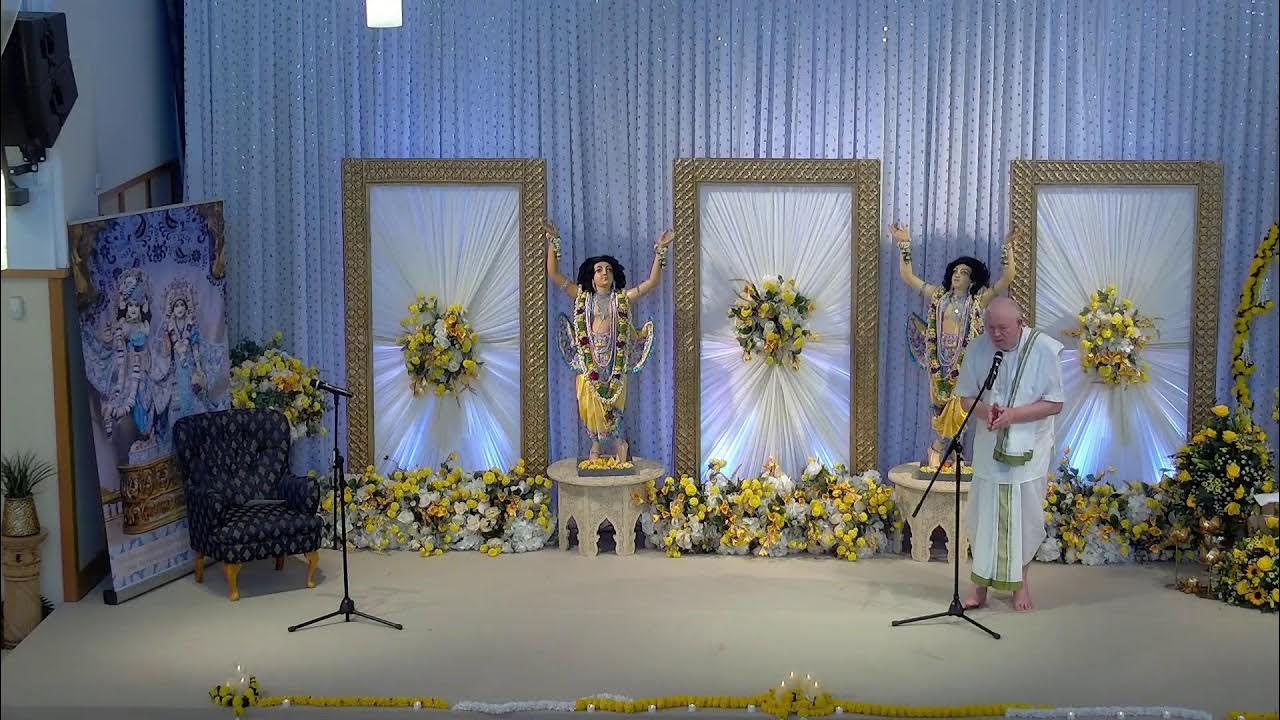
On 21 March 2026, Bhaktivedanta Manor hosted a joyful and meaningful celebration that converged three milestones within the International Society for Krishna Consciousness (ISKCON): the annual Srila Prabhupada festival, the 60th anniversary of ISKCON’s incorporation, and the fifth consecutive year of organizing this particular festival at the Manor. Opening remarks expressed heartfelt gratitude to key organizers, including Mother Guru and other dedicated volunteers, setting a tone of humility, community service (seva), and shared purpose.
Marking ISKCON@60 invited a considered reflection on six decades of institutional development and spiritual outreach anchored in the Gaudiya Vaishnava tradition of bhakti-yoga. Founded in 1966, the International Society for Krishna Consciousness emerged with a clear pedagogical mission: to present the teachings of the Bhagavad-Gita and the Bhagavata Purana through practice-centered education, kirtan, and the guru–shishya tradition. The anniversary consequently functioned not merely as a commemoration but as a benchmark for continuity, governance, and values-based community building.
At the center of the observance stood the enduring legacy of Srila Prabhupada, whose emphasis on devotional service, congregational chanting, and scriptural study catalyzed a global movement. The festival context foregrounded the living transmission of knowledge (parampara) as a public good, showing how accessible, daily practicesjapa, kirtan, satsang, and prasada distributionsustain spiritual life, social cohesion, and ethical discipline.
As a prominent ISKCON community hub in the United Kingdom, Bhaktivedanta Manor has cultivated a consistent framework for Hindu festivals, spiritual education, and community outreach. Its programming has long emphasized inclusive participation, intergenerational learning, and cultural continuity, providing a resilient setting for diasporic Hindu identity and service-oriented leadership.
Although each year’s agenda is distinct, Srila Prabhupada festivals commonly center on scriptural discourse, congregational kirtan, and collective offerings that honor the preceptor’s role in reviving and contextualizing bhakti for contemporary life. Within that normative structure, participants often report a tangible sense of upliftmentrooted in shared singing, reflective study, and communal mealsthat aligns spiritual practice with everyday well-being.
From a cultural heritage perspective, the 60th anniversary underscored how intangible traditionsritual, music, sacred narrative, and ethical codesadapt and thrive in new environments without losing doctrinal clarity. Such festivals help transmit living heritage through embodied practice rather than abstract description, thereby reinforcing a knowledge tradition that is both textually grounded and experientially verified.
The event also highlighted a broader dharmic horizon, affirming values shared across Hinduism, Buddhism, Jainism, and Sikhismsuch as ahimsa, seva, inner discipline, and truth-seekingwithout erasing distinct identities. By celebrating unity in diversity, the gathering modeled inter- and intra-dharmic harmony as a practical ethic: respectful dialogue, mutual inspiration, and cooperation in service projects that benefit the wider community.
Educationally, such festivals function as modular learning environments that integrate philosophy (siddhanta), practice (sadhana), and community responsibility (dharma). Readings from the Bhagavad-Gita and the Bhagavata Purana, along with discussions on Guru–Shishya Tradition, typically invite participants to connect timeless teachings with contemporary ethical questionsfamily life, work, citizenship, and ecological stewardshipthereby translating scriptural insights into daily choices.
From a community development lens, this fifth consecutive festival at the Manor illustrated how regular, well-curated gatherings create stable rhythms for volunteer engagement, youth mentorship, and leadership formation. Families and newcomers alike encounter not only devotional practices, but also a reliable social infrastructure: transparent organization, safe spaces, and a culture of gratitude that recognizes every contributionon stage, behind the scenes, and across service teams.
In terms of event governance, the festival reflected best practices in cultural programming: clear scheduling, coordinated volunteer roles, attention to accessibility, and an emphasis on sustainability. While specifics vary year to year, the Manor’s approach aligns with responsible stewardshipminimizing waste, encouraging mindful consumption, and promoting repair or reuse where feasibleso that celebration and environmental ethics reinforce one another.
The social impact of such observances can be mapped along three axes: identity, integration, and inspiration. Identity is strengthened through visible, participatory tradition; integration advances as interfaith neighbors encounter living Hindu practice in an atmosphere of dignity and welcome; inspiration grows as attendees witness the transformative potential of collective devotion and study. Taken together, these outcomes illustrate how a festival is both a spiritual intensifier and a civic asset.
Importantly, the festival’s toneanchored in devotional joy and scholarly clarityfavored persuasion by example rather than polemic. By celebrating Srila Prabhupada’s contribution to ISKCON and the wider dharmic conversation, participants were invited to deepen their own chosen paths while extending respect to others. This ethos is consistent with a pluralistic understanding of dharma and with the long arc of Indic traditions that value learning, contemplation, and compassionate action.
As the day concluded, the gathering stood as a composite tribute: to Srila Prabhupada as a visionary teacher; to ISKCON’s 60-year journey of institution-building and spiritual service; and to Bhaktivedanta Manor’s steady role in nurturing community, culture, and faith. The fifth consecutive iteration of this festival at the Manor affirmed a simple, durable truth: when knowledge, devotion, and service move together, unity in diversity ceases to be a slogan and becomes a lived experience.
Inspired by this post on Dandavats.