
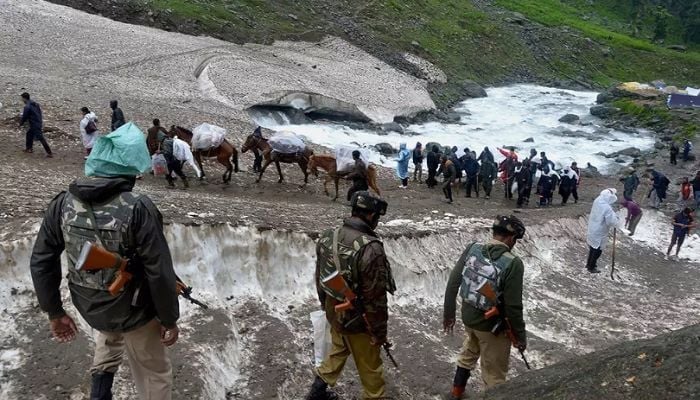
Shri Amarnath Ji Yatra 2026 is being prepared as a test of faith, logistics, technology, and internal security in Jammu and Kashmir. The pilgrimage is scheduled to begin on 3 July 2026 and conclude on 28 August 2026, drawing lakhs of devotees toward the Holy Cave Shrine in the Kashmir Himalayas through the traditional Pahalgam and Baltal axes. The route is sacred, difficult, and strategically sensitive; therefore, the administrative challenge is not merely to move pilgrims from one point to another, but to protect a living tradition while maintaining public order across mountainous terrain.
The security architecture being placed around the Amarnath Yatra this year reflects a broader shift in how large religious pilgrimages are managed in Bharat. The arrangements combine conventional deployment of security forces with digital verification, real-time movement tracking, traffic discipline, aerial restrictions, emergency drills, and sharper scrutiny of service providers. In practical terms, the pilgrim walking toward Darshan is now part of a managed security ecosystem in which identity, location, route timing, service access, and convoy movement are continuously coordinated.
The official Shrine Board information confirms that the 2026 Yatra will run from 3 July to 28 August. It also states that every registered Yatri must collect an RFID card from designated locations in Jammu or Kashmir before beginning the journey, carry Aadhaar details for that purpose, and wear the RFID tag around the neck throughout the Yatra for safety and security. The instruction is explicit: no registered Yatri is to be allowed to embark on the Yatra without an RFID card. This makes RFID not an optional convenience, but a central pillar of pilgrimage management.
The technical logic of RFID in the Amarnath Yatra is straightforward but significant. RFID, or Radio Frequency Identification, uses a small tag that can be read by compatible devices without requiring direct physical contact. In a high-altitude pilgrimage involving large crowds, convoy movement, weather disruptions, and security-sensitive routes, such tagging helps authorities maintain a more accurate picture of who has entered the Yatra system, where movement is taking place, and whether a pilgrim, vehicle, or service unit has deviated from expected patterns.
RFID is especially useful because a pilgrimage route is not a static venue. The Amarnath Yatra passes through base camps, checkpoints, highways, narrow mountain paths, halting points, langar areas, and service zones. Manual registers alone cannot provide timely situational awareness in such conditions. Digital tagging allows authorities to reconcile registration data with actual movement, support search and rescue efforts, reduce confusion in emergencies, and improve accountability across multiple administrative layers.
The new QR-code-based identity system for pony riders and other service providers adds another layer to this structure. Reports state that Jammu and Kashmir Police have introduced tamper-proof QR-coded identity cards for service providers associated with the pilgrimage. When scanned, these cards are intended to provide complete information about the person offering services. This has a direct security purpose: it helps distinguish authorised workers from suspicious persons attempting to blend into the support ecosystem around pilgrims.
This distinction matters because religious pilgrimages depend heavily on local service networks. Pony riders, porters, palki operators, drivers, accommodation providers, langar volunteers, and other workers make the Yatra possible for many elderly pilgrims, families, and devotees who cannot complete the route unaided. A secure pilgrimage cannot treat these service providers as an afterthought. Their identity verification is part of pilgrim safety, economic regulation, and social trust.
From a security studies perspective, the QR-code identity card is a low-friction verification tool. It allows personnel at a checkpoint or service area to scan a card and quickly match the service provider with verified records. Compared with visual inspection alone, such a system reduces dependence on memory, local familiarity, or paper documents that may be damaged, misplaced, or forged. In a sensitive environment, the ability to verify identity quickly can prevent both infiltration and unnecessary harassment of genuine workers.
The heightened security arrangements also include extensive surveillance. CCTV cameras, electronic monitoring systems, watch towers, and observation posts have been positioned at sensitive points along the Yatra routes. These measures are not ornamental. In mountain environments, visibility can be interrupted by bends, slopes, weather, vegetation, and crowd density. Surveillance infrastructure gives commanders a wider field of awareness and helps local units respond to bottlenecks, suspicious movement, medical distress, and route disruptions.
High-rise watch towers and locally referenced “Machan Morchas” are particularly important in areas where ground-level observation is inadequate. They allow security personnel to observe crowd flows, route edges, approach paths, and nearby terrain. Such posts complement digital systems because cameras and sensors are most effective when integrated with trained human observation. Technology can alert and record; personnel must still interpret, decide, and intervene.
Mock drills by Jammu and Kashmir Police and other security agencies indicate that the preparations are also focused on response readiness. A security plan is only as strong as its execution under pressure. Drills allow agencies to test communication chains, evacuation procedures, combing operations, crowd guidance, medical coordination, and the movement of reinforcements. They also expose weak points before the pilgrimage begins, which is far preferable to discovering them during a live emergency.
The deployment includes personnel from multiple agencies, and that inter-agency structure is essential. The Yatra involves civil administration, police, paramilitary forces, intelligence units, transport authorities, health services, disaster response teams, Shrine Board officials, and local service providers. Each institution has a different operational role. Strong coordination prevents duplication, gaps, and delayed decision-making, especially when weather, traffic, health emergencies, and security alerts occur simultaneously.
Director General of Police Nalin Prabhat has stressed stronger coordination among agencies involved in the operation. This emphasis reflects a key principle of internal security: intelligence sharing and operational clarity are as important as manpower. In a route-based pilgrimage, a warning at one point may be relevant to movement several kilometres away. Information must therefore travel faster than the convoy, faster than rumours, and faster than any hostile attempt to exploit confusion.
The no-fly zone declared over the Yatra routes is another major component of the 2026 security posture. The Shri Amarnath Ji Shrine Board has notified pilgrims that, under Government Order No. 321–HOME of 2026 dated 1 June 2026, all routes of the Yatra, including the Pahalgam and Baltal axes, have been declared a “No Flying Zone” from 1 July 2026 until completion of the Yatra. Consequently, helicopter services for pilgrim travel are not available in the Yatra area during SANJY 2026.
This restriction may inconvenience some pilgrims, especially those who might have relied on helicopter access due to age, time constraints, or physical limitations. Yet the logic is clear: restricted airspace reduces the number of aerial variables security agencies must monitor. It also lowers the risk of misuse of aerial platforms and allows authorities to concentrate on approved ground movement. In an era of drones and asymmetric threats, airspace control has become a standard part of high-security event planning.
The Shrine Board has advised that pilgrims may reach the Holy Cave Shrine on foot or use ponies and palkis during the Yatra. This makes the regulation of service providers even more important. If helicopter movement is unavailable, the demand for ground-based assistance is likely to rise. QR-coded identity cards, notified rates for pony rides, porters, palkis, accommodation, and passenger vehicles, and formal service regulation together create a more transparent pilgrimage economy.
Traffic management forms the civic backbone of the entire operation. Authorities have issued a detailed traffic plan for the duration of the Yatra, with restrictions on civilian movement along critical stretches of the Srinagar-Jammu National Highway and within the Valley. Reports note that vehicles travelling toward the Valley from Jammu are not to depart before 11:30 am, while vehicles moving toward Srinagar are not to cross the Banihal-Qazigund tunnel after 3 pm. Such timing rules are designed to preserve convoy discipline and prevent congestion at vulnerable points.

Traffic restrictions can appear severe to ordinary travellers, but they are central to risk reduction. A pilgrimage convoy differs from normal highway traffic because it involves concentrated movement of identified pilgrims, often under escort or monitoring. If civilian traffic mixes unpredictably with pilgrim convoys, authorities lose control over speed, separation, stopping points, and emergency access. Managed timing allows security forces to scan, secure, clear, and monitor route segments more effectively.
The geography of the Amarnath Yatra makes planning unusually complex. The shrine lies in a high-altitude Himalayan environment where weather changes can be abrupt, temperatures can fall sharply, and physical exhaustion can affect even healthy pilgrims. The Shrine Board’s guidance asks devotees to carry woollen clothing, rain protection, waterproof shoes, identity documents, Yatra permits, and emergency contact details. It also warns pilgrims not to ignore symptoms of high-altitude illness and not to attempt shortcuts.
This medical and environmental dimension is inseparable from security. A safe Yatra is not limited to preventing hostile action. It also means preventing avoidable deaths from exposure, altitude sickness, crowd mismanagement, landslides, exhaustion, or route violations. When pilgrims follow designated routes and wear RFID tags, authorities can better identify stranded or missing persons, manage evacuation, and coordinate medical help.
In the wider Dharmic context, the Amarnath Yatra is more than an annual movement of people. It is a sacred journey associated with Lord Shiva, undertaken through austerity, discipline, and devotion. For many families, the Yatra is remembered not only as travel but as tapas, endurance, seva, and surrender. That emotional dimension should not be dismissed when examining security arrangements. The state is not merely protecting a route; it is protecting the ability of devotees to practise faith with dignity.
This is why the balance between security and accessibility must be handled carefully. Excessive disorder can endanger pilgrims, while excessive friction can make the journey feel alienating. The best security systems are those that are firm, predictable, and transparent. RFID cards, QR-coded service IDs, notified traffic timings, and clear health advisories can reduce uncertainty when they are communicated well and implemented consistently.
The arrangements also highlight an important lesson for large religious gatherings across India. Traditional pilgrimage and modern technology need not be viewed as opposites. A QR code does not diminish devotion. An RFID card does not reduce the sacredness of Darshan. When used responsibly, these tools can protect pilgrims, support administrators, and preserve the continuity of ancient practices in a world where threats, crowds, infrastructure demands, and environmental risks have become more complex.
There is also a social cohesion aspect. A pilgrimage of this scale brings together devotees, local residents, security personnel, transport operators, langar volunteers, medical workers, and administrative staff. Many of them belong to different regions, languages, and communities, yet they cooperate around a sacred journey. This cooperation reflects the larger civilisational strength of Bharat: sacred traditions are sustained not only by belief, but also by organisation, discipline, service, and mutual responsibility.
The previous year’s terror attack on tourists in the Baisaran Valley near Pahalgam has understandably shaped the caution surrounding the 2026 Yatra. Even when officials state that there are no specific intelligence inputs about a threat to the pilgrimage, the absence of a specific alert cannot be treated as the absence of risk. Security planning in Jammu and Kashmir must account for intent, opportunity, terrain, symbolism, and past patterns. A pilgrimage associated with Lord Shiva and attended by lakhs of devotees is inherently a high-value target for those seeking disruption.
At the same time, factual restraint is necessary. The available reports indicate heightened preparedness, not panic. The measures described are preventive and administrative: surveillance, identity verification, controlled traffic, no-fly restrictions, watch towers, mock drills, and inter-agency coordination. These are signs of a state attempting to reduce vulnerability before the Yatra begins. Such preparation should be understood as risk management rather than sensationalism.
The pilgrim also has responsibilities within this security framework. Registration, collection of RFID cards, adherence to convoy timings, respect for no-go areas, use of approved service providers, avoidance of shortcuts, and attention to health advisories are not minor formalities. They are part of collective safety. In a pilgrimage where one person’s non-compliance can delay a convoy or trigger a search operation, discipline becomes a form of seva toward fellow devotees.
Environmental discipline is equally important. The Shrine Board’s guidance warns against pollution and notes restrictions on plastics. The Himalayan route is ecologically fragile, and pilgrimage management must recognise that sanctity includes care for the landscape. A secure Yatra should also be a clean Yatra, because sacred geography is not separate from Dharma. The mountain, the path, the cave, the river systems, and the pilgrim’s conduct are all part of the same moral environment.
From an administrative viewpoint, the 2026 Amarnath Yatra offers a model of layered security. The first layer is registration and health certification. The second layer is RFID-based pilgrim tracking. The third layer is QR-code verification of service providers. The fourth layer is route surveillance through CCTV, watch towers, and observation posts. The fifth layer is convoy and traffic control. The sixth layer is airspace restriction. The seventh layer is intelligence sharing, drills, and rapid-response readiness.
No single layer can provide complete protection. RFID cannot replace physical security. CCTV cannot replace local intelligence. Traffic restrictions cannot replace emergency medical care. QR codes cannot replace field judgement. The strength of the system lies in integration. When these layers operate together, they reduce ambiguity, increase accountability, and give commanders more time to act before a situation becomes unmanageable.
The 2026 arrangements therefore represent both continuity and adaptation. The continuity lies in the ancient impulse toward Tirtha-Yatra, Darshan, austerity, and devotion to Lord Shiva. The adaptation lies in the use of RFID, QR-coded identity, surveillance networks, no-fly zones, and modern traffic regulation. This combination is increasingly necessary for large Dharmic gatherings, where spiritual freedom must be protected through disciplined public systems.
Ultimately, the security preparations for Shri Amarnath Ji Yatra 2026 should be viewed through a humane lens. Behind every RFID card is a pilgrim whose family wants them to return safely. Behind every QR-coded service identity is a worker whose livelihood depends on trust. Behind every traffic restriction is an attempt to prevent chaos on a difficult road. Behind every watch tower and drill is the recognition that faith deserves protection without fear.
If implemented with discipline and sensitivity, the 2026 security grid can help ensure that the Amarnath Yatra remains what it is meant to be: a sacred journey through the Himalayas, undertaken with courage, reverence, and collective responsibility. The true measure of success will not be the visibility of the security apparatus, but the safe, orderly, and peaceful completion of the Yatra, allowing devotees to experience Darshan with confidence and dignity.
Inspired by this post on Hindu Post.









Leave a Reply
You must be logged in to post a comment.