
June 21 is widely associated with International Yoga Day, a global reminder of India’s civilizational gift of inner discipline, balance, and self-mastery. Yet the date also opens a different doorway into Indian history. In 2026, it invites reflection on 450 years since the Battle of Haldighati, a confrontation remembered not merely for its military outcome but for the deeper question it raises: why do some defeated figures become permanent moral symbols while many victorious commanders fade into archival obscurity?
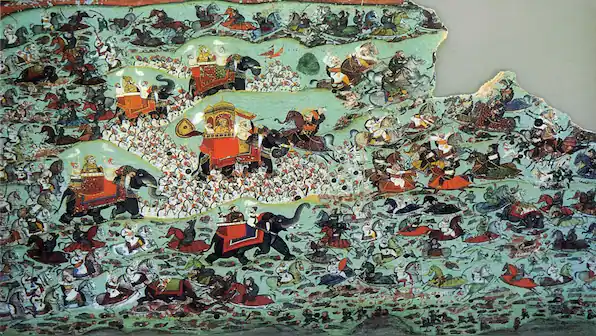
Haldighati, the rugged pass in Rajasthan whose yellowish soil recalls haldi, or turmeric, became the stage for one of the most emotionally charged episodes in medieval Indian history. The battle was fought in 1576 between the forces of Maharana Pratap of Mewar and the Mughal imperial army sent under Akbar’s authority. In narrow military terms, the Mughal side held the field. In civilizational memory, however, Maharana Pratap acquired a stature that cannot be measured by battlefield possession alone.
This distinction between tactical victory and historical legitimacy is central to understanding Haldighati. A battle can decide control over terrain, but it does not necessarily decide the moral verdict of posterity. Maharana Pratap’s importance lies in his refusal to reduce sovereignty to convenience. His resistance represented a larger principle: that political accommodation, however practical it may appear, cannot be treated as the only standard by which historical action is judged.
The debate around Haldighati has often been shaped by competing forms of historiography. One influential interpretation presents Mughal expansion under Akbar as a project of political integration, sometimes even as an early form of Indian nation-building. This reading notes that several Rajput houses entered into alliance with the Mughal court, and that Raja Man Singh of Amber, a distinguished Rajput general, commanded the Mughal army at Haldighati. That fact is historically important and should neither be denied nor simplified.
Yet the presence of Rajput allies in the Mughal camp does not automatically transform imperial expansion into national integration. Empires often incorporate local elites, marry into regional houses, absorb military talent, and create administrative partnerships. Such methods may produce stability, wealth, and cultural exchange, but they remain instruments of imperial statecraft. To call one expansionist project nation-building while refusing the same language to other conquerors creates an intellectual inconsistency that weakens historical analysis.
Akbar’s empire deserves serious study because it was administratively sophisticated, militarily ambitious, and politically adaptive. Its court drew in diverse groups, including Rajputs, Persianate elites, Central Asian lineages, Indian administrators, and scholars of different traditions. However, sophistication does not erase sovereignty. From the viewpoint of Mewar, Mughal suzerainty still meant accepting an imperial hierarchy. Maharana Pratap’s resistance, therefore, cannot be dismissed as stubborn isolationism; it was a principled defence of political autonomy.
That is why Haldighati continues to move the Indian imagination. The emotional power of the episode lies not in a romantic denial of military facts but in the recognition that history is not only written by those who win a day’s battle. A society remembers those who defend its dignity under impossible circumstances. The image of Maharana Pratap, his horse Chetak, the hills of Mewar, and the refusal to submit has become part of a larger vocabulary of courage, sacrifice, and dharmic duty.
In the Indic understanding of public life, power is not automatically sacred because it is successful. Rajadharma and kshatra dharma require strength, but they also require restraint, responsibility, and fidelity to a higher order. This is where the memory of Maharana Pratap resonates across dharmic traditions. Hindu, Buddhist, Jain, and Sikh civilizational ethics may differ in metaphysics and practice, yet they share a respect for discipline, truthfulness, self-command, and moral courage in the face of domination.
The comparison with Iran brings this historical lesson into the modern world of geopolitics. Contemporary conflicts often show that a state may achieve spectacular tactical gains through air power, intelligence operations, technological superiority, sanctions, or proxy networks, yet still fail to create political legitimacy. Destroying infrastructure, neutralising commanders, or winning a media cycle is not the same as building a durable peace. Modern warfare repeatedly demonstrates that military success becomes fragile when it is not matched by a credible political settlement.
Iran’s strategic environment illustrates the limits of coercive power. External pressure can damage capabilities, but it can also harden identity, deepen civilizational grievance, and strengthen the narrative of resistance. In West Asia, as in medieval India, the visible outcome of a confrontation may differ from its long-term historical meaning. The side that appears militarily weaker may preserve symbolic capital, while the side that claims victory may inherit instability, resentment, and strategic overextension.

This does not mean that all resistance is noble or that all imperial formations are identical. Historical judgment requires precision. The Mughal Empire, Rajput polities, Safavid Iran, Ottoman power, European colonialism, and modern nation-states each emerged from different institutional and ideological contexts. Still, a common principle can be observed: durable authority requires more than conquest. It requires consent, cultural legitimacy, ethical restraint, and the ability to create a shared future without humiliating the communities being governed.
Haldighati is therefore not merely a Rajput story or a regional memory of Rajasthan. It is a case study in the difference between control and legitimacy. The Mughal army could claim battlefield advantage, but Maharana Pratap’s refusal to surrender preserved a moral horizon for later generations. His example reminds society that defeat in one encounter does not equal defeat in history, and that the endurance of a civilizational ideal can outlast the administrative machinery of empires.
The episode also cautions against flattening Indian history into easy binaries. Some Rajputs allied with the Mughals; others resisted. Some alliances were pragmatic; others were shaped by compulsion, ambition, kinship, or regional calculation. Indian history is rarely reducible to a single slogan. Its richness lies in the coexistence of accommodation and resistance, diplomacy and defiance, political realism and moral aspiration. Academic honesty requires holding these complexities together without erasing the distinctiveness of Maharana Pratap’s stand.
For modern Bharat, the lesson is especially relevant. Nations are not sustained only by economic growth, military capability, or diplomatic positioning. They are sustained by memory, confidence, and a truthful relationship with their past. When historical narratives treat resistance to imperial power as backwardness while describing imperial consolidation as progress, they distort the moral grammar through which societies understand freedom.
At the same time, historical memory must serve unity rather than bitterness. Maharana Pratap’s legacy is most valuable when it strengthens civilizational self-respect without encouraging hatred toward communities today. The purpose of remembering Haldighati is not to reopen social wounds but to understand the price of autonomy, the ethics of statecraft, and the responsibility of preserving dharma in public life. A mature society can honour resistance without turning memory into resentment.
This is where dharmic traditions offer a deeper framework. Hinduism, Buddhism, Jainism, and Sikhism all preserve, in different ways, the insight that outer power must be disciplined by inner clarity. Yoga teaches self-mastery; Jainism emphasises restraint and non-possessiveness; Buddhism examines suffering, desire, and ethical conduct; Sikh tradition honours courage joined with seva and righteousness. Together, these traditions remind society that victory without dharma becomes domination, while struggle guided by dharma can become a source of renewal.
Haldighati’s continuing power lies in precisely this paradox. It was not a conventional victory for Maharana Pratap, yet it became a civilizational triumph of memory. It did not end Mughal power, but it preserved the idea that sovereignty, honour, and cultural selfhood were worth defending. The battlefield did not settle the argument; the centuries did.
From Haldighati to Iran, the lesson remains clear: winning battles is not enough. A power that wins militarily but fails morally may command fear without earning respect. A people who lose ground but preserve dignity may shape history long after the cannons fall silent. The deeper victory belongs not simply to the side that survives the battle, but to the side whose ideals survive time.
Inspired by this post on Hindu Post.


Leave a Reply
You must be logged in to post a comment.