
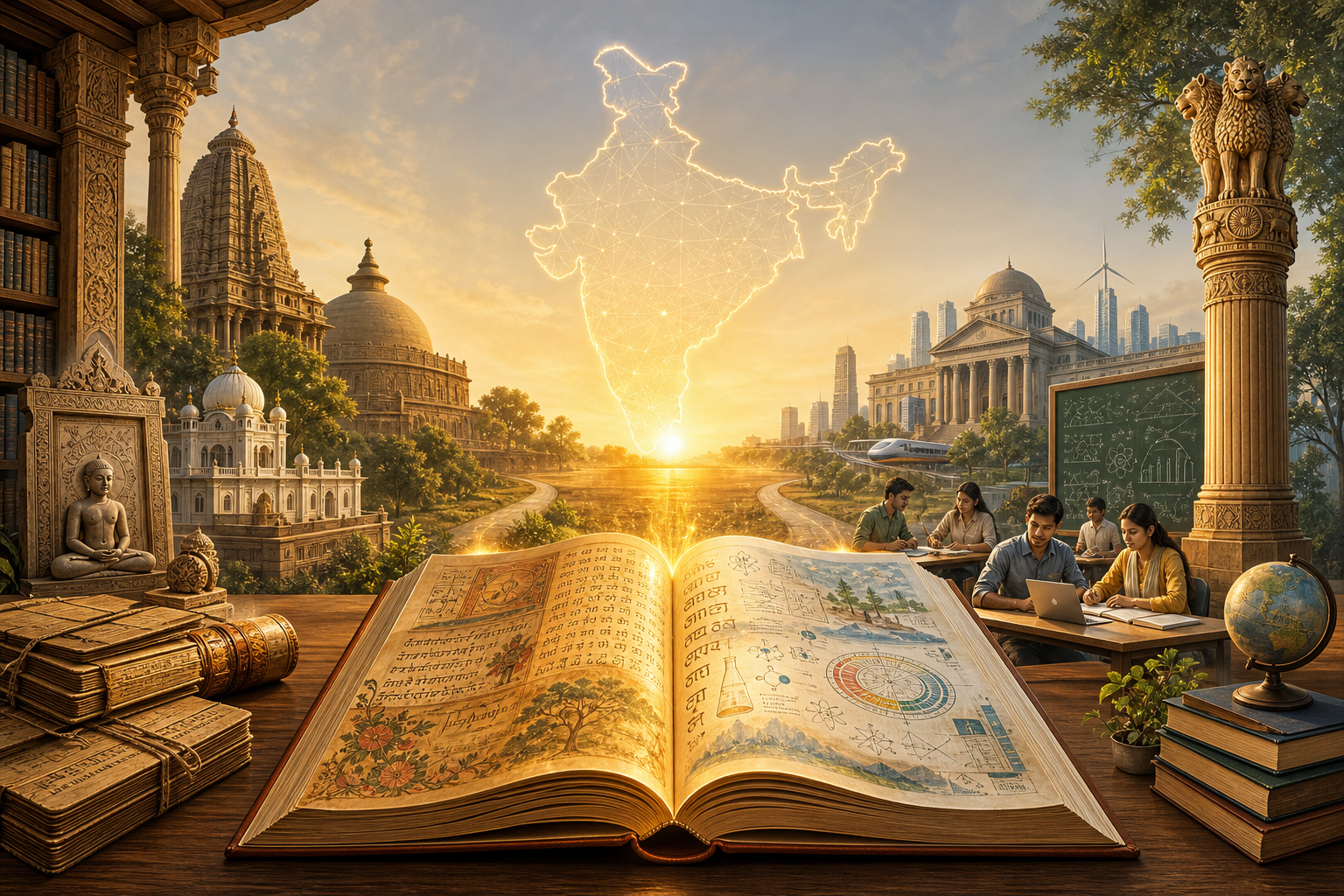
India’s public life has long been shaped by two competing visions of national identity. One vision treats the civilizational inheritance of India as a private memory, useful perhaps for ritual and sentiment, but largely irrelevant to statecraft, education, economics, and modern citizenship. The other vision argues that India cannot understand its future without recovering, studying, and critically engaging with its civilizational past. The conflict is often described through the language of secularism and communalism, but that vocabulary can be too narrow. At a deeper level, the debate concerns memory, identity, education, language, and the meaning of progress in a civilization that has never been reducible to a single creed, sect, region, or political party.
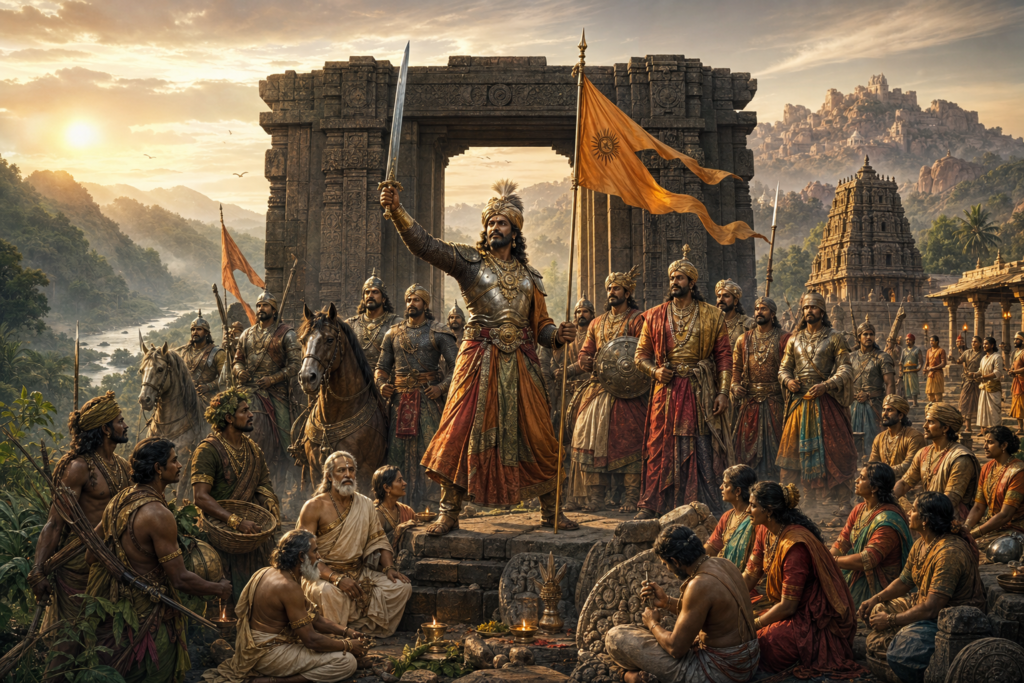
The metaphor of a modern Kurukshetra remains powerful because the dispute is not merely electoral. It is ethical and intellectual. It asks whether a nation can become modern by forgetting the sources of its own self-understanding, or whether modernization becomes stronger when rooted in historical confidence. For India, this question is especially significant because its civilizational life has included Hindu, Buddhist, Jain, and Sikh traditions; Sanskritic, Prakritic, Pali, Tamil, Persianate, and regional intellectual worlds; temple-centered communities; monastic institutions; philosophical schools; folk practices; oral epics; and a long tradition of debate over Dharma, duty, liberation, governance, and social order.
The first vision assumes that India’s civilizational heritage is primarily a burden. In this view, traditional knowledge, religious vocabulary, Sanskrit learning, inherited customs, and sacred geography are seen as obstacles to rapid modernization. The implied prescription is straightforward: India must move quickly toward Western institutional models, English-dominant education, technocratic development, and a public culture in which inherited spiritual categories are kept at the margins. This vision has often presented itself as rational, secular, and progressive. Its strongest appeal lies in the fear that appeals to tradition may become exclusionary, anti-scientific, or politically manipulative.
That concern cannot be dismissed casually. Any serious account of Indian civilization must acknowledge that inherited institutions require scrutiny, reform, and moral evaluation. Dharma has never meant blind repetition. The history of India includes philosophical disagreement, social reform, anti-ritual critiques, bhakti challenges to hierarchy, Buddhist and Jain critiques of violence, Sikh commitments to spiritual equality and public courage, and modern reformers who questioned practices that violated human dignity. A civilizational recovery worthy of the name must therefore be reflective rather than nostalgic. It must distinguish wisdom from habit, continuity from rigidity, and cultural confidence from cultural arrogance.
Yet the weakness of the first vision is its tendency to equate modernization with civilizational amnesia. When a society is taught that its ancestors produced only superstition, oppression, and backwardness, it does not become more rational; it becomes dependent on borrowed categories of self-evaluation. The result is a subtle form of deracination. Students may learn global theories, constitutional principles, and modern sciences, yet remain unable to explain the philosophical meaning of Dharma, the intellectual history of Sanskrit, the ethical debates in the Mahabharata, the contributions of Indian mathematics, the logic of Buddhist epistemology, the discipline of Jain ahimsa, or the political spirituality of the Sikh tradition. Such a curriculum creates technically educated citizens who may still be culturally illiterate.
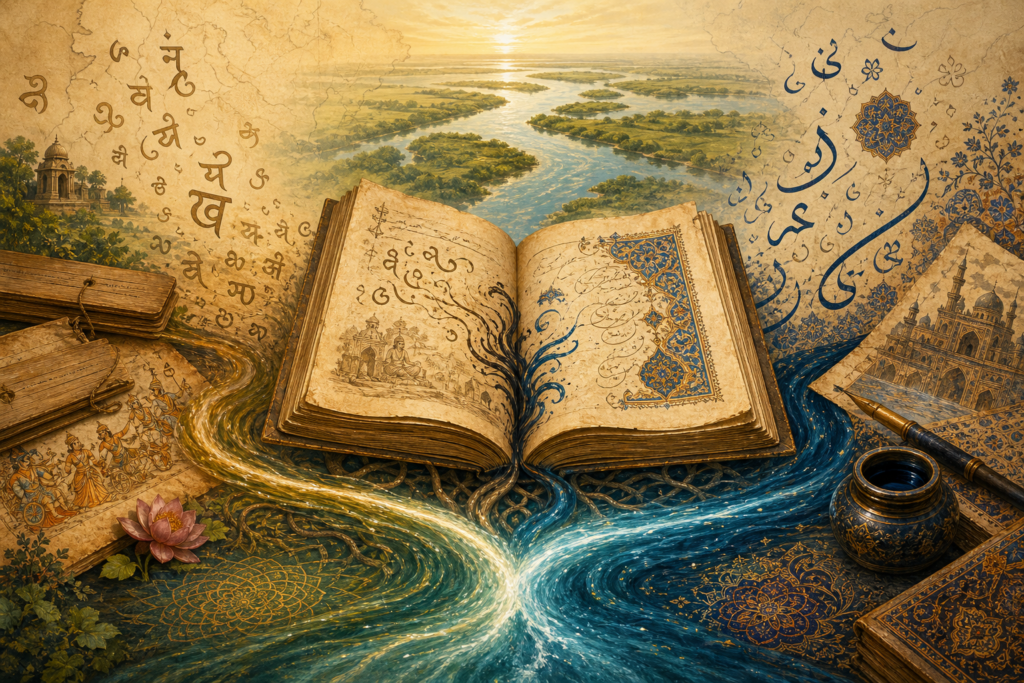
The question of Sanskrit is central to this debate. Sanskrit is not only a liturgical language; it is a major civilizational archive. It carries texts on grammar, logic, ritual, poetry, law, medicine, astronomy, aesthetics, philosophy, polity, and metaphysics. A society disconnected from Sanskrit is not merely separated from religious texts. It is separated from a large part of its intellectual memory. At the same time, Sanskrit must not be positioned against India’s regional languages. A responsible cultural vision would strengthen Sanskrit, Pali, Prakrit, Tamil, Kannada, Telugu, Bengali, Marathi, Punjabi, Assamese, Odia, Malayalam, and other languages as living gateways into India’s many knowledge traditions.
The colonial period intensified this separation. British educational policy did not invent all of India’s internal challenges, but it did reshape the prestige economy of knowledge. English education became a path to administration, employment, and elite recognition. Indigenous knowledge systems were often treated as inferior unless validated by European categories. Over time, this produced a class that could speak fluently about Europe’s intellectual history while knowing little about India’s own debates on consciousness, ethics, statecraft, aesthetics, ecology, and social duty. The problem was not the learning of English or Western thought; both have enriched India in important ways. The problem was the internalization of a hierarchy in which Indian knowledge appeared provincial and Western knowledge appeared universal.
Post-Independence India inherited this tension. The Constitution created a democratic republic committed to liberty, equality, pluralism, and civic rights. The word “secular” was formally inserted into the Preamble by the Forty-second Amendment in 1976, but the ethical challenge of secular governance existed from the founding moment itself. Indian secularism cannot be understood simply as hostility to religion. In practice, it has involved the difficult task of ensuring equal citizenship among communities while preventing the state from becoming an instrument of sectarian domination. This principle is compatible with civilizational literacy. A secular India does not need to be an amnesiac India.
The second vision begins from that distinction. It argues that India’s future cannot be de-linked from its civilizational past. It does not require the state to impose belief, ritual, or sectarian identity. Rather, it calls for the recovery of knowledge: the study of Indian civilization, Dharma traditions, philosophical inquiry, sacred literature, historical institutions, and cultural practices with seriousness and academic rigor. In this view, Bharatiyata is not a narrow slogan but a civilizational sensibility: a way of understanding India as a living continuum of memory, plurality, responsibility, and spiritual experimentation.
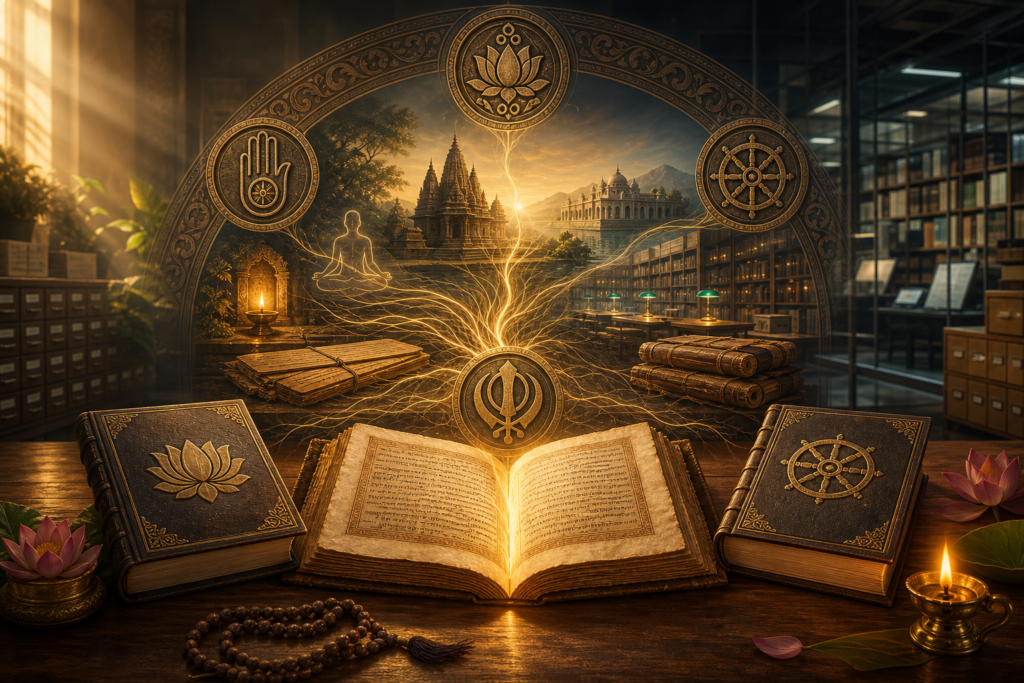
This recovery must be especially attentive to the unity of Dharmic traditions. Hinduism, Buddhism, Jainism, and Sikhism are distinct traditions with their own scriptures, lineages, disciplines, metaphysics, and historical experiences. They should not be flattened into one identity. Yet they share a civilizational space shaped by concepts such as Dharma, karma, liberation, self-cultivation, non-violence, renunciation, service, discipline, debate, and reverence for realized wisdom. Their differences are real, but their long coexistence has produced a family of traditions whose intellectual and ethical resources remain vital for India and the world.
The original political context of this debate became especially visible around the 2014 general election. Sonia Gandhi’s appeal to the idea of India and “Bharatiyata” reflected the language of cultural legitimacy in a moment of national churn. The rise of the Bharatiya Janata Party and its allies was interpreted in different ways. For some observers, it reflected a growing desire to restore cultural confidence and correct perceived distortions in education, history, and public discourse. For others, it was a reaction against corruption, policy paralysis, and governance failures associated with the UPA period. A balanced assessment recognizes that both elements were present: electoral change often combines cultural aspiration, institutional dissatisfaction, economic expectation, and leadership preference.
However, cultural recovery cannot be reduced to party politics. Political parties may express, exploit, distort, or institutionalize civilizational concerns, but they do not own civilization. India’s heritage is older than the Congress, older than the BJP, and larger than any electoral coalition. The deeper question is whether schools, universities, families, temples, gurudwaras, monasteries, libraries, research institutes, and public intellectuals can create conditions in which citizens encounter their inheritance with honesty. The goal should not be propaganda in reverse. It should be knowledge replacing ignorance, context replacing caricature, and inquiry replacing inherited contempt.
This distinction matters because the phrase “engineered forgetting” carries a serious charge. There has indeed been a long pattern in which many Indians encountered their own civilization through categories shaped by colonial administration, missionary critique, Marxist historiography, or postcolonial embarrassment. Yet the remedy cannot be a simplistic counter-mythology. A mature civilizational project must welcome evidence, philology, archaeology, textual criticism, comparative philosophy, and social history. It must be willing to study both glory and failure. It must recover Nalanda and Kashi, but also examine social exclusion; honor temple architecture, but also study economic institutions; celebrate the Bhagavad Gita, the Upanishads, the Guru Granth Sahib, the Dhammapada, and Jain Agamas, while allowing rigorous debate over interpretation.
Education is therefore the decisive field. If India’s civilizational memory has been weakened through curricula, language policy, and elite cultural habits, then the recovery of memory must also move through education. This does not mean turning classrooms into sites of political instruction. It means building a serious, multi-level curriculum on Indian civilization and culture. Students should encounter primary texts in translation and, where possible, in original languages. They should learn how Indian thinkers approached consciousness, logic, grammar, ecology, kingship, ethics, aesthetics, mathematics, medicine, and liberation. They should also learn how traditions disagreed with one another, because debate is one of the great signatures of Indian intellectual life.
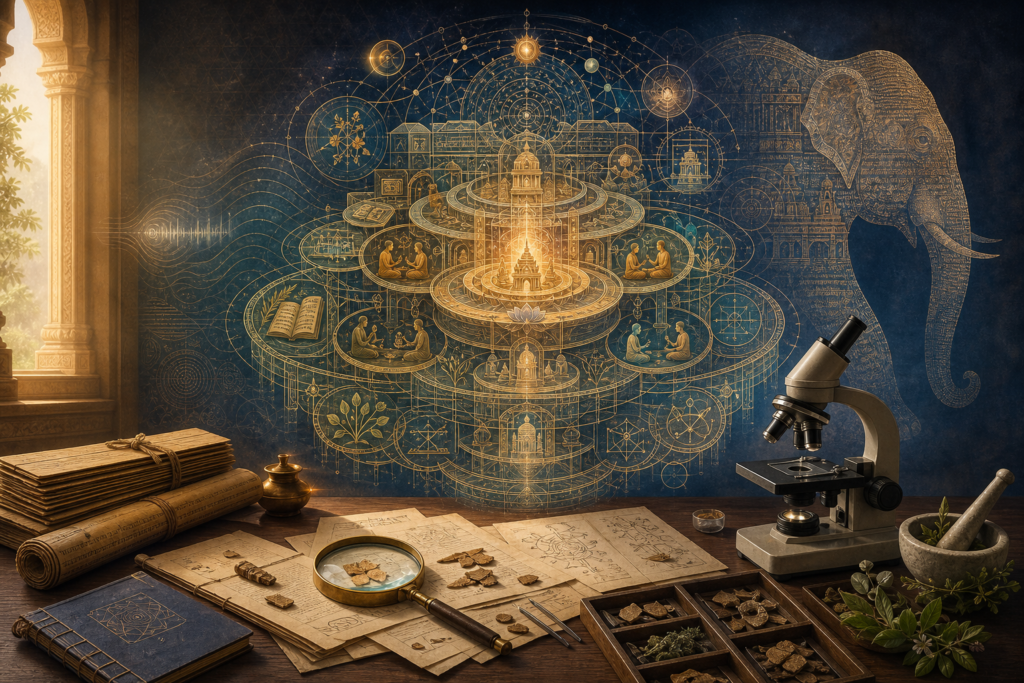
A technical approach to curriculum reform would require several layers. At the school level, cultural literacy should be age-appropriate and non-sectarian, introducing students to epics, ethical dilemmas, festivals, languages, geography, and civilizational themes. At the undergraduate level, Indian Knowledge Systems should be taught through interdisciplinary modules connecting history, philosophy, linguistics, science, art, law, ecology, and political thought. At the postgraduate and research level, universities should support philology, manuscriptology, archaeology, digital humanities, comparative theology, Sanskrit studies, Buddhist studies, Jain studies, Sikh studies, and regional intellectual histories. Such a framework would allow students to study Indian civilization with rigor rather than sentiment alone.
The National Education Policy 2020 made Indian Knowledge Systems, multilingual education, and cultural rootedness part of the national educational conversation. Its implementation remains uneven and debated, as any major education reform in a diverse federal country will be. Nevertheless, the direction is significant. It indicates that cultural memory is no longer only a matter of private devotion or ideological argument. It has become a policy question: how should a modern republic teach its citizens about the civilization that shaped its languages, ethics, arts, institutions, and social imagination?
Good governance and development remain indispensable. Roads, sanitation, energy, employment, public health, digital infrastructure, national security, and economic growth are not secondary concerns. A hungry citizen cannot be sustained by civilizational rhetoric. A young graduate without opportunity cannot live on heritage alone. Yet development without cultural self-knowledge can produce a society that is materially ambitious but spiritually insecure. The central challenge is integration. India must build world-class infrastructure and institutions while also restoring civilizational confidence. Development and Dharma need not be rivals when Dharma is understood as responsibility, balance, ethical order, and the pursuit of human flourishing.
Families occupy a crucial place in this recovery. National identity is not formed only through policy documents; it is formed through stories told at home, languages spoken across generations, festivals observed with meaning, books placed in the hands of children, and the dignity with which elders explain inherited practices. Many Indian families experience a quiet fracture: grandparents may live in one symbolic world, parents in another, and children in a third. The result is not always rebellion; often it is confusion. A child may participate in a ritual without understanding it, reject a custom without studying it, or inherit pride without knowledge. Civilizational education must therefore move beyond slogan and sentiment into explanation.
This is also where secularism becomes more meaningful, not less. A genuinely secular society should allow every family and individual to make informed choices about heritage. Some may become practitioners, some scholars, some reformers, some critics, and some respectful observers. What weakens secularism is not knowledge of Dharma traditions, but ignorance combined with political labeling. When citizens know little about their own traditions, public debate becomes vulnerable to fear, caricature, and manipulation. When citizens study traditions seriously, they are better equipped to distinguish spiritual insight from political abuse, cultural continuity from majoritarian excess, and reform from deracination.
The recovery of India’s civilizational past must also be plural in method. Temples, monasteries, gurudwaras, Jain derasars, libraries, universities, museums, and digital archives all have roles to play. Manuscripts need preservation and translation. Regional histories need careful documentation. Oral traditions need recording before they disappear. Local temple economies, pilgrimage routes, craft lineages, classical arts, folk performance, and village institutions deserve study alongside imperial courts and modern political movements. A civilization is not preserved only by celebrating kings and battles; it is preserved by understanding the everyday forms through which people carried meaning across centuries.
At the same time, civilizational recovery must avoid contempt for the modern world. Science, constitutionalism, gender justice, technological innovation, global commerce, and democratic rights are not foreign impurities. They are now part of India’s lived reality and must be engaged creatively. The better question is not whether India should modernize, but how. A nation can modernize by imitating external models with insecurity, or it can modernize through dialogue between inherited wisdom and contemporary need. The latter path is harder, but it is also more intellectually honest.
The two visions of India, then, are not merely two campaign narratives. They represent two theories of national renewal. One seeks confidence through distance from the past; the other seeks confidence through critical continuity with the past. The first fears that memory may imprison India. The second fears that forgetting may empty India of meaning. A mature national conversation should recognize the valid concerns on both sides while rejecting their extremes. India should neither romanticize every inheritance nor despise its own civilizational foundations.
The most constructive path is civilizational literacy within a democratic and plural framework. That means teaching India’s history without shame and without exaggeration. It means restoring Sanskrit and other classical languages without diminishing living regional languages. It means studying Hindu Dharma alongside Buddhist, Jain, and Sikh traditions in a spirit of respect. It means recognizing that Bharatiyata is strongest when it is capacious, ethical, and rooted in knowledge. It means accepting that political power may open opportunities, but cultural renewal depends on institutions, scholarship, families, teachers, and disciplined public conversation.
India’s future will not be secured by development alone, nor by memory alone. It will require a synthesis: good governance joined to civilizational understanding, economic progress joined to ethical reflection, national confidence joined to pluralism, and secular citizenship joined to cultural literacy. The real task is not to force citizens into one interpretation of the past, but to ensure that they are not deprived of the knowledge needed to evaluate that past for themselves. In that sense, the study of Indian civilization and culture in schools, colleges, and institutions of higher learning is not a backward-looking project. It is a necessary foundation for India’s recovery, unity, and progress.
Inspired by this post on Dharma Civilization Foundation.



Leave a Reply
You must be logged in to post a comment.