
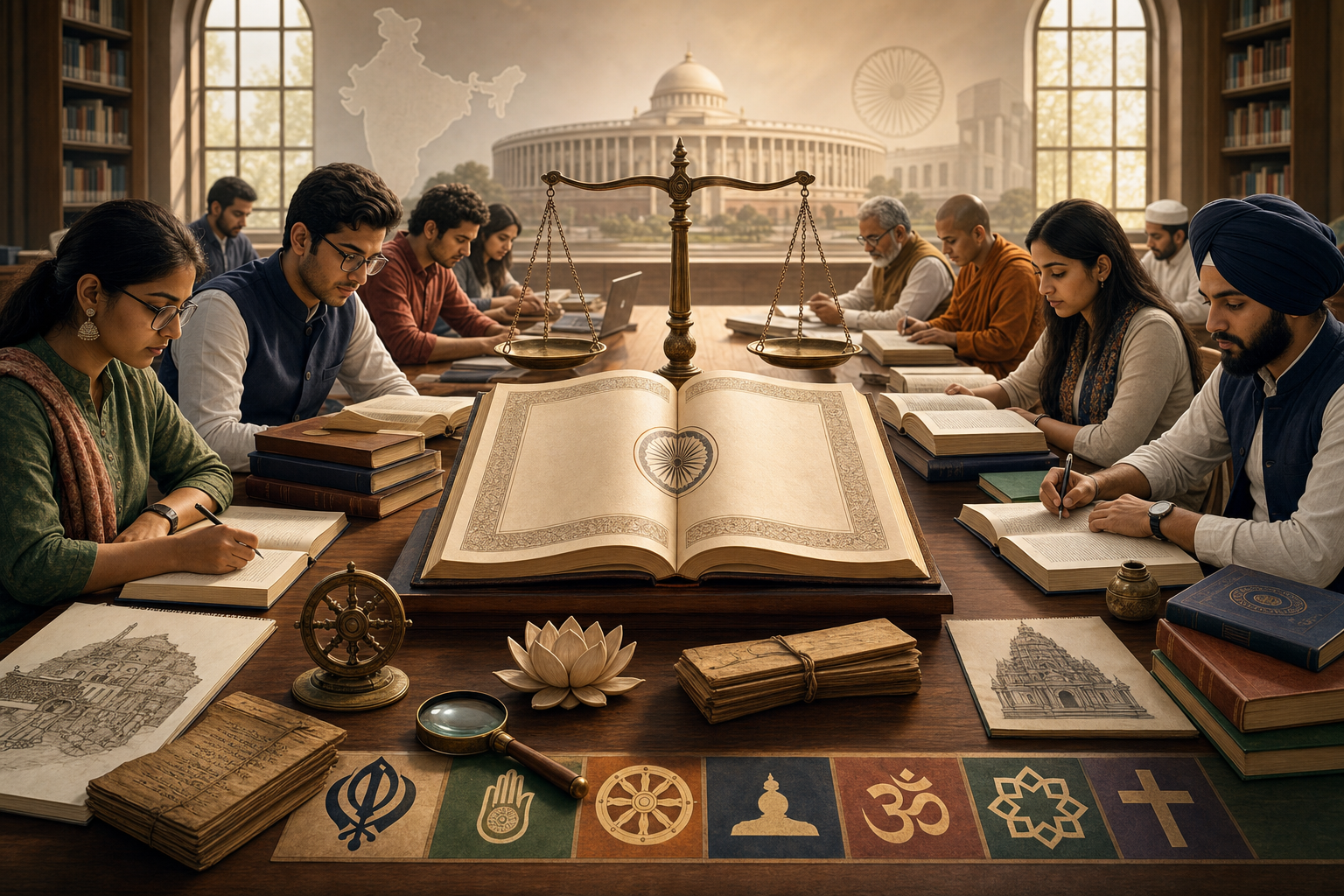
Article 28 of the Indian Constitution sits at the centre of a difficult and often misunderstood debate about Indian secularism, state-funded education, and the academic study of religion. Clause (1) states that “No religious instruction shall be provided in any educational institution wholly maintained out of State funds”. Read casually, this line appears to create an absolute wall between religion and public education. Read more carefully, however, it raises a more technical question: does the Constitution prohibit religious instruction, or does it also discourage the scholarly study of religion as history, philosophy, civilization, language, ethics, and culture?
This distinction matters because religious instruction and religious studies are not the same thing. Religious instruction usually means teaching a doctrine devotionally, with the expectation that students internalize or practice it. Religious studies, by contrast, is an academic discipline. It examines texts, institutions, rituals, languages, ethics, social movements, historical change, theology, art, architecture, philosophy, and civilizational memory. A university course on the Bhagavad Gita, the Guru Granth Sahib, the Agamas, Buddhist philosophy, Jain ethics, or Islamic intellectual history need not be an act of religious preaching. It can be a disciplined intellectual inquiry into traditions that have shaped human life for centuries.
The confusion becomes sharper when Indian public universities are compared with major universities in the Western world. The University of California, Santa Barbara, a publicly funded institution, has long been known for a major Department of Religious Studies. Its academic field includes areas such as Buddhist Studies, Christian Studies, East Asian religions, Islamic Studies, Mediterranean religions, Native American religions, philosophy of religion, religion and culture, religions in North America, and South Asian religions. The essential point is not that India should mechanically copy an American model. The point is that a secular state can fund rigorous study of religion without turning the state into a religious authority.
Many public universities in the United States and Europe have departments of religion, theology, divinity, or religious studies. Oxford has a Faculty of Theology and Religion. The School of Oriental and African Studies in London has historically supported serious scholarship on Asian, African, and Middle Eastern religious traditions. The American Academy of Religion brings together thousands of scholars who study religion across disciplines. In these systems, secularism is generally understood as state neutrality toward religion, not state indifference to religious knowledge. Religion remains a legitimate object of academic study because societies cannot be understood without understanding the traditions that formed them.
India’s situation is more sensitive because religion is not merely a private belief system in the Indian context. Dharma traditions have shaped philosophy, kingship, aesthetics, law, grammar, music, mathematics, pilgrimage, temple culture, ecology, family life, and social ethics. Hinduism, Buddhism, Jainism, and Sikhism are not isolated compartments in civilizational history. They have debated one another, borrowed from one another, disagreed with one another, and enriched one another. A student who cannot academically study these traditions in a serious public institution is deprived of a major key to Indian civilization.
The case of Jamia Millia Islamia makes the constitutional puzzle more visible. Jamia Millia Islamia is a Central University, and its Department of Islamic Studies describes Islamic Studies as an inquiry into the broad range of Islamic civilization and culture, including religion, socio-economic structure, administration, sciences, thought, cultural life, cosmology, mysticism, literature, and fine arts. The department’s own academic description notes that Islamic Studies has been part of Jamia’s curriculum since its inception in 1920, that a separate multidisciplinary department was created in 1975, and that a full-fledged Department of Islamic Studies emerged in 1988. It offers undergraduate, postgraduate, and doctoral study in areas such as History of Muslim Civilization, Islamic Religious Sciences: The Quran, Hadith, Fiqh, Tasawwuf, Muslim Sects and Kalaam, Muslim Philosophy, Islam in India, Major World Religions, and medieval Muslim contributions to science, technology, and fine arts.
There is nothing inherently objectionable about a public university studying Islam in this way. On the contrary, such study can be academically valuable when conducted with intellectual rigor, historical method, linguistic competence, and openness to debate. The constitutional concern arises when comparable academic space is not consistently available for Hindu Studies, Buddhist Studies, Jain Studies, Sikh Studies, Sanskrit knowledge systems, temple studies, and broader Dharmic civilizational studies in publicly funded institutions. The issue is not that one tradition is studied. The issue is whether a plural republic should support all major civilizational traditions with comparable seriousness and fairness.
Article 28(2) provides one important exception to the rule in Article 28(1). It says that nothing in clause (1) shall apply to an educational institution administered by the State if that institution was established under an endowment or trust requiring that religious instruction be imparted there. Article 28(3) adds another safeguard: no student in a State-recognized or State-aided institution can be compelled to take part in religious instruction or worship without consent, or without guardian consent in the case of a minor. These clauses show that the Constitution did not imagine every relationship between religion and education as unconstitutional. It attempted to balance state neutrality, institutional history, donor intent, and individual freedom of conscience.
Article 30 adds another layer. Article 30(1) states that “All minorities, whether based on religion or language, shall have the right to establish and administer educational institutions of their choice”. Article 30(2) states that the State shall not, while granting aid, discriminate against an educational institution on the ground that it is under minority management. These provisions were designed to protect vulnerable communities from cultural erasure and majoritarian uniformity. They are part of India’s constitutional promise that linguistic and religious minorities may preserve their inheritance through education.
Yet Article 30 also creates a practical asymmetry that deserves calm examination. Minority communities are explicitly protected in their right to establish and administer institutions of their choice and to receive State aid without discrimination. The Constitution does not explicitly say that the majority community is forbidden from establishing educational institutions rooted in its own civilizational inheritance. Nor does it say that State aid must be denied to institutions that study or transmit majority traditions. The constitutional text is protective toward minorities, but that protection should not be converted into intellectual exclusion for the civilizational traditions followed by the majority of Indians.
A fair reading must therefore avoid two extremes. One extreme treats secularism as suspicion toward religion itself, especially toward Hindu, Buddhist, Jain, and Sikh knowledge traditions in public education. The other extreme treats education as a vehicle for sectarian assertion. Neither is adequate for a civilizational republic. A more mature approach would distinguish devotional instruction, academic study, comparative inquiry, and cultural literacy. It would protect every student’s conscience while allowing public institutions to study India’s religious and philosophical traditions with seriousness.
The absence of robust Hindu Studies in many public institutions is not a small curricular gap. It affects how generations understand Indian history, Indian philosophy, temple architecture, Sanskrit literature, Vedanta, Mimamsa, Yoga, Shaiva and Vaishnava traditions, Shakta traditions, Bhakti movements, regional devotional cultures, and the intellectual exchanges among Hindu, Buddhist, Jain, and Sikh thinkers. When these subjects are ignored or treated only through political controversy, students encounter their own inheritance as either mythology without method or ideology without depth. That is a loss for scholarship, not merely for religious communities.
Dharmic traditions also cannot be responsibly studied through a narrow sectarian lens. Hinduism, Buddhism, Jainism, and Sikhism share civilizational vocabulary while retaining distinct doctrines, practices, texts, and historical trajectories. They have contributed to ideas of ahimsa, karma, liberation, discipline, devotion, seva, meditation, philosophical debate, and ethical self-cultivation. A university committed to Indian Education should be able to teach these traditions comparatively and respectfully, without flattening their differences and without using one tradition against another. Such study would strengthen unity among Dharmic communities by replacing suspicion with knowledge.
The emotional force of this issue comes from a familiar educational experience. Many students pass through years of schooling with some exposure to European political theory, Abrahamic religious history, colonial categories, and modern social science, but with little structured access to Indian philosophical systems or Dharmic textual traditions. The result is often a strange alienation: students may know fragments of their inherited practices at home, but they lack the academic language to understand those practices in public. A serious curriculum would not demand belief. It would provide vocabulary, context, and intellectual dignity.
This is where the distinction between “instruction” and “study” becomes constitutionally decisive. A State-funded university should not compel students to worship, recite, confess, or accept a doctrine as a condition of education. But a State-funded university can teach the history of Vedic literature, the philosophy of the Upanishads, Buddhist epistemology, Jain logic, Sikh ethics, the development of temple institutions, the role of monasteries, the history of pilgrimage, the evolution of Sanskrit and Prakrit intellectual cultures, and the relationship between Dharma and society. Such teaching is not religious coercion. It is civilizational literacy.
Article 28 should therefore be understood with precision. Its core concern is the prevention of compulsory or State-sponsored religious indoctrination in institutions wholly maintained by public funds. It need not be read as a ban on the academic study of religion. Indeed, reading it as a ban on religious studies would create an impoverished university system, especially in a country where religious and philosophical traditions have been central to literature, law, aesthetics, social reform, and political imagination. A secular Constitution should not require public ignorance of religion.
The endowment and trust exception in Article 28(2) is also worth examining carefully. If an institution was established under a trust or endowment requiring religious instruction, and if the State administers it, Article 28(1) does not apply in the same way. This clause suggests that founders’ intent, institutional character, and historical purpose can matter. For Dharmic educational initiatives, the question is whether properly structured trusts, endowments, and university centres can support rigorous study of Hindu Studies and allied Dharmic traditions while remaining compliant with constitutional safeguards, academic standards, and student consent requirements.
Any such initiative must be academically credible. It cannot be a slogan attached to a department name. It would need trained scholars, language competence, peer-reviewed research, critical editions, manuscript work, archaeology, philosophy, history, comparative theology, sociology, art history, and engagement with living traditions. A strong Hindu Studies or Dharmic Studies programme should welcome debate, including internal debate among different sampradayas and darshanas. The dignity of Dharma does not depend on avoiding questions. It is strengthened when questions are addressed with intellectual discipline and fairness.
The policy goal should therefore be parity, not resentment. If Islamic Studies, Christian Studies, Buddhist Studies, or other religious traditions can be studied in public or State-aided institutions as academic subjects, then Hindu Studies, Jain Studies, Sikh Studies, and broader Dharmic Studies should also be supported where there is scholarly demand and institutional capacity. The argument is not for reducing the study of any tradition. It is for expanding India’s academic imagination so that the country’s own civilizational inheritance is not treated as unsuitable for serious public knowledge.
This also aligns with the deeper promise of Indian secularism when properly understood. Indian secularism has never been identical to a total exclusion of religion from public life. It has often meant principled engagement, reform, distance, and equal respect. The Constitution protects freedom of conscience under Article 25, denominational rights under Article 26, protection from tax compulsion for a particular religion under Article 27, and safeguards around religious instruction under Article 28. Articles 29 and 30 then protect cultural and educational rights. Together, these provisions form a complex architecture, not a simple command to erase religion from education.
For Indian Education, the constructive path is clear. Public universities should develop transparent criteria for religious studies programmes: academic method, non-compulsion, openness to students of all backgrounds, respect for constitutional morality, and clear separation between scholarship and sectarian recruitment. They should also build departments and centres that study Dharmic traditions in their own categories, not only through inherited colonial frameworks. This would allow Indian students to encounter Dharma, Buddhism, Jainism, and Sikhism as living intellectual traditions with textual depth, historical complexity, and ethical relevance.
The constitutional question, then, is not whether India should become less secular in order to study religion. The question is whether Indian secularism can become more intellectually confident. A confident secularism does not fear the study of the Vedas, the Agamas, the Puranas, the Tripitaka, Jain Agamas, the Guru Granth Sahib, Bhakti literature, temple inscriptions, philosophical commentaries, or the social history of religious communities. It studies them with care, compares them honestly, and protects every student’s freedom of conscience.
The debate around Article 28 and Article 30 should therefore move beyond accusation and defensiveness. It should ask how constitutional safeguards can support fairness, cultural continuity, and academic excellence at the same time. India does not need a public education system that preaches one religion. It needs a public education system mature enough to study all major traditions, including Dharmic traditions, with rigor and respect. That approach would reduce constitutional confusion and build a more rooted, informed, and united civilizational future.
Inspired by this post on Dharma Civilization Foundation.






Leave a Reply
You must be logged in to post a comment.