

The celebrated Hindu expression “Truth is one. Paths are many.” is often invoked as a compact summary of religious pluralism, interfaith respect, and the spiritual generosity of Sanatana Dharma. A related formulation, “Truth is one. Sages call it by many names,” is equally familiar in Hindu discourse. Both sayings have become widely used because they speak to a deeply human experience: sincere seekers may differ in language, ritual, theology, and inherited tradition, yet they often sense that their search is not random or meaningless. It is directed toward what may be called ultimate reality, sacred truth, divine presence, or the deepest ground of existence.
The Sanskrit source behind these popular renderings is Rig Veda 1.164.46, a verse whose language deserves careful attention. The phrase is:
ekaṁ sad viprā bahudhā vadanti
There is one (ekam) Reality (sat)
about which vibrant persons (viprā)
in various ways (bahudhā) speak (vadanti).
This translation brings out an important nuance. The Sanskrit line does not literally contain the words “paths” or “names.” Those popular English renderings are interpretive summaries, not strict translations. Yet they are not meaningless distortions. They attempt to communicate the verse’s broader insight: there is one Reality, and human beings, especially those touched by spiritual insight, speak about that Reality in multiple ways.
For Hindu philosophy, this distinction matters. A loose rendering may inspire devotion, but a careful reading can deepen understanding. Ekaṁ points to oneness. Sat points to being, reality, or what truly is. Viprā refers not merely to intellectuals, but to inspired persons, those who are inwardly stirred or awakened. Bahudhā means manifoldly, in many ways, or in many forms. Vadanti means they speak. The verse is therefore not a shallow slogan of sameness. It is a profound statement about unity, diversity, revelation, and language.
The insight is especially valuable for understanding Dharmic traditions. Hinduism itself contains many sampradayas, darshanas, forms of worship, philosophical positions, devotional moods, and ritual cultures. Buddhism, Jainism, and Sikhism also preserve distinct spiritual disciplines, metaphysical frameworks, ethical practices, and communities of memory. A mature Dharmic approach to unity does not flatten these traditions into one vague system. It allows difference to remain visible while recognizing that spiritual life is often animated by a shared seriousness about truth, liberation, discipline, compassion, devotion, and moral transformation.
Rig Veda 1.164.46 offers a framework for dialogue precisely because it avoids two common errors. It does not say that all religious claims are identical. It also does not imply that difference must produce hostility. Instead, it suggests that one Reality may be approached, experienced, named, contemplated, loved, debated, and expressed through many forms of insight. This allows religious diversity to be treated not as a problem to be eliminated, but as a field in which deeper understanding can emerge.
The first element in this framework is the affirmation of “one Reality.” Whatever a person believes, rejects, worships, studies, or struggles to understand exists within a single totality of reality. This is not merely a theological claim; it is also an existential observation. Human beings share one world. They experience birth, longing, loss, duty, love, mortality, hope, and the search for meaning. Religious traditions give these experiences different forms of interpretation, but the field of existence in which they arise is shared.
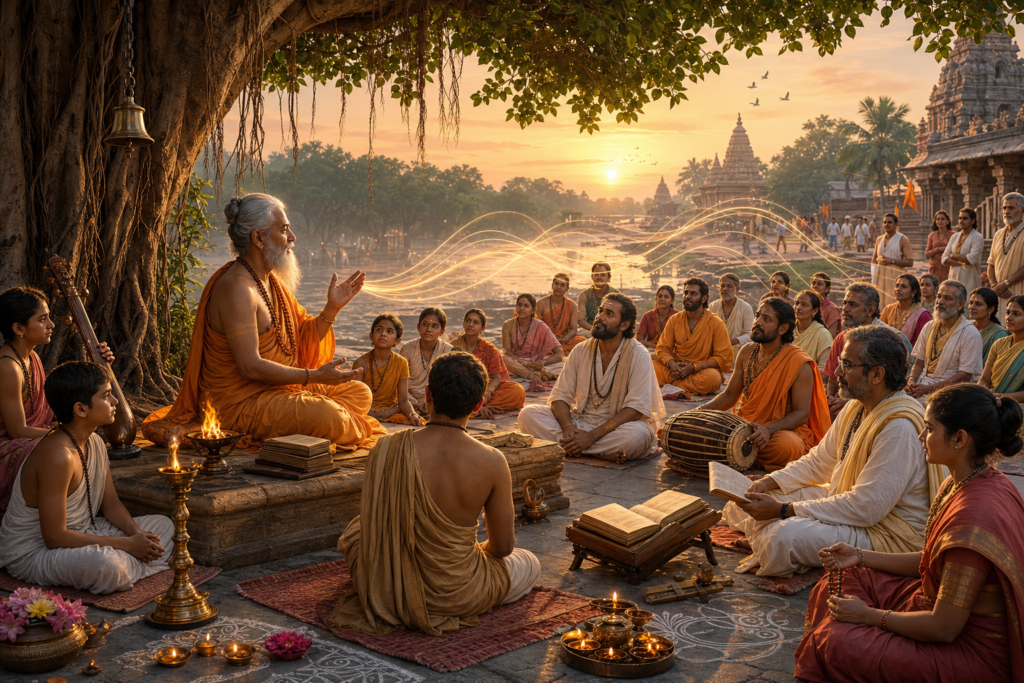
The second element is the role of the viprā, the inspired or vibrant persons who speak from an encounter with reality. The word suggests more than formal learning. It evokes those who have been moved, shaken, or made inwardly alive by contact with the sacred. In every Dharmic tradition, such persons appear in different forms: rishis, acharyas, gurus, bhaktas, munis, sadhus, monks, saints, philosophers, poets, and householders whose lives become luminous through practice. Their speech is not merely information; it carries the force of lived realization.
The third element is speech itself. The verse does not say that inspired persons remain silent before Reality, even though silence has its own revered place in Indian spirituality. It says they speak. They teach, sing, debate, narrate, compose, remember, and transmit. Vedic mantras, Upanishadic dialogues, Bhagavad Gītā teachings, Jain agamas, Buddhist sutras, Sikh shabad, bhakti poetry, and philosophical commentaries all testify to this sacred labor of expression. Language becomes a bridge between inner realization and shared culture.
The fourth element is plurality. Inspired persons speak bahudhā, in many ways. This word is crucial for religious pluralism. Human beings do not experience the sacred with identical temperaments, histories, questions, or capacities. Some approach through devotion, some through inquiry, some through meditation, some through seva, some through renunciation, some through ethical discipline, some through ritual, some through scriptural study, and some through a quiet transformation of daily life. The diversity of expression reflects the diversity of relationship.
This point becomes especially significant when placed beside Bhagavad Gītā 4.11, where Śrī Krishna declares:
In the way they offer themselves to me, in just that way I offer my love to them reciprocally.
Human beings follow my path universally, O Pārtha.
The verse presents divine response as relational and reciprocal. It does not reduce spiritual life to mechanical uniformity. Rather, it acknowledges that the divine meets beings according to the manner of their offering, disposition, and approach. The word “path” appears in the singular in this translation, which is theologically important. The many forms of religious life may be understood not as disconnected routes in a competitive marketplace of belief, but as manifold engagements with the single field of divine reality.
In the Chaitanya school of Vaishnavism, this relational dimension reaches one of its most refined theological expressions through the concept of rasa. The term has a long and complex history in Indian thought. In aesthetic theory, rasa refers to relishable essence, flavor, or the deeply felt emotional savor of an experience. In the devotional theology associated with Rūpa Gosvāmin and the Chaitanya tradition, rasa becomes a way of describing the soul’s living relationship with Bhagavan, especially in relation to Krishna.
The Upanishadic phrase raso vai saḥ, from the Taittirīya Upanishad, becomes especially meaningful in this context. “Rasa truly is that (Reality)” suggests that ultimate reality is not a cold abstraction. It is not merely an object of analysis. It is also the ground of bliss, relationship, and fulfillment. When a person reaches that rasa, the tradition says, one becomes deeply joyful. This is why devotional traditions treat truth not only as a proposition to be defended, but as a relationship to be lived.
The Chaitanya school classically speaks of five principal devotional rasas, or relational moods, through which the devotee relates to the divine. Yet the broader idea can be used carefully to illuminate the wider theme of religious dialogue. Human beings do not merely hold doctrines; they inhabit relationships with what they regard as ultimate. A person’s “truth” is often inseparable from reverence, discipline, memory, longing, surrender, and ethical commitment. This is why sincere religious conversation can feel deeply personal even when it is conducted in scholarly language.
From this perspective, a refined restatement of the popular Vedic adage might be: “The totality of all reality is one. Religious truths, or rasas, are many.” This does not mean that every claim is equally precise, equally coherent, or equally compatible with every other claim. Academic honesty requires careful distinctions. It means that human relationships with ultimate Reality may be manifold, and these relationships generate different languages of truth, devotion, practice, and realization.
This insight has practical value in an age marked by polarization. Many religious disputes arise not only from doctrinal disagreement, but from the fear that another person’s sacred language threatens one’s own. The Vedic vision offers a more disciplined response. It asks whether another tradition’s expression may reveal a dimension of longing, discipline, surrender, compassion, or wisdom that deserves to be heard. Listening, in this sense, is not weakness. It is a form of intellectual humility and spiritual maturity.
Such listening is central to unity among Dharmic traditions. Hinduism, Buddhism, Jainism, and Sikhism have distinct histories and cannot be responsibly collapsed into one another. Their views on self, liberation, God, karma, ritual, scripture, and community may differ substantially. Yet they share civilizational conversations shaped by tapas, dharma, karma, ahimsa, meditation, liberation, devotion, discipline, and the transformation of the human person. Dialogue among them is most fruitful when it is neither defensive nor careless, but reverent, precise, and historically aware.
Intra-faith dialogue is the first training ground for such maturity. Within Hindu Dharma itself, Shaiva, Vaishnava, Shakta, Smarta, Vedantic, Yogic, Tantric, and folk traditions have long interacted through debate, adaptation, shared pilgrimage, philosophical disagreement, and ritual coexistence. The same principle applies within Buddhism, Jainism, and Sikhism, where internal diversity has also produced rich traditions of interpretation. A community that cannot listen within itself will struggle to listen across traditions.
Interfaith dialogue becomes meaningful when it grows from depth rather than vagueness. The goal is not to abandon conviction for politeness. Nor is it to weaponize conviction against others. Genuine dialogue happens when rooted persons speak with other rooted persons. Each participant brings a disciplined relationship with truth, not a thin performance of tolerance. In that meeting, the conversation itself can become revelatory, because something emerges between persons that no isolated monologue can produce.
This is where the emotional force of the Vedic verse becomes visible. Many seekers have experienced moments when another person’s prayer, chant, meditation, seva, or ethical courage awakens respect even across doctrinal boundaries. A Sikh kirtan, a Jain vow of non-violence, a Buddhist meditation practice, a Hindu puja, or a Vaishnava kirtan may each disclose a different texture of sacred seriousness. The forms differ, but the encounter can still deepen reverence for the human search for truth.
The word bahudhā therefore carries both theological and social significance. It reminds traditions that plurality is not merely a modern political arrangement. It is already acknowledged in one of the oldest layers of Vedic literature as a feature of inspired speech about Reality. This does not remove the need for debate. Dharmic traditions have always debated rigorously. But debate need not become contempt. Difference can sharpen understanding when it is held within a larger discipline of respect.
Religious pluralism, properly understood, is not the claim that truth is subjective or that all distinctions are irrelevant. It is the disciplined recognition that the human encounter with Reality is mediated through language, practice, lineage, temperament, and experience. The Vedic seer’s insight allows for both unity and precision. There is one Reality; there are many ways of speaking, many modes of relationship, and many forms of realized life.
For contemporary Hindu thought, this remains a powerful foundation. It supports interfaith understanding without dissolving Hindu categories into generic spirituality. It affirms Vedic wisdom while allowing later traditions, including the Chaitanya school of bhakti, to unfold the relational depth of that wisdom. It also offers a framework for Dharmic solidarity, where shared civilizational values can be honored without denying real philosophical differences.
The deepest implication may be that truth is not exhausted by possession. A tradition may preserve profound truth, but the living experience of that truth must be renewed through practice, humility, and dialogue. When communities speak only to defend themselves, speech contracts. When they speak from realization, speech becomes luminous. The viprā are not merely those who argue about Reality, but those whose contact with Reality makes them vibrant enough to speak in ways that awaken others.
The phrase ekaṁ sad viprā bahudhā vadanti thus remains more than a slogan of tolerance. It is a demanding spiritual and intellectual principle. It asks for fidelity to truth, seriousness about language, respect for plurality, and openness to the revelations that arise when sincere seekers meet. In that meeting, religious diversity need not weaken unity. It can become the very place where unity is tested, refined, and made visible.
The many truths of the one Reality are not fragments scattered in isolation. They are living relationships, spoken through many traditions, disciplines, and hearts. When approached with clarity, humility, and devotion, they can strengthen Dharmic unity, deepen interfaith dialogue, and remind modern seekers that the search for ultimate truth is both intensely personal and profoundly shared.
References
Rig Veda 1.164.46, especially the phrase ekaṁ sad viprā bahudhā vadanti, remains the central textual basis for this discussion of one Reality and many forms of inspired speech.
Bhagavad Gītā 4.11 is relevant for understanding divine reciprocity and the way different forms of offering are received within a unified sacred order.
The Taittirīya Upanishad 2.7.1, with its phrase raso vai saḥ, provides an important Upanishadic foundation for understanding ultimate Reality as blissful, relational, and deeply experiential.
Sir Monier Monier-Williams, Sanskrit-English Dictionary, Oxford University Press, 1899, remains a standard lexical reference for terms such as bahudhā.
Inspired by this post on Dharma Civilization Foundation.








Leave a Reply
You must be logged in to post a comment.