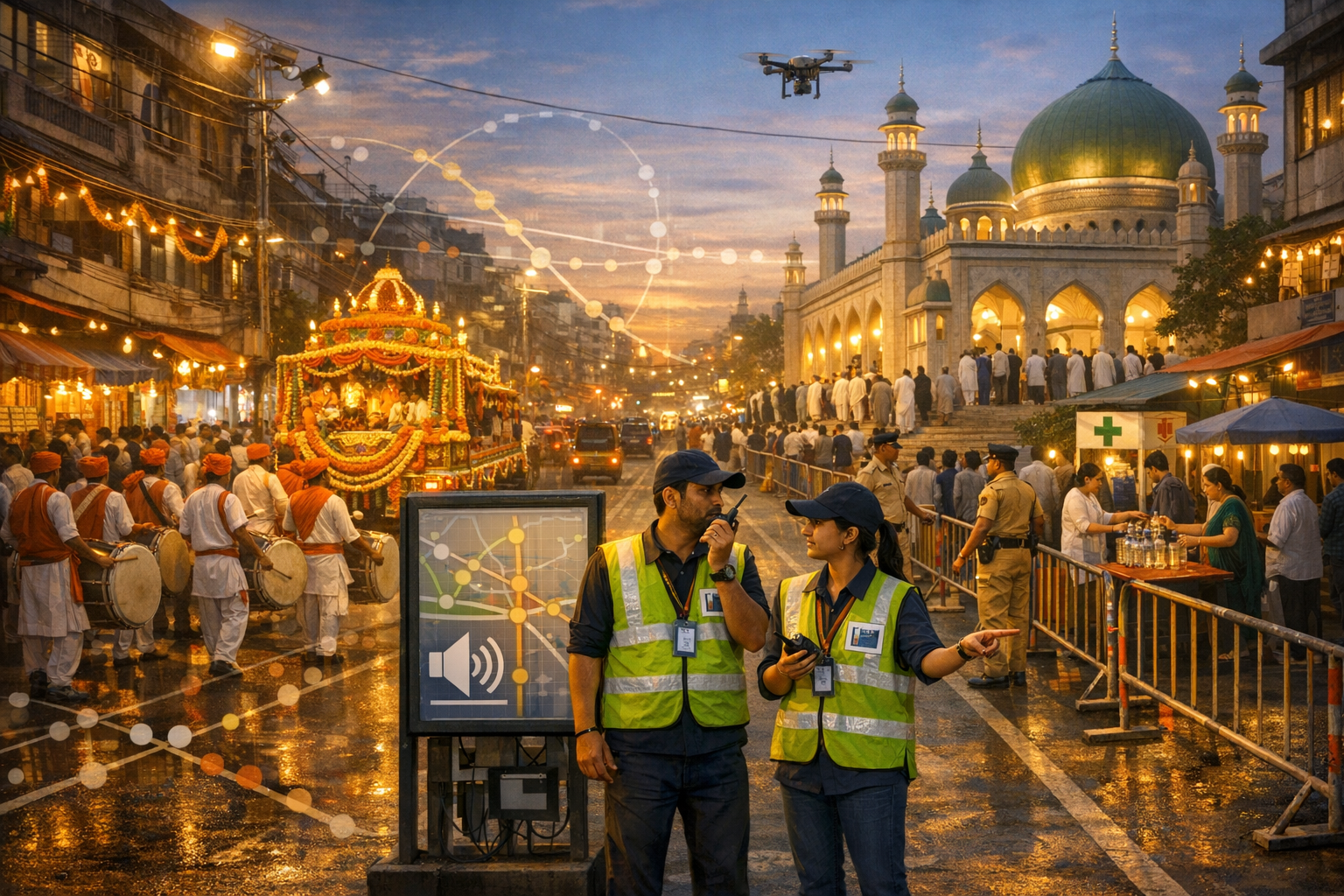
Localized confrontations were reported across three Indian states on or around 19–20 February 2026 during overlapping observances of Shivaji Jayanti and Ramzan. Police units were deployed promptly to disperse crowds, protect processions, and stabilize law and order. Preliminary accounts from local administrations described short-duration clashes along select routes, followed by rapid restoration of normalcy in most areas.
Shivaji Jayanti, commemorating the birth anniversary of Chhatrapati Shivaji, typically features cultural pageantry, dhol–tasha ensembles, historical tableaux, and community processions. The commemorations carry deep social meaning in Maharashtra and beyond, celebrating ideals of sound governance, strategic acumen, and civic protection associated with the Maratha sovereign.
Ramzan brings heightened congregational prayers, daytime fasting, and post-sunset iftar gatherings. In dense urban neighborhoods, evening footfall increases around prayer times, and local administrations often implement traffic diversions and sound-management protocols to preserve a contemplative environment near masjids.
When festival calendars overlap, three operational factors frequently converge: route alignment through religiously mixed localities, high-decibel soundscapes near prayer venues, and transient congestion at chokepoints. Most communities routinely self-regulate these frictions; confrontations generally arise from narrow windows of miscommunication, rumor propagation, or sudden crowding on constricted streets.
Event-risk analysis suggests that small triggersdisputes over procession halts, amplified music during azan, or perceived provocationscan escalate if crowd density, exit flow, and real-time communication are not managed. Crowd science emphasizes keeping density below hazardous thresholds and maintaining clear, bidirectional egress to prevent compression risks, especially at intersections and narrow lanes.
In the incidents under discussion, police interventions reportedly included rapid separation of groups, targeted detentions of alleged instigators, and temporary restrictions on assembly under standard provisions of law. These steps are consistent with established protocols such as advance bandobast planning, command-and-control through the Incident Response System, and liaison with community peace committees to safeguard communal harmony.
Disinformation dynamics play a recurrent role in communal flashpoints. Unverified images or old videos, recirculated with misleading captions, can outrun official clarifications. A standing rumor-control cell, multilingual advisories, and timely press briefings are empirically shown to truncate escalation curves and reinforce interfaith dialogue.
Attribution requires care. Assigning collective blame to entire communities obscures the narrow subset of actors responsible for disorder and erodes the social capital needed for long-term peace. The analytical focus therefore remains on proximate triggers, risk-controls, and institutional responses that protect rights while preserving order and community cohesion.
Historical memory offers constructive guidance. Sources across Maratha and Persianate chronicles note that administrative and military networks under Chhatrapati Shivaji included people of diverse backgrounds, and that protection of local shrines and civic life was integral to rajadharma. Those values align with contemporary commitments to constitutional rights, unity in diversity, and religious harmony.
A dharmic frameworkrooted in ahimsa, karuna, maitri, and seva across Hinduism, Buddhism, Jainism, and Sikhismsupplies a shared civic ethic for plural neighborhoods. These traditions encourage restraint in speech and action, stewardship of public spaces, and compassionate engagement even during disagreement. Applied to crowded festival settings, this ethic translates into neighborly conduct that reduces friction and promotes safety.
Pre-event risk mapping is foundational. Administrations and organizers can jointly classify road segments by width, frontage activity, and prior incident history; mark sensitive zones around places of worship and hospitals; and model peak loads by time-of-day. This enables evidence-based route selection and scheduling for Shivaji Jayanti pageants and Ramzan prayers without compromising devotional integrity.
Scheduling reciprocity builds trust. Where processions intersect prayer windows, temporary sound limits near masjids, brief halts for azan, and pre-notified detours acknowledge each other’s needs. This reciprocal accommodationcommunicated in advancehas repeatedly defused tension in comparable settings and strengthens Hindu–Muslim relations at the street level.
Transparent agreements reduce ambiguity. Written undertakings on sound systems, pyrotechnics, banner dimensions, and stopping pointsco-signed by local committeesprovide clarity for enforcement and predictability for residents. Public display of route maps and timings further minimizes rumor-fueled anxieties and promotes communal harmony.
Communication must be hyperlocal and continuous. Street-level wardens from mohallas and mandals, carrying visible IDs and equipped with secure messaging channels, can relay ground truth to a joint control room. Two-way, time-stamped updates about bottlenecks and deviations enable rapid, proportionate responses that preserve law and order without overreach.
Real-time safety engineering matters. Temporary lighting at dark intersections, removable barricades that preserve emergency vehicle lanes, and medical posts at congregation nodes reduce preventable harm. Where feasible, overhead observation from fixed cameras and drones enhances situational awareness while respecting privacy norms and rights.
Post-incident restoration should prioritize reconciliation. Within 24–72 hours, mixed-neighborhood meetings, fair compensation for verified losses, and transparent reviews of police action help reset trust. Documented lessons learned should feed back into standard operating procedures before the next festival cycle.
Citizen-level conduct shapes outcomes. Residents interviewed after similar events often emphasize small gestureslowering volume near prayer time, offering water during processions, and keeping storefronts open as a signal of normalcythat recalibrate crowd mood. These gestures are consistent with the dharmic spirit of mutual care and strengthen community cohesion.
Ultimately, communal harmony is an applied discipline, not a slogan. Overlapping observances such as Shivaji Jayanti and Ramzan can remain occasions of shared civic pride when risk is anticipated, protocols are co-owned, and speech remains responsible. The rapid restoration of order in the reported incidents demonstrates that timely, coordinated action works; the task ahead is to institutionalize that readiness and deepen everyday solidarities.
Inspired by this post on Struggle for Hindu Existence.