
-

Varanasi Vigilantism Allegations: Interfaith Rumors, Rule of Law, and Paths to Communal Harmony
Read more: Varanasi Vigilantism Allegations: Interfaith Rumors, Rule of Law, and Paths to Communal HarmonyAllegations of an assault in Varanasi over interfaith rumors highlight why vigilantism has no place in a constitutional democracy. This analysis explains the legal framework in Uttar Pradesh and India, including key Supreme Court judgments protecting adult autonomy and anti-lynching guidelines. It clarifies that the phrase “love jihad” lacks a legal definition and that only…
-

Oppiliappan Temple’s Sacred Vow: Vishnu’s Marriage to Bhumi Devi and the Saltless Offering
Read more: Oppiliappan Temple’s Sacred Vow: Vishnu’s Marriage to Bhumi Devi and the Saltless OfferingOppiliappan Temple at Thiruvinnagar near Kumbakonam enshrines Vishnu’s sacred marriage to Bhumi Devi and preserves a distinctive liturgical vow: all offerings are prepared without salt. This long-form study situates the temple among the 108 Divya Desams, explains the Markandeya-based sthala-purāṇa, and interprets the saltless naivedyam as a pedagogy of grace, humility, and ecological restraint. It…
-

Hard Realities of the Bengali Bhadralok: From British Raj Brokers to Mamata Banerjee’s West Bengal
Read more: Hard Realities of the Bengali Bhadralok: From British Raj Brokers to Mamata Banerjee’s West BengalThis long-form analysis offers a rigorous, non-polemical history of the Bengali Bhadralok from the late colonial period to the Trinamool era. It defines the Bhadralok as an intermediary elite shaped by British institutions yet rooted in a rich civilizational matrix, and explains why Marxist ideas resonated in Bengal’s post-famine and post-Partition moral economy. Readers gain…
-

Rakshasa Linga Explained: How Fierce Tapas Wins Shiva’s Non‑Discriminating Grace
Read more: Rakshasa Linga Explained: How Fierce Tapas Wins Shiva’s Non‑Discriminating GraceThis in-depth exploration clarifies what a Rakshasa Linga is and why it matters: a Shivalinga worshipped or installed by a Rakshasa in Purana and sthala-mahatmya traditions. It explains how Skanda Purana and Shiva Purana preserve narratives—such as Gokarna’s Atma Linga and Baidyanath Jyotirlinga—that highlight Ravana’s fierce tapas and Shiva’s impartial grace. It situates these accounts…
-

May 2026 ISKCON TV Diary: Sridhama Mayapur’s Sacred Pulse, Gaura Purnima, and TOVP’s Promise
Read more: May 2026 ISKCON TV Diary: Sridhama Mayapur’s Sacred Pulse, Gaura Purnima, and TOVP’s PromiseThe May 2026 ISKCON TV English Video Diary presents a clear, documentary-style portrait of Sridhama Mayapur and the global Hare Krishna Movement. It highlights Gaura Purnima celebrations, congregational kirtans, yajnas, pilgrimages, and temple festivals, offering an accessible primer on bhakti-yoga in practice. Viewers gain context on the Temple of the Vedic Planetarium and its educational…
-

Beyond Rivalry: Why a True Vaidika Honors Tantra and a True Tantrika Reveres the Vedas
Read more: Beyond Rivalry: Why a True Vaidika Honors Tantra and a True Tantrika Reveres the VedasVedas and Tantra are not adversaries but complementary avenues to the same truth, a reality long recognized across authentic lineages. This article traces their historical interdependence through the Agamas, Pancharatra, temple praxis, and Vedantic metaphysics to clarify why both are indispensable. It explains how mantra, yantra, mudra, nyasa, and Kundalini sadhana can integrate seamlessly with…
-
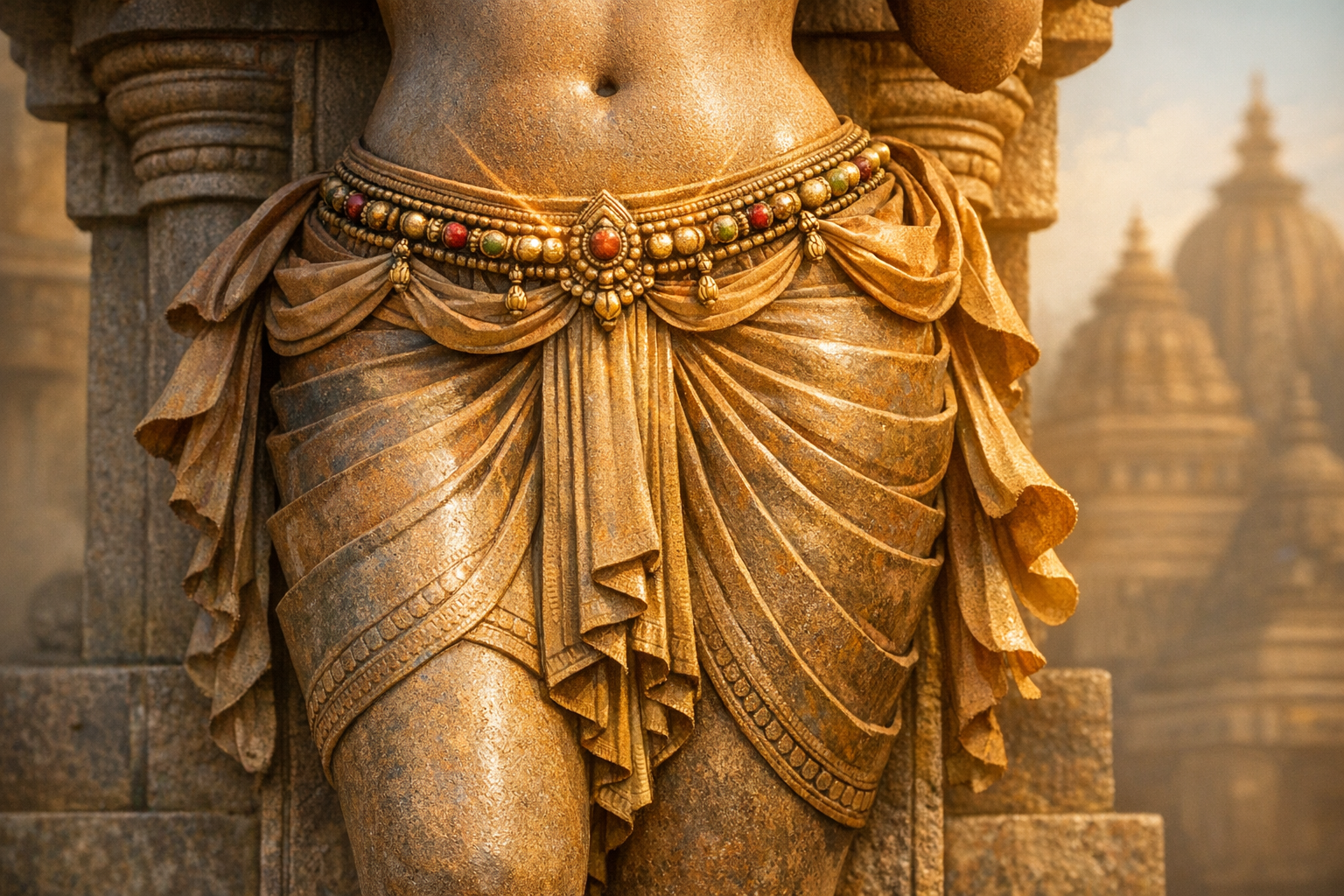
Antariya Unveiled: The Sacred Lower Garment Shaping Hindu Sculpture and Symbolism
Read more: Antariya Unveiled: The Sacred Lower Garment Shaping Hindu Sculpture and SymbolismAntariya—the unstitched lower garment secured by a mekhala—is the foundational drape of Hindu sculpture and iconography, predating later dhoti forms. This long-form guide explains how to identify antariya in stone and bronze through pleat geometry, knots, and belt types, and how these features assist in dating and attributing works from Bharhut and Sanchi to Gupta…
-
Sanatana Dharma Beyond Labels: A Scholarly Guide to Universal, Compassionate Spirituality
Read more: Sanatana Dharma Beyond Labels: A Scholarly Guide to Universal, Compassionate SpiritualityThis essay clarifies why sanatana-dharma is a universal, practice-oriented framework rather than a sectarian label. It distinguishes dharma from the modern category of “religion,” showing how Vedic principles guide ethical life, contemplative practice, and social harmony for all communities. It integrates perspectives from Hinduism, Buddhism, Jainism, and Sikhism to demonstrate a shared commitment to truth,…
-

From $150 to 20,000: Srila Prabhupada’s daring print strategy that built Back to Godhead
Read more: From $150 to 20,000: Srila Prabhupada’s daring print strategy that built Back to GodheadThis article reconstructs Srila Prabhupada’s account of how a $150 equipment purchase on Long Island seeded the U.S. growth of Back to Godhead magazine. It traces the leap from five hundred early copies to multi-thousand runs and the decisive instruction to order twenty thousand. The narrative explains why offset printers require minimums, how fixed setup…
-

Is Life Easy or Difficult? Dharmic wisdom unites dukkha and ananda with practical tools
Read more: Is Life Easy or Difficult? Dharmic wisdom unites dukkha and ananda with practical toolsThe longstanding paradox—Buddhism’s dukkha versus the claim that life is joy—resolves when viewed through dharmic frameworks that distinguish conventional from ultimate truth. Buddhism names the instability of conditioned life, while Vedanta points to ananda as the intrinsic nature of consciousness; Jain Anekantavada and Sikh Chardi Kala further harmonize these insights. This synthesis is practical, not…
-

Adhika Maasa 2026 (Adhik Jyeshta): What to Avoid, What to Embrace, and Why It Matters
Read more: Adhika Maasa 2026 (Adhik Jyeshta): What to Avoid, What to Embrace, and Why It MattersAdhika Maasa 2026 (Adhik Jyeshta) runs from 17 May to 15 June and is traditionally reserved for inward-focused sadhana rather than celebratory beginnings. Marriages (Shubha Vivaha), Mundan Sanskara, Griha Pravesh, business inaugurations, and other elective samskaras are best deferred. Nitya and naimittika duties continue, and practices such as vrata, japa, parayana, and daana are especially…
-

Guru–Shukra Moodami Decoded: Key Do’s & Don’ts for Yagna, Aksharabhyasam, Seemantham, and Business
Read more: Guru–Shukra Moodami Decoded: Key Do’s & Don’ts for Yagna, Aksharabhyasam, Seemantham, and BusinessMoodami (combustion) occurs when Guru (Jupiter) or Shukra (Venus) draws too close to Surya and becomes ‘asta,’ diminishing its auspicious agency in Muhurta. Drawing on Panchang practice and classical digests, this guide explains how Guru Moodami and Shukra Moodami affect Yagna, Aksharabhyasam, Seemantham, and the launch of new businesses. It clarifies what to defer, what…
-

Adhika Jyeshta Masam 2026: Definitive Telugu Panchangam Guide to Purushottam Maas
Read more: Adhika Jyeshta Masam 2026: Definitive Telugu Panchangam Guide to Purushottam MaasAdhika Jyeshta Masam 2026 in the Telugu Chandramana Panchangam runs from 17 May to 15 June during Parabhava Nama Samvatsaram. This guide explains the exact intercalation rule in the Hindu calendar—no Sankranti between two Amavasyas—and why 2026 qualifies as an Adhika Masam. It maps the month’s Shukla and Krishna Paksha flow, notes the special Ekadashi…
-

Tula Rashi Shani Sade Sati: Master the First 2.5 Years (Viraya Shani) with Clarity
Read more: Tula Rashi Shani Sade Sati: Master the First 2.5 Years (Viraya Shani) with ClarityWhen Shani enters Virgo, the first 2.5-year phase of Shani Sade Sati for Tula Rashi—called Viraya Shani—activates the 12th house of expenditure, solitude, and completion. This long-form guide explains the technical framework (12th, 2nd, 6th, 9th house dynamics, Saturn’s aspects, nakshatra nuances, Ashtakavarga, Shadbala, and dasha interplay) and translates it into clear, practical steps. Readers…
-

Tula Rashi Shani Sade Sati: Navigate Exalted Janma Shani (Second 2½ Years) with Clarity and Confidence
Read more: Tula Rashi Shani Sade Sati: Navigate Exalted Janma Shani (Second 2½ Years) with Clarity and ConfidenceThis in-depth guide explains the second 2½-year phase of Shani Sade Sati (Janma Shani) for Tula Rashi, when exalted Saturn transits Libra over the natal Moon. It clarifies why this exalted transit intensifies tests yet enhances reliable rewards for disciplined effort. Readers learn how Saturn’s drishti to the 3rd, 7th, and 10th houses shapes motivation,…
-

Mayasura: Legendary Demon Architect of Maya Sabha, Mandodari’s Lineage, and Vastu Shastra
Read more: Mayasura: Legendary Demon Architect of Maya Sabha, Mandodari’s Lineage, and Vastu ShastraMayasura (Maya Dānava) stands at the confluence of epic imagination and technical science—an unrivaled asura architect who builds palaces, aerial cities, and enduring canons of design. The Mahabharata’s Maya Sabha showcases optical and spatial ingenuity while warning against hubris. The Ramayana’s lineage threads—through Mandodari, Mayavi, and Dundubhi—demonstrate how moral counsel and unchecked pride shape political…
-

Shani Sade Sati for Tula Rashi: Navigate the Final 2.5 Years (Paada Shani) with Clarity
Read more: Shani Sade Sati for Tula Rashi: Navigate the Final 2.5 Years (Paada Shani) with ClarityShani Sade Sati for Tula Rashi culminates with Paada Shani—Saturn’s 2.5-year transit through Scorpio, the second house from the Moon—emphasizing finances, speech, family duties, and sober planning. This guide explains the technical architecture of the third phase, including Saturn’s aspects, nakshatra sub-phases (Viśākhā, Anurādhā, Jyeṣṭhā), and key modulators such as Ashtakavarga and ongoing dashas. It…
-

Encountering Mahaperiyava: A scholarly, soul-stirring journey with the Sage of Kanchi
Read more: Encountering Mahaperiyava: A scholarly, soul-stirring journey with the Sage of KanchiShri Chandrashekarendra Saraswati Swamigal (Mahaperiyava), the 68th Jagadguru of the Kanchi Kamakoti Peetham, united rigorous Advaita Vedanta with a lived ethic of compassion and service. This academically grounded reflection explains how his padayatra, pedagogy, and daily austerities shaped an enduring model of spiritual leadership. Readers gain a clear overview of his scriptural method, practical household…
-

Shiva Purana Timeless Tales: Daksha Yajna, Markandeya’s Grace, Neelakantha’s Compassion
Read more: Shiva Purana Timeless Tales: Daksha Yajna, Markandeya’s Grace, Neelakantha’s CompassionThis in-depth exploration of the Shiva Purana presents three profound narratives—Daksha Yajna and Sati, Markandeya’s deliverance through Mrityunjaya grace, and Shiva as Neelakantha during the Samudra Manthana—set within their textual, historical, and philosophical contexts. It clarifies how Puranic storytelling operates as both scripture and contemplative guide, uniting ritual, devotion, and ethics. Readers gain a nuanced…
-

Transformative Gauranga Mahaprabhu Lila Kirtana (Part 2), Melbourne — 12 April 2026
Read more: Transformative Gauranga Mahaprabhu Lila Kirtana (Part 2), Melbourne — 12 April 2026Held on 12 April 2026 in Melbourne, Gauranga Mahaprabhu Lila Kirtana (Part 2) offered a structured immersion into Gaura-lila through congregational kirtana guided by His Grace Bhurijana Dasa, a senior disciple of Srila Prabhupada. The evening combined theology, narrative, and music to align aesthetic feeling with philosophical insight, grounded in sources such as Srimad Bhagavata…
-

Seated Andal at Thiru Anbil: Chola Bronze Mastery, Iconography, and Living Devotion
Read more: Seated Andal at Thiru Anbil: Chola Bronze Mastery, Iconography, and Living DevotionThe seated Andal at Thiru Anbil’s Sundararaja Perumal Temple is a rare Chola-era bronze that redefines Andal’s familiar standing iconography through a contemplative enthroned posture. This long-form study situates the image within Sri Vaishnava theology, Shilpa Shastra canons, and lost-wax panchaloha craftsmanship. Readers gain a framework to decode attributes such as the Andal Kondai, gesture,…
-

Live Richly, Beyond Wealth: A Timeless Upanishadic Blueprint for Inner Abundance
Read more: Live Richly, Beyond Wealth: A Timeless Upanishadic Blueprint for Inner AbundanceThis article reframes “live richly” through the Upanishads as a disciplined path to inner abundance rather than material accumulation. It explains Brahman and Ātman, unpacks the mahāvākyas, and clarifies methods like neti neti and the practice triad of śravaṇa–manana–nididhyāsana. Readers gain a practical seven-day template for integrating meditation, ethical action, and service. The piece shows…
-

Pana Patra in Hindu Sculptures: A Powerful Symbol of Abundance, Compassion, and Divine Grace
Read more: Pana Patra in Hindu Sculptures: A Powerful Symbol of Abundance, Compassion, and Divine GraceThe pana patra—the ritual bowl seen across Hindu sculptures—serves as a compact key to decode abundance, renunciation, immortality, and grace in temple art. Grounded in Shilpa Shastra logic and Agamic practice, this guide clarifies how Annapūrṇā’s food bowl, Bhairava’s skull-cup, Kubera’s jewel vessel, and cups in Samudra Manthana scenes each signal distinct theological roles. It…
-

Historic MP High Court Verdict Affirms Bhojshala as Saraswati Temple: Devotees Pray Peacefully
Read more: Historic MP High Court Verdict Affirms Bhojshala as Saraswati Temple: Devotees Pray PeacefullyA day after the Madhya Pradesh High Court affirmed Bhojshala as the Mata Saraswati temple, Hindu devotees in Dhar offered prayers peacefully under a robust security plan. The verdict clarifies the site’s religious character while embedding worship within heritage protection norms and public-order protocols. Historical and archaeological evidence—documented by the Archaeological Survey of India—underpins the…
Categories
- Agriculture (20)
- Akhand Bharat (30)
- Aryan Migration -vs- Out of India (8)
- Ayurveda (20)
- Celebrations (882)
- Community (150)
- Community Events (231)
- Cross Posted (105)
- Cultural Advocacy (33)
- Cultural Commentary (61)
- Cultural Heritage (556)
- Cultural Insights (142)
- Cultural Issues (29)
- Cultural Traditions (757)
- Culture (33)
- Economics (22)
- Education (152)
- Geo-Politics (60)
- History (377)
- Indian Authors (6)
- International Trade (8)
- Labor Market (8)
- Literature (97)
- News (619)
- Opinion Pieces (143)
- Personal Reflections (161)
- Personalities (186)
- Philosophy (1,036)
- Politics (208)
- Scripts (3)
- Scriptures (975)
- Spiritual Insight (3,207)
- Spirituality (750)
- Temples (731)
- Tribute (65)
- Uncategorized (6)
- Yoga (103)
Archive