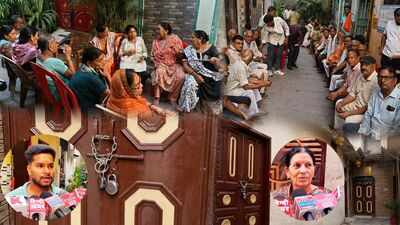
In Dhar, Madhya Pradesh, a day after the Madhya Pradesh High Court affirmed that the Bhojshala complex is the Mata Saraswati temple, hundreds of Hindu devotees performed puja amid a calm yet robust security arrangement. The measured response by district authorities ensured orderly darshan, protected the protected monument fabric, and reaffirmed the priority of peace.
This moment is legally and culturally consequential. The judgment clarifies the religious character of a long-contested site while also anchoring worship within the guardrails of cultural heritage management and public-order obligations. The calibrated approach signals that devotion, conservation, and constitutional process can be harmonized at Bhojshala.
Historically, Bhojshala is widely associated with the 11th‑century Paramara ruler Bhoja, celebrated for patronage of Sanskrit learning. Local memory, textual references, and epigraphic material have long linked the precinct with Vagdevi (Saraswati) worship, yielding the appellation Bhojshala: Mata Saraswati temple. Over subsequent centuries, the built fabric accumulated additional layers, notably the Kamal Maula dargah/mosque components, creating a palimpsest typical of Indian sacred geographies.
Archaeological Survey of India (ASI) inventories and scholarly surveys document temple‑style column fragments, sculptural moldings, lotus medallions, and Sanskrit inscriptions consistent with medieval Hindu temple architecture. Epigraphic paleography and stylistic analysis place many elements in the Paramara horizon, while later insertions reflect adaptive reuse across political epochs. This hybrid fabric has informed both conservation policy and juridical evaluation.
Litigation around Bhojshala has unfolded over decades through petitions, administrative orders, and court‑mandated arrangements for limited worship. In 2026, the Madhya Pradesh High Court, drawing on ASI records, gazette notifications, expert affidavits, and archival materials, held that the primary religious character of the complex is that of a Hindu temple dedicated to Saraswati. The Court directed the State to facilitate puja and darshan in a regulated manner subject to monument protection norms, crowd‑management plans, and law‑and‑order imperatives.
From a legal‑policy standpoint, the case engages multiple frameworks: the Ancient Monuments and Archaeological Sites and Remains Act, 1958 (AMASR) and its 2010 Rules governing interventions in protected areas; state police regulations for mass gatherings; and the interpretive reach of the Places of Worship (Special Provisions) Act, 1991. Courts in related matters have emphasized evidence‑based adjudication, non‑alteration of heritage fabric, and calibrated access that preserves both public order and cultural patrimonyprinciples manifest in the Bhojshala directions.
On the ground, the first day of worship following the verdict remained peaceful. Families arrived with flowers, akshata, and notebooks for blessings, and collective recitation of Saraswati vandana preceded aarti. Volunteers managed queues, separated entry and exit flows, and facilitated access for elderly devotees, while maintaining the sanctity of the protected zones identified by ASI.
The security architecture employed standard best practices for heritage‑religious sites: multi‑ring perimeters, metal detectors and frisking points, CCTV coverage with live monitoring, quick‑reaction teams positioned at chokepoints, and emergency medical stations. Micro‑zoning reduced crowd density around fragile architectural elements, and signage reminded visitors to avoid touching carved surfacesprotecting both people and stonework.
Community engagement underpinned the day’s composure. District peace committees convened local stakeholders, including respected representatives from Hindu, Buddhist, Jain, and Sikh communities, to reiterate commitments to ahimsa, seva, and mutual respect. The shared message was clear: honour the High Court’s directions, safeguard the monument, and ensure that devotion strengthens, rather than strains, social harmony.
Conservation planning will be decisive as footfall grows. Practical measures include a visitor‑cap per time‑slot, rubberized walkway mats in high‑traffic aisles, non‑intrusive lighting, and periodic vibration monitoring near vulnerable pillars. Digital documentationhigh‑resolution photogrammetry and 3D LiDAR scanningshould be completed to inform preventive conservation and, if ever needed, reversible stabilization.
Interpretation and education can transform a contested site into a shared classroom. Curated panels explaining Paramara history, Saraswati iconography, and ASI conservation protocols, delivered in Hindi and English, would deepen visitor understanding. Training local youth as certified heritage guides can create livelihoods while embedding a culture of respect for Bhojshala’s layered past.
The verdict also bears administrative implications. Clear standard operating procedures (SOPs) for festival days such as Vasant Panchami, integration of disaster‑management checklists, and a real‑time command room for crowd analytics will help sustain safe, inclusive access. A grievance‑redress channelonline and on‑sitecan quickly address concerns about queues, cleanliness, or inadvertent breaches of protected areas.
Economic ripples are already visible in Dhar’s hospitality and small‑business ecosystem. With responsible pilgrimage and cultural tourism, local artisans, transport providers, and eateries can benefit, provided authorities enforce waste‑management, traffic diversions, and noise‑control norms that keep the precinct serene and the monument unharmed.
Importantly, the discourse around Bhojshala should model civility. Robust debate is compatible with compassion; faith can walk hand‑in‑hand with scholarship. Upholding the High Court’s directions, respecting ASI’s guardianship, and centring inter‑community trust will ensure that Bhojshala thrives as a living Saraswati temple and a conserved heritage sitean emblem of unity across the dharmic traditions.
As devotees departed at dusk, the atmosphere in Dhar felt contemplative rather than combustible. The day’s orderly worship, careful security, and neighbourly restraint offered a template for balancing devotion, heritage, and harmony. If stewarded wisely, Bhojshala can become a beacon where law, culture, and spirituality reinforce one another for the common good.
Inspired by this post on Struggle for Hindu Existence.