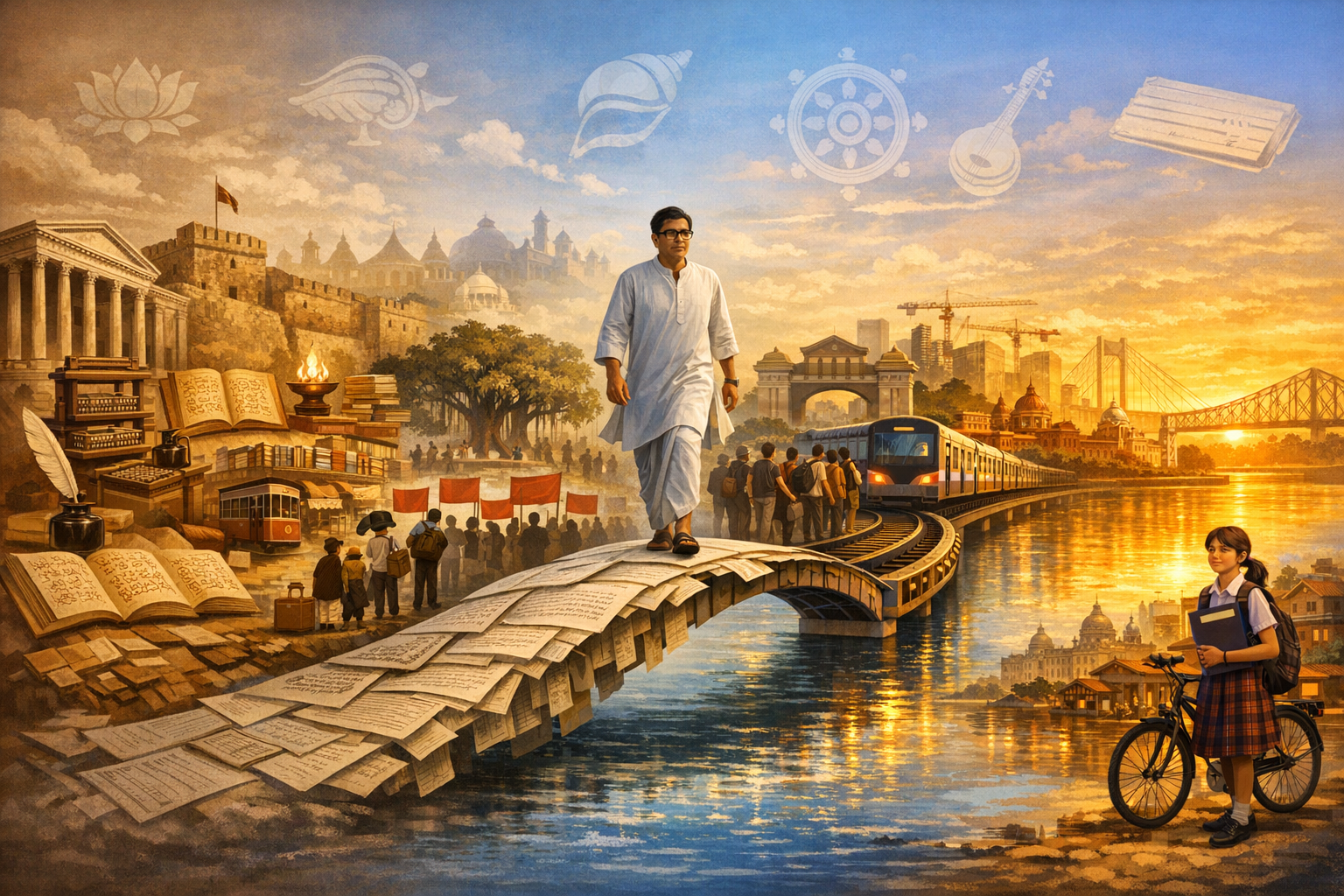
What explains the arc by which Bengal, the sacred landscape of Swami Vivekananda, Bankim Chandra Chattopadhyay, and Chaitanya Mahaprabhu, also became a crucible for twentieth‑century revolutionary romanticism associated with Lenin, Mao, and Stalin? A historically grounded answer points not to sudden ideological betrayals but to the long continuity of an elite intermediary classthe Bengali Bhadralokwhose political survival, cultural influence, and institutional control were repeatedly recalibrated from the late eighteenth century to the present.
Bhadralok, literally “gentlefolk,” emerged as a distinctive social formation in colonial Bengal. Rooted in specific urban-caste matricesprominently Brahmins, Baidyas, and Kayasthasthis stratum combined land-revenue ties under the Permanent Settlement (1793), access to English education, and insertion into the colonial bureaucracy and professions. It was at once a product of British Colonial Rule and a carrier of an extraordinary vernacular modernity, shaping Bengal’s print culture, law, journalism, and pedagogy.
The institutional infrastructures of Calcuttacourts, colleges, Fort William College, early presses, and missionary schoolscreated the conditions for the Bhadralok’s ascent. Macaulay’s Minute on Education (1835) and the expansion of the civil services multiplied opportunities for an Anglophone elite that could mediate between imperial power and local society. That mediation, however, never existed in a vacuum. It was counterbalanced by a parallel currentthe Bengal Renaissancewithin which Bankim Chandra Chattopadhyay, Rabindranath Tagore, Swami Vivekananda, and Aurobindo Ghosh harnessed Sanskritic learning, Bengali literary genius, and global thought to articulate a civilizational confidence rooted in dharmic pluralism.
These two faces of elite lifecolonial brokerage and civilizational recoverycoexisted in tension. The Bhadralok learned to navigate imperial hierarchies while energizing a potent social imagination that valued epistemic freedom, religious diversity, and public debate. Brahmo reformism, the press, vernacular prose, and associational life created a capacious public sphere that, at its best, encouraged unity across Hindu, Buddhist, Jain, and Sikh traditions while acknowledging the intricacies of Hindu-Muslim relations in a plural society.
Bengal’s early twentieth-century politics sharpened these contradictions. The Partition of Bengal (1905) provoked the Swadeshi movement and mass mobilization, while the Great War and the interwar period seeded radical critiques of imperialism. The Bengal Famine of 1943, a catastrophic convergence of wartime policy failures and market distortions, produced a moral shock that profoundly disrupted elite certainties and opened space for more radical, redistributionist, and often Marxist interpretations of justice and state responsibility.
Communist and socialist ideas found resonance in this moral economy not primarily because of doctrinal fealty to authoritarian regimes abroad, but because Marxism offered a rigorous explanatory framework for famine, exploitation, and imperial extraction. For segments of the Bhadralok, these theories promised structural answersland reform, labor rights, and state-led developmentthat classical liberalism or incremental reformism seemed too slow to deliver. The admiration expressed in some quarters for Leninist or Maoist resolve was thus often a symbol of anti-imperial will rather than an endorsement of totalitarian methods; nevertheless, the human costs of Stalinism and the Cultural Revolution were real and demand sober recognition within any responsible historiography.
Partition in 1947 reconfigured Bengal’s demography, economy, and elite networks. The Great Calcutta Killings of 1946 and the violent ruptures of 1947 were followed by long years of refugee inflows from East Pakistan (later Bangladesh). Families across Kolkata and the districts carry intergenerational memories of displacement, loss, and reconstitution of livelihood. These memories informed the Bhadralok’s subsequent policy preferencessecurity, welfare, and access to educationwhich were channeled through universities, courts, and the civil service.
Post-Independence, the abolition of zamindari and early land reforms weakened the older landed pillars of elite power. Many Bhadralok consolidated influence in the professions, the press, and Bengal Education. Institutions such as the Ramakrishna Mission, shaped by Sri Ramakrishna Paramahamsa and Swami Vivekananda’s emphasis on seva, pluralism, and character formation, advanced a dharmic ethic that resisted sectarianism and promoted social uplift. This civilizational plank remained a crucial counterweight to ideological dogma, enabling textured coexistence among Hindu, Buddhist, Jain, and Sikh communities.
The 1950s–60s marked the ascent of organized Left politicstrade unions, student mobilizations, and peasant movementsculminating in the Naxalbari uprising (1967). While the Naxal phase fragmented and drew a harsh state response, the broader Left consolidated hegemony through electoral legitimacy. From 1977 to 2011, the Left Front’s long tenure institutionalized Operation Barga, decentralized panchayati raj, and a culture of party-society linkage that many perceived as stabilizing rural power while constraining industrial revival. In cultural fieldspublishing, cinema, theatre, and universitiesLeft-of-center norms acquired the grammar of common sense, in a Gramscian sense of hegemony.
There were concrete gains: tenancy security, expanded basic education, and a relative calm in parts of the countryside. There were also costs: capital flight, missed industrialization windows, and the normalization of cadre mediation in everyday governance. The Bhadralok adapted, often serving as administrators of this order or as critics demanding course correction. Historians like R.C. Majumdar and Jadunath Sarkar, who insisted on methodological rigor and civilizational depth, coexisted uncomfortably with Marxist historiography that sometimes prioritized ideology over archive. The resulting debates over textbook content, communal historiography, and national memory shaped how generations learned India’s past.
The 1971 Liberation War added another layer. The genocide in East Pakistan and the consequent refugee waves again remade West Bengal’s social fabric. Civil society networkslegal aid, shelters, cultural associationsactivated relief on a massive scale. The experience reinforced a normative emphasis on human rights and minority protection while also exposing the limits of state capacity. Within the Bhadralok, commitments to humanitarian service sat alongside a sharpening interest in security, border management, and economic resilience.
Liberalization in the 1990s confronted West Bengal with national shifts it had not architected: a pan-Indian market economy, an IT boom, and new forms of capital and aspiration. While individual Bengalis excelled globally, domestic industrial revival lagged. A generation of students left for Bengaluru, Pune, Hyderabad, Delhi, and overseas, turning “brain drain” into a household phrase. Universities such as Presidency and Jadavpur retained intellectual prestige but also became arenas for contested ideologies and struggles over campus culture.
The transition of power in 2011 to the Trinamool Congress (TMC) under Mamata Banerjee was read, by many, as a popular repudiation of stagnation. Policy signatures such as Kanyashree and Sabuj Sathi emphasized social welfare and women’s advancement, while allegations in the public sphere pointed to clientelism and “syndicate” dynamics in localized contracting. For the Bhadralok, this was less a rupture than a reconfiguration: elite networks recalibrated to a new center of gravity, preserving institutional footholds in law, academia, media, and culture while adapting to a changed political idiom.
The chargeoften made polemicallythat the Bhadralok merely moved “from British boots to servility” elides the structural logic of elite continuity in modernizing polities. A more precise reading is “adaptive brokerage”: a durable capacity to mediate resources, ideas, and legitimacy between state and society. Brokerage can be constructivewhen it delivers public goods, protects pluralism, and advances scholarshipor corrosive, when it substitutes partisan gatekeeping for merit and fosters social mistrust. West Bengal’s twentieth-century trajectory records both possibilities.
Why, then, did revolutionary figures gain symbolic traction in a land of bhakti, Advaita, and Shakta energies? Part of the answer lies in Bengal’s ethical imagination. The suffering of the poorduring famines, strikes, and land strugglesdemanded structural explanations. Marxism’s analytical power offered clarity about class, surplus, and state violence. Yet Bengal’s deeper civilizational grammar, visible in the inclusive teachings of Vivekananda, the kirtan of Gaudiya Vaishnavism, the intellectual discipline of Navya-Nyaya, the aesthetic legacy of Pala-Sena Buddhism, and Jain ethical rigor, remained resilient. This resilience is the wellspring for unity among dharmic traditions today.
Contemporary politics has opened a new front. The rise of the Bharatiya Janata Party (BJP) and the organizational expansion of Hindutva in Bengal have challenged the Left–TMC duopoly, reframing debates on identity, development, and security. In this churn, portions of the Bhadralok have diversified their alignments, with some investing in a cultural renaissance rooted in civilizational self-confidence and others defending regional subnationalism. The healthiest path forward lies not in sectarian competition but in a sarva dharma ethic that centers policy on education quality, jobs, public safety, and institutional impartiality.
An academic lens helps clarify these cycles. Concepts such as elite circulation (Pareto), path dependence, and hegemony (Gramsci) explain the Bhadralok’s staying power across regimes. The state’s “embedded autonomy” (Peter Evans) offers a benchmark: institutions should be autonomous enough to resist partisan capture yet embedded enough to understand society’s needs. In Bengal, when elite brokerage aligned with embedded autonomysuch as in service-oriented institutions and meritocratic academic labsthe results were salutary; when autonomy weakened, party-society substitution impaired innovation and trust.
Education is the decisive lever. Curricula that juxtapose Marx, Gandhi, and Vivekananda; Bankim’s political theology and modern constitutionalism; R.C. Majumdar’s archival method and comparative historiography; Jadunath Sarkar’s military history and contemporary strategic studies; can cultivate analytical seriousness without ideological dogma. Such a synthesis would also foreground the unity-in-diversity of Hinduism, Buddhism, Jainism, and Sikhism, presenting these traditions as interconnected streams within a civilizational confluence rather than as competitive sects.
Cultural policy can further entrench pluralism. Durga Puja, a living art form and social institution, can be curated to highlight Bengal’s shared civilizational inheritanceGaudiya kirtan, Baul mysticism, Pala iconography, Jain narrative art, and Sikh contributions to martial and musical traditionswhile encouraging contemporary innovation. Museums and archives can memorialize the 1943 famine and the 1971 Liberation War with soberness, fostering empathy and civic solidarity across communities.
Economic policy must tackle the fundamentals: logistics modernization around the Kolkata–Haldia corridor, MSME credit, university–industry research clusters, and urban planning that supports creative industries. Reindustrialization, if anchored in transparent regulation and competitive land policy, can reduce the incentive for corrosive brokerage. When high-quality jobs proliferate, ideological polarization typically moderates, and the public sphere becomes more hospitable to scholarly disagreement conducted in good faith.
The media and publishing ecosystemlong an arena of Bhadralok influencecan renew its legitimacy by recommitting to editorial pluralism and methodological integrity. Commissioning translations of classical Sanskrit, Pali, Prakrit, Apabhramsha, and Persian sources relevant to Bengal’s history; pairing them with modern social science analyses; and producing accessible editions for schools can bridge scholarly and popular discourse. Such projects would honor both the civilizational archive and contemporary needs.
None of these tasks are alien to Bengal’s best traditions. The region has repeatedly demonstrated how intellectual seriousness and spiritual inclusivity can reinforce each other. Borrowing Vivekananda’s insistence on strength with compassion, Bankim’s call to national duty, and Aurobindo’s synthesis of yogic introspection with political realism, the Bhadralok can again orient brokerage toward public purpose.
Seen in full, the story is less an “ugly saga” than a demanding civics lesson. The Bhadralok survived by mediating power, knowledge, and resourcesfrom British Colonial Rule through Left Front hegemony to Mamata Banerjee’s West Bengal. The moral question is whether that mediation advances institutional excellence, pluralism, and prosperity. Bengal possesses the intellectual, cultural, and spiritual capital to answer in the affirmativeif policy, pedagogy, and public life are aligned to a civilizational ethos that unites dharmic traditions and serves the last person first.
Inspired by this post on Dharma Dispatch.