Mayasura (Maya Dānava) occupies a singular place in Sanskrit epic and Purāṇic literature, renowned as the preeminent architect of the asuras and a polymath whose technical mastery ranges from palace engineering to aerial craft, and from urban design to astronomical computation. Across the Ramayana and the Mahabharata, he appears not merely as a mythic figure but as a cultural archetype: ingenuity coupled with māyā (artifice), a motif that illuminates how ancient India imagined technology, aesthetics, and ethics as interdependent domains.
Genealogically, sources consistently identify Mayasura as a son of the primordial sage Kashyapa, while his maternal lineage varies across traditionssometimes as Diti (classifying him among the Daityas) and elsewhere as Danu (hence a Dānava). Rather than contradiction, this fluidity reflects the layered nature of epic transmission. His consort is the pious and chaste apsara Hema. Their children include Mandodariwho becomes the celebrated queen of Lanka in the Treta Yugaas well as the asuras Mayavi and Dundubhi, both pivotal to the Kishkindha episodes in the Ramayana.
Mandodari’s character subtly refracts Mayasura’s legacy. As daughter of the master builder, she brings sober counsel and an ethic of restraint to the court of Ravana. The narrative contrast is instructive: technical power (Mayasura) does not preclude moral clarity (Mandodari). In a theme cherished across dharmic traditions, capability attains meaning only when yoked to dharma. This alignment resonates with Hindu, Buddhist, Jain, and Sikh perspectives that esteem knowledge when guided by responsibility and reverence for life.
The Kishkindha Kanda situates Mayasura at another narrative fulcrum through his sons. Mayavi provokes a fateful duel with Vali, which draws Sugriva into conflict and ultimately preludes Sugriva’s alliance with Rama. Dundubhi, later slain by Vali, becomes the occasion for the exile of Sugriva and the eventual fraying of bonds that Rama helps to mend. Through these episodes, the tradition underscores how personal tempers and old grievances, left ungoverned, can destabilize politiesa timeless political insight woven through epic storytelling.
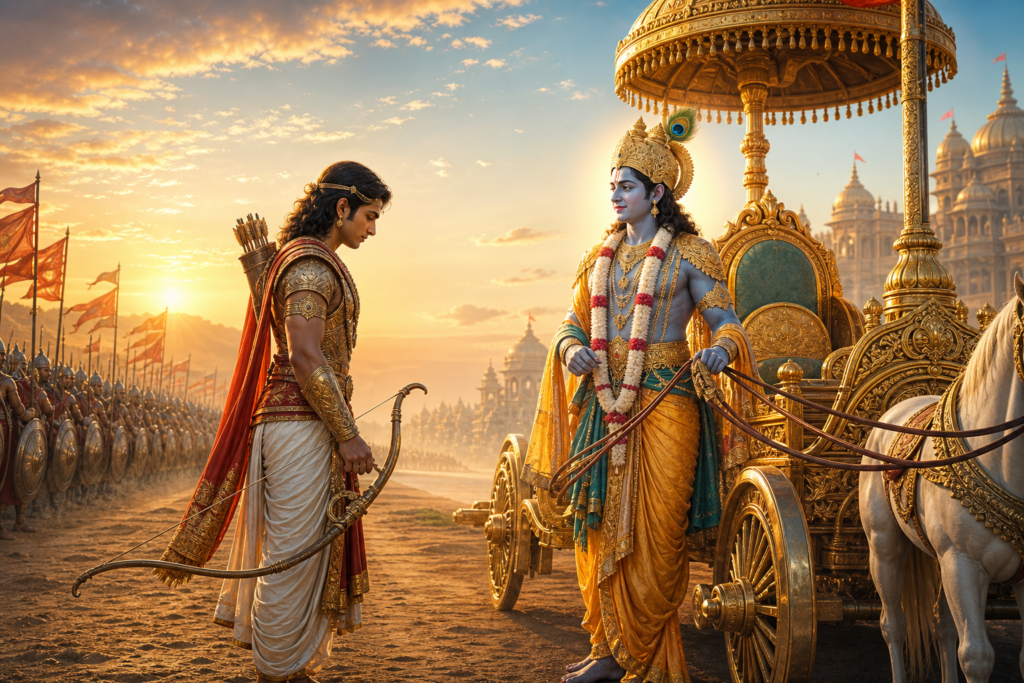
In the Mahabharata, Mayasura emerges dramatically in the Khandava-daha narrative. When Agni seeks to consume the Khandava forest and Indra counters with torrential rains, Krishna and Arjuna aid Agni, subduing the deluge. Amid the conflagration, Arjuna spares Mayasura. Out of gratitude, Mayasura constructs for Yudhishthira the fabled Maya Sabha at Indraprastha (Sabha Parva), a marvel of engineering that becomes as much a character as a settingembodying the sophisticated play of perception and reality.
The Maya Sabha blended function with illusion: crystal-like floors mistaken for water, lakes mistaken for polished stone, and thresholds that challenged habitual gait. These optical and spatial effectsprecisely the province of a master of māyāfamously ensnare Duryodhana, whose slip and ensuing humiliation help catalyze later hostilities. The assembly hall thus operates as an ethical theatre: when pride and insecurity collide with sophisticated design, social fissures widen, warning that technical brilliance intensifies, rather than resolves, questions of character.
Mayasura’s most sweeping urban commission is the Tripura complexthree fortified cities reputedly of gold, silver, and iron, dwelling in the heavens, atmosphere, and earth, and aligning cyclically. Built for the asura triad (often named Tarakaksha, Vidyunmali, and Kamalaksha), Tripura embodies apex engineering and aerial mobility. In Purāṇic memory, Tripura’s destruction by Shiva as Tripurantaka with a single arrow is both cosmic drama and cautionary tale: unchecked prowess invites nemesis when divorced from balance and virtue.
An allied tradition credits Mayasura with constructing the aerial city Saubha for King Shalva, an illusory, maneuverable craft that laid siege to Dvaraka. The Bhagavata Purana (10.76) notes Saubha’s bewildering tacticsfeints, vanishings, and rapid redeploymentsbefore Krishna neutralizes its advantages. This episode exemplifies an enduring strategic lesson: technology creates temporary asymmetries that only wisdom, discipline, and adaptability can decisively overcome.
Beyond narrative, Mayasura’s name endures in the technical canons of architecture and planning. The Mayamata, a foundational Vastu Shastra treatise traditionally attributed to Maya, codifies site selection (bhūmi-parīkṣā), orientation and layout via the vāstu-puruṣa-maṇḍala, proportional canons (tāla and aṅgula measures), and typologies for dwellings and temples. It details drainage, thresholds, courtyards, superstructure articulation, and ornamentwith a consistent emphasis on harmony between built space, climate, and human purpose.
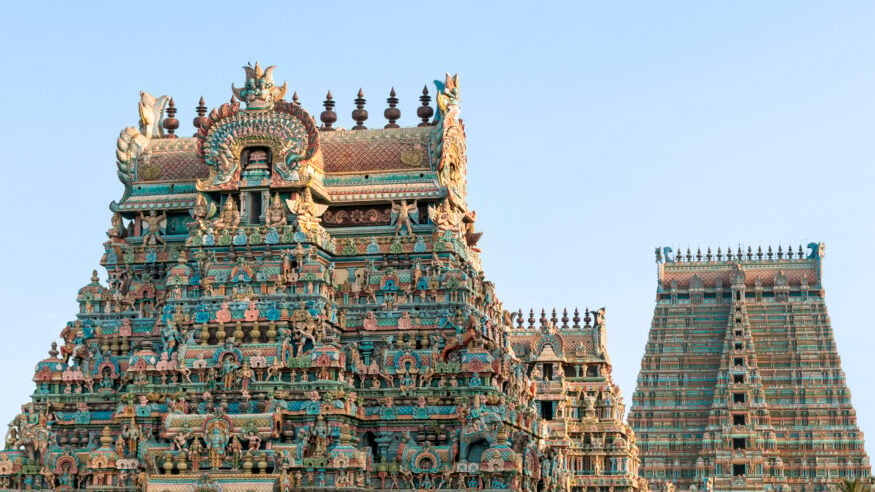
The cross-pollination of these ideas shaped temple architecture across South Asia, informing Drāviḍa traditions and contributing to broader vāstu discourse that engaged Hindu, Buddhist, and Jain patrons over centuries. From sanctum geometry to ambulatory paths, the shared grammar of sacred space reflects a dharmic consensus: architecture is more than shelter; it is a discipline aligning body, mind, and environment toward ethical and contemplative ends.
In the sciences, the Surya Siddhantaone of the classical siddhāntas of Indian astronomyopens with a celebrated tradition in which the solar deity imparts astronomical doctrine to Maya. While technical authorship is complex and layered, this framing emphasizes Maya’s stature as a custodian of precision knowledge: calendrics, planetary periods, eclipse computation, and trigonometric tables (jya), essential to ritual timing, agriculture, and navigation. Varahamihira’s Panchasiddhantika corroborates the vitality of such siddhānta literature in the classical period.
Comparative epic portrayals accentuate a philosophical dyad: Vishvakarma as the devas’ architect and Mayasura as the asuras’ architect. Rather than a stark moral binary, these counterparts embody a civilizational truth: technical capacity is universal; its ethical valence depends on intention, patronage, and use. The epics therefore present technology as a shared human inheritance, inviting responsibility rather than rivalrya message consonant with interfaith and intrafaith collaboration across the dharmic spectrum.
For readers, pilgrims, and designers alike, Mayasura’s portfolio evokes recognizable experiences: the hush of a temple corridor calibrated to induce inwardness; the way morning light traverses a sanctum precisely at festival dawn; the sudden change in footing across a sub-threshold that subtly readies the body for reverence. These are not accidents; they are design choices that translate cosmology into lived space, confirming the Mayamata’s premise that good architecture is embodied ethics.
Mandodari’s presence returns the discussion to ethics. As Mayasura’s daughter, she articulatesoften in vaincounsels of prudence to Ravana, modeling moral courage under pressure. Her voice at court underscores a recurring epic principle: technical genius without reflective conscience derails sovereignty. In modern terms, this suggests that policy, engineering, and urban development flourish only when anchored in a culture of restraint, consultation, and care.
The legacy of Mayasura thus bridges mythic time and historical practice. In narrative, he crafts palaces, aerial cities, and urban complexes that test character and fate. In technical literature, he stands for a canon of building science and astronomical calculation integral to ritual calendars and sacred architecture. In civilizational memory, he symbolizes a challenge and an invitation: to cultivate mastery while honoring the dharmic imperative to serve, protect, and uplift.
Read together, the Ramayana, Mahabharata, and allied śāstra present Mayasura not as a foil to dharma but as a mirror of human possibility. They encourage communities to draw on shared knowledgeacross Hindu, Buddhist, Jain, and Sikh lineagesto build spaces and systems that advance well-being. When skill, insight, and humility converge, architecture becomes a path of harmony, and technology a vehicle for compassion.
Inspired by this post on Hindu Pad.